EVERY SIGNATURE MATTERS - THIS BILL MUST PASS!

EVERY SIGNATURE MATTERS - THIS BILL MUST PASS!
CLICK - GOAL - 100,000 NEW SIGNATURES! 75,000 SIGNATURES HAVE ALREADY BEEN SUBMITTED TO GOVERNOR CUOMO!

EFF Urges Court to Block Dragnet Subpoenas Targeting Online Commenters

EFF Urges Court to Block Dragnet Subpoenas Targeting Online Commenters
CLICK! For the full motion to quash: http://www.eff.org/files/filenode/hersh_v_cohen/UOJ-motiontoquashmemo.pdf

Monday, May 15, 2017

When a 14-year-old who had suffered greatly at the hands of the rabbi decided to speak up, the head of the yeshiva used every manipulation in the book to control him, even taking the boy to a psychiatrist to have him declared mentally unfit....


The founders of 'Lo Tishtok': Tzviki Fleishman, Avigail Karlinsky and Racheli Roshgold

The Crusaders Fighting Sex Abuse in the Underbelly of Israel's ultra-Orthodox Community. The practice was simple: If you don't speak about sexual violence, it doesn't exist. Then these three started a Haredi awareness revolution

Jerusalem in late 2015 was a place marked by fear. It was mainly fear of lone wolf terrorists with knives, but Avigail Karlinsky thought it time to explain something to men: Maybe they weren’t used to constantly being alert, warily looking left and right for attackers, but women were. “I hereby tell you that a woman walking in the street alone at night walks just like that,” the 28-year-old Karlinsky, who is ultra-Orthodox, wrote on Facebook. “Every woman knows what I’m talking about. There isn’t a single one who doesn’t.”

Publishing a post like that in October 2015 was highly unusual in the Haredi community. Sexual violence isn’t a topic for conversation, certainly not something to be spoken about out loud. It turned out she had touched a very sore nerve.

“I wasn’t prepared for what happened after I posted that,” says Karlinsky, who belongs to the non-Hasidic (Lithuanian) ultra-Orthodox community. “I had entered a vacuum so immense in the Haredi community that everybody who had anything to say about sexual harassment, a personal story or somebody near them – everybody came to me. Dreadful stories started to pour in. I was inundated. It affected me physically. For two weeks I was just sick. I couldn’t stand on my feet.”

After recovering, she asked some people for help to set up the Facebook page “Lo Tishtok” – “Thou Shalt Not Be Silent.” The page marks a revolution in the ultra-Orthodox world. The magnitude of the drama set off by Karlinsky, with two partners, Tzviki Fleishman and Racheli Roshgold, who are also Haredi, is hard to comprehend.

It took them time to understand it, but there is an ultra-Orthodox underbelly, the three say.

Until Lo Tishtok, the practice in the Haredi world was simple: If you don’t speak about it, it doesn’t exist. As a topic, sexual predators was not talked about. Even serious cases were concealed, handled and resolved within the community. The established media of the ultra-Orthodox world does not discuss it and neither do the schools, at least until recently.

But the internet is the ultimate force. For the first time in ultra-Orthodox history, those behind Lo Tishtok could conduct a dialogue directly with people in their community, beyond the watchful eye of the establishment.

Karlinsky, Fleishman and Roshgold spend hours each day running their Facebook page. Sometimes people send their hair-raising stories to their personal inboxes, and they post them online for others to read. Sometimes they meet with the victims and sometimes try to persuade them to file a complaint with the police. They also publish pictures and video clips, including difficult-to-watch ones of ultra-Orthodox men sexually abusing teenage girls or children. The purpose is for the community to identify the men and give their details to the police.

If Lo Tishtok has an overarching purpose, it is to increase awareness among Haredim. There are community organizations and rabbis whose job is to help people with problems, but Lo Tishtok is sick of sexual assaults being handled silently, behind closed doors. For instance, some incidents culminate in supervision for the attacker, or exile from the community.

“We want to give the victims back their pride,” says Karlinsky. “We are increasing awareness of sexual assaults and giving the victims the feeling that they have nothing to be ashamed about.”

Lo Tishtok became involved in the case of a 14-year old boy who had been attacked by the head of his yeshiva.

“There were rabbis who stopped us from handling complaints,” the student wrote in rhyme (in Hebrew) on the Facebook page. “An innocent boy around 14 years of age… the sound of study rises and penetrates the room / I am in my bed, my limbs are paralyzed / while the hands of the representative of God violate my body / his cold hands take my hands and put them in his trousers / my wounded soul wants to shriek / my blood boils on the floor… here is the fire and the wood, and I am the sacrificial lamb / where are you, Lord, as my soul and body rise.”

The yeshiva, in the ultra-Orthodox West Bank settlement of Modi’in Ilit, had an excellent reputation, but underneath its leader’s elegant suit lurked a pedophile. He would summon boys to his chamber, strip them and molest them. Some people in the city who knew; a number even confronted him, but the abuse continued.

When a 14-year-old who had suffered greatly at the hands of the rabbi decided to speak up, the head of the yeshiva used every manipulation in the book to control him, even taking the boy to a psychiatrist to have him declared mentally unfit. The boy felt confused and bereft, until coming across Lo Tishtok – whose organizers took him to the police. Then the extent of the rabbi’s misdeed with other children came to light. The head of the yeshiva fled abroad, but then returned. The chief rabbi of the city realized that it was necessary to act decisively and involve the police. The rabbi is now facing serious charges.


The lack of awareness creates perfect conditions for criminal activity to flourish, says Roshgold: Sexual predators in an ultra-Orthodox city simply aren’t under threat. She points out that there are Haredi pedophiles who, when caught abroad, simply move to Israel, knowing they’ll be safe from prosecution. “There is no awareness of what is prohibited and what is permissible,” she says. “We have to start an awareness revolution.”

A Jerusalem woman who had been raped for years by her brother-in-law didn’t go to the police for fear of hurting the family. Lo Tishtok consulted with a rabbi on whether to go to the police, and his answer was that the man has atoned, so there is no need.

But the silence goes farther. “We had a case of mothers who met every day in a public park, who told us about a man hurting the children there. They all knew each other but never talked about it among themselves,” says Roshgold. The group intervened to connect the mothers over their complaints, which were about the same man.

Their shared goal is so important that the people behind Lo Tishtok, men and women, cooperate despite coming from all over the ultra-Orthodox political spectrum – no trivial thing. Karlinsky is a married student with two children. Fleishman, 27, is affiliated with the Hasidic Chabad movement and is studying for an M.A. in psychology. For him, this is a mission comparable to Chabad’s practice of providing Jews around the world with kosher food. Thirty-year-old Roshgold, a nurse at a center for sexual assault victims, comes from the rigid Gur Hasidic sect and is also studying for a master’s degree.

Ultra-Orthodox rabbis claim that simply talking about sexual assault increases harassment because it gives people ideas. (IDIOTS)

Karlinsky: “Studies from around the world show that there are more sexual attacks in closed hierarchical communities… modest women don’t get raped less. That claim is factually untrue.”

Roshgold: “Many rabbis understand the gravity of the problem, some also talk with us and encourage our activity.”

Karlinsky: “There were grave cases where the rabbis blocked us from acting. In one case a woman lodged a complaint and the rabbis said we were committing the sin of humiliating another person for our own gain… in another case, by the time the rabbi permitted filing a complaint, the pedophile had fled the country.”

Roshgold: “Others don’t ask the rabbi whether a child with a cut should be taken to the doctor, and in cases of sexual injury, the rabbis shouldn’t be the first point of call. This is about saving lives.”

There is an opposite argument, that since the religious community has no outlet for release, there are more sex crimes.

Fleishman: “Sexual urges and sexual violence aren’t even on the same scale. They are not connected. Sexual violence is on the scale of a disease, hurting the other, criminal activity.”

Letter from a daughter to her father, from the Lo Tishtok Facebook page: ”You are so weak and despicable / You have compassion, but only for yourself / For only didn’t you manage to protect the girl you brought into this world / You hurt her yourself! In the worst way possible / There are no words to describe your cruelty, wrapped in compassion / You are the scum of the human race / I have mercy and compassion. Even towards you! How absurd.”

Not all secular rape victims go to the police, but they at least know it’s an option. Ultra-Orthodox victims may not know that, Karlinsky says. Lo Tishtok can introduce them to the possibility but the police officers and Haredim don’t speak the same language. The police has been trying to recruit Haredi investigators, but difficulties remain. An ultra-Orthodox boy who tried to file a complaint completely shut down when the female detective insisted on full details of the assault and said the word “penis,” Roshgold relates. “You have to know how to talk with Haredim,” she says.

Lo Tishtok intends to train people to help members of the ultra-Orthodox community handle the interaction with the secular authorities, and ultimately, adds Fleishman, to establish a crisis center, with outreach to the Haredi community at large.

While recommending police involvement, the group respects the victims’ right to settle the cases in a different way. For instance, one woman agreed to accept financial compensation from a public figure who abused her.

That enables him to go on hurting others.

Roshgold: “When a victim arrives, the paramount thing is their well-being… if a victim gets money, who am I to tell her what to do? Sometimes they only come 25 years after the event and all they want to do is share it.”

Fleishman: “That’s part of the strategy. To return control to the victim. Nobody tells them what to do. The whole experience of rape is a loss of control, so we don’t force them to file a complaint.”

All three work as volunteers for the time being, devoting about three hours a day to Lo Tishtok’s operations. But they also spring into action when needed, for instance if a person calls in crisis at three in the morning. “By seven he may have changed his mind, so you have to work at odd hours,” says Roshgold. They are planning a fundraising drive to expand activity. “We are just three,” says Karlinsky. “We need social workers on salary and people who can do things that for now we’re somehow managing to handle.”

They know they’ll pay a price for their activity. Fleishman says he knows his son won’t be accepted to a heder (a religious elementary school). Roshgold had been attacked as a child by a family friend.

Her mother rebuked her for publicizing it in an interview on Army Radio. She told her mother that she has nothing to be ashamed of; if anything the man who hurt her should be ashamed. She says she isn’t afraid and is ready to pay any price. “If they spray-paint the walls of my home, I’ll kiss the vandalized walls. Even if they kill me, I want it written on my gravestone what price I paid for doing this.”


Read more: http://www.haaretz.com/israel-news/.premium-1.788744?&ts=_1494591977623

Sunday, May 14, 2017

Take Heed Prime Minister Bibi Netanyahu --- This Guy is a Quart of Oil Short! Library is well stocked - with Dr. Zeuss books. Life by Norman Rockwell, screenplay by Stephen King. A few tiles missing from his Space Shuttle. An ego like a black hole..

He Shows He Is Unfit. Yet He's Still the President. 


 "Living proof of evolution. A hump short of a camel. Mentally qualified for handicapped parking. So dumb, blondes tell jokes about him. So stupid, mind readers charge him half price. A "crackpot" without the cholent" Takes him 1.5 hours to watch "60 Minutes".


The system can deal with a crooked president. But not a crazy one. 


Not reassuring.

President Donald Trump is not always crazy like a fox. And that -- more than obstruction of justice, or any potential criminality related to Russia -- is the greatest threat facing the U.S. It's also a threat that U.S. institutions are failing to acknowledge, let alone confront.

Trump is unlikely to succeed at completely derailing the FBI investigation into his campaign's ties to Russia. But he might undermine it enough to avoid any serious consequences. Even without his subterfuge, the investigation could prove inconclusive.

But at least there is an investigation into Russia, in addition to congressional inquiries, news reporting, and a general mobilization of expert opinion and institutions. The investigations are vital. Unless they are, ultimately, beside the point.

For two days early this week, Trump's staff went to great lengths to establish a plausible claim that Trump did not instigate the firing of FBI director James Comey. Instead, White House aides and Vice President Mike Pence insisted that Trump was responding to concerns raised in a memo by Deputy Attorney General Rod Rosenstein.

This White House has not assembled a highly competent or ethical team. So the explanations were pretty dodgy. But they nonetheless represented a coordinated effort to define Trump's actions and confine the political damage from firing Comey.

Then on Thursday Trump told NBC News anchor Lester Holt that Rosenstein's memo wasn't even significant. "I -- I was going to fire Comey," Trump said. Holt immediately questioned him on the issue, all but encouraging Trump to get his story aligned with the previous White House talking points. Trump wasn't having it.

"Oh, I was gonna fire regardless of recommendation," Trump said.

There is good reason for journalists and others to ask whether Trump's statements to Holt constitute something close to an admission that he fired Comey to impede the Russia investigation. (Trump said he was eager for the investigation to end.) There is good reason to use this interview as evidence that Trump's White House staff is often no more truthful than Trump himself.

But the issue of the motives and means of the Trump White House is small compared with the enduring madness of the man himself. Trump's admission to Holt was not an effort to distract from a bunch of bad news stories. Does Trump use such tactics? Frequently. And from this comes the notion that Trump is "crazy like a fox."

But the Holt interview wasn't evidence of being crazy like a fox. This was not a devious move. 

Trump can be cunning. But he also flails wildly, harming others often and himself occasionally. His recent interviews with the Economist and Time were bizarre and frequently incoherent.
As my colleague Jon Bernstein wrote:
Trump can't be bothered to even master his own talking points, even in something which could put his entire presidency at risk. Or perhaps he's intellectually incapable of doing so.
Trump is almost supernatural in his multivariate unfitness, combining combustible levels of ignorance, amorality, venality and mental imbalance in a way not seen even when Richard Nixon drank alone.

The Russia investigation serves as an outlet for collective anxiety about Trump's unfitness, just as the prospect of indictments offers a potential deus ex machina to resolve the dangers inherent in Trump's administration. But what if they resolve nothing? Or take too long doing so?

It's easy to miss the dense and haunted forest of Trump for all the trees. Speaking to National Public Radio, Republican Senator Ben Sasse, who has kept a safe distance from Trump, spoke of his concerns and lamented the state of American political conflict.
We have a crisis of public trust in this country that is much deeper than just the last four months or the last 18 months. We have an erosion of a shared narrative about what America is about. And we have the huge unpopularity of almost all of our governing institutions. That should trouble everybody.
Yes, indeed. That's all true. Meanwhile, however, we have a slightly more pressing problem. The president of the United States is mentally and morally unfit with a nuclear arsenal at his fingertips. And no one in Washington knows what to do about it.

This column does not necessarily reflect the opinion of the editorial board or Bloomberg LP and its owners, but does reflect the opinion of this Blogger!


  • He told the Economist he invented the use of "priming the pump" with regard to the economy. It's probably most associated with Franklin Roosevelt, and even if Trump meant "came upon it" rather than "came up with it" it's remarkable for anyone in his position to be that ignorant of normal economics usage. Then again, he's never shown that he knows anything about economics.
  • He spoke gibberish about aircraft carriers to Time magazine: "I said what system are you going to be–'Sir, we’re staying with digital.' I said no you’re not. You going to goddamned steam, the digital costs hundreds of millions of dollars more money and it’s no good." I know very little about aircraft carriers, but the people who do know this stuff confirm that he doesn't know what he's talking about. Not that he's wrong, mind you; he isn't coherent enough to be wrong.
  • Then he completely contradicted his own explanation on James Comey's firing to NBC News. The old story that Trump was reacting to a recommendation from the Department of Justice; the new story is that he was always going to fire Comey. 
Why does that fit in with the other two quotes? Because it demonstrates that Trump can't be bothered to even master his own talking points, even in something which could put his entire presidency at risk. Or perhaps he's intellectually incapable of doing so. Either way, the president talks and talks without showing any mastery -- any understanding -- of anything.

Friday, May 12, 2017

A Real Simple Choice For The OU --- Money or Principle?

The Power of OU Kosher Certification


The U.S. kosher market has become an unheralded boom for food manufacturers. Today, consumers are concerned about more than just the kosher status of their food. Over 12 million American consumers choose Kosher food products for reasons related to health, food safety, taste, vegetarianism, lactose intolerance, and other dietary restrictions. Generating over $12 billion in annual sales, the kosher food industry has become big business.

 Certifying over 800,000 products produced in more than 8,500 plants located in 100 countries around the world, OU Kosher is the clear leader in the kosher food industry. As the world’s largest, most respected kosher certification agency, the OU certifies close to 70% of the kosher food sold worldwide. Increased industrialization of food production has boosted demand for kosher certification. 

Foods are increasingly produced using complex processing techniques and multiple additives, all of which require kosher certification services. The OU is at the forefront of this worldwide industrialization with Rabbis who have specialized expertise in all areas of food production.

Of well over 200,000 packaged food products on U.S. supermarket shelves, the OU kosher symbol is found on close to 70% of all products combined. OU certified companies know that having the OU symbol on their products immediately and universally enhances their marketability. That’s why they choose the OU.


Will OU Oust Shuls With Women Clergy?

Concern whether visits to four congregations will lead to compromise or punitive action.


01topright
Rabba Sara Hurwitz: “Glad to know that the OU is finally meeting a few of [Yeshivat Maharat’s] graduates.” Yeshivat Maharat


Less than three months after the Orthodox Union issued a halachic prohibition against women serving in clerical roles, three leaders of the influential national body have begun meeting with the rabbis of the four OU-member synagogues in the U.S. that employ women clergy, The Jewish Week has learned.

Some believe the visits may be a first step toward punitive measures, and possible expulsion, for congregations that do not conform with the OU’s decision. 

“It’s a threat, no question,” said Rabbi Shmuel Herzfeld of Ohev Sholom, also known as The National Synagogue, in Washington, D.C., which employs Maharat Ruth Friedman. (Maharat is a Hebrew acronym that translates as female leader of Jewish law, spirituality and Torah.)

But according to OU sources, the goal of the visits of OU’s executive vice president, Allen Fagin, its president, Mark Bane, and past president Martin Nachimson, is to look into the policies and practices related to women of the four congregations in question, and to report back to the OU board.

The OU, which serves some several hundred Modern Orthodox congregations around the country, hopes to find a path to ensure that the congregations remain member synagogues without violating its prohibition.


Yeshivat Maharat’s 2014 graduation. 
The four women serving in clerical roles around the country,
 who are now being scrutinized by the OU,
 were ordained at the Riverdale seminary.

The four congregations — the Hebrew Institute of Riverdale, Beth Sholom in Potomac, Md., Bnai David-Judea in Los Angeles and Ohev Sholom in Washington, D.C. — have women with various titles to indicate they serve rabbinic functions.

In February, the OU released a 17-page report by a nine-rabbi panel that praised advanced Torah study and teaching for women but stated that women cannot have the title of rabbi or the status of a clergy member.


The rabbinic statement, endorsed in an accompanying OU report, said that women in the clergy was contrary to the “halachic ethos,” and not in keeping with traditional Jewish gender roles.

Those close to the discussions, which are private and at an early stage, say some OU leaders want to “nip the problem in the bud” by removing the four synagogues from membership now rather than waiting until there are more congregations employing women in clerical positions. The belief is that a decisive action will dissuade other congregations from contemplating such a move.

Others within the OU camp believe its leaders hope compromises can be reached — such as changing the titles, roles or practices of the women clergy — that would allow the synagogues to retain their OU status. While the primary role of the women in question is Torah education and pastoral counseling, which is not only permissible but exemplary according to the OU report, the chief sticking point appears to be the women’s titles.

Any designation suggesting a rabbinic role, such as maharat, rabba (or assistant rabba) or rabbanit, is problematic, according to the OU, not so much for the title itself but for the context of how it is publicized and what it connotes in terms of duties and responsibilities. The real problem for the OU is if a woman is seen to be on a rabbinic track rather than an educational or pastoral role model.

The formation of the rabbinic panel, which was charged with determining whether it is acceptable under halacha (Jewish law) to “employ a woman in a rabbinic function,” was prompted by what the OU’s Fagin described to The Jewish Week in February as “an acceleration of shuls that hired or contemplated hiring female clergy in the last several years.”

Rabbi Herzfeld noted that in a survey taken by his D.C. synagogue among its membership of 400 families, 82 percent agreed that female spiritual leadership enhances members’ spiritual connection with Judaism; less than 4 percent disagreed.

Further, 90 percent felt the Orthodox community should have female spiritual leadership, and less than 2 percent disagreed.

Perhaps most significant, more than 68 percent of the respondents — about 37 percent of the membership — said that “the OU statement about female clergy makes me less likely to affiliate with Orthodox groups in other contexts.” Sixteen percent disagreed with that statement. And almost three-quarters of the members polled said the OU statement about female clergy “diminished” their view of Orthodox Judaism.

“That’s what makes me most sad,” said Rabbi Herzfeld, who is scheduled to meet, along with Maharat Friedman, with the three OU leaders later this month. “The survey demonstrates that this very aggressive position of the OU is causing people to be less likely to affiliate Orthodox.
“Many of our congregants,” he said, “and especially the younger ones, may conclude: ‘If this is Orthodoxy, I don’t want any part of it.’”

Traditionalists might well counter that if a synagogue permits women clergy, it’s not really Orthodoxy.

Jonathan Sarna, professor of American Jewish history at Brandeis University, put the issue in historical context, noting that “women’s issues have become defining ones for a Jewish religious movement. This has a long history — first, Orthodox debated the size and placement of the mechitza, then the question of mixed seating itself became a hotly debated issue, and now women clergy.”

The problem with making women clergy the dividing line between Orthodoxy and the other denominations, according to Sarna (whose daughter, Leah, is a student at Yeshivat Maharat), is three-fold: Orthodoxy has trained a significant number of well-educated women, some of whom are less willing to automatically accept interpretations of male rabbinic leaders on a given issue; the Orthodox movement has “greatly benefited from being inclusive” so that “some in the OU understand they are playing with fire when they start talking about expelling congregations over this issue”; and “women Orthodox clergy are becoming more and more prevalent in Israel,” where “the title of choice” has become rabbanit.

Sarna observed that as women clergy become increasingly accepted in Israel, “one suspects that the opposition in America will decline. But in the short term, some at the OU believe they can still stamp out the trend toward women clergy.”

It’s not hard to imagine a divide within Modern Orthodoxy on the issue of women’s ritual roles, but as Sarna points out: “The question that Orthodox leaders have to ask themselves is whether such a division would ultimately strengthen Orthodoxy in America or weaken it.”

For now, the OU leaders are set to hold meetings in the next week with the rabbinic team at Hebrew Institute of Riverdale, which is led by Rabbi Steven Exler and includes three women (full disclosure: I am a member there), and with Rabbi Nissan Antine of Beth Sholom in Potomac, Md., where Maharat Hadas Fruchter is assistant spiritual leader.

Rabba Sara Hurwitz, dean of Yeshivat Maharat, where each of the women at the four congregations received ordination, said she was pleased to learn the OU is “finally meeting a few of our graduates,” and noted that five more women will be ordained there next month. Ariel Groveman Weiner, chair of the board of the women’s yeshiva, said she was certain the OU leaders will hear “what Yeshivat Maharat knows to be true — that Orthodox female clergy are deeply embedded and respected, and have raised the level of Jewish commitment, engagement and connection in the communities they serve.”

The OU leaders met in Los Angeles in recent days with Rabbi Yosef Kanefsky of Bnai David-Judea, where Rabbanit Alissa Thomas-Newborn serves.

The rabbis in question appear to want to remain within the OU, among whose many programs include the National Conference of Synagogue Youth (NCSY), popular with teens, and Yachad, which offers a range of inclusion activities for children and adults with disabilities.

But the rabbis also believe that having women clergy enhances Orthodox Jewish life.

In an Opinion piece in The Jewish Week in February, in response to the OU rabbinic statement, Rabbi Kanefsky described it as “a leadership error of historic proportions.” He wrote: “I do not know what action the OU will take against us. But I do know that we will be strong, and that we will be resolute, because that’s what you do when you are right … [and] your driving value is the service of God and of the Jewish people.”

Gary@jewishweek.org

Thursday, May 11, 2017

On Supposed Charedi Sexual Abuse Progress


  In an article published in The Forward on May 2nd, Barbara Finkelstein painted a very optimistic picture of the shifting landscape in the Charedi world concerning child sexual abuse policies. In that article, she claimed that “Virtually no mainstream religious Jewish organization or sect publicly insists anymore that victims speak to their rabbi before going to the police.” As proof she cited the grassroots efforts of rabbis from Chabad, Yeshiva Chovevei Torah, Yeshiva University, and the Rabbinical Council of America.

While it is true that progress has been made over the past 5 years in regards to sexual abuse awareness and prevention, this doesn’t tell the whole story. Of course, Finklestein might argue that it depends on how you define ‘mainstream religious Jewish organizations.

Arguably, Agudath Israel of America is a mainstream religious Jewish organization. It’s constituent organizations and demographic include large swaths of the Charedi, Litvish, and Yeshivish populations in North America. The official policy of Agudah, as of writing this, is still that a rabbi must be consulted before any abuse allegation can be brought to the authorities.

Presumably, the hundreds of different sects of Chassidim living in New York qualify as mainstream Jewish organizations, and yet there has been no public change in policy from any of them toward advocating reporting abuse directly to the authorities.

While it is admirable that some Charedi sects, particularly those under Agudah’s umbrella are pouring resources into prevention and training, the fact remains that they do not advocate going immediately to the authorities in cases of sexual abuse. In fact, it could be argued that their overemphasis on prevention, while certainly beneficial, is designed to shield them from public scrutiny and criticism, especially since a majority of their preventative curricula and protocols are focused on preventing abuse in institutions, while a majority of abuse happens outside of institutions, and is perpetrated, in a majority of cases, by someone the victim knows.

While Agudah’s preventative measures may reduce, and hopefully eliminate abuse in institutions, their policies still do nothing to prevent abuse by family members, family acquaintances, tutors, or other people known to the victim outside of institutional settings, and, in fact, enable these other forms of abuse, because while the preventative curricula do, in fact, cover potential intrafamilial abuse, the psychological dynamics inherent in intrafamilial abuse are such that even the most well educated child is susceptible.

Home settings cannot be controlled the same way institutional settings are. You can’t have cameras in every room. You can’t have glass in every door. You can’t always have a buddy system. You certainly can’t implement policies which mandate that a student and teacher are never alone and unobservable. Abuse will happen in the home, and other non-institutional settings. Siblings will abuse their siblings. Parents will abuse their children. Trusted family acquaintances will abuse children they know.

Rabbinical authorities will abuse the children of adults who trust them. Abuse happens everywhere, and the only tool we have to fight it, other than preventative education, is the ability to report it once it happens.

By implying that the problem is next to solved, Finklestein does a dangerous disservice to victims by providing a shield behind which institutions can hide when faced with claims of apathy and obstruction concerning child sexual abuse. If there’s one way to ensure that the fantasy espoused in her article never comes true, it is by issuing unearned participation trophies to organizations that hide behind the illusion of change to perpetuate harmful policies.


https://hareiani.com/2017/05/10/calling-bullshit-on-supposed-charedi-sexual-abuse-progress/

Wednesday, May 10, 2017

Trump is learning on the job and we have no idea where his education will take him. One can envisage scenarios from his being very friendly to very hostile toward Israel, and everything in between. If I must predict, I expect mild hostility – because egomaniacs tend to be more gratified visiting Riyadh and Dubai than Jerusalem and Tel Aviv.

Interview: I Expect Trump to Be Mildly Hostile to Israel

by Daniel Pipes
Question: President Trump's very first stop abroad - before Israel and the Vatican – will be in Saudi Arabia. What do you make of this surprising decision?
Answer: Everything about Donald Trump surprises, from the day he announced for the presidency two years ago until now, so this trip fits into part of a much larger pattern. It's unprecedented for a president not to visit first a Central American, North American, or Western European country. Why does Trump bestow this honor on Saudi Arabia? I suppose he wants both to redeem his anti-Muslim reputation and galvanize governments against Tehran.

Round One of Trump's diplomacy with the Saudi monarchy began on Mar. 14 in Washington with Deputy Crown Prince Mohammad bin Salman.
Q: Why do Americans see Riyadh as less dangerous than Tehran, given that the Saudi government has invested enormous funds to spread its Wahhabi version of Islam, thereby increasing Islamism and jihadism?
A: Easy: Tehran is simply antagonistic whereas Riyadh plays a complex game of cooperating with Washington on the political-military level while portraying Christian and Jews as the enemy on the educational-religious level.
Q: Since 1979, the Islamic Republic of Iran has exported extremism and terrorism targeting in particular Americans and Jews. It is currently fighting in Lebanon, Syria, Iraq, and Yemen. Do you see Iran's power continuing to grow?
A: I do not. Iran benefits right now from almost two decades of stable leadership, the JCPOA, and unrest in the Arabic-speaking countries. But all this could soon change, leaving the Islamic Republic of Iran much weakened.
Q: The Syrian crisis gave the Russians a chance to return to the Middle East, yet President Trump has stated that Vladimir Putin is a potential partner. Do you agree?
A: I do not. Putin's main foreign policy goal is to gain power and prestige at the expense of the United States, so he cannot be a partner.

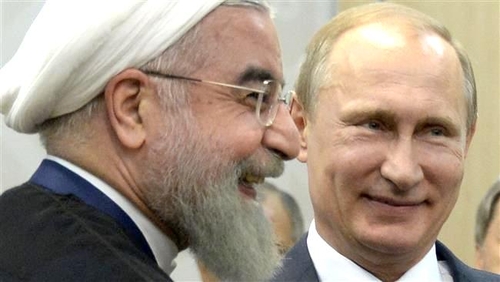
It's all smiles when Russia's President Putin (R) meets Iran's President Rouhani.
Q: Reactionary and would-be totalitarian forces, such as the governments of China, Russia, Iran, Turkey, and Venezuela, seem to be gaining at the expense of the liberal democratic order. Do you agree?
A: Yes, the liberal democratic order reached its high-water mark with the Soviet collapse in 1991 and has been in decline ever since. Poor Western leadership partially accounts for this, as does the perennial allure of bad political choices outside the West.
Q: During his campaign, Donald Trump called for "America First," a seeming Jacksonian pull back from the troubles of the world. As president, however, he has abandoned many of those positions. Will the U.S. government continue with its traditional post-1945 positions?
A; Trump has reversed himself on innumerable campaign pledges. This is easily explained, for he had only simplistic opinions before becoming president, after which he has been learning about the complexities and realities of the world. Fortunately, he has not insisted on sticking with his earlier ignorance but has been willing to absorb new materials. So, yes, I think he will stick with something along the standard post-1945 policies.
Q: You wrote in January, in "A New Strategy for Israeli Victory," that "When enough Palestinians abandon the dream of eliminating Israel, they will make the concessions needed to end the conflict. To end the conflict, Israel must convince 50 percent and more of the Palestinians that they have lost." But Daniel Polisar of Jerusalem's Shalem College found, in a recent examination of hundreds of Palestinian surveys, that the majority of Palestinians reject an Israel alongside Palestine by as much as 3 to 1. How do you respond to this data?
A: Polisar finds variously that 25, 30, and 32 percent of Palestinians are willing to live alongside a Jewish state; these numbers slightly exceed my estimate of 20 percent of Palestinians accepting Israel's existence. So, (1) his estimate is more optimistic than my own and (2) there's a lot of work ahead to turn these low proportions into a majority.
Q: Most observers see Trump as far more favorable to Israel than Obama. Do you agree?
A: Trump is learning on the job and we have no idea where his education will take him. One can envisage scenarios from his being very friendly to very hostile toward Israel, and everything in between. If I must predict, I expect mild hostility – because egomaniacs tend to be more gratified visiting Riyadh and Dubai than Jerusalem and Tel Aviv.

Dubai, a real estate developer's dream.
Q: The amended Hamas charter states that all of Palestine belongs to the Muslim umma, reminding us of the Islamist refusal to Israel and the longstanding Arab and Islamic rejectionism of the Jewish state. If the Israeli-Arab conflict was from its inception a religious war, this makes it particularly difficult to resolve. Do you agree?
A: I do. Although mostly hidden, the religious basis of the Arab-Israeli conflict has always been key. The fact that Jews historically lacked power makes the creation of Israel the more bitter and unpalatable. That Zionists purchased Israel rather than stole Palestine makes matters even more humiliating.
Q: Islam is at its core both a theological and political system. How can we reasonably expect such a system to accommodate Western values without destroying its intrinsic logic? In other words, isn't jihadism inevitable?
A: No, it's not. All religions – indeed, all human creations – change over time. Christianity and Judaism a few centuries ago differed profoundly from their current manifestations. Islam has changed in many ways over the past half-century. This being the case, there is every reason to think that Islam will continue to change; let's hope it modernizes and jihadism disappears.

Tuesday, May 09, 2017

More Baseballs Than Brains...

 Rabbi throws out first pitch at New York Mets game


 Lou Lookstein Getting Ready For The Pitch - He's Not On First!


(JTA) — Perhaps the injury-plagued New York Mets thought that having a rabbi throw out the first pitch before a game would bring some divine intervention.

Rabbi Haskel Lookstein, the modern Orthodox rabbit who oversaw Ivanka Trump’s conversion to Judaism, made the ceremonial toss at the Mets-Marlins game on Sunday to a smattering of applause at Citi Field in Queens.

The Mets suffered a 7-0 loss — the first time this season they were shut out — and managed just one hit against Miami, so interpret the Lookstein effect as you wish.

Lookstein is the rabbi emeritus of Congregation Kehilath Jeshurun on the Upper East Side of Manhattan, where he served as the spiritual leader for more than 50 years. He also was the principal of the prestigious Ramaz School in Manhattan from 1966 through 2015.

It wasn’t his first time on a professional mound: Lookstein tossed out the first pitch before a Mets-Phillies game in May 2006, when the New Yorkers played at Shea Stadium. The throw made it over the plate, earning the rabbi kudos for a “good pitch” from then-manager Willie Randolph.

Ramaz posted a video on Facebook of Lookstein’s pitch on Sunday — which again made it over the plate.

Lookstein had been scheduled to give an invocation at the Republican National Convention in Cleveland in July, but he withdrew “after the whole matter turned from rabbinic to political, something which was never intended,” as he wrote in a letter to his congregation.

http://www.jta.org/2017/05/08/arts-entertainment/ivanka-trumps-rabbi-throws-out-first-pitch-at-new-york-mets-game


Monday, May 08, 2017

According to a later text, Rabbi Akiva himself acclaimed Bar Koseba as the messiah. No doubt that was how he got the name Bar Kokhba “Son of a Star.” But he was, at most, a failed messiah...


Bar Kokhba: When (rabbinic) leadership fails


In 130-131 CE, Hadrian, emperor of Rome for more than a decade already, traveled to the east — one of the many trips he made around his empire. He thought it would be a good idea to invest in rebuilding Jerusalem, which had been destroyed 60 years earlier: it could once again be a grand city, a jewel in the Roman empire. He may have considered allowing the Jews to re-build their temple, but in any event that was not in the final plans. Those did include a temple to Jupiter. The rebuilt city, to be home for the Jews and the Romans, would be called Aelia Capitolina — Aelia for Hadrian himself, whose family name was Aelius, and Capitolina for the god Jupiter, for whom a temple would be built. 


The Jews were less grateful than Hadrian may have expected. After a year of planning, including the digging and construction of hundreds of underground tunnel complexes throughout the land of Judea, the Jews revolted. 

The entrance to one of hundreds of underground cave networks used in the revolt led by Bar Koseba. Image from Wikipedia.

The entrance to one of hundreds of underground cave networks used in the revolt led by Bar Koseba.
They were led by a man named Shimon bar Koseba, along with a priest named Elazar. We know next-to-nothing about these men — where they came from, how they came to lead, what they did before the year 132. Elazar’s name is known only from coins. Bar Koseba’s name — his real name — is known to us only from letters he wrote, which were found in the middle of the twentieth 
 century.


The name of Shimon ben Koseba, from the beginning of a letter dictated by him. Photo from http://cojs.org/bar_kokhba_letter-_132-135_ce/


The name of Shimon ben Koseba, from the beginning of a letter dictated by him. (http://cojs.org/bar_kokhba_letter-_132-135_ce/( With the discoveries of the letters, we know something of the man. We also know something of his administration, and of the people involved in the revolt — at least of those who fled to caves in the Judean desert, documents in hand, and hoped that the Roman threat would dissipate and they would be able to return to their homes. Perhaps the most interesting is the woman named Babatha, originally from the other side of the Dead Sea, who came to a cave together with some of Bar Koseba’s warriors, carrying her ketubah and other legal documents. From these we get a sense of her life — and of the people supporting Bar Koseba.


A text from the archive of Babatha, a woman caught up in Bar Koseba's revolt, who died in a cave in the Judean Desert. Photo from Wikipedia.

A text from the archive of Babatha, a woman caught up in Bar Koseba’s revolt, who died in a cave in the Judean Desert. (Wikipedia)

None of those people in the caves escaped, though. A bag of skulls was found in the cave, too. In the long run, the Romans always win.


Bag of skulls found in a cave where Bar Koseba's fighters and others had hid. Photo available on http://www.yadinproductions.com/.


Bag of skulls found in a cave where Bar Koseba’s fighters and others had hid (http://www.yadinproductions.com/)

According to a later text, Rabbi Akiva himself acclaimed Bar Koseba as the messiah. No doubt that was how he got the name Bar Kokhba “Son of a Star.” But he was, at most, a failed messiah. The results of his revolt were catastrophic. A Roman writer puts the number of Jewish dead at 580,000. Jerusalem was destroyed once more, more thoroughly this time. Jews were banned. Hadrian never forgave the Jews, and the stories of martyrs proliferated. Intellectuals throughout the Roman empire castigated the Jews, condemning them as ingrates (and far worse) for not appreciating the stability and enlightenment brought by Roman rule.

Rabbi Akiva’s students, the Tannaim, left us a lot of texts — the Mishnah, the Tosefta, halakhic midrashim. What do they have to say about this episode? Nothing at all. He is never mentioned in any of the works of the Tannaim. No Jewish text for the next century or more so much as mentions his name.

Why? I think it’s not hard to discern the reason. What can be said? There is nothing positive to say, certainly not for those living in the aftermath of the devastation. The Tannaim for the most part lived in the Galilee, having been banished from Judea or drifted away from there after the catastrophic revolt. But they also have nothing negative to say. How could they? To criticize Bar Koseba would be to criticize Rabbi Akiva, to concede that the great scholar and teacher, the intellectual master of nearly all the Tannaim, and the mind behind the Mishnah, was wrong on the most important of worldly matters. It would be to concede that great rabbinic scholar as he was, Rabbi Akiva’s judgment led to the deaths of hundreds of thousands of Jews. Better to remain silent.

It is worth comparing this to reactions to the Holocaust. Setting aside the question of God’s involvement, what of the rabbis? What of the many great rabbinic scholars who advocated remaining in Europe, rather than assimilationist America or — Heaven forfend! — the Zionist settlement in Palestine? What to say about the rabbis who could have, had they offered different advice, perhaps saved the lives of thousands of followers?

The paths diverge: while the Tannaim remained silent, twentieth-century Haredi thinkers offered a multitude of words. It was the fault of the Zionists; it was the devil himself; assimilationist tendencies had to be punished; the most precious Jews were being sacrificed by God; and so on. Is it better to speak or to remain silent? Norman Lamm wrote that one cannot remain silent in light of the Holocaust, but neither can one say anything.

Jews have grappled with the image of Bar Koseba for nearly 1,900 years. A rebel leader and failed messiah, he became a Zionist hero in the 19th century, and is now the protagonist of Lag ba-‘Omer celebrations. Bows and arrows and bonfires show the rehabilitation of a man whose origins are lost to history, and whose ill-fated revolt changed Jewish society.
Aaron Koller’s mini-course, “Bar Kokhba: Rebel, Failure, Hero,” is taking place at the Drisha Institute for Jewish Education, on Tuesday May 9, 16, and 23. For more information, see http://drisha.org/product/bar-kokhba-rebel-failure-hero.

Sunday, May 07, 2017

Behind the lies of Holocaust denial


"There are facts, there are opinions, and there are lies," says historian Deborah Lipstadt, telling the remarkable story of her research into Holocaust deniers -- and their deliberate distortion of history. Lipstadt encourages us all to go on the offensive against those who assault the truth and facts. "Truth is not relative," she says.

David John Cawdell Irving (born 24 March 1938) is an English Holocaust denier[1] and author who has written on the military and political history of World War II, with a focus on Nazi Germany. His works include The Destruction of Dresden (1963), Hitler's War (1977), Churchill's War (1987), and Goebbels: Mastermind of the Third Reich (1996). In his works, he argued that Hitler did not know of the extermination of Jews or, if he did, opposed it.[2] Though Irving's revisionist views of World War II were never taken seriously by mainstream historians, he was once recognised for his knowledge of Nazi Germany and his ability to unearth new historical documents.

Irving marginalized himself in 1988 when, based on his reading of the pseudoscientific[3] Leuchter report, he began to espouse Holocaust denial, specifically denying that Jews were murdered by gassing at the Auschwitz extermination camp.[4][5]

Irving's reputation as a historian was discredited[6] when, in the course of an unsuccessful libel case he filed against the American historian Deborah Lipstadt and Penguin Books, he was shown to have deliberately misrepresented historical evidence to promote Holocaust denial.[7] The English court found that Irving was an active Holocaust denier, antisemite, and racist,[8] who "for his own ideological reasons persistently and deliberately misrepresented and manipulated historical evidence".[8][9] In addition, the court found that Irving's books had distorted the history of Adolf Hitler's role in the Holocaust to depict Hitler in a favourable light.

Friday, May 05, 2017

It has been said of the Jews that they earn like Episcopalians and vote like Hispanics. Obviously their economic success and connection to Israel are not enough to separate them from the Democratic Party. The two groups are joined at the hip.


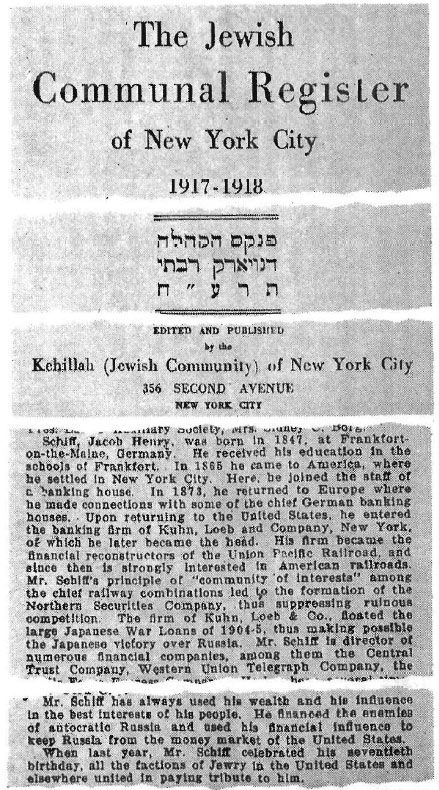
Jacob Schiff, described here on pages 1018-1019 of New York's Jewish Communal Register for 1917-1918, was one of the wealthiest Jewish capitalists in America. He headed the powerful Wall Street banking firm of Kuhn, Loeb. Yet Schiff, after first bankrolling the Japanese against the Russians in 1904, gave Trotsky and other Jewish communists $25 million to launch the Bolshevik revolution of 1917. And some Americans still believe that there is a fundamental antithesis between Jewish capitalism and Jewish communism!
 
Jacob Schiff, described here on pages 1018-1019 of New York’s Jewish Communal Register for 1917-1918, was one of the wealthiest Jewish capitalists in America. He headed the powerful Wall Street banking firm of Kuhn, Loeb. Yet Schiff, after first bankrolling the Japanese against the Russians in 1904, gave Trotsky and other Jewish communists $25 million to launch the Bolshevik revolution of 1917.


The Jews, the Communists, and the Democratic Party


I just began reading Blacklisted by History; The Untold Story of Joe McCarthy.  It seeks to establish that many of the people that McCarthy targeted unsuccessfully were later proven to be communists.  It brought back many memories for me.

I grew up in the forties and fifties.  My father's family, like many other Polish Jewish families in Canada, were avowed Communists.  They were dedicated to workers' rights and marched in the streets.  They even managed to get one of their own, J P Salsberg, elected to the Ontario legislature representing the Communist Party, then called the Labour-Progressive Party.

I was old enough to remember the heated debates on the trial and execution of the Rosenbergs, the Doctor's Plot as alleged by Stalin, and the McCarthy hearings.  I even watched the hearings on that newfangled device called television.  I read the Bintel Brief and The Rise of David Levinsky by the editor of the Forward, Abraham Cahan.  I was an avid reader of IB Singer, Bernard Malamud, Phillip Roth (I married a Communist), Irving Howe, Chaim Grade, Sholem Asch, I.J. Singer, and many others.  I went beyond the tribe and read Theodore Dreiser, John dos Passos, Upton Sinclair, and John Steinbeck.  That was my generation.  My Zionist readings had not yet begun.

Massive Jewish emigration from Russia to the U.S. was caused by a wave of anti-Jewish pogroms sponsored by the tsarist government after the assassination of Alexander II in 1881.  Russia  wanted to suppress those advocating reform.  The minister of the Interior gave a speech in 1903 in which he said:
In Western Russia, some 90 per cent of the revolutionaries are Jews, and in Russia generally -- some 40 per cent. I shall not conceal from you that the revolutionary movement in Russia worries us but you should know that if you do not deter your youth from the revolutionary movement, we shall make your position untenable to such an extent that you will have to leave Russia, to the very last man!
And so they did.
Wikipedia summarizes:
By 1924, two million Jews had arrived from Eastern Europe. Growing anti-immigration feelings in the United States at this time, resulted in the National Origins Quota of 1924 which severely restricted immigration from many regions including Eastern Europe. The Jewish community took the lead in opposing immigration restrictions, which remained in effect until 1965.
Thereafter, Jews came to Canada as their second choice.  These included my father's family, which were Communists, and my mother's family, which were Zionists.

In the thirties, America was plagued by the Great Depression.  I was proud of my father's family because they fought for workers' rights and a better world.  Franklin Delano Roosevelt, on the promise of a New Deal, was elected president in 1932, an office he held until his death in 1945.  The Jews, Communist or otherwise, worshiped Roosevelt.  That worship was little diminished by Roosevelt's failure to bomb the extermination camps or to allow Jews, even those fleeing the Holocaust, to enter the U.S.  He would not allow the Jews on the St. Louis to disembark, leaving them to their fate, which was a return to Europe and death.  It was of no concern to U.S. Jews that the New Deal was unconstitutional or ultimately was proven to have extended the Depression.  And it was of no concern to the Jewish leadership that Jews were dying by the millions in the Holocaust.

The Jews remained loyal to the Democratic Party throughout.  They also remained loyal to liberalism and secularism.  Communism was embraced because it offered an antidote to discrimination and persecution as it existed in Russia and in America in the first half of the 20th century; you know, "Workers of the World, Unite!"  Even though Communism proved to be a false God, duly noted by Kunstler's The God That Failed, the Jews continued their quest for equality and civil rights.  They believe as a result in the separation of church and state and the responsibility of the state to provide for those in need.

After 2,000 years of Christian anti-Semitism and discrimination, is it any wonder?  To them, the present was never worth preserving.  To the contrary, it needed to be transformed.  First, the Jews focused on workers' rights and union rights in America.  Then they led the civil rights movement, which resulted in the liberation of blacks.  Not that the blacks appreciated it.  In fact, black anti-Semitism is very high compared to other groups.  They see the Jews as responsible for black exploitation rather than black liberation.

The American Civil Liberties Union (ACLU) was formed in 1920 by a group of radicals, socialists, and Communists whose purpose was to defend their fellow radicals.  The founders were not Jewish.  Twenty years later, the ACLU banned Communists from positions of leadership and from its staff.  Over the years, Jews became very influential in this organization.

The ACLU's stated goals were "to defend and preserve the individual rights and liberties that the Constitution and laws of the United States guarantee everyone in this country."  It was prominent in the Scopes trial of 1925, which hoped to ban the teaching of evolution in the public schools; it stood alone in fighting the internment camps for the Japanese after the Japanese attack on Pearl Harbor; and it paired with the NAACP to challenge racial segregation in public schools.  The resulting Supreme Court decision in Brown v. Board of Education that ended the era of "separate but equal" was a major victory for racial justice.  The ACLU was also involved in the 1973 Supreme Court victories in Roe v. Wade and Doe v. Bolton, which held that the right to privacy encompasses a woman's right to decide whether she will terminate or continue a pregnancy.  It even fought in defense of freedom of speech, for the rights of Nazis to march against Jews in Skokie, Illinois.  It led the attack against the Patriot Act.

The ACLU's activities have been characterized as anti-God, anti-American, and anti-family, all notable communist goals.  Yet the ACLU did what it did in the name of individual rights.  Although the ACLU lobbies Congress and state legislatures, its accomplishments derive chiefly from judges who share the ACLU's view of the Constitution as a "living document."  There is little if any daylight between them and the Democratic Party and Barack Obama. And they are all pro-uncontrolled immigration.

A fellow traveler of the ACLU is the Anti-Defamation League (ADL), which was formed in 1913 "to stop the defamation of the Jewish people and to secure justice and fair treatment to all."  It has served a useful purpose and has done good work but, according to Bill Levinson, has strayed from its charter.  Levinson charges that "[t]he ADL has also become a facilitator and enabler of the very hate-mongers it claims to oppose," that it shilled for President Obama by proposing "National Pledge for Unity on Israel," that it was and is an advocate against Second Amendment Rights to bear arms, and that it is a defender of sharia.


Rabbi Nachum Shifren is not so kind.  He writes, "The ADL has nothing to do with Judaism, Jews, or Jewish Survival. It is a collection of communists, anarchists, Jewish 60's [sic] drop-outs, bitter about their nothing status and eager to spread their venom about a socialist paradise at which they believe only they can succeed. (The earlier Bolsheviks and Trotskyite's [sic], they assure us, just didn't get it right.! [sic])"  (Emphases in the original.)

Unfortunately, liberal Jews don't see it that way.  They continue to worship the ACLU and the ADL.

Is it any wonder, then, that 78% of the Jews voted for Barack Obama in '08 and his goal of "transformation of America," notwithstanding his pro-Palestinian and anti-American running dogs?  Most Jews still support Obama, notwithstanding his very anti-Israel policies.

This is not to say that all Jews, or even many of them, are Communists or anti-Americans.  They aren't.  America has been good to them, and they know it.  Having been denied civil and human rights for at least a thousand years, they have become fierce defenders of such rights as they see them.

It has been said of the Jews that they earn like Episcopalians and vote like Hispanics.  Obviously their economic success and connection to Israel are not enough to separate them from the Democratic Party.  The two groups are joined at the hip.

Thursday, May 04, 2017

When the media runs these evocative nostalgic pieces about Communism, it's the equivalent of a pedophile sharing snapshots of summer camp. It's the disgusting secret of truly vile people leaking out.


The Dirty Red Secrets of May

American leftists celebrated the venerable Communist holiday of May Day in the traditional fashion. Portland grad students, who have never worked a day in their lives, marked International Workers Day by smashing the windows of local businesses. There's a long proud tradition of the revolutions of the working class being led by rich leftists like Marx, Engels, Lenin and Castro to whom work is an evil mystery that they spent their miserable lives resolving never to become acquainted with.

The New York Times, which has far too many of its own windows to go around smashing those of others, instead offered some sickening nostalgia for the red dead past with a little piece titled, "When Communism Inspired Americans."

Which Americans did Communism inspire? Communists and their fellow travelers. Despite the news stories cheerfully reporting on May Day protesters in the United States waving Soviet flags, there aren't very many Communists in this country. Communism is a demanding mistress. It requires knowing a whole lot, not so much about the real world, but about Communism.

Most leftists are dilettantes. They admired and admire Communism's commitment to murdering millions of people and arguing the esoteric dogmas of the party line. It's this latter that Gornick's New York Times piece bleeds with nostalgia for. She tells us, again and again, that the Communists were wonderfully inspirational because they sat around kitchen tables arguing about ideas.

So did the Nazis. But the New York Times doesn't print fond recollections of debates over whether the Japanese really counted as Aryans and how National Socialism should approach the rights of workers. Nostalgia for the Third Reich is rightly regarded as abominable. And the hobby of those who have a soft spot for its murderous totalitarian ideology.

Curiously, the left never applies this same indictment to its own fondness for Communism. Instead it traffics in nostalgia for Communism's idealism, as if its ideals were any nobler than those of Nazism. But the left believes they were. And how could it not? Communism is just the left taken to its inevitable conclusion. And so the left excuses Communism's excess of enthusiasm for the cause.

Mistakes were made. The mass murder of millions being one of them. Generations of repression being another. Forced abortions, mass starvation, forced labor, slavery, death camps, virulent racism, psychiatric torture, invasion and terrorism being a few others. But their ideals were so idealistic.

Communism didn't inspire Americans, it did inspire the left to try and turn America into a totalitarian state. It still does. This is the dirty little secret that leaks out of the left. When the media runs these evocative nostalgic pieces about Communism, it's the equivalent of a pedophile sharing snapshots of summer camp. It's the disgusting secret of truly vile people leaking out.

And the vile people are the cultural leftist elites claiming to be our moral superiors on account of their commitment to total government control of everything... for the benefit of the people.

Sound familiar?

The double standard is why Nazi historical revisionism is evil, but Communist historical revisionism gets a wink and a nod. It also makes a mockery of the conviction that the mass murder of Jews for the sake of a totalitarian ideology during the 20th century was a bad thing that we ought to deplore.

The Soviet Union began murdering Jews when the Holocaust was just an evil twinkle in a mad Fuhrer's eye. It went on murdering Jews long after he shot himself in the head. Stalin liked Hitler's Holocaust so much that he tried to plan his own version of it. He would have gotten away with it too if he hadn't died, throwing the Soviet Union and his various malicious plans into chaos with it.

The left doesn't believe that Hitler was bad because he killed Jews. Mass murder isn't a crime in the left's eyes. Just ask Stalin, Mao, Pol Pot and the rest of the gang of monsters whom the left defended in papers just like the New York Times until they had committed the worst of their crimes.

As long as the Hitler-Stalin pact held, leftists vehemently campaigned against war. There were plenty of "Hitler is bad, but" pieces of the sort that they're running about North Korea or Iran. Hitler only became truly irredeemable when he invaded the Soviet Union. And then everyone, except the Trotskyists, decided that Nazi Germany was utterly evil. Leftist fellow travelers went, in the span of days, from protesting "warmongering" and "militarism" to demanding action yesterday.

And that too is another dirty red secret of the left.

It's inconceivable that the New York Times or any paper would run a glowing piece titled, "When Nazis Inspired Americans". No fond recollections from participants in the Madison Square Garden rally. No fond memories of Bund camps. No sugar-coated recollections of how the Thousand Year Reich would create a better world... only to then learn that Hitler wasn't a very nice man.

But "When Communism Inspired Americans".regurgitates the same exact message. And it remains acceptable because the left feels an emotional and intellectual connection with Communists.

That is the ugly truth at the root of our conflict.

Liberalism, the old vintage that actually stood up to Communists, is as dead as the dodo. In its place are smug leftists eager to repeat the same old sins.

Nazis don't get a forum to pour out their romantic nostalgia for attending Hitler rallies. Communists do because the left sympathizes with them. It must offers occasional apologies and disavowals, but the love for a horrifying ideology that was totalitarian all the way down, whose mass murder of millions was not an accident of fate, but was always an integral part of it, tells the truth about the left.

"The party was possessed of a moral authority that lent shape and substance, through its passion for structure and the eloquence of its rhetoric, to an urgent sense of social injustice," Gornick writes.

Gornick begins with individuals and concludes with the ugly collectivist mass of the party. It is always the party in the end. The individuals are disposable. They are, as Stalin said, statistics.

The rest is tiresome. The same recitations of "We knew nothing". As if the crimes of Communism had been some sort of mystery until Khrushchev admitted them.

And what were the Moscow Trials? What were the decades of reports about abuses and atrocities?

Like Pol Pot's crimes, an outraged left denied it all.

After all the mass murders and crimes have been admitted, the left always returns to this nostalgia. To that emotional linkage to the total commitment to a totalitarian state.

To the party.

This is the left. It returns, like a dog to its vomit, to the dream of the true radicalism of a totalitarian leftist state. It occasionally deals with uncomfortable truths. Circles around them. And then it lapses back into an opium dream of Marxists sitting around a kitchen table and debating which windows to smash first and whom to shoot first.