EVERY SIGNATURE MATTERS - THIS BILL MUST PASS!

EVERY SIGNATURE MATTERS - THIS BILL MUST PASS!
CLICK - GOAL - 100,000 NEW SIGNATURES! 75,000 SIGNATURES HAVE ALREADY BEEN SUBMITTED TO GOVERNOR CUOMO!

EFF Urges Court to Block Dragnet Subpoenas Targeting Online Commenters

EFF Urges Court to Block Dragnet Subpoenas Targeting Online Commenters
CLICK! For the full motion to quash: http://www.eff.org/files/filenode/hersh_v_cohen/UOJ-motiontoquashmemo.pdf

Friday, November 10, 2017

The OU cannot — dare not — allow any of its executives to kosher and legitimize countries like Qatar. Only the emir himself can do that, by immediately ceasing all funding of terror against Jews...


Message to the Orthodox Union: Blood Is Never Kosher


Doha, Qatar.

America is having another bad week.

On Sunday, yet another mass shooting struck the United States, this time in a house of worship where 26 of the faithful were shot as they crawled out from behind their pews. Then we watched as the Middle East teetered ever closer to the brink, with political waves rocking Saudi Arabia, Yemen and Lebanon. Then came the release of the “Paradise Papers” by The New York Times, with yet more blatant financial corruption laid bare for all to see. This, all in addition to the endless scandals that plague our political and cultural spheres.

One would expect that in such times as these, rabbis and other religious leaders would stand tall as beacons of hope of moral clarity within which our hearts could find some much needed refuge.
Yet on Monday, The Jerusalem Post reported that a coalition of prominent rabbis led by Rabbi Menachem Genack of Englewood, New Jersey had traveled to Qatar to meet with its emir.

Following the recent successes of the Russian military forces in Syria, there are renewed indications that Moscow is seeking some...
Qatar isn’t any Arab state. It’s the world’s number one funder of Hamas, an organization dedicated not only to the annihilation of Israel, but to the murder of all Jews — “wheresoever they may be found,” to quote Hamas’ founding charter.

In 2012, the nation of Qatar pledged four hundred million dollars to the terror group. Apparently pleased to see Hamas had used this money to launch over 5,000 rockets against Israeli civilians, Qatar would ratchet up its commitment by promising another billion dollars to the blood-thirsty leadership of Gaza in 2014.

As if their anti-Semitism couldn’t be more clear, Qatar hosts not just the Hamas leadership, but the man who may be described as the world’s foremost Jew hater: Yusuf al-Qaradawi. Worse than denying the Holocaust, Qaradawi has praised Hitler for his slaughter of European Jews and prayed that Allah help him finish the job. “Oh Allah,” he cried in a sermon, “take this oppressive, Jewish, Zionist band of people…count their numbers, and kill them down to the very last one!” The nation of Qatar didn’t just tolerate that kind of genocidal hate-speech, it actually broadcast it on its own Al Jazeera network.

Moreover, Rabbi Genack, whom I consider a friend, isn’t just any American rabbi. He’s one of America’s most prominent Orthodox Jewish voices, known for his close friendship with former President Bill Clinton. And just to make these efforts to kosher Qatar (intentionally or not) even more ironic, Rabbi Genack is actually the head of the Orthodox Union’s global kosher authority.

The man responsible for the koshering of crackers, cheese and steaks has now been brought in to “kosher” the emir of Qatar who finances tunnels meant to kidnap Jewish children from southern kibbutzim; to “kosher” Qatar’s funding of rockets meant to dismember elderly men and women who can’t run fast enough toward the nearest shelter; to “kosher” Qatar’s financing of the murder of sixty-seven soldiers and six Israeli civilians during Operation Protective Edge.

But the Bible is clear: Blood can never be kosher (Leviticus 17:13-14).

A few weeks ago, I was myself invited to meet the emir by the man organizing the whitewashing effort. Our organization, The World Values Network, responded with two full-page ads in The New York Times declaring “If Qatar Wants a PR Makeover, Stop Funding Terror.” On the bottom of the ad, we added the headline: “Meeting with Qatar Condones Murder.”

Why? Because Qatar is only hiring Jewish PR agencies and arranging meetings with American Jews in order to prove its legitimacy. After all, it could now tell the American people and the rest of the world: “How bad could we be? Look how many rabbis and Jewish leaders have come to meet with us.” And thus, it gets to fund the murder of Jews without paying a price. Enabling a Qatari makeover allows it to get away with murder.

Qatar can repent. If the emir to be brought back into the community of nations, all he needs to do is announce the immediate cessation of all funding of Hamas. He should immediately expel Yusuf al-Qaradawi, and Hamas terror masterminds Ismail Haniyeh and Khaled Mashaal. And he should stop the daily demonization of Israel that takes place on Al Jazeera, a veritable glut of anti-Semitic poison designed to make the world hate the Jewish state. But until such steps are taken, Qatar cannot be allowed to whitewash its crimes.

This is not the first time Rabbi Genack and I have clashed over Israel. When my close friend, Senator Cory Booker, whom I introduced to Rabbi Genack at my home, shocked and shattered American Jewish hearts by voting for the Iran nuclear deal despite the rogue state’s daily threats of a second Holocaust of the Jews, Rabbi Genack was one of the Jewish leaders who worked to protect Cory’s reputation among American Jews and help him hold on to his quickly vanishing Jewish support.
This led to serious pain in my relationship with Rabbi Genack. It was just beginning to heal when I suddenly saw this shocking story about Qatar.

I do not doubt that Rabbi Genack is a very good man, a great scholar and utterly dedicated to the welfare of the Jewish people. No doubt in his mind he believes that he can change the emir. But far more likely is that Qatar is using him to show it’s kosher, and Rabbi Genack should judge the Qatari government by its actions, not its hospitality. Respectfully, we owe it to all the Jews that have been murdered by Hamas to never allow its paymasters off the hook.

The Orthodox Union put out a puzzling statement that “Rabbi Genack is traveling [to Qatar] in his personal capacity as a private individual and this trip is not under the auspices of the OU.”

But you cannot have a top executive of the most important Orthodox Jewish organization in the United States playing global diplomat with terror financiers noted for their hatred of Jews. So long as he occupies one of the OU’s most senior positions, Genack’s actions will reflect on the organization itself.

The concept of kosher is more than just an examination of body parts and mixing milk and meat. It communicates a vital idea of taking something as mundane as meat and elevating it into the realm of holiness. It conveys the human capacity to live a sacred life in accordance with God’s will.

The OU cannot — dare not — allow any of its executives to kosher and legitimize countries like Qatar. Only the emir himself can do that, by immediately ceasing all funding of terror against Jews.

Until then, let us not forget, blood is never kosher.

https://www.algemeiner.com/2017/11/08/message-to-the-orthodox-union-blood-is-never-kosher/


Thursday, November 09, 2017

For him, there was only one thing worse than illusion – self-delusion, an enterprise he feared the Jews had begun to master all too well....

The iconoclastic firebrand that was Rabbi Meir Kahane, Hy"d

For his yahrzeit, 18 Cheshvan.

Tragically, when the sun set before its scheduled time, we lost the most noble Jew of our generation.

Perhaps more than any other, his was a life dedicated to serving Am Yisrael. Regrettably, it was a life ended abruptly in the struggle to awaken a nation that had taken to slumber only a generation after the greatest tragedy that befell its people.

Brilliant and inspired, he was an iconoclastic firebrand who left his mark wherever he walked or whenever he talked. To be sure, friend and foe alike came to understand that there was no place he was ever afraid to go, and nothing that was ever left unsaid.

With a penchant for understanding the ways of the world, and a political proclivity that was rooted to the core in his love of his people, Rabbi Meir Kahane lived his life devoted to the cause of Ahavat Yisrael. Driven by an intense passion for justice that had rarely been seen before, and lamentably that seems to be especially found wanting today, he became the most controversial Jewish spokesman of our generation.

Born in 1932, Meir David Kahane was raised in a religious nationalistic home in New York. Son to a scholar, he learned at a very early age that Judaism was inseparable from Zionism. And that anti-Zionism was just another manifestation of anti-Semitism. He was taught also that, sadly, there were too few Jewish proponents of the biblical notion that posited that Jews should, unapologetically, stand tall. He understood even then that Jewish history, and destiny, was often determined by the bold actions of a few noble Jews. His heroes were Ze’ev Jabotinsky, Yosef Trumpledor, Menachem Begin, Shlomo Ben Yosef, Dov Gruner, Meir Feinstein, and their compatriots of the Irgun and Lehi, a too-small select group of modern Jewish warriors whose names were sadly unknown, or unspoken, in too-many Jewish homes.

The valiant struggle undertaken by these extraordinary Jewish heroes would leave its impact on Kahane. In response to the anti-Semitism that seemed ubiquitous, the unpretentious and private young man from New York would one day be drawn by circumstances to take a demonstrative public stance because others would not. Yet, that metamorphosis should not have surprised anyone, certainly not those who remember this once-quiet New York teenager hurling stones at the passing motorcade of British Foreign Minister Ernest Bevin, an archenemy of Jewish nationalist aspirations.

Following his years at the Mir Yeshiva, he picked up a law degree from New York Law School, and a Master’s degree in International Relations from New York University along the way. He moved from being a modest neighborhood rabbi to copy editor and frequent contributor of the Jewish Press, to a neophyte rabble-rouser whose presence would soon shake the world.

Establishing the Jewish Defense League in 1968 in response to an anti-Semitism that proliferated seemingly unchecked in the neighborhoods of New York, he introduced with it a new breed of American Jew – one willing to fight back. As the JDL’s reputation and popularity grew, so did the condemnations, especially from those so-called Jewish leaders who had previously been empowered by their Jewish constituents to serve the need now taken up by the new Jewish defenders.

Nonetheless, the young men of the JDL continued to take to the streets undeterred, feared and respected by those with whom they did battle, and delivered a renewed message that Jewish blood was not cheap.

But Rabbi Kahane had a greater calling -- helping Jews everywhere. It was not enough, he opined, to serve only those Jews beleaguered only in our own neighborhoods. What of those who stood defenseless elsewhere, and who, he wondered, would feel their pain?

Not long after he founded the Jewish Defense League, Rabbi Kahane made a priority of taking up the cause of Soviet Jewry, a people subjugated and smothered by Soviet totalitarianism. Through extralegal and illegal means, the JDL directed its war against a détente that had masked the Soviet oppression of its religious minorities. No Soviet diplomat would walk the streets of New York freely, the Rabbi warned, if any Jew were compelled to walk the streets of Moscow in fear. In a bold and imaginative campaign to rein terror on the perpetrators, the JDL became a bone in the throat to Soviet interests in America. Numerous times the Soviet Union directed its complaints to the United States government and the United Nations assembly in an effort to curb the “Jewish hooligans,” protests that served only to bolster the latter’s fearless reputation, and determination.

In the end, when all was said and done, the JDL brought to the fore a Soviet Jewish problem that had been shrouded for too long, mobilized an apathetic American Jewish establishment, and befittingly laid claim to opening the iron curtain to the several hundred thousand Russian Jews who were reluctantly permitted to emigrate. All because there walked a rabbi who would not allow himself to sleep comfortably knowing that Jews elsewhere could not.

But most importantly, there was Israel. In keeping with the most fundamental principle of the Jewish Defense League’s ideology, Rabbi Kahane, his wife Libby, and their four children made aliyah in 1971. Welcomed at first as a modern American Jewish hero, the Rabbi soon made his political mark by antagonizing the prevailing political order. Challenging its neglect of the inevitable demographic clash with its own Arab population, and calling to question the ill-fated desire to seek peace at any cost with its neighboring Arab countries, Kahane became a small, though vocal, political alternative.

As Israel confronted an assault of Arab terrorism unleashed, coupled with proliferating social problems, his appeal and support grew. Elected to the Knesset and given a legitimate forum in 1984, and barred from running again in 1988 when the polls predicting an almost unprecedented rise in power, Rabbi Kahane’s name became synonymous with Israeli right-wing politics. “Extremism,” some called it. To be certain, it rendered a new terminology to Israel’s political lexicon:

 “Kahanism.”

Representing people, problems, and issues that had remained unaddressed by successive Israeli governments, he became a popular figure who threatened conventional politics. Remarkably, his impact was so great that the Likud government that presented itself as “nationalist” fought to keep him at bay with a fury that even eclipsed the old Labor governments’ efforts.

Always placing the fate of others above his own, he discounted any concern for his own reputation, faithfully leaving that judgment to God, and to history. As the bravest and loudest voice forewarning the Jews in Israel, and elsewhere, of the impending dangers of a specious and spurious yet all-encompassing quest for Middle East peace, he believed that history would certainly vindicate him.

Long before the fraudulent peace of Oslo, when all others were still hailing the accomplishments of an earlier Camp David surrender to appeasement, Rabbi Kahane spoke about the dangers engendered by the lack of Jewish resolve. He warned that this perilous march to peace, based foolishly on illusions and the best of intentions, would ultimately lead Israel on the path of disaster. As seemed his duty, he shamelessly reminded those who would listen that the road to Hell was paved with good intentions, and, too many dead Jews.

Rabbi Kahane once wrote the words that perhaps more than any others explained this march of madness:

“Not all Jews are heroes, and there are those who grow weary of the long struggle, and the longer wait.  And weariness carries with it weakness.  Weakness of the body, and weakness of the spirit.  Weakness that persuades the Jew to believe, that which just yesterday, he knew to be nonsense. Weakness that prepares the ground for the Jew to believe in madness, and in illusions.”

For him, there was only one thing worse than illusion – self-delusion, an enterprise he feared the Jews had begun to master all too well.

In 1924, the prolific Jewish writer Maurice Samuel, daring to call Jews a “separate and holy people,” concluded his book You Gentiles with the following: “…I console myself with the thought that if this book offends by its assertiveness, God knows that the infinite tactfulness of thousands of other Jews seems to have offended no less. Whatever we do we are damned – and I would rather be damned standing up than lying down.”

Rabbi Meir Kahane, was a rabbi who was in fact damned – damned standing up, but never lying down. His writings, his speeches, and his audacious actions on behalf of his fellow Jews gave no quarter. As certain as the sunrise, his words and his deeds carried with them the assured belief that they invoked the blessings of Heaven.

As the founder and leader of the Jewish Defense League, and then the Kach Movement in Israel, he was condemned, and imprisoned, too-numerous times for his radical actions. And at other times, for his views.  Yet he remained undeterred. Articulating a philosophy pregnant with moral clarity, he once wrote:

“The real prisoners are the ones who walk the streets daily, knowing that they should do a certain thing, and are afraid to do it.  They are serving life sentences. If a person believes in something, and does it – he is never in prison – he is always free.”

Never, then, was there a freer man than Rabbi Meir Kahane.

Rabbi Kahane, for two decades warned us through word and through deed, of the impending catastrophes that we would inevitably face if we chose to follow Washington, and place our trust in princes, rather than the path prescribed by Torah. The Rabbi warned us that when the final showdown would come, the support of these “so-called friends” of Zion would, to use the language of Pierre Van Passan, evaporate like snow on a summer day’s sun.”

With the nations of the world in general, and Israel’s Arab neighbors in particular, the Rabbi understood that there would only be peace through strength.  Not because they loved us, but because they could be made to respect us.

Rabbi Meir Kahane was an unconventional genius.

 His name was, and will forever remain, synonymous with Jewish activism. Principled in purpose, he feared no fight. Therefore it was understandable that the establishment feared his ability to capture and radicalize the hearts and minds of a generation of youth that had been left with little direction, and even less purpose.

A prolific writer, his pen left a penetrating mark on the generation that was influenced by his many books and frequent articles. Tireless, he spoke everywhere, and to everyone, and galvanized a generation of Jews that began to question its parents’ indifference to the life and death issues that he brought to the fore.

The cry of “Never Again,” if ever heard before the rabbi established the Jewish Defense League, was certainly too faint. Rabbi Meir Kahane, and the Jewish Defense League, proclaimed it loudly, and proudly. And it was nothing less than a revolution in Jewish affairs. “Never Again” did not mean that never again would the Jewish people be confronted with anti-Semitism, pogroms, and worse. In the galut, that promise cannot be made, nor kept. But “Never Again” did mean, that never again would the Jews stand idly by, while the anti-Semitic beast reared its pernicious face. It was a chant – a promise – a that became the hallmark of a new Jew. It was a message that instilled a measure of fear in those who made sport of hating Jews. It was a compelling wake-up call to the Jews who had long served as their victims. And it sent a stern and menacing signal to the Jewish leaders who for too long seemed indifferent to both.

He would often remind us that the Jew needed to stand on two legs – the religious, and the nationalistic.


Rabbi Kahane was in every sense, a unique man, a visionary. But he was more. So much more. No political visionary ever knew as much about the New York Yankees as did the rabbi; and no Yankee fan ever climbed more police barricades than did he. No biblical scholar comprehended international law as well, and certainly no international jurist ever understood the Five Books of Moses as did the venerated and often berated rabbi. Perhaps more politically astute than anyone we will ever meet, he often, nevertheless, refused to be diplomatic. You see, he understood, that one doesn’t compromise Jewish values.

With one leg fully entrenched in Israel, and the other still planted in America, the once-quiet pulpit rabbi from Howard Beach, New York reluctantly became an international celebrity. In the matter of a few short years, he came to champion Jewish causes everywhere, and in his own unique manner, left life-lasting reverberations in his wake. It was not history that created this man, but this man who helped fashion history.

He would often remind us that the Jew needed to stand on two legs – the religious, and the nationalistic. Those who stood on only one, he argued, were crippled. And never had one man stood taller on both legs.

Bold, brazen, and never bashful, Rabbi Kahane commanded the ability to engage in intellectual discourse that made even the most erudite opponent shrink before him. Or, he could shift gears effortlessly, and communicate masterfully, with the young and disenfranchised.

The rabbi often addressed groups a thousand strong, and at times, spent endless hours passionately mentoring a single lost soul. Because he understood, that that one lone soul might one day himself alter the course of Jewish history. This endless passion to serve his people, coupled with the determined drive to pursue justice, was in every sense, his raison d’être.

More serious than any man we have ever met, he balanced that with a wonderful sense of humor that always “humanized” the man they wanted us to see as a Jewish outcast.

Often late for appointments, he was always the first to rush to the aid of a Jew in peril. Talented, and of brilliant mind, he was tortured by the notion of Jews suffering, whether in Manhattan, or Moscow.

He feared only God.

He was instrumental in disseminating the type of pride that brought many a young Jew to proudly place the knitted kippa on his head. Finding little time, or use, for sleep, the rabbi’s twenty-hour workday was never enough. Like Ze’ev Jabotinsky, a generation and a half before him, he saw things that others could not. And as was true of Jabotinsky, he was branded a “pariah” by the established Jewish world, which wanted him so much – to simply go away.

Doors to the established Jewish institutions were regularly closed to him – sometimes, as in the case of the campus Hillels throughout the United States, they were literally, physically chained, all in the endeavor to keep him out. Yet, not surprisingly, his ideas still seeped through.

Who really appreciated this remarkable man? Ask an old Holocaust survivor, who knew too well what it meant to be forgotten by American Jewry, while European Jewry burned in flames. Ask the frightened American Jew, living alone in a once Jewish neighborhood, fearful of the anti-Semitism that he felt every day. Ask the Jewish settler in holy Hevron – resting-place of our forefathers - deserted by his own Israeli government, while surrounded by a marauding pack of wolves. Ask the more than a quarter of a million Russian Jews, prisoners of a totalitarian Soviet regime for over fifty years, who had their fate, their future, and their freedom tied to the radical rabbi – a rabbi who was willing to go to jail, for them.

Rare indeed was the man who was willing to shake heaven and earth and sacrifice almost all for his fellow man. Unwilling to compromise the truth, and bereft of any concern for political correctness or conventional expectations, Rabbi Meir Kahane taught us that the life in one’s years is infinitely more important than the years in one’s life.

Felled by a murderous assassin’s bullet in New York in November 1990, he is now gone.

The loss of one great man, and our world will never be the same. It is no doubt the most important thing that the rabbi would ever teach – that one person, could indeed, be the difference.

How different our world would have been had Rabbi Meir Kahane decided that the pain and suffering of the Jews everywhere was not his pain. Or if he had not stood in opposition to the ongoing Jewish retreat from the territories liberated in the 1967 Six Day War, an event that should have instead ushered in the age of redemption. Or, had he simply accepted that these things were sometimes better left alone. God knows, our Jewish leaders said it was so.

Without the rabbi, we mournfully lack the vocal and vociferous outcry against the perfidious and misbegotten peace process. More importantly, we shall forever miss the fury of the same noble rabbi, not here today to lead the voices of reason, and demonstrate in angry protest against the road map to madness.

“Never Again” did mean, that never again would the Jews stand idly by, while the anti-Semitic beast reared its pernicious face. It was a chant – a promise – a that became the hallmark of a new Jew.
Tragically, it seems that we really didn’t deserve him, and must now fend for ourselves.

The message of Rabbi Meir Kahane is still quite clear today. And for the Jewish people wandering seemingly leaderless in a desert of our own creation, he is needed more than ever before.

We stand today at the moment of truth, called on to muster the courage to break with illusion and foolishness. We stand today a moment that finds us still masters of our own fate, having learned from that noble rabbi that much can be accomplished through dedication, and the faith and the fight of the few against the many.

His legacy should not to be misunderstood, nor left to the historians who so often rewrite it. The message is as clear as it is powerfully poignant: If we march forward with the courage that is called for, guided by Torah and unencumbered by the need to appease unappeasable opponents, then future generations will indeed bless us. If, on the other hand, we equivocate and vacillate, misled by a fearful and faint-hearted temperament while our fate and that of our brethren in Israel and elsewhere still hang in the balance, we shall forever regret the moment of truth when we might have achieved glory, and were found wanting.

The struggle continues.  And it continues without the voice, or the hand, of the most noble Jew of our generation.

And, it seems so much harder today to say: “Od lo avda tikvateynu.” That “our hope is not yet lost.”

Meir Jolovitz is a past national executive director of the Zionist Organization of America, and formerly associated with the Institute for Advanced Strategic and Political Studies. He had previously served as national chairman of the Jewish Defense League.

http://www.israelnationalnews.com/Articles/Article.aspx/21227?utm_source=activetrail&utm_medium=email&utm_campaign=nl

POST SCRIPT: Meir Kahane was far from perfect in his personal life, this post is about the recognition of his great accomplishments with all his human flaws. PM

Wednesday, November 08, 2017

But scratch the surface, and heart-wrenching stories are revealed. These girls have been removed from their family homes by court order as a result of severe neglect or physical, sexual or emotional abuse — or any combination thereof....


It takes a village to heal Israel’s abused teen girls

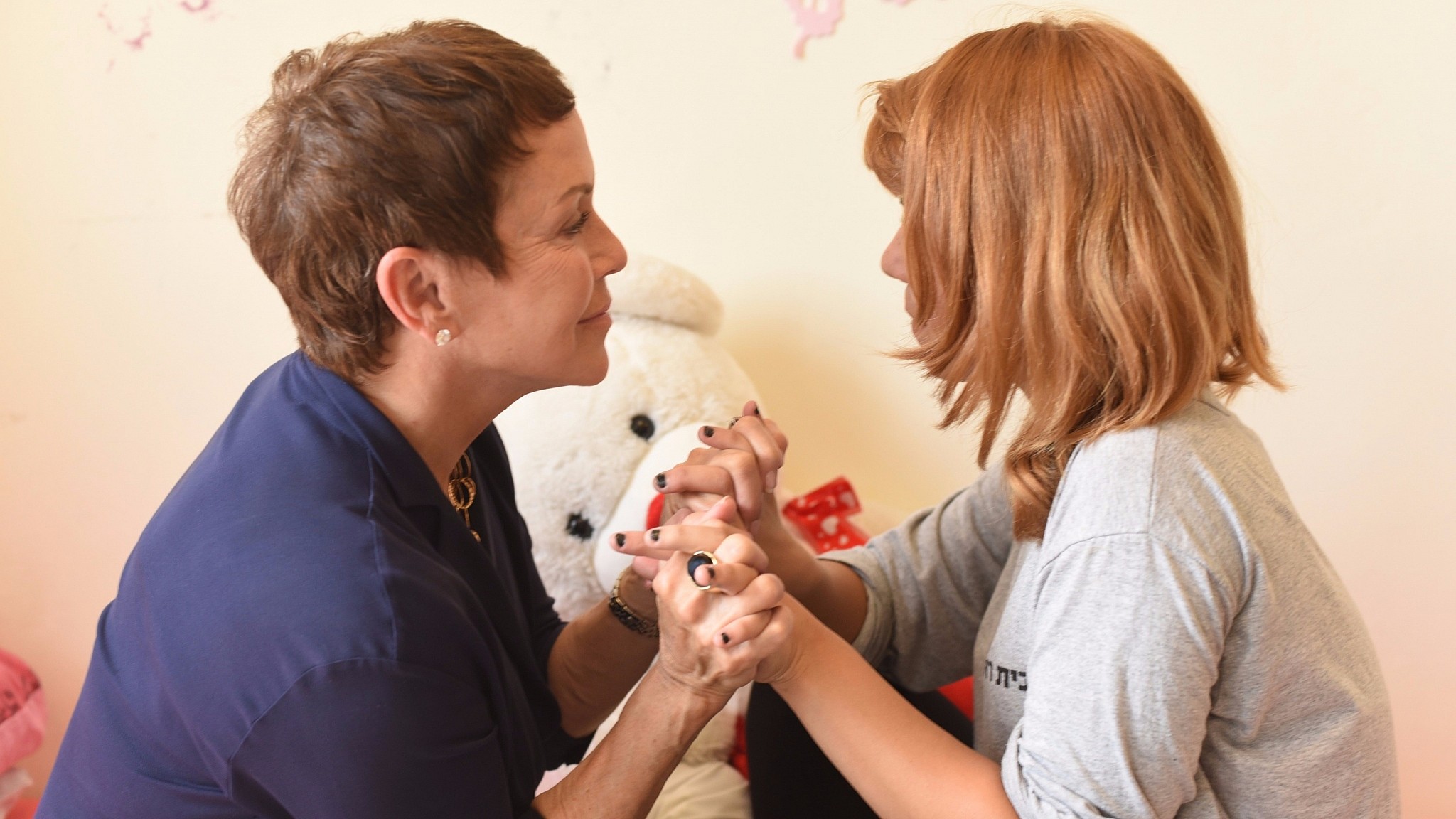
NY philanthropist Susan Ashner celebrates opening of new school at Beit Ruth, marking growth for the holistic therapeutic refuge for young female victims


Beit Ruth co-founder and board chair Susan Ashner checks in with one of the residents, July 2017 (Meir Azoulay)
Beit Ruth co-founder and board chair Susan Ashner checks in with one of the residents, July 2017

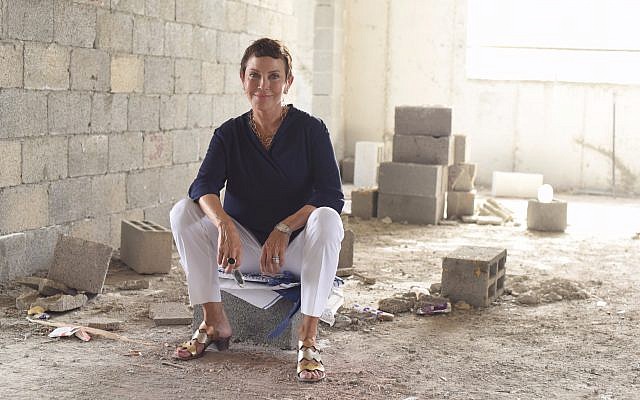
AFULA — Susan Ashner wasn’t dressed appropriately, but that didn’t stop her. In white pants and heeled metallic slide sandals, she carefully stepped her way through a construction site in this northern Israeli city on a blisteringly hot afternoon this past July.

Sitting down on a randomly strewn cinder block, Ashner took a moment to reflect on this building rising from the ground at Beit Ruth, the unique educational and therapeutic residential village for vulnerable and at-risk teen girls she and her husband Michael Ashner co-founded 14 years ago. The New York philanthropist couple’s dream of a proper school for the residents was coming to fruition.
Flash forward four months, and construction of the $3.4 million facility is now complete. Beit Ruth’s residents have been studying and participating in enrichment programs there since mid-October.


New school building at Beit Ruth village under construction, July 2017

The school has the capacity to accommodate several hundred residential and day students. It also has a dedicated lecture hall for Beit Ruth’s advocacy and educational outreach programs on issues related to at-risk girls for key groups such as teachers, school directors, medical professionals, and police.
While the school was built with future growth in mind, Beit Ruth currently has only 45 residents, all who appear to the casual observer like typical teenage girls. They dress according to the latest trends, know the lyrics to popular songs, and swoon over famous movie actors and rock stars.


Beit Ruth village, Afula, Israel

But scratch the surface, and heart-wrenching stories are revealed. These girls have been removed from their family homes by court order as a result of severe neglect or physical, sexual or emotional abuse — or any combination thereof. Many are runaways.Beit Ruth, with its holistic therapeutic approach designed specifically to address the needs of at-risk and vulnerable girls, is often these girls’ last — and best — hope for turning their lives around.

“I could have gotten to the point of my being on the streets if I hadn’t gone to live at Beit Ruth,” said S., a 23-year-old Beit Ruth graduate.

Thanks to individualized academic programs that catch them up on months or years of missed material, Beit Ruth residents graduate high school, some with full matriculation. Many graduates, like S. and D., a 22-year-old Beit Ruth graduate who has returned to live temporarily at the village to mentor younger residents, go on to serve in the IDF and then study at university or work.

At 14, S. did not get along with her mother and was physically, emotionally and sexually abused by her 16-year-old boyfriend. Today things are different for her.

“I have a good relationship with my mother and, although I will remember that boyfriend’s abuse, I don’t have to suffer from it and I know that I didn’t do anything wrong. He did,” S. said.


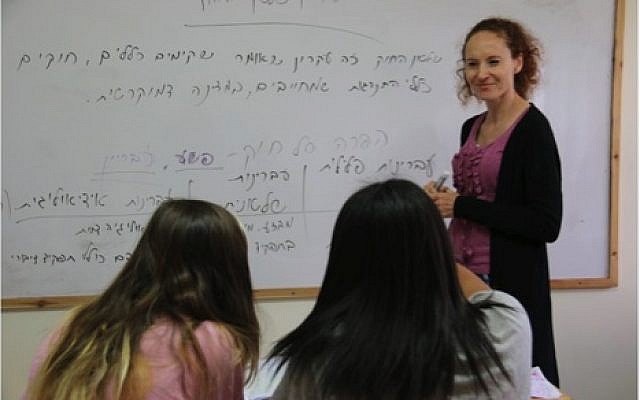
Teacher Orit Ohev Zion teaches a small class at Beit Ruth

D. is thankful for important life lessons she learned at Beit Ruth. Among them are the strength to say “no,” recognize her own worth, and stand her ground and speak up for herself.

“I also know how to take responsibility for both the bad and the good, and to hold myself to high standards,” she said.

From streets to school


Many of Beit Ruth’s 13- to 18-year-old residents have actually been on the streets. One current 13-year-old was using drugs and alcohol and was involved in prostitution at age 12. With her sick, single mother neglectful and her father out of the picture, the girl was victimized by the father of one of her friends, who pimped both girls.

“With the girl having been out of school for a year, a social worker approached her and asked her if she wanted to be removed from her home,” said Iris Twerski, Beit Ruth’s managing director. (Beit Ruth is granted physical custody of its residents, while the girls’ parents retain legal custody.According to Twerski, Beit Ruth was the only realistic option for this girl.

“She was traumatized and needed to heal. Girls like this cannot be placed in a boarding school, especially one where there are boys and men. Boys do well in co-ed programs, but girls don’t,” Twerski said.

“We’ve had girls here who have been abused in mixed-gender facilities,” she said.


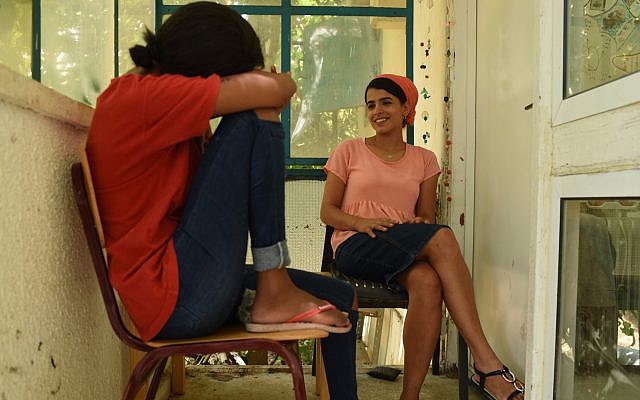
Beit Ruth teacher Pnina Amitay speaks with one of her students, July 2017
Beit Ruth (Hebrew for “Ruth’s House,” and named for the biblical heroine) is the only female-led residential village and school in Israel of its kind.

The country has other residential programs for at-risk girls, but Beit Ruth is the only one where virtually every member of the staff — from the directors to the house coordinators, to the social workers, teachers, therapists and counselors — is a woman.

“A hug from a female counselor is different from a hug from a male counselor,” said mentor D.
The Beit Ruth leadership cites Welfare Ministry statistics that 30,000 teen girls in Israel are at at-risk, of whom 1,000 need to be removed from their homes. There is a shortage of institutions and programs to provide the necessary response to this crisis, and those that do exist have long waiting lists.


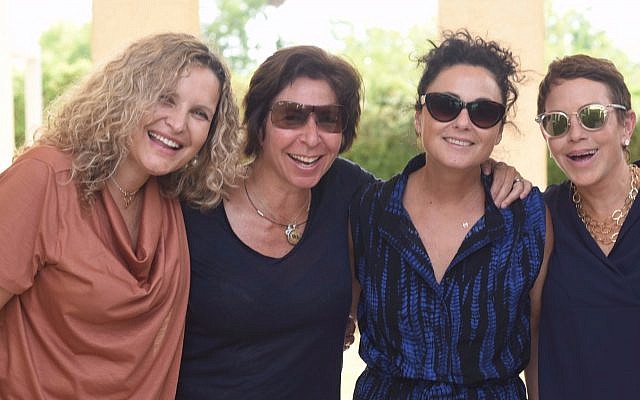
From left: Beit Ruth managing director Iris Twerski, executive director Danielle Burenstein, public council chair Hanna Azoulay Hasfari, and co-founder and board chair Susan Ashner at Beit Ruth, Afula, Israel, July 2017.


One hundred and ninety girls from all sectors of Israeli society have resided at Beit Ruth since 2006 (in Afula, and at a prior location in Rishon Lezion). Many more than the current 45 residents could benefit from the specialized program. The plan is to triple the village’s capacity to 150 girls in the not too distant future.


To that end, Beit Ruth’s board is engaged in an $800,000 capital campaign. Board chair Ashner, who together with her husband has to date given $11 million to Beit Ruth, hopes to establish a $35 million endowment to support capital expansions and improvements, and the village’s operating budget.
Seventy percent of Beit Ruth’s $2 million annual operating budget is covered by the Welfare Ministry, with the remainder from donors in the US. WIZO (the Women’s International Zionist Organization) donated the land on which the village was built.

Free to help themselves


Although girls are directed to Beit Ruth by a court order, there is nothing that compels them to live at the village. Unlike lock-in facilities with security that prevents teenagers from leaving, Beit Ruth is an open facility that relies on mutual trust and cooperation between staff and residents. The girls are free to leave the village at any time, but in reality most are content to be in a self-contained environment where home and school are on the same campus and there is no need to venture out alone.


“We work with the girls on values and taking personal responsibility. It’s about giving positive motivation and reinforcement. We never punish unless it’s for violent behavior,” said Twerski.


Two friends at Beit Ruth hug outside one of the residences at the village

Girls must sign on to a variety of conditions for acceptance to Beit Ruth, which include participation in all aspects of the village’s therapeutic program: Academics, enrichment activities (music, drama, art, sports), psychotherapy, and home life.

The girls do not live in dormitories, but rather in large houses designed and built according to specifications that support the Beit Ruth philosophy. Each two-story group home accommodates up to 15 residents. Upstairs are are five bedrooms (each shared by three girls) and a room for a therapist, who is present every day.

The communal bathrooms are located in the open hallways (deliberately not ensuite within the bedrooms), so that girls with suicidal or self-harm tendencies cannot lock themselves away and out of sight.

The staff-resident ratio is very high, and staff members are present in the houses 24/7 on a rotating basis.

“There is no feeling of hierarchy. The girls can turn to any staff member at any time,” said staff member Mor Ben Simhon-Lipin.

On her visit, Ashner joined the girls in one of the houses for a lunch of roast chicken, roasted vegetables and salads at the long dining table on the main floor, where there are also bathrooms, staff offices, and a living area.

All meals are taken together family-style. A paid cook produces the meals in the kitchen, but the girls are expected to help prepare the food, set the table and clean up. They are equally responsible for keeping all other areas of the house tidy.

“The idea is to give the girls a sense of normalcy, a sense of what it is like to live in a functional family,” said actress Hanna Azoulay Hasfari, who chairs Beit Ruth’s public council and occasionally takes the girls on theater outings.

The one exception to this normalcy is a severe restriction on computer and social media use. Permitted only a half hour per day of social media access, the girls do not walk around staring at smartphone screens like typical teenagers.

“The internet is too dangerous for these girls,” said Ben Simhon-Lipin.

Haven on a high wire

Beit Ruth is a haven, but it must still abide by Israeli laws and regulations requiring the teenage residents to return home for a visit once every three weeks, if they so desire. Girls may choose to maintain a relationship with their parents, even if going home means putting themselves in a vulnerable position.

“A girl can deny her trauma. It often takes two years in therapy at Beit Ruth until she faces the issue and deals with it,” said Ben Simhon-Lipin.

The village’s community was rocked earlier this year by the suicide of 22-year-old graduate Avigayil Lavi, who had been a long-term victim of incest.


Beit Ruth co-founder Susan Ashner at construction site of new school at the village, July 2017

Lavi’s tragic death highlighted the importance of getting girls into treatment at Beit Ruth as early as possible (Lavi arrived at the village as an older teen), and of increasing support services for young women after they age out of Beit Ruth and other programs for 13-18 year olds.

Talk of Lavi brought tears to Ashner’s eyes on her visit to Beit Ruth this summer.

“It is extremely difficult to talk about these things, and about the need for Beit Ruth, but it is so, so important because this could be your sister, or your wife. These girls are the future mothers of Israel,” she said.

Ashner was forthcoming about her love of Israel and her feminism, but less so about events in her own past that drove her to found and sustain Beit Ruth.

“All I will say is that I grew up similar to these girls, and unfortunately I didn’t have a Beit Ruth to go to,” she said.

https://www.timesofisrael.com/it-takes-a-village-to-heal-israels-abused-teen-girls/?utm_source=The+Times+of+Israel+Daily+Edition&utm_campaign=11abd1ce8e-EMAIL_CAMPAIGN_2017_11_06&utm_medium=email&utm_term=0_adb46cec92-11abd1ce8e-55186525


Tuesday, November 07, 2017

Organizations need “multiple, accessible avenues of complaint,” as a federal task force concluded. These avenues should be blazingly obvious, not buried in a corporate policy that nobody reads. They should include anonymous reporting options. They should feed into a process that’s confidential and fair, including to the accused.

The Conspiracy of Inaction on Sexual Abuse and Harassment


Caution --- This Video Contains Sensitive Material In Brutal Adult Terminology:

When Gretchen Carlson spoke out about her experience of workplace sexual harassment, it inspired women everywhere to take their power back and tell the world what happened to them. In a remarkable, fierce talk, she tells her story -- and identifies three specific things we can all do to create safer places to work. "We will no longer be underestimated, intimidated or set back," Carlson says. "We will stand up and speak up and have our voices heard. We will be the women we were meant to be."


The Horace Mann School in the Bronx

I caught the journalism bug in high school. I was fortunate to be a scholarship student at a rigorous New York private school with a weekly newspaper, and some of the older students I admired taught me the power that the written word could have.

When we complained verbally to teachers or administrators about a problem, they could ignore us. 

When we put our arguments in writing, they tended to pay attention. So we became teenage crusaders, inveighing against perceived injustices. Sometimes, the subjects were sophomoric (“censorship” of the talent show), but often they were serious (inequality, racism, South African divestment).

Three decades later, I look back on the experience with deep gratitude. I also look back with haunting regret.

For all of our crusading, we ignored the biggest story at the school. We were aware of the rumors — the teachers who made comments about girls’ bodies, the teacher suspiciously friendly with female students, the music teacher solicitous of male students.

But we never wrote about it. As best as I can remember, we didn’t even talk about writing about it. We didn’t know how. It seemed too dark, too uncertain.
In 2012, the truth came out. My school — Horace Mann — had tolerated sexual molestation for decades. Administrators whose most solemn responsibility was protecting children instead chose to look the other way and protect child abusers. The music teacher, a cultish figure named Johannes Somary, was the worst abuser during my time. One of his victims later committed suicide.

The current torrent of harassment revelations — following Jodi Kantor’s and Megan Twohey’s Times exposé of Harvey Weinstein — has caused me to think back on high school again, because every big case has had something in common with Horace Mann.

People knew. 

Even if they didn’t know the details — I didn’t know what Somary was actually doing — they knew that something was wrong. At Fox News, many knew that Roger Ailes and Bill O’Reilly mistreated women. At ABC, The New Republic and NPR, respectively, people talked about the harassment by Mark Halperin, Leon Wieseltier and Michael Oreskes. In Hollywood, people talked about Weinstein and Kevin Spacey — not to mention Donald Trump, who nonetheless became a heavily promoted reality star.

As the screenwriter Scott Rosenberg has written about Weinstein, “Everybody knew.” (The full quotation includes a colloquial adverb of emphasis between “everybody” and “knew.”)
“Maybe we didn’t know the degree. The magnitude of the awfulness,” Rosenberg continued. “But we knew something.”

And yet no one did anything about it. People were afraid to, or didn’t know how. So they — we — became part of an unwitting conspiracy of inaction.

This conspiracy has spanned the relatively powerless, like interns, secretaries and teenagers, to the wealthy and famous, as well as every level of power in between. Jill Abramson, my old boss, is one of the toughest journalists I know. Still, as a midlevel manager two decades ago, she didn’t go over the head of her old boss — Oreskes — to report his behavior at The Times, as she regretfully said last week.

Post-Weinstein, the emphasis has been on holding other abusers accountable. So far, each seems to deserve his delayed consequences. (And, yes, the severity of the various abuses varies.) I hope the exposés continue.

But post facto truth and punishment are not enough. We also need to figure out how to prevent future abuse. We need to make inaction feel unacceptable.

Doing so will require changes from both organizations and individuals. Every workplace and school should be asking itself: Do people here know how to report a suspicion of abuse? Do they feel comfortable doing so even when, as is typical, they have only an incomplete sense of it?

At most places, the answers remain no and no.

Organizations need “multiple, accessible avenues of complaint,” as a federal task force concluded. These avenues should be blazingly obvious, not buried in a corporate policy that nobody reads. They should include anonymous reporting options. They should feed into a process that’s confidential and fair, including to the accused.

Every leader should also read case studies, to understand how frequently other leaders, at Horace Mann, NPR and elsewhere, have bungled these situations, usually through cowardice. Often, a victim or someone else did summon the courage to come forward, only to have the institution do little or nothing.

But the changes can’t be only about policies and organizations. They need to be personal, too. I’m guessing that you get angry when you think about the abuse committed by Weinstein, O’Reilly, Trump or Somary — about the long-lasting misery they have inflicted on other human beings. I certainly do.

The next time I see something that doesn’t seem quite right, I’m going to remember that anger. One conspiracy of inaction is more than enough for a lifetime.


Monday, November 06, 2017

Let me repeat it for those who came in late: The reason we keep getting acts of terrorism is because we keep importing terrorists...


How’s “diversity” working out for you?


Do the math and you will understand why we keep having terror attacks


Why is this so complicated? 

Especially after Tuesday’s jihadist slayings in Manhattan, the cry arose throughout the airwaves – why do these things keep happening?

So let me spell it out as simply as I can. Are you sitting down? Okay – here goes:
The reason we keep getting acts of terrorism is because we keep importing terrorists.
That is not politics. That is mathematics.


Let me repeat it for those who came in late: The reason we keep getting acts of terrorism is because we keep importing terrorists.


For instance, like most Americans, I did not know, until recently, that since the early 1990s we had a program named the “Diversity Visa Lottery.” So each year some 50,000 people are invited into our country from hellholes all around the globe, like Uzbekistan. Over there it is 96.3 percent Muslim, coincidentally.

That is where the Manhattan murderer came from…and, along with the rest, was welcomed with smiles over the years from types like NY Gov Cuomo and NYC Mayor Bill de Blasio and Sen. Chuck Schumer. Their smiles vanished after the attack when they had to explain how it happened on their support for diversity uber alles.

But that did not stop them from taking the stage to further dump on Trump and even though ashen-faced from shame, they continued to grandstand their Liberal pieties. As if none of this was their doing and if it came again between them and us, between migrants and citizens, they’d still choose the migrants.

President Trump wants to end the diversity lottery program. Trump wants to limit immigration altogether. Trump knows the math.

Let me repeat it for those who came in late: The reason we keep getting acts of terrorism is because we keep importing terrorists.

The very definition of the program, in view of the word “lottery,” means that we are GAMBLING with our security. 

Gambling is okay for horses; not for people. Betting on people, strangers especially, is a sucker bet. Under these terms, we don’t really know who’s coming. 

In other words, we don’t really know who we’re betting on. Democrats and even some Republicans don’t care.

Trump cares. “The safety of our citizens comes first,” says Trump.

What a novel concept if you are a Liberal.

To the question why – better ask where.

It was in Israel where all those deadly car and truck rammings began.

But the world and its experts took it to mean a Jewish problem rather than a universal problem. So nobody gave a damn. Let the Israelis deal with it; it’s got nothing to do with us. So they said, knocking on wood. They refused to learn…learn that, sooner or later, the same jihadists will come knocking anywhere and everywhere. 

From the terror tunnels of Gaza to the streets of New York, they will come.

Now even here jihadists feel they can get away with murder so long as they’ve got airheads like CNN’s Jake Tapper to assure us that Allahu Akhabar really means peace.

Tell it to the dead, Jake.

It’s a wonderful world of immigration jihad so long as they’ve got the fools of the world on their side – from de Blasio in New York City to Merkel in Berlin.

Now one man on a diversity LOTTERY visa from Uzbekistan comes to Manhattan and murders eight people.

We gambled. We lost.

http://www.israelnationalnews.com/Articles/Article.aspx/21215?utm_source=activetrail&utm_medium=email&utm_campaign=nl

Sunday, November 05, 2017

Only a special kind of PUTZ can do Holocaust jokes as if being Jewish gives him that right. FECH!!!


Pretty, pretty, pretty awful.

"Curb Your Enthusiasm" star Larry David is in hot water with "Saturday Night Live" viewers after making a joke about the Holocaust that's being slammed as insensitive.

"I've always been obsessed with women, and I've often wondered if I'd grown up in Poland when Hitler came to power and was sent to a concentration camp, would I be checking women out in the camp? I think I would," he said in his monologue.

"However, there are no good opening lines in a concentration camp."

http://www.nydailynews.com/entertainment/tv/larry-david-slammed-snl-holocaust-weinstein-jokes-article-1.3612102


Friday, November 03, 2017

Evidence given in the case -- which was not disputed by the school -- said Leifer targeted girls who struggled with issues at home and carried out abuse in closed rooms at the school, on school camps, and in her private home...

Australian sexual abuse victims bring campaign for justice to Israel


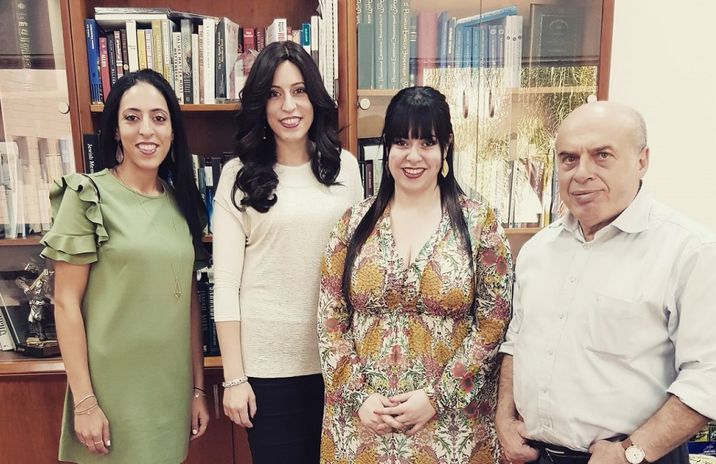
From left to right: sisters Elly Sapper, Nechama Meyer and Dassi Erlich with Jewish Agency Chairman Natan Sharansky in Jerusalem on October 27 2017
 
Australian PM is expected to demand Leifer's extradition during his meeting with Netanyahu

During his official visit to Israel this week, Australian prime minister Malcolm Turnbull will demand justice for three sisters whose alleged serial sexual abuser is living free in the city of Bnei Brak after successfully avoiding extradition by checking herself into psychiatric care on the day of her scheduled court appearances.

For the first time since launching a concerted public campaign last year, Australian woman Dassi Erlich and her two sisters are in Israel to heap pressure on officials to revive the stalled extradition process for former teacher Malka Leifer, wanted by police in the state of Victoria on 74 charges relating to sexual assault.

And Erlich has the growing anger of the Australian community -- Jewish and not -- behind her.
Leifer, an Israeli citizen, fled Australia on a midnight flight in 2008 after allegations surfaced that she had sexually abused more than eight teenage girls, both as students and teachers, at the ultra-Orthodox Adass Israel School in Melbourne.

The extradition process has been moving at a snail's pace for years because court-appointed psychiatrists in Israel say she is too mentally ill to attend an extradition hearing, although she has not been admitted to ongoing care and was photographed this year in attending a raucous Lag B’Omer religious festival in the village of Meron.

The only conditions placed on Leifer by the Jerusalem District Court were that she surrender her passport and attend psychiatric appointments roughly once every four weeks for up to ten years. There are no limits on her contact with young girls, something the sisters say is deeply concerning.

Courtesy  
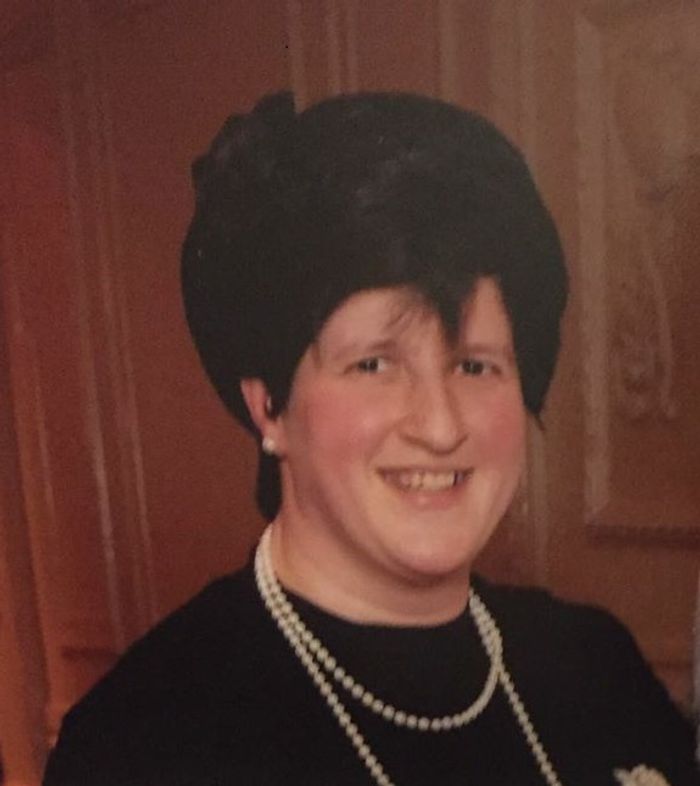
Malka Leifer, a former principal wanted for extradition to Australia on sex abuse charges is pictured here in 2006
 
There is swelling outrage in Australia’s Jewish community and among survivors of sexual abuse over the case, enough that it has begun to taint Jerusalem’s ties with what is seen as one of the most Israel-friendly governments in the world, just as hundreds of Australians descend on the country for the 100th anniversary of the ANZAC campaign in Be'er Sheva.

A delegation of Australian lawmakers is attempting to get a meeting with Minister of Justice Ayelet Shaked next week to hammer home their frustration over the legal process. Israeli prosecutors are understood to share their concerns.

Erlich met last month with Turnbull, who on Monday was asked what he will tell his Israeli counterpart Benjamin Netanyahu about the case during a much-anticipated visit alongside a bevvy of senior Australian political figures and Jewish community leaders.

“What I'll say is that justice demands that she be brought back to Australia to answer the charges,” he told a press conference.

Last week, Dassi and her sisters, Elly Sapper and Nechama Meyer, took their battle to the Knesset, the Jewish Agency, and the state prosecutor in the hope of a breakthrough if they turn the screws on senior Israeli officials.

On Thursday the three women met with Jewish Agency chief Natan Sharansky in Jerusalem ahead of the board of governors meeting this week, which they described as “inspiring and encouraging”.

“He assured us he would raise this issue with the Israeli government, not only for justice but for the safety of Jewish children in Israel and was well on behalf of the Jewish diaspora,” the sisters told i24NEWS.

The meeting was arranged by Mark Leibler, chairman of the Australia/Israel & Jewish Affairs Council (approximate to the Australian version of AIPAC), who earlier this year met with Shaked to press home the Australian Jewish community’s anguish over the stalled legal process. He did not respond to a request for comment on the meeting.
The sit-down with Sharansky came after a session in the Knesset on Wednesday in which the sisters strategized with Israeli lawmakers.

Likud MK Sharren Haskel -- who lived in Australia for several years -- told i24NEWS that “it’s a very big issue for the Jewish community and an important issue for legislators in Australia,” adding that it was frequently brought up in her meetings with legislators during a recent visit to the country.

“I’ve been working in the past few months to make sure that the PMO, the foreign ministry, and the justice ministry are all aware of this situation and are turning the wheels quicker to make sure that this person will get a trial,” she said.

Influential Zionist Union member Meirav Michaeli, who has also met with Dassi on a trip to Australia earlier this year, said it was “inconceivable that a predator -- even though she’s a Jewish ultra-Orthodox woman -- should enjoy an immunity just because the people she allegedly victimized live abroad.”

Supplied  
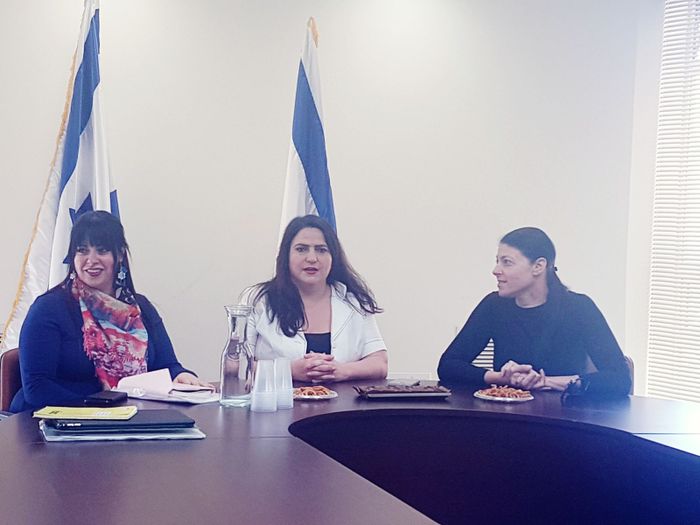
Dassi Erlich (L) meets with Zionist Union lawmakers Michal Biran and Meirav Michaeli in the Knesset on Wednesday October 27, 2017.

 
Michaeli noted that she and Michal Biran, another MK who has taken a strong interest in the Leifer case, have initiated a discussion in the Knesset’s health committee to get "some answers as to the way she’s been playing the mental health issue: turning it on when there’s a hearing and turning it on when she can live her life.”

On Friday Leifer's lawyer, Yehuda Fried, described her condition as "chronic" and said that she is barely able to hold a conversation or leave her home. He added in an interview with Haaretz newspaper that the extradition "will never come."

Leifer’s alleged abuse against at least eight pupils -- victim advocates suspect there are more who are too afraid to come forward -- was described as “destructive and evil” by Victorian Supreme Court Justice Jack Rush QC in his decision to award Erlich $1.27 million Australian dollars (approximately $979,000 USD) in damages after a 2015 civil suit. It was the largest payout to a survivor of sexual abuse in the state’s history.

“Leifer used her position of control, power and authority within the school to manipulate the plaintiff’s sense of vulnerability,” the judge wrote, adding that the motivation was her own “sexual gratification.” Community members in Australia who tried to support victims at the time say they have been subject to threats and intimidation from people connected to the Leifers.

Evidence given in the case -- which was not disputed by the school -- said Leifer targeted girls who struggled with issues at home and carried out abuse in closed rooms at the school, on school camps, and in her private home.

According to the evidence, Leifer would tell the girls during the assaults that she was preparing them for marriage and showing them how to love.

The Adass Israel school is the heart of eastern Melbourne’s insular and strictly observant Adass community, within which mixing of unrelated men and women is tightly controlled, and interaction with the outside community limited.

Dassi lived an ultra-Orthodox lifestyle in Israel for two years in the period before making the decision to seek justice through the courts.

"It feels so weird to be here for this reason, I never imagined coming to Israel for this," she said. "Never in my wild dreams did I imagine coming here for this. It feels so strange that we are here doing this but the level of campaigning had become so big that we feel it was necessary that we come here.”

“When I lived here I was living here as a Haredi (ultra-Orthodox) religious woman, still living a very sheltered life, I never imagined that this is where I would end up.”

http://www.i24news.tv/en/news/israel/israel/158737-171027-sexual-abuse-victims-bring-campaign-for-justice-to-israel?utm_source=SIM&utm_medium=email&utm_campaign=Newsletter_20171102_en&utm_content=&utm_term=

Thursday, November 02, 2017

Pini Landau was a 20-year-old Gerrer Hasid who lived in a yeshiva dormitory in Arad, in which many things that the average western person — secular or religious — finds normal are forbidden. One of these things is a smart phone...


Vicious Child Abuse By Another Name!

The Ger Cult


Hormone suppressants for yeshiva students with smartphones?


Recently, Amnon Levi, the host of Panim Amitiyot (True Faces), did a segment on a young man named Pini Landau, who recently left the Gerrer Hasidim. The segment was called “Castration among Hasidim” (sirus be-hasidut). The story is as simple as it is problematic. Pini Landau was a 20-year-old Gerrer Hasid who lived in a yeshiva dormitory in Arad, in which many things that the average western person — secular or religious — finds normal are forbidden. One of these things is a smart phone. 

According to Pini’s explanation, the assumption is that if a young man has internet access, it is guaranteed that he will use it to watch pornography. Pini had previously been caught with a cellphone, so he was considered a repeat offender. Thus, he was presented with a choice, either to be kicked out of the yeshiva or take medication that would make him stop behaving wickedly. 

Pini was already taking a number of medications: Methylphenidate (for ADHD), Risperidone (an antipsychotic) and Sertraline (an antidepressant), so the idea of taking medication wasn’t particularly frightening to him, and he agreed. The medication that they wanted him to take was Decapeptyl SR (triptorelin), which is a Gonadotropin-releasing hormone agonist (GnRH–A). What that means in simple English is that it is a hormone suppressor. In women, it suppresses estrogen, in men, testosterone.

Hormone Suppressants

The drug has many medical uses for people with different needs. It is used by women going through in vitro fertilization to help control ovulation. It is used to treat prostate cancer (prostate tumors feed on testosterone). It is used to block puberty in children with precocious (=early) puberty and in children with gender-dysphoria (to give them time to mature and think about what they really want). Male-to-female transsexuals take the drug to suppress masculine traits.

It is also given to sex offenders; without testosterone, sexual desire in men plummets to virtually non-existent, so in some states and countries, rapists or pedophiles are offered reduced sentences in exchange for an agreement to take the drug.

In addition to suppressing sexual desire in men, it also brings about a number of body adjustments that give the man female secondary sexual characteristics such as breasts. This is only one of the many unfortunate side effects of the drug, others include osteoporosis, severe weight gain especially in the abdominal area (in medical terms, “increased visceral adiposity”), impaired glucose tolerance, abnormal amounts of lipids in the blood (dyslipidemia), and emotional disturbances. It is counter-indicated for people with depression, and in general, anyone taking the medication has to be seen regularly by a doctor to monitor the side effects and make sure the patient is healthy and safe.
All of the above information is easily found on the internet, to which Pini had no access once they took his smart phone. It is also something that should have been explained to him by his doctor.

A Doctor’s Role

The doctor to whom the yeshiva referred Pini is a psychiatrist in the Haredi community named Michael Bontzel, an American immigrant who has been the physician of choice for the Gerrer community for ten years. Before sitting in his office, Pini was coached by the yeshiva’s powers that be about what to say.

He could not go into a doctor’s office and say that he wanted to take hormone suppressant medication because he bought a smart phone. What could the doctor write in his notes to defend such a thing? So Pini needed to say something along the lines of, “I am haunted by desires that are hurting my quality of life. I just want these thoughts to go away.”

On the face of it, such a request sounds “reasonable.” Perhaps the young man has obsessive tendencies that are torturing him or desires that could lead him to put others in harm’s way. But the doctor could also wonder about the more likely alternative, that this could be a rehearsed and curated cover story that the boy was being forced to recite to get the drugs his teachers and administrators wanted him to take.

What the Doctor Should Have Said

The decision to give a 20-year-old boy a GnRH–A is serious,[1] and the fact that this doctor was so familiar with the Ger community means that he must know the kind of pressures that can be brought to bear on such a boy to stop him from “sinning.”

In my view, he needed to have a candid and private conversation with Pini, and say the following:

Young man, it is, of course, your right to ask for this medication but first we need to clear the air. As this drug will entirely suppress your sexual drive and has painful side effects, including the possible growth of breasts, the loss of bone material, and extreme weight gain, we need to be sure that this treatment is what you need.
The drug is generally used on sex-offenders, people whose desires urge them to do terrible things. Is this what you are going through? Because here is what I am worried about: You are a single, ostensibly celibate twenty-year-old man. Any normal man in your situation has sexual fantasies. Many masturbate or have sexual partners, some even watch pornography or visit prostitutes.
It may be that these behaviors are religiously prohibited in our world, but they are not abnormal, psychologically speaking. And it is very questionable for me as a doctor to prescribe medication that isn’t medically indicated.
Do you want to tell me a little more about what you are going through? Are you really sure that suppressing your sex drive entirely and risking all those side effects is really what you want?

Perhaps at that point, Pini would have told him that he his yeshiva was forcing him to ask for the drug because he bought a smart phone. Perhaps Pini would have withdrawn his request at this point and said that this was too high a price to pay to stay in yeshiva. But the doctor did not give this speech; he merely prescribed the meds and Pini took them and suffered.

Willful Blindness and Legal Cover

The doctor seems to have been willfully blind to the situation. When Pini confronted him in the segment and asked him how he could have prescribed him those meds, the doctor’s response was to repeat in a mantra-like form, “you were twenty years old and legally responsible for your own actions.” Yes, this is likely true in a narrow legal sense, but this sounds more like legal cover than a real response.

In Charles Dickens’ Great Expectations, the main character named Pip needs to speak to his lawyer Mr. Jaggers about his (Jaggers’) client named Abel Magwitch, who had been exiled to Australia but was now illegally back in England.

The moment Pip mentions to Jaggers that he spoke with Magwitch, Jaggers replies that he (Pip) must mean that he corresponded with Magwitch “of New South Wales” Australia, not that he spoke with him, since Magwitch isn’t in England (returning to England after exile being a death penalty offense).
Throughout the conversation, every time Jaggers mentions Magwitch, he adds the phrase “of New South Wales.” He is doing this because he knows full well that Magwitch is in England; Jaggers is overcompensating to cover himself.

To me, Dr. Bontzel’s “you were a legal adult” sounds an awful lot like Magwitch’s “of New South Wales.”

Stopping Medical Abuse of Yeshiva Bachurs

Looking to the future, it is clear that we have a problem in the world of Gerrer Hasidim and perhaps even in more yeshivot. Young men are being medicated as a crutch to help these authority figures control their behavior. According to the segment, Pini’s case is just one example of a pervasive phenomenon that has likely been foisted on hundreds of young men in Pini’s situation for years, maybe even decades.

If it wasn’t obvious to doctors that the vast majority of yeshiva bachurs asking for hormone suppressants are examples of spurious use, forced on these boys by the undue persuasive power of the authority figures in that world, it should be now. And thus, as a society, it is incumbent upon us to stop this “medical abuse,” and doctors need to be extra cautious about yeshiva bachurs showing up asking for hormone suppressants.

No yeshiva should be allowed to pressure young men to medicate themselves as a way of ensuring that these boys comply with the community’s strict religious norms. This is abusive behavior and should be identified as such in our statutes. Moreover, we need to ask ourselves if doctors who are colluding with this behavior, whether for ideological reasons or financial gain, should be allowed to continue practicing medicine here.
[1] On one point, I have a serious quibble with Amnon Levi’s presentation. When he was interviewing Dr. Tzahi ben Tziyon, the doctor explained how the drug works by suppressing testosterone. Dr. Ben Tziyon explained that it was called “chemical castration” once because both procedures shut down testosterone production. Never did he imply that the effects are permanent, like castration. Yet, Amnon Levi kept responding by saying that “so they are essentially castrating him.” I feel that he was being willfully obtuse in order to use a sensationalist term “castration” that brings up the horrible image of permanent loss of libido, impotence, and even sterilization. As Pini complains of loss of libido even eight months after taking the drug, this could be a possible side effect. 

Nevertheless, permanent or even long term loss of libido is certainly not the medical function of the drug or a normal effect of it. And yet, the title of the segment is “Castration among Hasidim.” I worry that the Ger community and its doctors will grab hold of this unfortunate description and call “witch hunt.” It is never good to turn a horrible behavior into a monstrous behavior for rhetorical reasons. It is distracting, and as the Rabbis say “if you grab too much you get nothing” (תפשת מרובה לא תפשת).

http://blogs.timesofisrael.com/hormone-suppressants-for-yeshiva-students-with-smartphones/


Rabbi's Little Helper

Forget 'Big Brother': Psychiatric drugs are frequently administered within the Haredi community at leaders' requests, in order to bring members in line with norms, say sources. 


This is not a reality show. It's a true story that's been going on for years. No one denies it, neither the psychiatrists nor their patients: Psychiatric drugs are being given to ultra-Orthodox yeshiva students, men, seminary girls and married women at the request of rabbis, yeshiva "supervisors" and marriage counselors. The furor that erupted recently after a psychiatrist prescribed pills to participants on the TV reality show "Big Brother" - apparently to help the production and not the patients - convinced some Haredi patients to come forward with prescriptions and documents attesting to a far broader practice.

Haaretz spoke to psychiatrists and others knowledgeable about psychiatric treatment in the Haredi community, and collected testimonies from half-a-dozen patients and their families. 

About half of them are Haredi and the others have left the community. Each told a different story, mentioning the names of senior psychiatrists, rabbis and community functionaries.
Psychiatric drugs are rife in Israel's ultra-Orthodox community, sources say,


Psychiatric drugs are rife in Israel's ultra-Orthodox community, sources say.


READ IT ALL:
https://www.haaretz.com/israel-news/rabbi-s-little-helper-1.422985

Wednesday, November 01, 2017

Isaak Goldschmidt, 49, abused boys and girls, aged eight to 14 years old, for 11 years between 2003 and 2014.

Jewish man jailed for eight years over child sex assaults


A female victim also told police officers he had beaten her with “various weapons” including a walking stick and a belt

Isaak Goldschmidt was jailed for more than eight years
Isaak Goldschmidt was jailed for more than eight years 
 

A Manchester Jewish man has been jailed for a series of “sickening” sexual and physical assaults against children.

Isaak Goldschmidt, from Castlefield Avenue, in Salford, was sentenced to eight years and three months in jail at Manchester Crown Court today.

Goldschmidt, 49, abused boys and girls, aged eight to 14 years old, for 11 years between 2003 and 2014.

A female victim also told police officers he had beaten her with “various weapons” including a walking stick and a belt.

Goldschmidt was convicted of three counts of sexual assault of a boy; four counts of sexual assault of a girl; three counts of sexual activity with a girl under 16; four counts of causing or inciting a girl under the age of 13 to engage in sexual activity; three counts of causing or inciting a girl under the age of 16 to engage in sexual activity; and one count of child cruelty.

He admitted each count.

An investigation was launched in March last year after police received information that Goldschmidt had sexually and physically assaulted two young people over a number of years.

Detective Chief Inspector Alan Clitherow of Greater Manchester Police’s Salford borough, said: “The persistence Goldschmidt has shown in carrying out his crimes, undiscovered for a number of years, is truly sickening.

“It is only down to the courageous decisions the victims in this case have made that we have been able to remove him from society and do everything we can to protect and support them.

“I’d like today’s result to send a message to those who are victims of abuse that it does not matter when or where abuse happened or by whom.

“We treat every report with the utmost severity to ensure the right people are behind bars and their victims are freed from the shackles of their crimes.”

Det Ch Insp Clitherow told the JC that the police had received a “flurry of information” after the investigation and conviction of Todros Grynhaus, a member of Salford’s Charedi community who was jailed for more than 13 years in 2015 for molesting two teenage girls.

David Glausiusz was jailed for 22 years in April 2017 for sexual abuse and beatings against children as young as seven, while another man, Daniel Golomb, 44, will appear at Manchester Crown Court after denying 12 counts of indecent assault on an underage boy.

A wider investigation into abuse in the Manchester Jewish community, Operation Parachute, was opened in the wake of Grynhaus’ trial.

Information can be reported to Greater Manchester Police on 101, or alternatively people can refer themselves to St Mary's Sexual Assault Referral Centre on 0161 276 6515, whether or not victims wish make a police report.

https://www.thejc.com/news/uk-news/jewish-man-jailed-for-eight-years-over-child-sex-assaults-1.446949


Tuesday, October 31, 2017

For The First Time Ever, An Entire Edition Of A Torah Publication Devoted Entirely To The Issue Of Child Sex Abuse In The Orthodox Jewish Community...

Magazine Cover Photoshopped - Courtesy a UOJ  Groupie

Standing idly by: when leaders enable sexual abuse by Dr. Erica Brown....and other important reads.


 READ AND DOWNLOAD ENTIRE ISSUE FOR FREE:
http://www.pdf-archive.com/2017/10/30/tradition/tradition.pdf