EVERY SIGNATURE MATTERS - THIS BILL MUST PASS!

EVERY SIGNATURE MATTERS - THIS BILL MUST PASS!
CLICK - GOAL - 100,000 NEW SIGNATURES! 75,000 SIGNATURES HAVE ALREADY BEEN SUBMITTED TO GOVERNOR CUOMO!

EFF Urges Court to Block Dragnet Subpoenas Targeting Online Commenters

EFF Urges Court to Block Dragnet Subpoenas Targeting Online Commenters
CLICK! For the full motion to quash: http://www.eff.org/files/filenode/hersh_v_cohen/UOJ-motiontoquashmemo.pdf

Wednesday, July 18, 2018

The Audacity of a Dope... I despise Obama but he is giving Obama too much credit...

Trump accuses Obama of rigging Russia investigation


The president also praised Putin and told Hannity that the Mueller probe is hurting U.S.-Russia relations.


President Trump accused his predecessor, President Obama, of rigging the ongoing Russia investigation against him and instructing an FBI agent to carry out the task, during an interview with Fox News’ Sean Hannity Monday night.

FBI agent Peter Strzok, a former member of Special Counsel Robert Mueller’s Russia investigation team, has long been a target of conservatives, who claim his previous anti-Trump texts to a colleague with whom he was having an affair prove the Russia investigation is nothing more than a political witch-hunt. Trump has repeatedly echoed those claims, suggesting Strzok wanted to prevent him from winning the presidency and that the investigation is baseless, despite the numerous indictments Mueller’s team has handed down over the past year.

On Monday night, following his diplomatic summit with Russian President Vladimir Putin in Helsinki, Finland, Trump took things a step further by implying his predecessor had directly ordered Strzok to rig the investigation against him.

After calling Strzok “a disgrace to our country,” Trump added, “You have to find out — who did Peter Strzok report to? Because it was James Comey and it was (former FBI Deputy Director Andrew) McCabe, but it was also probably Obama. If you think that Obama didn’t know what was going on….”


Trump offered no evidence to back that claim, appearing to make it up on the spot.

Trump previously accused Obama of spying on him, suggesting in March last year that the former president had wiretapped his offices in Trump Tower during the 2016 election — a claim that was later debunked by the Justice Department.

Trump had kinder words for Putin, who he praised as “very, very strong.” He then paraphrased Putin’s comments describing Mueller’s investigation as a “phony witch hunt,” saying the Russian president had told him it was preventing them from striking any deals, such as the “safety of nuclear.”

“President Putin said, one of the early things he said when we started, he said it’s really a shame because we could do so much good, whether it is humanitarian aid throughout the Middle East, whether it’s not just Syria, so many different things. The safety of nuclear, which ultimately, there is nothing bigger and more important,” he said. “And they drove a phony wedge, just a phony witch hunt, a rigged deal with guys like Peter Strzok and Comey and McCabe. The whole group. And you can imagine who else. It’s a real shame.”

Trump also said Putin was angry to hear about salacious allegations from the Steele dossier, which Russia’s president claimed were not true.

“It makes him angry when he sees it,” he said. “You know it’s very interesting — you look at what’s happening, you look at what — that whole thing. He understood it. And he was — I don’t know if you could see it — he was incensed even talking about it.”

Trump seized the moment to once again publicize Putin’s offer to help “analyze” U.S. intelligence on 12 GRU officers — Russian military intelligence — who Mueller indicted Friday for their alleged roles in hacking the DNC and DCCC servers, as well as the email accounts of Hillary Clinton campaign staffers.

“He’s willing to take those 12 people, there is no extradition,” Trump said. “But he is willing to let Robert Mueller’s people go over there and bring a big investigation of those people, working together with the Russian investigators.”

Monday’s interview was recorded shortly after Trump’s disastrous joint press conference with the Russian leader, who the U.S. intelligence community has “assessed with high confidence” directed a covert attack on the 2016 American election to help Trump.

Despite the intelligence community’s assessment, Trump has continued to downplay the threat Russia and Putin pose, choosing instead to paint his friendly relationship with the autocratic leader as diplomatic bridge-building.

https://thinkprogress.org/donald-trump-sean-hannity-fox-news-vladimir-putin-barack-obama-robert-mueller-64c19150ed79/?utm_source=newsletter&utm_medium=email&utm_campaign=tp-letters

 I agree with Tom Friedman entirely on his take on Trump:


From the beginning of his administration, President Trump has responded to every new bit of evidence from the C.I.A., F.B.I. and N.S.A. that Russia intervened in our last election on his behalf by either attacking Barack Obama or the Democrats for being too lax — never President Vladimir Putin of Russia for his unprecedented cyberhit on our democratic process. Such behavior by an American president is so perverse, so contrary to American interests and values, that it leads to only one conclusion: Donald Trump is either an asset of Russian intelligence or really enjoys playing one on TV.

Everything that happened in Helsinki today only reinforces that conclusion. My fellow Americans, we are in trouble and we have some big decisions to make today. This was a historic moment in the entire history of the United States.

There is overwhelming evidence that our president, for the first time in our history, is deliberately or through gross negligence or because of his own twisted personality engaged in treasonous behavior — behavior that violates his oath of office to “preserve, protect and defend the Constitution of the United States.”

Trump vacated that oath today, and Republicans can no longer run and hide from that fact. Every single Republican lawmaker will be — and should be — asked on the election trail: Are you with Trump and Putin or are you with the C.I.A., F.B.I. and N.S.A.?


It started with the shocking tweet that Trump issued before he even sat down with Putin this morning: “Our relationship with Russia has NEVER been worse thanks to many years of U.S. foolishness and stupidity and now, the Rigged Witch Hunt!” The official Twitter account of the Russian foreign ministry — recognizing a useful idiot when it saw one — immediately “liked” Trump’s tweet and later added: “We agree.”

I’ll bet they do.

It only got worse when, in his joint news conference with Putin, Trump was asked explicitly if he believed the conclusion of his intelligence agencies that Russia hacked our elections. The president of the United States basically threw his entire intelligence establishment under a bus, while throwing out a cloud of dust about Hillary Clinton’s server to disguise what he was doing.

Trump actually said on the question of who hacked our election, “I don’t see any reason why it would be” Russia. And in a bit of shocking moral equivalence, Trump added of the United States and Russia: “We are all to blame … both made some mistakes.” Trump said that it was actually the American probe into the Russian hacking that has “kept us apart.”

To watch an American president dis his own intelligence agencies, blame both sides for the Russian hacking of our election — and deliberately try to confuse the fact that there is still no solid proof of collusion between the Trump campaign and Russia with the fact that Russia had its own interest in trying to defeat the anti-Putin Hillary Clinton — actually made me sick to my stomach. I completely endorse the former C.I.A. director John O. Brennan’s tweet after the news conference:

“Donald Trump’s press conference performance in Helsinki rises to & exceeds the threshold of ‘high crimes & misdemeanors.’ It was nothing short of treasonous. Not only were Trump’s comments imbecilic, he is wholly in the pocket of Putin. Republican Patriots: Where are you???”

Trump is simply insanely obsessed with what happened in the last election. But now he is president, and the fact that he may not have colluded with the Russians doesn’t mean he does not, as president, have a responsibility to ensure that the Russians be punished for interfering in our last election on their own and be effectively deterred from doing so in the future. That is in his job description.

Listening to Trump, it was as if Franklin Roosevelt had announced after Pearl Harbor: “Hey, both sides are to blame. Our battleships in Hawaii were a little provocative to Japan — and, by the way, I had nothing to do with the causes for their attack. So cool it.”

There is only one message Trump should have sent Putin in this meeting today: “You have attacked our democracy, as well as two core pillars of the global economic and security order that have kept the peace and promoted prosperity since World War II — the European Union and NATO. We are not interested in any of your poker-faced denials. Just know that if you keep doing it, we will consider it an act of war and we will not only sanction you like never before, but you’ll taste every cyberweapon we have in our arsenal — and some of your most intimate personal secrets will appear on the front pages of every newspaper in the world. Is there any part of that sentence you do not understand?

“So we will be watching you between now and our midterm elections,” Trump should have added. “I’m sure you know the date. If you behave well, we’ll talk again in December 2018 about anything you want — Ukraine, Syria, Crimea or arms control. Until then our C.I.A. and N.S.A. are on to you and your cyberspooks. And Vlad, as you may have noticed from my Justice Department’s recent indictment of 12 of your agents, you are not as good as you think.”

That is what a real American president, sworn to protect and defend the Constitution, would have said to Putin today. He would have understood that this meeting had only one agenda item — and it was not developing an “extraordinary” relationship.

It was d-e-t-e-r-r-e-n-c-e — deterrence of a Russia that has been increasingly reckless and destabilizing.


In the past few years what has Putin done to deserve an American president sucking up to him for an “extraordinary” relationship? Putin has seized Crimea, covertly invaded Ukraine, provided the missiles that shot down a civilian Malaysian airliner over Ukraine, bombed tens of thousands of refugees out of Syria into Europe, destabilizing Europe, been involved in the death of a British woman who accidentally handled a Russian nerve agent deployed to kill ex-Russian agents in England and deployed misinformation to help tip the vote in Britain toward exiting and fracturing the European Union.

Most of all, Putin unleashed a cyberattack on America’s electoral process, aimed at both electing Trump — with or without Trump’s collusion — and sowing division among American citizens.
Our intelligence agencies have no doubt about this: Last week, America’s director of national intelligence, Dan Coats, described Putin’s cybercampaign as one designed “to exploit America’s openness in order to undermine our long-term competitive advantage.” Coats added that America’s digital infrastructure “is literally under attack,” adding that there was “no question” that Russia was the “most aggressive foreign actor.”

I am not given to conspiracy theories, but I cannot help wondering if the first thing Trump said to Putin in their private one-on-one meeting in Helsinki, before their aides were allowed to enter, was actually: “Vladimir, we’re still good, right? You and me, we’re still good?”

And that Putin answered: “Donald, you have nothing to worry about. Just keep being yourself. We’re still good.”

https://www.nytimes.com/2018/07/16/opinion/trump-and-putin-vs-america.html?action=click&pgtype=Homepage&clickSource=story-heading&module=opinion-c-col-left-region&region=opinion-c-col-left-region&WT.nav=opinion-c-col-left-region

Tuesday, July 17, 2018

Leifer’s story is just a part of a much broader problem in the community that is being hushed up by leaders. “It’s Sodom and Gomorrah in Emmanuel,” he said. “Child abuse, pedophilia… it’s rampant.”

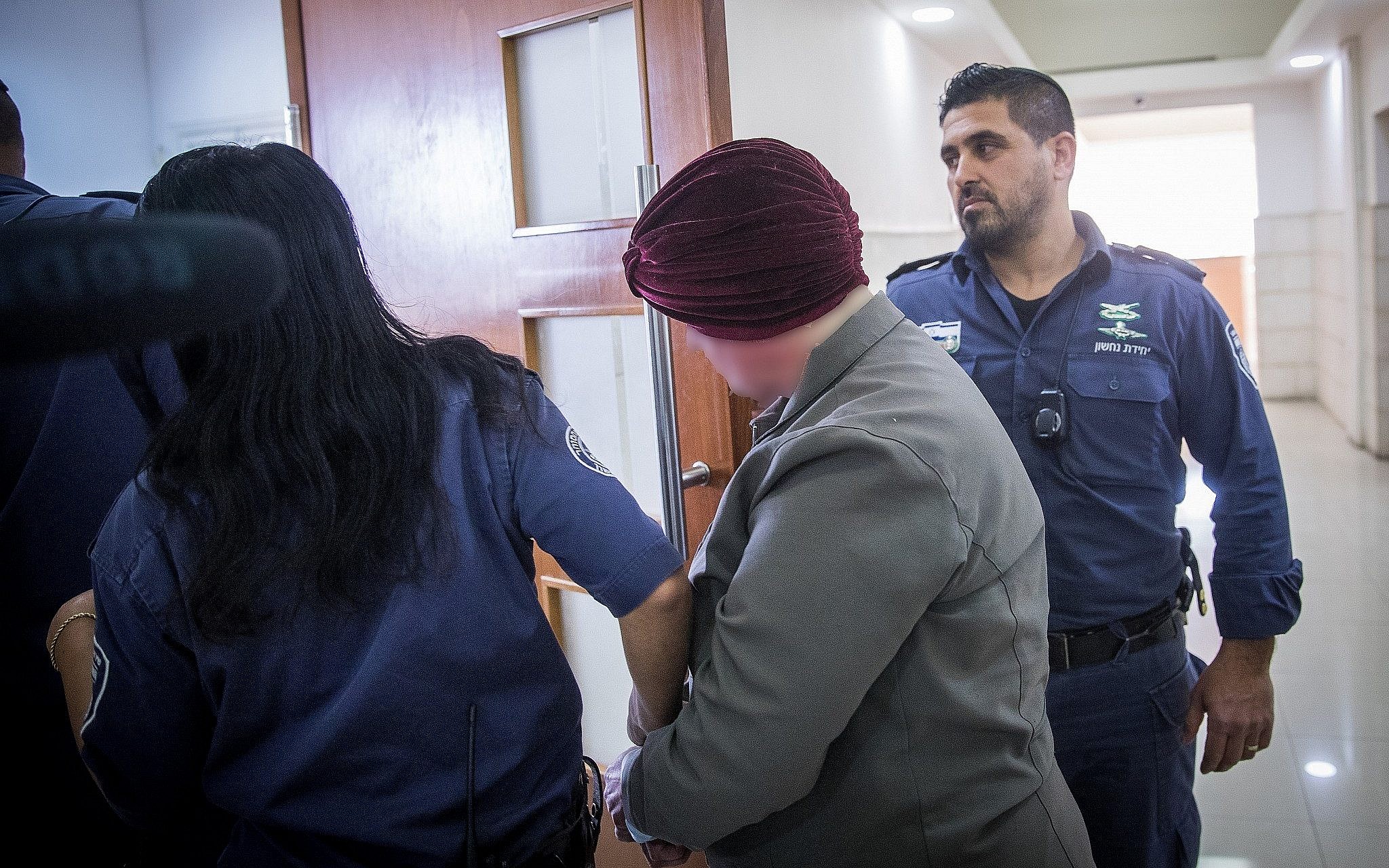
Woman wanted for abuse in Australia accused of molesting Israeli girl


Resident of Emmanuel, where ultra-Orthodox former school principal Malka Leifer resided, claims she behaved inappropriately with his daughter


Former Australian principal Malka Leifer, who wanted in her home country for child sex abuse crimes is seen at the Jerusalem District Court on February 14, 2018. (Yonatan Sindel/Flash90)
Former Australian principal Malka Leifer, who wanted in her home country for child sex abuse crimes is seen at the Jerusalem District Court on February 14, 2018

A school principal facing extradition from Israel to Australia over allegations she molested schoolchildren has been accused of continuing to sexually assault children while in Israel.

Although Malka Leifer has not been formally accused of a sex crime in Israel, one man claims she molested his daughter and cautions that she has been privately tutoring other children in the ultra-Orthodox West Bank settlement of Emmanuel, where she has been living.

In a story published by the Sydney Morning Herald on Sunday, the father, identified only as Daniel, further claimed that Leifer’s husband had admitted to him that she “likes to touch” because she is “loving,” but that even he is wary of leaving her alone with children.
Leifer, an Israeli citizen, left Australia for Israel in 2008 shortly after molestation accusations against her surfaced, skipped several extradition hearings in Israel because she had committed herself into psychiatric institutions for short periods coinciding with the court dates. She is wanted for questioning in Australia in connection with 74 instances of molestation, including rape, of several teenage girls at the Adass school in Melbourne. Many of the alleged crimes were committed during private tutoring sessions with the girls.

Australian authorities first filed a request for her extradition in 2014. Leifer, was arrested in the country at the time but later released to house arrest.

In 2016 she, her husband, and their 10 children went to live in Emmanuel.


Ultra-Orthodox Jews at a bus stop in the Emmanuel settlement in the West Bank

Daniel, an Emmanuel resident, said that at the time, residents of the community knew nothing of Leifer’s past or the accusations against her.

Shortly after arriving in the settlement, the former principal offered to tutor Daniel’s daughter Sarah in religious studies. he said. The report did not say how old the girl was at the time.
Sarah later told her father that Leifer had pulled at her clothes, pulling down her skirt and “started to touch” her.

“Her childhood was over from that moment,” he said.

Concerned over what his daughter had told him, Daniel said he hired a private investigator to watch the woman as she visited other children in their homes and lured “troubled, disadvantaged kids” into her own home by offering them food and free tutoring.

Widespread deprivation in the community made the offer of something to eat effective bait, Daniel noted.

“There is a lot of poverty, with families struggling to buy food,” he said.

On one occasion Daniel claims he saw Leifer “grab this young-looking blonde girl, pushing her, grabbing her boobs and ass. She was all over her, crazy-like.”

Daniel claimed that he spoke to Leifer’s husband about the alleged assaults.

“I asked him about his ‘handsy’ wife,” he said of her husband. “He said, ‘She likes to touch but that’s all she does, because she’s a loving person… but we did try not to leave her alone with kids.’”

Despite his complaints, Leifer would continue to send her son to their home with instructions to bring Daniel’s daughter for more sessions, the father said.

His daughter has since moved to a boarding school in the nearby town of Petah Tikva, he said.

Daniel began researching the former principal, who had been living in Israel with no restrictions on her freedom, and discovered her past and the accusations in Australia. He blasted Emmanuel community leaders for allowing the woman to live freely among residents, accusing them of not doing enough to protect children from.

“She carried on molesting children here after she was freed!” he told the newspaper. “They let her return here, to my home. To my town!”


The report described a tightly closed community living under the rule of ultra-Orthodox leaders who prefer to suppress reports of child abuse rather than involve authorities and deal with the unwanted attention.

“The issue became well known here in Emmanuel,” one resident was quoted as saying, “but it was comfortable for [her] to manage her life here because it’s a small town where nobody looks for trouble.”

Local residents said that community leaders were well aware of Leifer’s past but had failed to deal with the matter.

“They definitely knew she did what she’s been accused of, that’s why they told her not to teach young girls, and at the beginning, she obeyed those demands, things started to blow up after she volunteered to teach [Daniel’s daughter],” one source was quoted as saying.

The woman’s defense lawyer Yehuda Fried declined to comment on the accusations, saying that unless charges were filed he had no response to give, according to the report.

Daniel claimed that Leifer’s story is just a part of a much broader problem in the community that is being hushed up by leaders.

“It’s Sodom and Gomorrah in Emmanuel,” he said. “Child abuse, pedophilia… it’s rampant.”

The father vowed to campaign until the community addressed the issue.

“The Catholics went through the exposé of such crimes,” he said. “Now it’s our turn to address the big problem.”


Monday, July 16, 2018

So to discover whether there actually is or is not something beyond this anxious, guilty, fearful, competitive existence, it seems to me that one must have a completely different approach altogether.

Freedom From the Known

Man has throughout the ages been seeking something beyond himself, beyond material welfare – something we call truth or reality, a timeless state – something that cannot be disturbed by circumstances, by thought or by human corruption.

Man has always asked the question: what is it all about? Has life any meaning at all? He sees the enormous confusion of life, the brutalities, the revolt, the wars, the endless divisions of religion, ideology and nationality, and with a sense of deep abiding frustration he asks, what is one to do, what is this thing we call living, is there anything beyond it?

In this constant battle which we call living, we try to set a code of conduct according to the society in which we are brought up, whether it be a Communist society or a so-called free society; we accept a standard of behaviour as part of our tradition or whatever we happen to be.

 We look to someone to tell us what is right or wrong behaviour, what is right or wrong thought, and in following this pattern our conduct and our thinking become mechanical, our responses automatic. We can observe this very easily in ourselves.

We Have Been Spoon-Fed by Our Teachers

For centuries we have been spoon-fed by our teachers, by our authorities, by our books, our saints. We say, `Tell me all about it – what lies beyond the hills and the mountains and the earth?’ and we are satisfied with their descriptions, which means that we live on words and our life is shallow and empty. We are second-hand people. We have lived on what we have been told, either guided by our inclinations, our tendencies, or compelled to accept by circumstances and environment. We are the result of all kinds of influences and there is nothing new in us, nothing that we have discovered for ourselves; nothing original, pristine, clear.

Throughout theological history we have been assured by religious leaders that if we perform certain rituals, repeat certain prayers or mantras, conform to certain patterns, suppress our desires, control our thoughts, sublimate our passions, limit our appetites, we shall, after sufficient torture of the mind and body, find something beyond this little life. And that is what millions of so-called religious people have done through the ages, either in isolation, going off into the desert or into the mountains or a cave or wandering from village to village with a begging bowl, or, in a group, joining a monastery, forcing their minds to conform to an established pattern. But a tortured mind, a broken mind, a mind which wants to escape from all turmoil, which has denied the outer world and been made dull through discipline and conformity – such a mind, however long it seeks, will find only according to its own distortion.

So to discover whether there actually is or is not something beyond this anxious, guilty, fearful, competitive existence, it seems to me that one must have a completely different approach altogether. The traditional approach is from the periphery inwards, and through time, practice and renunciation, gradually to come upon that inner flower, that inner beauty and love – in fact to do everything to make oneself narrow, petty and shoddy; peel off little by little; take time; tomorrow will do, next life will do – and when at last one comes to the centre one finds there is nothing there, because one’s mind has been made incapable, dull and insensitive.

Having observed this process, one asks oneself, is there not a different approach altogether – that is, is it not possible to explode from the centre?

The First Step is to Reject the Traditional Approach

The world accepts and follows the traditional approach. The primary cause of disorder in ourselves is the seeking of reality promised by another; we mechanically follow somebody who will assure us a comfortable spiritual life. It is a most extraordinary thing that although most of us are opposed to political tyranny and dictatorship, we inwardly accept the authority, the tyranny, of another to twist our minds and our way of life. A respectable human being cannot possibly come near to that infinite, immeasurable, reality.

You have now started by denying something absolutely false – the traditional approach – but if you deny it as a reaction you will have created another pattern in which you will be trapped; if you tell yourself intellectually that this denial is a very good idea but do nothing about it, you cannot go any further.

 If you deny it however, because you understand the stupidity and immaturity of it, if you reject it with tremendous intelligence, because you are free and not frightened, you will create a great disturbance in yourself and around you but you will step out of the trap of respectability. Then you will find that you are no longer seeking. That is the first thing to learn – not to seek. When you seek you are really only window-shopping.

The question of whether or not there is truth or reality, or whatever you like to call it, can never be answered by books, by priests, philosophers or saviours. Nobody and nothing can answer the question but you yourself and that is why you must know yourself. Immaturity lies only in total ignorance of self. To understand yourself is the beginning of wisdom.

And what is yourself, the individual you? I think there is a difference between the human being and the individual. The individual is a local entity, living in a particular country, belonging to a particular culture, particular society, particular religion. The human being is not a local entity. He is everywhere. If the individual merely acts in a particular corner of the vast field of life, then his action is totally unrelated to the whole. So one has to bear in mind that we are talking of the whole not the part, because in the greater the lesser is, but in the lesser the greater is not. The individual is the little conditioned, miserable, frustrated entity, satisfied with his little gods and his little traditions, whereas a human being is concerned with the total welfare, the total misery and total confusion of the world.

We human beings are what we have been  —  colossally greedy, envious, aggressive, jealous, anxious and despairing, with occasional flashes of joy and affection. We are a strange mixture of hate, fear and gentleness; we are both violence and peace. There has been outward progress from the bullock cart to the jet plane but psychologically the individual has not changed at all, and the structure of society throughout the world has been created by individuals. The outward social structure is the result of the inward psychological structure of our human relationships, for the individual is the result of the total experience, knowledge and conduct of man. Each one of us is the storehouse of all the past. The individual is the human who is all mankind. The whole history of man is written in ourselves.

Observe What is Taking Place Within and Outside Yourself

Do observe what is actually taking place within yourself and outside yourself in the competitive culture in which you live with its desire for power, position, prestige, name, success and all the rest of it – observe the achievements of which you are so proud, this whole field you call living in which there is conflict in every form of relationship, breeding hatred, antagonism, brutality and endless wars. This field, this life, is all we know, and being unable to understand the enormous battle of existence we are naturally afraid of it and find escape from it in all sorts of subtle ways. And we are frightened also of the unknown – frightened of death, frightened of what lies beyond tomorrow. So we are afraid of the known and afraid of the unknown. That is our daily life and in that there is no hope, and therefore every form of philosophy, every form of theological concept, is merely an escape from the actual reality of what is.

All outward forms of change brought about by wars, revolutions, reformations, laws and ideologies have failed completely to change the basic nature of man and therefore of society. As human beings living in this monstrously ugly world, let us ask ourselves, can this society, based on competition, brutality and fear, come to an end? Not as an intellectual conception, not as a hope, but as an actual fact, so that the mind is made fresh, new and innocent and can bring about a different world altogether? It can only happen, I think, if each one of us recognises the central fact that we, as individuals, as human beings, in whatever part of the world we happen to live or whatever culture we happen to belong to, are totally responsible for the whole state of the world.

We are each one of us responsible for every war because of the aggressiveness of our own lives, because of our nationalism, our selfishness, our gods, our prejudices, our ideals, all of which divide us. And only when we realize, not intellectually but actually, as actually as we would recognise that we are hungry or in pain, that you and I are responsible for all this existing chaos, for all the misery throughout the entire world because we have contributed to it in our daily lives and are part of this monstrous society with its wars, divisions, its ugliness, brutality and greed – only then will we act.
But what can a human being do – what can you and I do – to create a completely different society? We are asking ourselves a very serious question. Is there anything to be done at all? What can we do?

Will somebody tell us? People have told us. The so-called spiritual leaders, who are supposed to understand these things better than we do, have told us by trying to twist and mould us into a new pattern, and that hasn’t led us very far; sophisticated and learned men have told us and that has led us no further. We have been told that all paths lead to truth – you have your path  and they all meet at the same door – which is, when you look at it, so obviously absurd. Truth has no path, and that is the beauty of truth, it is living. A dead thing has a path to it because it is static, but when you see that truth is something living, moving, which has no resting place, which is in no temple, mosque or church, which no religion, no teacher, no philosopher, nobody can lead you to – then you will also see that this living thing is what you actually are – your anger, your brutality, your violence, your despair, the agony and sorrow you live in. In the understanding of all this is the truth, and you can understand it only if you know how to look at those things in your life. And you cannot look through an ideology, through a screen of words, through hopes and fears.


There is No Guide, Teacher or Authority

So you see that you cannot depend upon anybody. There is no guide, no teacher, no authority. There is only you – your relationship with others and with the world – there is nothing else. When you realize this, it either brings great despair, from which comes cynicism and bitterness, or, in facing the fact that you and nobody else is responsible for the world and for yourself, for what you think, what you feel, how you act, all self-pity goes. Normally we thrive on blaming others, which is a form of self-pity.

Can you and I, then, bring about in ourselves without any outside influence, without any persuasion, without any fear of punishment – can we bring about in the very essence of our being a total revolution, a psychological mutation, so that we are no longer brutal, violent, competitive, anxious, fearful, greedy, envious and all the rest of the manifestations of our nature which have built up the rotten society in which we live our daily lives?

It is important to understand from the very beginning that I am not formulating any philosophy or any theological structure of ideas or theological concepts. It seems to me that all ideologies are utterly idiotic. What is important is not a philosophy of life but to observe what is actually taking place in our daily life, inwardly and outwardly. If you observe very closely what is taking place and examine it, you will see that it is based on an intellectual conception, and the intellect is not the whole field of existence; it is a fragment, and a fragment, however cleverly put together, however ancient and traditional, is still a small part of existence whereas we have to deal with the totality of life. And when we look at what is taking place in the world we begin to understand that there is no outer and inner process; there is only one unitary process, it is a whole, total movement, the inner movement expressing itself as the outer and the outer reacting again on the inner. To be able to look at this seems to me all that is needed, because if we know how to look, then the whole thing becomes very clear, and to look needs no philosophy, no teacher. Nobody need tell you how to look. You just look.

Can you then, seeing this whole picture, seeing it not verbally but actually, can you easily, spontaneously, transform yourself? That is the real issue. Is it possible to bring about a complete revolution in the psyche?

I wonder what your reaction is to such a question? You may say, `I don’t want to change’, and most people don’t, especially those who are fairly secure socially and economically or who hold dogmatic beliefs and are content to accept themselves and things as they are or in a slightly modified form.

With those people we are not concerned. Or you may say more subtly, `Well, it’s too difficult, it’s not for me’, in which case you will have already blocked yourself, you will have ceased to enquire and it will be no use going any further. Or else you may say, `I see the necessity for a fundamental inward change in myself but how am I to bring it about? Please show me the way, help me towards it.’ If you say that, then what you are concerned with is not change itself; you are not really interested in a fundamental revolution: you are merely searching for a method, a system, to bring about change.

You Won’t Find a System Within These Words

If I were foolish enough to give you a system and if you were foolish enough to follow it, you would merely be copying, imitating, conforming, accepting, and when you do that you have set up in yourself the authority of another and hence there is conflict between you and that authority. You feel you must do such and such a thing because you have been told to do it and yet you are incapable of doing it. You have your own particular inclinations, tendencies and pressures which conflict with the system you think you ought to follow and therefore there is a contradiction. So you will lead a double life between the ideology of the system and the actuality of your daily existence. In trying to conform to the ideology, you suppress yourself – whereas what is actually true is not the ideology but what you are. If you try to study yourself according to another you will always remain a second-hand human being.

A man who says, `I want to change, tell me how to’, seems very earnest, very serious, but he is not. He wants an authority whom he hopes will bring about order in himself. But can authority ever bring about inward order? Order imposed from without must always breed disorder.

You may see the truth of this intellectually but can you actually apply it so that your mind no longer projects any authority, the authority of a book, a teacher, a wife or husband, a parent, a friend or of society? Because we have always functioned within the pattern of a formula, the formula becomes the ideology and the authority; but the moment you really see that the question, `How can I change?’ sets up a new authority, you have finished with authority for ever.

First of all, can you reject all authority? If you can it means that you are no longer afraid. Then what happens? When you reject something false which you have been carrying about with you for generations, when you throw off a burden of any kind, what takes place? You have more energy, haven’t you? You have more capacity, more drive, greater intensity and vitality. If you do not feel this, then you have not thrown off the burden, you have not discarded the dead weight of authority.

Activating Your Life Force Begins Now

But when you have thrown it off and have this energy in which there is no fear at all — no fear of making a mistake, no fear of doing right or wrong — then is not that energy itself the mutation? We need a tremendous amount of energy and we dissipate it through fear but when there is this energy which comes from throwing off every form of fear, that energy itself produces the radical inward revolution. You do not have to do a thing about it.

So you are left with yourself, and that is the actual state for a man to be who is very serious about all this; and as you are no longer looking to anybody or anything for help, you are already free to discover. And when there is freedom, there is energy; and when there is freedom it can never do anything wrong. Freedom is entirely different from revolt. There is no such thing as doing right or wrong when there is freedom. You are free and from that centre you act. And hence there is no fear, and a mind that has no fear is capable of great love. And when there is love it can do what it will.

What we are now going to do, therefore, is to learn about ourselves, not according to me or to some analyst or philosopher – because if we learn about ourselves according to someone else, we learn about them, not ourselves – we are going to learn what we actually are.

Having realized that we can depend on no outside authority in bringing about a total revolution within the structure of our own psyche, there is the immensely greater difficulty of rejecting our own inward authority, the authority of our own particular little experiences and accumulated opinions, knowledge, ideas and ideals. You had an experience yesterday which taught you something and what it taught you becomes a new authority – and that authority of yesterday is as destructive as the authority of a thousand years. To understand ourselves needs no authority either of yesterday or of a thousand years because we are living things, always moving, flowing, never resting. When we look at ourselves with the dead authority of yesterday, we will fail to understand the living movement and the beauty and quality of that movement.

To be free of all authority, of your own and that of another, is to die to everything of yesterday, so that your mind is always fresh, always young, innocent, full of vigour and passion. It is only in that state that one learns and observes. And for this a great deal of awareness is required, actual awareness of what is going on inside yourself, without correcting it or telling it what it should or should not be, because the moment you correct it you have established another authority, a censor.

https://ideapod.com/philosopher-made-reassess-everything-ive-told-life/?utm_medium=email&utm_source=ideapod&utm_campaign=broadcast


Friday, June 29, 2018

Rabbi Shraga Feivel Mendlowitz's Legacy of Genius and Vision Had No Precedent - Nor Will It Ever Be Replicated!


Rabbi Shraga Feivel Mendlowitz  ZTVK"L


From Artscroll's Reb Shraga Feivel: The Life and Times of Rabbi Shraga Feivel Mendlowitz, the Architect of Torah in America, pp. 331-332, 335-336,

On Friday, November 29, 1947, the United Nations debated the issue of partitioning the British Mandate for Palestine into two countries, one Arab and one Jewish. Reb Shraga Feivel prayed fervently for partition. He had no radio in his house, but that Friday he borrowed one and set it to the news, leaving it on for Shabbos. He waited with such tense anticipation to hear the outcome of the U.N. vote that he did not come to shalosh seudos. When he heard the U.N.'s decision to establish a Jewish state, he stood up and recited the blessing - BARUCH HATOV V'HAMATEV - Who is good and Who does good...[3]

Four days after the United Nations vote, on 19 Kislev, Reb Shraga Feivel spoke in Bais Medrash Elyon, to present his talmidim with a Torah perspective on the event. He began by emphasizing that in the absence of prophecy no one could interpret the U.N. declaration with any certitude.[7] Nevertheless the whole tenor of his remarks reflected his hope that the moment was a positive one for the Jewish people.[8] He described three aspects of the final redemption: the redemption of the Land, the ingathering of the exiles, and the return of the Divine Presence to her proper place. The redemption of the Land is the first of the three...

In a similar vein, he also explained why the secular Zionists might have been chosen to play such a fateful role in the history of the Jewish people... Divine Providence might have arranged that the secular Zionists play a major role in the redemption of Eretz Yisrael precisely in order to maintain their connection to Klal Yisrael.

In a conversation with the Satmar Rav, shortly after his talk on the U.N. declaration, Reb Shraga Feivel was subjected to the sharpest criticism for his "Zionist leanings." Later he told his family, "I could have answered him Chazal for Chazal, Midrash for Midrash, but I did not want to incur his wrath, for he is a great man and a tzaddik." He added with a twinkle, "And besides, he has a fiery temper"..
.
[3] In 1948, after the Arabs attacked the newly declared Jewish state and soldiers were falling on the battlefield, several roshei yeshiva taunted Reb Shraga Feivel for having recited the blessing. Reb Shraga Feivel turned to Rabbi Aharon Kotler, who agreed with him that the favorable U.N. resolution was indeed worthy of the blessing. Rabbi Nesanel Quinn.

Reading further in the biography, we see some of Reb Shraga Feivel's reasons for being a Zionist:

Without losing sight of the antireligious nature of the leaders of the yishuv in Eretz Yisrael, he nevertheless saw the creation of a Jewish state as an act of Providence and as a cause for rejoicing. At the very least, there would now be one country in the world whose gates would be open to the thousands of Holocaust survivors still languishing in Displaced Persons Camps in Germany and Austria.

Reb Shraga Feivel gave voice to the ambivalence with which religious Jews around the world greeted the creation of an independent Jewish state in Eretz Yisrael nearly two millennia after the destruction of the Beis Hamikdash by Titus army. On the one hand, there was the recognition that the new state led by those raised in ideologies hostile to Torah was not the return of the Davidic kingdom for which they had prayed so long. Yet coming a scant three years after the greatest tragedy in modern Jewish history, it was hard not to hope that the new state was a harbinger of a new life for the survivors.

In a famous parable, Reb Shraga Feivel compared the new state to a breech birth. When a baby is born normally, head first, Reb Shraga Feivel said, the delivery is easiest and safest for the mother, and augurs best for the future development of the infant. In the context of the establishment of Jewish political sovereignty in Eretz Yisrael, a head-first birth would have been one in which the great Torah leaders the true heads of the nation led the way. But even in a breech birth, despite the danger to the infant, one can still hope that it will live and be healthy. Perhaps Chazal were referring to the legs-first manner in which the new state was born, Reb Shraga Feivel concluded, when they said (Yalkut Shimoni to Amos, 549), In a generation that rejects Hashem, expect the footsteps of Mashiach,

Four days after the United Nations vote, on 19 Kislev, Reb Shraga Feivel spoke in Bais Medrash Elyon, to present his talmidim with a Torah perspective on the event. He began by emphasizing that in the absence of prophecy no one could interpret the U.N. declaration with any certitude. Nevertheless the whole tenor of his remarks reflected his hope that the moment was a positive one for the Jewish people. He described three aspects of the final redemption: the redemption of the Land, the ingathering of the exiles, and the return of the Divine Presence to her proper place. The redemption of the Land is the first of the three. The Sages (Megillah 17b) explain why the blessing over fruitfulness of the Land (Birkas Hashanim) comes before the blessing for the ingathering of the exiles. The prophet Yechezkel says, And you, mountains of Israel, shall shoot forth your branches and lift up your fruits to My people Israel, for they are soon to come (Yechezkel 36:8). In other words, the physical rebirth of the Land and its release from foreign domination is the prelude to the return of the exiles. (See p.x )

Reb Shraga Feivel suggested that the present moment paralleled the return of the exiles from Babylonia under Ezra and Nechemiah, which had come about only through the permission of a gentile ruler, King Cyrus. Just as Cyrus in his time had his own reasons for allowing the Jewish exiles to return to Jerusalem, so the nations of the U.N. no doubt had interests of their own that they sought to advance by allowing a Jewish state. But, in the final analysis, the heart of a king is in Hashems hands; He directs it where He wants (Mishlei 21:1).

Reb Shraga Feivel followed his comparison of the U.N. and Cyrus to its logical conclusion. While agreeing that the Torah leaders of the past two generations had been absolutely correct in directing their followers to have nothing to do with the Zionist movement, the question of the hour was: What should the Torah world do now after having witnessed Heavenly intervention? To that question, there could be only one answer: It was incumbent upon all bnei Torah to do everything in their power to ensure that the voice of Torah increase and be heard in the new state:

It is our duty to participate in the building of the State, physically and spiritually!The choice is in our hands. Will we make ourselves a high wall and go up, as they failed to do in the days of Ezra? If causeless hatred prevails among us, the arousal of Divine favor from above could all be lost. We must be the pioneers of Torah. We must form a nation worthy of the Land, a nation of Torah.

The thrust of his remarks was that the future of Eretz Yisrael would be determined by the response of religious Jews to the new opportunity. If they rose to the challenge, he suggested, it would be possible to create a land filled with Torah. 

Reb Shraga Feivel noted that those who failed to take advantage of Cyrus permission to return to the Land are severely criticized in both the Gemara and the Midrash (Shir Hashirim Rabah 8:9). The Sages give the following interpretation to the verse in Shir Hashirim: If her faith and belief are strong as a wall we shall become her fortress and beauty, building her city and Holy Temple, but if she wavers like a door, with fragile cedar panels shall we then enclose her. The Talmud (Yuma 9b) comments that if Israel's faith had been strong like a wall and the people had unanimously followed Ezra back to Eretz Yisrael, they would have been privileged to have the full glory of the Shechinah in the Second Beis Hamikdash, just as it had been in the First. But since only a small minority followed Ezra, the Shechinah was lacking in the Second Temple. Instead of being like silver, which never rusts, the people were likened to cedar, which warps and rots. Those who remained in Babylonia, writes Rashi (to Yuma 9b), prevented the Shechinah from returning to dwell in the Second Beis Hamikdash. Reb Shraga Feivel strongly implied that the Jewish people should not miss such an opportunity a second time by remaining aloof from the fate of the Land or being reticent about going there.

In response to those who claimed that Providence would not have made the United Nations the instrument to make such a gift to the Jewish people, Reb Shraga Feivel compared the current phenomenon to the events of Purim. In that miracle, the Sages saw Hashem working His will through Achashveirosh, clearly an unworthy person. Do Chazal not tell us, he asked, that the first steps of the final redemption will go very slowly, to be followed by a sudden burst of light, just as the sun suddenly appears in the morning? (Midrash Shir Hashirim 6:10, Yerushalmi Berachos 1:1, Yerushalmi Yoma 3:2.)

He did not deny that there was merit in opposing views, nor did he think that his reading of events was beyond question. To those close to him he admitted that others might be right from a logical point of view, but nevertheless maintained my heart tells me that our approach is the right approach.

Of course, he did not let his feelings alone guide him. In Rabbi Moshe Chaim Luzzatto's Daas Tevunos, he found support for his view. There the Ramchal specifically describes the period of Ikvesa d'Meshicha (the time before the coming of Mashiach) as one in which Hashem does not guide the world according to the normal calculations of reward and punishment. At that time, events will take place regardless of the merit of the generation.

And in the writings of his beloved Reb Tzadok Hakohein of Lublin he found a hint that there would be a time in which the aggressive stance of the Zionists would succeed. After the sin of the spies, Moshe Rabbeinu warned those who regretted their original lack of faith that they should not attempt to go into Eretz Yisrael by force: vehi lo sitzlach, it will not be successful. Reb Tzadok Hakohen adds, however, Now it will not succeed, but there will be another time when it will succeed. That will be in the time of the footsteps of Mashiach.

According to this account, Reb Shraga Feivel was clearly in either the Messianic or non-Messianic Zionist camp. Although most of his statements (the comparison to a breech birth, the comparison to Cyrus, the quotation from the Midrash and Yerushalmi that the final redemption will develop slowly, his noting that the blessing over the land comes before the blessing of the ingathering of exiles) imply that the State had to do with the geulah, some of his statements (that now there would be a place for refugees) imply that it did not. Probably he was not sure about this; he speculated about the geulah aspect, but at least he felt sure that the state was a good thing, an opportunity granted by Hashem to the Jewish people. As far as addressing the central question of Zionism the Three Oaths he does almost nothing. The only thing he said that might be called an attempt to address that question is the quote from Reb Tzadok.

What Reb Tzadok actually writes (in Tzidkas Hatzadik 46, written 1848, first published in 1913) is that the "mapilim" knew that their act was against the will of Hashem, but justified it based on the statement of Chazal, "All that the host tells you to do, you must do, except for leaving (Pesachim 86b). They understood this to mean that for the sake of coming close to Hashem, one may sometimes violate the command of Hashem; we need not listen when He tells us to leave Him. Despite these good intentions, they were punished severely for their sin. But Moshe said to them, "And it will not succeed" - this time it will not succeed - hinting that there would come a time, in the era known as "the Footsteps of Moshiach," when such a sin would have success.

 In the Footsteps of the Moshiach, chutzpah will increase (Sotah 49b). That is the time when such a brazen idea to conquer the land in violation of Hashem's command will meet with some success.

In other words, he does not say that the sin will be permitted in the footsteps of moshiach; he only says that it will be successful then.

*

"On his deathbed, on practically his last breath, he instructed that his son-in-law Rabbi Alexander Linchner to go to Eretz Yisroel and "tut epes far de Sfardishe kinder" (do something for the Sephardi children). He knew the children were shipped off to secular kibbutzim, and their tefillin confiscated. Boys Town Jerusalem was born from the birth pangs of the Jewish state!
It is the largest yeshiva/vocational school in the world

BOYS TOWN JERUSALEM 18 ACRE CAMPUS

https://en.wikipedia.org/wiki/Boys_Town_Jerusalem

In other words, he knew about the anti-religious forces in Israel but still considered the state to be a major step towards the redemption, if not already a part of it. And he voiced these views in public and directly to the Satmar Rav." 

Once again, history has proven him right!

PM


Thursday, June 28, 2018

The question for the airline became, which core group of customers do we upset: Ultra-Orthodox Jews or everybody else? That question has hovered in the air for a while, but the pre$$ure was finally enough that they had to make a decision...

El Al Will Boot Ultra-Orthodox Jews from Planes if They Refuse to Sit by Women

In a move that should have happened a long time ago, Israeli national airline El Al announced that they would no longer accommodate ultra-Orthodox Jewish men who refuse to sit next to women.

In the past, the airline would encourage women to change their seats, decisions that have led to massive outcries and plenty of viral stories each time it happens. Why should women have to change their seats because some men have a hang-up about sitting next to them? It’s not sexual. It’s just faith-based sexism.

That policy is now changing.

El Al says it will no longer facilitate discrimination and that “Any passengers refusing to sit next to other passengers will immediately be removed from the aircraft.”

The airline, whose bottom line depends on both ultra-Orthodox and business customers… apologized after the incident, stating that “discrimination by passengers is absolutely forbidden. El Al flight attendants do everything that they can to provide service to a wide range of passengers and various requests and try to assist.”
[Chairman Gonen] Usishkin’s announcement comes at a time of growing pushback from Israeli feminists and human rights advocates, who have been demanding that the airline comply with laws banning religious coercion on planes, buses and other venues.
Don’t assume this came out of nowhere. It’s not that they finally saw the light. It arguably took a powerful tech company to push them to this conclusion. That company, Nice, said yesterday that its employees would no longer be flying El Al due to the discriminatory policy:
… Nice CEO Barak Eilam wrote on his LinkedIn page on Monday: “At NICE we don’t do business with companies that discriminate against race, gender or religion. NICE will not fly @EL AL Israel Airlines until they change their practice and actions discriminating women.
That turned out to be very effective. The question for the airline became, which core group of customers do we upset: Ultra-Orthodox Jews or everybody else? That question has hovered in the air for a while, but the pressure was finally enough that they had to make a decision.

They didn’t even try and half-ass it. They always had the option of saying passengers who had their own rules about who they could or couldn’t sit next to would just have to buy two seats. They didn’t do that. They went straight to kicking those people off the flight. Good move. 

Let’s be honest, though. It shouldn’t have taken this long. Passengers have complained about this problem for years and El Al did nothing. A lawsuit didn’t change anything either. It took public pressure.

There have always been religious accommodationists arguing that women should just change their seats when an ultra-Orthodox man asks them to. It’s the polite thing to do, after all. That was always a despicable position, suggesting that faith-based sexism deserved to be respected.

It’s good to see that, now, even religion isn’t an excuse for bigotry on El Al.


Wednesday, June 27, 2018

A UOJ Experiment on Jewish Discourse in the Trump Era ---- The Wildest & Craziest Post Wins A UOJ Cap Just in Time For The Catskills Summer...(No obscene comments or nasty language) Email: a_unorthodoxjew@yahoo.com


Addictive videos exploit and terrify young minds -- and they tell us something about where our increasingly data-driven world is headed. - The Message is really Important! Watch It for the Content!

Writer and artist James Bridle uncovers a dark, strange corner of the internet, where unknown people or groups on YouTube hack the brains of young children in return for advertising revenue. From "surprise egg" reveals and the "Finger Family Song" to algorithmically created mashups of familiar cartoon characters in violent situations, these videos exploit and terrify young minds -- and they tell us something about where our increasingly data-driven world is headed. "We need to stop thinking about technology as a solution to all of our problems, but think of it as a guide to what those problems actually are, so we can start thinking about them properly and start to address them," Bridle says.


Tuesday, June 26, 2018

Here we go again: El Al complies with the desire of Orthodox Jews to not sit next to women..


The Haredim comprise a number of sects of ultra-Orthodox Jews who adhere strictly to a religious code of conduct. The Haredi code happens to prohibit tactile contact of any sort between men and women. And so it happens that Haredim often refuse to sit next to women on planes. They might accidentally touch them! And get cooties!
As a secular Jew, I am especially embarrassed and revulsed, when Jews engage in this type of ridiculous behavior. But of course few religions are exempt from irrationality. I've posted before on men of the Haredim refusing to sit next to women on planes, and how the airlines (including El Al, the Israeli national carrier) try to accommodate them.
What those airlines should be doing is to either heave the buggers off the plane (calling security if they have to), or require the Haredim to purchase an empty seat next to them beforehand, or sit together. El Al's refusal to do so has led to successful lawsuits against them, like the suit by Renee Rabinowitz against El Al last year. As I reported, Rabinowitz, who was unwillingly moved at the request of a Haredi man, won a suit that got her not only money, but a promise from El Al. As I noted at the time (my emphasis):
Rabinowitz asked for 50,000 shekels (about $14,000 US) in damages, and was represented by the Israeli Religious Action Center, a legal and reform organization run by progressive Jews. El Al defended itself by saying it wasn’t discriminating against women because it would also ask a man to move if seated next to an Orthodox woman who objected to male cooties. But that’s still gender discrimination, and the judge awarded Rabinowitz 6500 shekels ($1800). More important, because El Al was found to violate Israel anti-discrimination laws, the airline agreed to never again ask a passenger to move seats based on a request that involved gender.
Well, here we go again: Reader Alex called my attention to this article on Ynet (click on screenshot).
A passenger, Khen Rotem, wrote about it on his Facebook page (in Hebrew); the partial translation is below:
"The planned takeoff time: Six in the evening. Everyone boards, sits down, waits. Then the commotion starts. Four Haredim who boarded the flight refuse to sit next to women."
Rotem said one of the Haredi men, "particularly zealot and ascetic, boarded the plane with his eyes shut tight, led by the hand by his friend, and remained that way throughout the entire flight."
"The flight crew tries to resolve the matter, but it isn't working. The flight attendants male [sic] way to the authoritative men on board—the customer service manager and someone who appeared to be the head of the crew—who try to resolve the crisis. The Haredim were unwilling to speak with—or look at—the female flight attendants. All of the men on the flight crew, apart from the captain, were now focused solely on this, instead of preparing for takeoff and serving the passengers. The Haredim won't blink first. One crew member threatens: 'If you don't sit down, you can get off the plane now.'"
Eventually, Rotem wrote, "after many minutes of negotiations, the crew gave in. And then a prolonged diplomatic process began of moving female passengers from their seats to clear a row of seats for the four Haredim.
"After a lot of twists and turns, shouting and maneuvering, two women (one American around 70 years old and the other a young Israeli woman) agreed—because of time constraints among other things—to switch seats, and the crisis was resolved."
This infuriates me. It's bad enough that the men won't sit next to women, but it's compounded when they won't even talk to or look at female flight attendants. What Jewish law dictates that women shouldn't be recognized as human beings?
The article notes that other Jews on the plane, including religious ones, were rightfully disgusted by the behavior of the Haredim, that the flight was delayed for an hour and a quarter by their behavior, and that the women who were displaced weren't even offered upgrades.
And El Al's response to Rotem is hardly satisfactory:
"Hello Khen. We apologize if any inconvenience was caused. Any discrimination of passengers is strictly forbidden. El Al's flight attendants do all they can to provide service to a wide variety of passengers and fulfill a variety of different requests, trying to assist as much as they can. All of this is done in order to take off on time and bring the passengers to their destination according to schedule."
This masterpiece of equivocation violates El Al's settlement with Renee Rabinowitz, and I've told El Al so in two ways, via Tweet . .
.@ELALUSA How dare your airline force women to be reseated at the request of misogynistic Haredi men who won't sit next to women? When you settled the last case like this, you agreed to never again ask passengers to move seats based on such a request.https://t.co/YGOk8qQBL4
— Jerry Coyne (@Evolutionistrue) June 24, 2018
(feel free to tweet to El Al USA if you have a Twitter account).
. . . and by an email to El Al customer relations in New York (customer@elal.co.il):
Dear El Al airlines:
I have read in Ynet an article describing how, on an El Al flight from New York to Tel Aviv, a group of Haredi men refused to be seated next to women, and, ultimately, your staff accommodated these men by making women move. And you didn't even offer to upgrade them!
This is an unconscionable action on the part of your airline, which is complicit in sex discrimination. Not only that, but it violates what your airline promised when you were sued by Renee Rabinowitz, who was likewise forced to move. Besides having to pay 6500 shekels, your airline, because it was found to violate Israeli anti-discrimination laws " agreed to never again ask a passenger to move seats based on a request that involved gender."
Well, you did move seats based on a request that violates gender. The proper move on your part would have told the Haredim to either sit in their assigned seats or be kicked off the plane. Instead, you did your best to accommodate that sexist request, result in a flight delay of 1.25 hours.  Do you not know how to call security to have people removed from a plane?
I am appalled by the behavior of your airline and by the staff that allowed the Haredim to discriminate against women. I would like to know if you intend to do this again? Your response to Khen Rotem was a masterpiece of dissimulation, explaining that you try to "fulfill a variety of requests" and to "bring passengers to their destination according to schedule." No you don't; you broke the law and your own agreement, and enabled bias and discrimination against women. You should be ashamed of yourself.
I would appreciate a response to this email.
Yours sincerely,
Jerry Coyne
Professor Emeritus
The University of Chicago.
By all means write to the address above if you feel so inclined. I have a feeling that if many people write to El Al, they'll start taking this seriously. You are free to use my own email as a template.

Here we go again: El Al complies with the desire of Orthodox Jews to not sit next to women

by whyevolutionistrue


Monday, June 25, 2018

I would argue precisely the opposite. Zionism is the antithesis of messianism. Zionism argued against waiting in the Diaspora with prayer and fervency for some deus ex machina to come and to rescue the Jews. Zionism rejected the idea of waiting for an outside agent, for a Shabbetai Zvi and a Bar Kochba. Zionism is supremely an ideology of self-reliance, of self-realization. It refuses to depend on others, it postulates no sudden change in the psychology of enemies, it postulates no change in human nature, it postulates no discontinuity in history.


Charles Krauthammer was buried Sunday, June 24, 2018 with a complete Jewish service and laid to rest in a Jewish cemetery in Maryland

JTA) — On June 10, 2002, Charles Krauthammer delivered the Distinguished Rennert Lecture upon receiving the Guardian of Zion Award from Bar-Ilan University’s Ingeborg Rennert Center for Jerusalem Studies. Below is an excerpt from the lecture titled “He Tarries: Jewish Messianism and the Oslo Peace.” 
 
In the 1990s, America slept and Israel dreamed.

The United States awoke on Sept. 11, 2001. Israel awoke in September 2000.

Like the left and like the reverie that we had in the United States, secular messianism was intoxicated with the idea that history had changed from a history based on military and political conflict to one in which the ground rules were set by markets and technology. This was the infatuation with globalization as the great leveler and the abolisher of things like politics, war and international conflict. This kind of geo-economics was widely accepted in the early post-Cold War era.

It was Sept. 11th that abolished that illusion. It taught us in America there are enemies, they are ideological, they care nothing for economics and they will use whatever military power they have as a means to achieve their ideological ends. This is the old history, perhaps the oldest history of all, the war of one God against another. No new history, no break in history, no redemption from history.

The other source of this secular messianism in the Israeli context was the success of the European Union, which was seen as a model for peace in the Middle East. There was talk of Israel, Palestinian and Jordan becoming a new Benelux, with common markets, open borders, friendship and harmony.
 
Indeed, if you look at the Oslo Accords, of course there is page upon page of all of these ideas of cooperation on economics, on technology, on environment, all which in retrospect appear absurd. 

And indeed, this entire idea of the Benelux on the Jordan looks insane in retrospect, but I believe that it was insane from the very beginning, when it was first proposed 10 years ago.

There are such obvious differences between the European situation and the Middle Eastern one. First is that the period of harmony, integration and commodity among the Europeans happened only after the utter and total defeat of one party. It did not come from long negotiations between France and Germany at Camp David, compromising their differences over the 20th century. It came from the utter destruction of Germany and the rebuilding of a new Europe after that surrender and accommodation.

These conditions do not apply in the Middle East.

 The only way that that kind of peace will come definitely is the peace not of the brave but of the grave, and that means a peace that would be established with the defeat of Israel and its eradication.

 There is no way that Israel can utterly defeat the Arabs the way the Allies defeated Germany and Japan in the Second World War. So that the idea of some kind of harmonious Middle Eastern Union drawing on the European mantle is drawn from a totally false historical analogy, one that is based on surrender and accommodation that could not happen in this Middle Eastern context unless we are looking at the world through the eyes of Hamas and Hezbollah.

Secondly, the Middle East is still a collagen of religious fanaticism, economic backwards and political tyranny. It is nothing more than a mirage to transpose the situation in Europe with the harmony that came after half a millennium of conflict and in conditions of modernity to transpose those conditions to the Middle East, with a conflict as much younger and the political culture infinitely less mature. In this context, to look at the savage religious and secular conflicts going on throughout the Middle East and to believe that the most virulent of these, the conflict with Israel, can find the kind of harmonious coexistence that exists in Europe, can only be called messianic.

Now this is not to say that the only impulse underlying Oslo was messianic. There was a messianic left and there was a realistic left, if you like. The realists saw Oslo as a pragmatic way out of Israel dilemma. I believe in retrospect, as I believed at the time, that they were utterly mistaken, but at least they were not dreaming.

I think Rabin had a fairly coherent logic behind Oslo. He saw three basic changes in the world having occurred in the ’90s, and he thought they would give Israel an opportunity to quickly settle the Palestinian dispute and to concentrate on the larger disputes coming in the longer run from the periphery, from the missiles and the weapons of mass destruction that would soon be in the hands of Iran, Iraq, Libya and others.

And the three events he saw were: First, the collapse of the Soviet Union, which deprived the rejectionist Arabs of the great superpower sponsor and source of economic, military and diplomatic assistance. Second was the victory of the United States in the Gulf War and the establishment of American hegemony in the region. Third was the terminal condition of the PLO. Arafat had again, as always, chosen the wrong side in war, was cut off by Kuwait and Saudi Arabia, ostracized by the United States, lost all of his financial and diplomatic support. The PLO was on its last legs.

Rabin thought he was cleverly exploiting the weakness of the PLO by reviving it, he imagined, just enough so it could make peace with him. With the Soviets gone, with Iraq defeated, with the U.S. ascended, with the PLO weakened, he thought he could make a deal on this basis. He turned out to be hopelessly mistaken, both on the intentions and on the recuperative powers of the PLO once Israel had helped it out of its abyss.

It was one of the great miscalculations in diplomatic history.

Indeed, I believe Oslo will stand as perhaps the most catastrophic, self-inflicted wound by any state in modern history.

But at least in Rabin’s mind, as I understood it, it was a calculation. For Peres and his counterpart on the Israeli left, it was a leap of faith. And I mean the word literally, faith.

Chesterton once said that when a man stops believing in God he doesn’t believe in nothing, he believes in anything. In the ideologically fevered 20th century, this belief in anything often turned out to be a belief in history, history with a capital H. For the messianic left, Oslo was more than a deal. It was a realization, a ratification of a new era in history.

Rabin’s Oslo was pessimistic, peace with fences, separation, divorce wearing its tenuousness. Peres’ Oslo was eschatological: Benelux, geo-economics, the abolition of power politics.

Israel, labored under its illusion, did not awake to its reality for seven long years, until reality declared itself in the summer of 2000 at Camp David, when Barak’s astonishingly conciliatory peace offer elicited a Palestinian counteroffer of terrorism and suicide bombing.

This is not to say that peace is impossible; it is only to say that peace will always be contingent. And even that contingent peace will require the demonstration by the Arab side of its willingness, its genuine willingness, to live in acceptance of a Jewish state.

Again, that is not impossible. That is what Sadat offered, and he meant it. It is not clear that post-Sadat Egypt means it, although it has lived within the Sadatian parameters at least for reasons of prudence ever since.

But there has never been a Sadat among the Palestinians. And the idea that one can strike a real peace deal with Arafat, in the absence of a Sadat-like acceptance of the Jewish state, is indeed delusional. Until there is a genuine Arab, a genuine Palestinian acceptance of a Jewish state within whatever borders, there will be no end to history, there will only be more and more history.

Bismarck once said of the Balkans that they produce more history than they can consume, and that will be the fate of the Middle East for the foreseeable future.

Let me conclude by dealing with one objection to my characterization of the secular messianism of the Israeli, and I might say American, left. One might ask, “Was not the original Zionist dream itself messianic?” After all, a hundred years ago Zionism itself appeared to be a crazy dream. The idea of the ingathering of the exiles, the reestablishment of the Hebrew language, of Hebrew culture, the settling of the land, the achievement of political independence, appeared all to be, well, messianic.

I would argue precisely the opposite. Zionism is the antithesis of messianism. Zionism argued against waiting in the Diaspora with prayer and fervency for some deus ex machina to come and to rescue the Jews. Zionism rejected the idea of waiting for an outside agent, for a Shabbetai Zvi and a Bar Kochba. Zionism is supremely an ideology of self-reliance, of self-realization. It refuses to depend on others, it postulates no sudden change in the psychology of enemies, it postulates no change in human nature, it postulates no discontinuity in history.

Zionism accepted the world precisely as it was and decided that precisely because the world was as it was, the Jews had no future in the Diaspora and would have to build their future in Zion. Most of all, they understood that the building of Zion would depend on Jewish action, Jewish initiative, Jewish courage. They had to go out and to build a state themselves, and they did.

Oslo, on the other hand, a supreme expression of post-Zionist messianism, was entirely contrary to that spirit. Why? Because of its passivity, its reliance on an almost quasi-religious change of heart among Israel’s enemies. It is an acceptance of Israel by people who daily in their propaganda, in their sermons, in their pedagogies, anatomize the very idea of the Jewish state. It expected a renunciation of terrorism by people who practice, support, and fund and glorify it, and who had been doing that for 20 years, 30 years. It believed in entrusting the security, the safety, perhaps even the very existence of the Jewish state into the hands of sworn enemies.

We have now learned, to our sadness and horror, that one cannot contract out the safety of the Zionist experiment to others, most especially to Arafat and the PLO. That was the premise of Oslo and it has proven to be catastrophic.

I repeat, in the 1990s America slept, and Israel dreamt.

The only good news is that Israel has awoken from that reverie, the most disastrous messianic seduction since Shabbetai Zvi. Shabbetianism survived nonetheless for centuries; Osloism still has its cultic adherence. But the body of the Jewish people has awoken, let us hope not too late, and once and for all determined never again to succumb to the messianic temptation.