EVERY SIGNATURE MATTERS - THIS BILL MUST PASS!

EVERY SIGNATURE MATTERS - THIS BILL MUST PASS!
CLICK - GOAL - 100,000 NEW SIGNATURES! 75,000 SIGNATURES HAVE ALREADY BEEN SUBMITTED TO GOVERNOR CUOMO!

EFF Urges Court to Block Dragnet Subpoenas Targeting Online Commenters

EFF Urges Court to Block Dragnet Subpoenas Targeting Online Commenters
CLICK! For the full motion to quash: http://www.eff.org/files/filenode/hersh_v_cohen/UOJ-motiontoquashmemo.pdf

Wednesday, January 16, 2019

Going To Chabad, Winds Up With Garbage? We Want Moshiach Now! ----- It began in the summer, when I decided to start taking my children on weekends to the Chabad shul located near this city’s famed Albert Cuyp Market ----

How going to synagogue regularly turned me into a dumpster diver


AMSTERDAM (JTA) — I was recently offered a handout while rummaging for food in a heap of trash as my two small children looked on.

It happened all because I wanted to start attending synagogue regularly.

To be clear, I’m writing this neither as a plea for pity nor an indictment against organized religion. I’m actually grateful for how my shul landed me in a heap of garbage.

You see, collecting and eating vegetables and fruit that have been thrown away has made my family’s diet healthier, improved our quality time together and helped us live up to our environmental convictions. On Jan. 20, we will be celebrating Tu b’Shvat, the Jewish holiday celebrating trees, fruits and the environment.

But I’m getting ahead of myself. First let me explain how I ended up joining the community of freegans, or dumpster divers, as we like to be called (though my wife prefers “Garbage Pail Kids”).

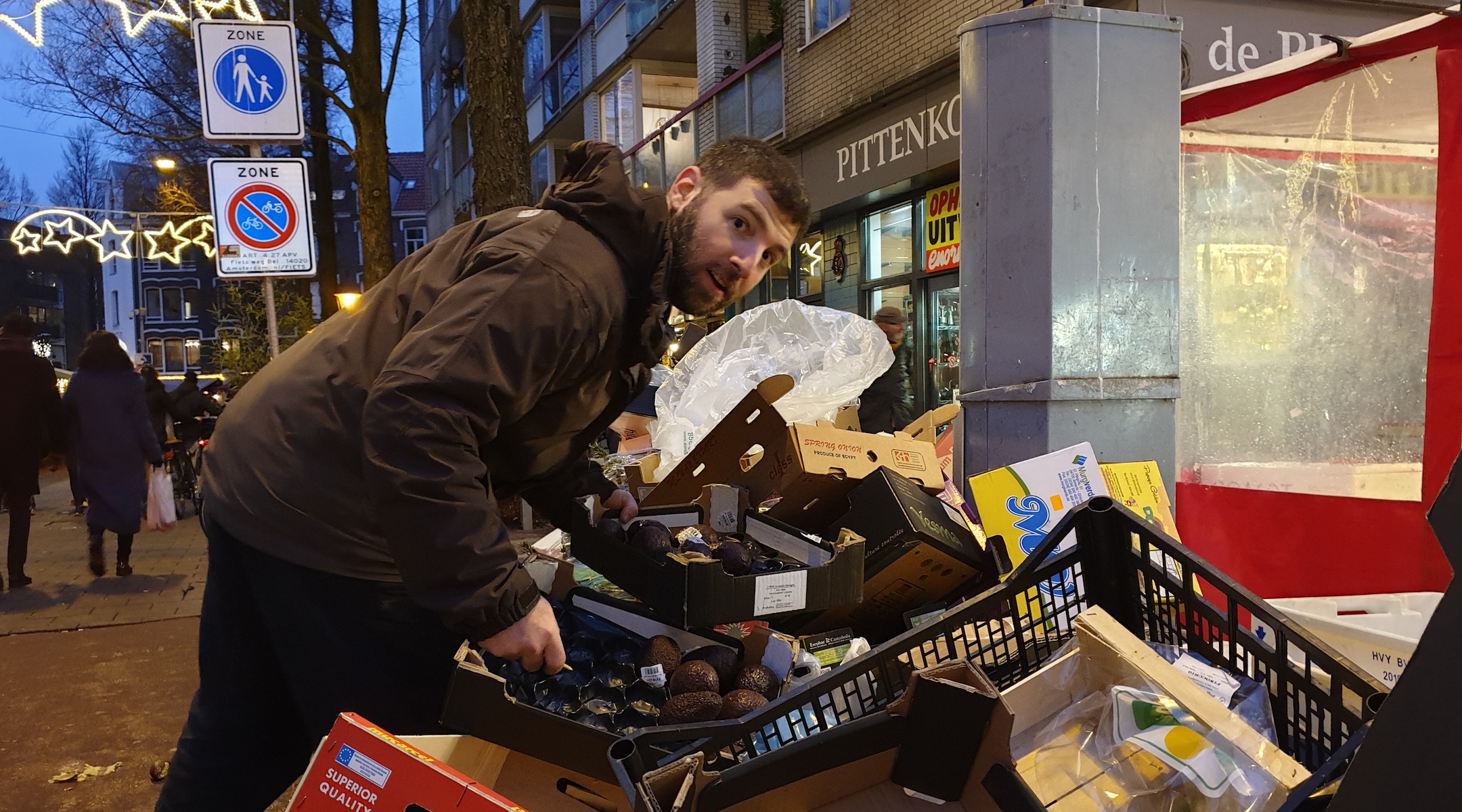
It began in the summer, when I decided to start taking my children on weekends to the Chabad shul located near this city’s famed Albert Cuyp Market.

Pushing them along in a buggy at closing time, I saw greengrocers binning full crates of still-fresh luxury items: avocados, mangoes, kiwis and persimmons ($1.50 each). Some were rotten. Mostly, though, there were boxes full of perfectly edible items: mushrooms, asparagus, raspberries and blueberries. There were honey melons and pricey herbs like cilantro, thyme, dill, basil and ginger.

I placed a few items in the buggy’s basket before davening, and a greengrocer gave me the thumbs up.

“It’s all good food,” he said. But by the start of business the following week, he added, it will have developed spots or gone soft, “and then it’d get binned anyway ’cause no one would buy it.”
From one weekly Torah portion to another, I perfected my foraging skills and gear.

I began taking a larger buggy and a fleet of reusable plastic bags. I started wearing boots and other dumpster-worthy attire. I got better at discerning levels of ripeness. And my children learned to be patient while I looked for food. I often held up various finds, explaining which part of the world they come from and what the plant that produces them looks like.

I only realized how this must look two days before Christmas, when a kind Spanish tourist handed me 5 euros. He was clearly shocked by the sight of a seemingly desperate man standing at the height of winter in a pile of trash amid a flock of herons picking at the fish remains, cleaning off produce and announcing it enthusiastically to his infant children.

Then it got slightly awkward.

I explained that I didn’t need his money. He dismissed my protest as pride and implored me to take it “for the children,” adding “There is no shame in receiving help.”


Shoppers take in the Albert Cuyp Market in 2005

That may be true, but there’s shame aplenty in wasting food – at least in Judaism.

The prohibition against doing so – “do not destroy” — appears in the Torah in a verse devoted to the rules of war. Even when laying siege to a city to starve its residents into surrendering, the verse stipulates, “do not destroy its trees by putting an ax to them, because you can eat their fruit.”

That verse in Deuteronomy goes on to juxtapose people and trees in a statement that is often repeated on Tu b’Shvat because many misconstrue it to be an equation. “Do not cut them down. Are the trees people, that you should besiege them?” the text demands.

“Do not destroy” is also the reason that in my native Israel, edible foods and bread especially are often set aside and placed separate from the trash bins. In case no people claim them, they must be given to animals, according to some rabbis, including Pinchas Badosh of the Israeli city of Beit Shean. He ruled recently that leftovers must not even be placed near other types of garbage to improve their chances of being eaten.

For descendants of Holocaust survivors like myself, there’s an added aversion to waste that I learned from my grandmother early in childhood. She described the potato peels that she once encountered in her bowl of soup at Auschwitz, saying she had never tasted anything more delicious. She ate those peels as a young woman weighing 85 pounds, she would say.

Unfortunately, the Jewish state does not quite live up to the Jewish principles on wastage.

In Israel, about 35 percent of food gets binned, resulting in an annual loss of $5.2 billion, according to a 2018 report. Of that, nearly half is thrown away by retailers and consumers.

Beyond the loss of the produce itself, this waste represents gratuitous damage to the environment through the carbon footprint of producing and transporting the food — not to mention fertilizers and the suffering of animals involved in its production.

The loss in Israel is similar to the world average, but it’s significantly higher than in EU countries like the Netherlands, where only 20 percent of food is lost. It’s the result of an ambitious effort in which Dutch supermarket chains are obliged to label and significantly discount soon-to-expire food and transfer unsold produce to a network of food banks.

My wife and I kind of started our own food bank: We cook wholesale over the weekend — small tubs of asparagus soup are a common sight — and distribute the result among anyone willing to take it.
It has brought us closer to people outside our comfortable little circle: less fortunate neighbors who respond to our offers of free food on the neighborhood WhatsApp group and Facebook page.

It has helped us save money (about $150 a month) while simultaneously realizing our goal to reduce meat consumption — another major cause for pollution worldwide. We’ve become quite creative in the kitchen. Our meals now are scrumptious and healthy affairs.

The weekend cooking marathons reduced the amount of time we spend on preparing weekday dinners, affording us more time together. They also brought our family closer because we have dinner every Shabbat now at my father-in-law’s, who lives conveniently near the market.

I even made new friends with fellow scavengers; we exchange tips and loot.

Marianne is a retired Jewish woman who sets aside and sends to Israeli charities whatever money she saves by foraging. Jamal hands out produce at his mosque. And Pieter, well, he’s probably addicted to weed and forages to free up dope money.

Most important perhaps is how foraging is helping me teach my children the value of food and expose them to what many millions of people must do to grow, ship, sell and cook it.

Maybe it’s time to take the educating down a notch on this front, though.

Last week I saw my boy inviting classmates at his posh Jewish kindergarten to join him in the yard and “look for good food.”


https://www.jta.org/2019/01/08/opinion/how-going-to-synagogue-regularly-turned-me-into-a-dumpster-diver?utm_source=JTA%20Maropost&utm_campaign=JTA&utm_medium=email&mpweb=1161-8267-21723



Tuesday, January 15, 2019

Advocating for secular education is not about providing abstract information in the classroom. It’s about giving young Jewish men the means through which they can lead dignified lives and support their families, which is a tall order without proper education....

New Yorkers should pay attention to the yeshiva schools controversy


Schools that deprive children of basic skills get millions of taxpayer dollars


After years of focus on the major educational deficiencies within many ultra-orthodox or Hasidic schools in New York, the state Education Department in November issued updated guidelines that included clarification on “substantial equivalency” requirements for nonpublic schools.

As these guidelines apply to all private schools, it’s been met with a bit of an uproar. Several politicians have been swift to pander to Agudath Israel—an Orthodox Jewish advocacy organization—and yeshiva leaders by portraying this as an assault on yeshivas and calling on the state to back off.

Schools in the Orthodox Jewish community exist along a spectrum. The Modern Orthodox schools offer a well-rounded Jewish education as well as a robust secular education, by which I mean instruction in English, math, science, history, physical education, etc. Graduates of these Modern Orthodox schools do quite well academically and professionally, and their successes are now being touted as “proof” that the yeshiva system works and is even superior to public schools.

On the other end of the spectrum are the Hasidic schools, particularly boys' high schools, where the school day is dominated by Judaic studies. Secular studies are either given short shrift or not taught at all. Their students don’t typically graduate with a state-recognized high school diploma.

Unfortunately, an initial misreading of the revised guidelines worried parents of students in well-performing yeshivas that the state would require an unreasonable six to seven hours a day of secular studies. The state then clarified that the distribution of hours from which that estimate was drawn covered a two-year period, which means the actual requirement is around three-and-a-half hours per day.

But Agudath Israel cynically exploited that momentary confusion and rallied the Modern Orthodox to the defense of the ultra-Orthodox and the Hasidic yeshivas—the schools with serious educational deficiencies. Agudath Israel and a Borough Park-Williamsburg group formed in 2016 called Parents for Educational and Religious Liberty in Schools have unfortunately framed this as an attack on the community’s religious beliefs, labeling educational advocates as outsiders set on destroying its way of life.

In fact, the majority of those advocating for educational improvement are former Hasidic students who were never provided a proper education. They care deeply about the Jewish community and about the education and welfare of children.

Portraying the guidelines as an attack on all yeshivas is shortsighted, foolish and dangerous. The education of thousands of children is at stake. One can choose to be misinformed or one can take the time to learn the truth. If the state succumbs to special-interest pressure, the ultimate victims will be more generations of Hasidic children.

New Yorkers should be paying close attention for several reasons. Hasidic schools receive millions of taxpayer dollars. With students emerging without a high school education or even basic English language skills, their career prospects are limited and their families struggle from the start.

A parent’s right to choose to send a child to yeshiva is unquestionable, but there is no parental or communal right to deny children the tools necessary to survive and thrive.

It is no secret that thousands of young Hasidic families, primarily in the communities of Williamsburg, New Square and Kiryas Joel, depend on government aid to survive. Now that their children attend the same or similar schools, we can expect the cycle to continue for another generation.

Advocating for secular education is not about providing abstract information in the classroom. It’s about giving young Jewish men the means through which they can lead dignified lives and support their families, which is a tall order without proper education. They should have the options of joining the workforce and reap opportunities available to all U.S. citizens. Far from being a threat to the community, secular education is the only way to save the community.

Shlomo Noskow is an emergency physician practicing in New York. He is on the board at Yaffed, an organization advocating for improved education in Hasidic schools.


Sunday, January 13, 2019

Maryland Attorney General Announces New Phone Hotline To Report Child Sex Abuse


BALTIMORE (WJZ) — Maryland Attorney General Brian Frosh announced Thursday a new telephone hotline for individuals to report child sex abuse.

The hotline number is 410-576-6312.

Victims of an abuser associated with a school or place of worship, or any individual who knows about the abuse, can share this information by calling the hotline number above or by email to: report@oag.state.md.us.

Callers may be asked, but are not required to say, the caller’s name and contact information, name of abuser, where the abuse occurred, timeframe of the abuse and any other details they would like to report.

In some cases, they may refer the information reported to their office to the local State’s Attorney where the abuse occurred.

https://baltimore.cbslocal.com/2019/01/10/md-attorney-general-announces-new-phone-hotline-to-report-child-sex-abuse/#.XDvIVNa-5Ks.facebook

Friday, January 11, 2019

The Only Language That Matters To These Rabbis Without Consciences....Not Hebrew...Not Yiddish... Not Hungarian... But The "Gelt" Language!

Donor freezes funding to Bnei Akiva over Rabbi Druckman’s silence on Elon 


Druckman has faced criticism in recent weeks for failing to apologize or express regret over incidents of sexual abuse by Moti Elon. 


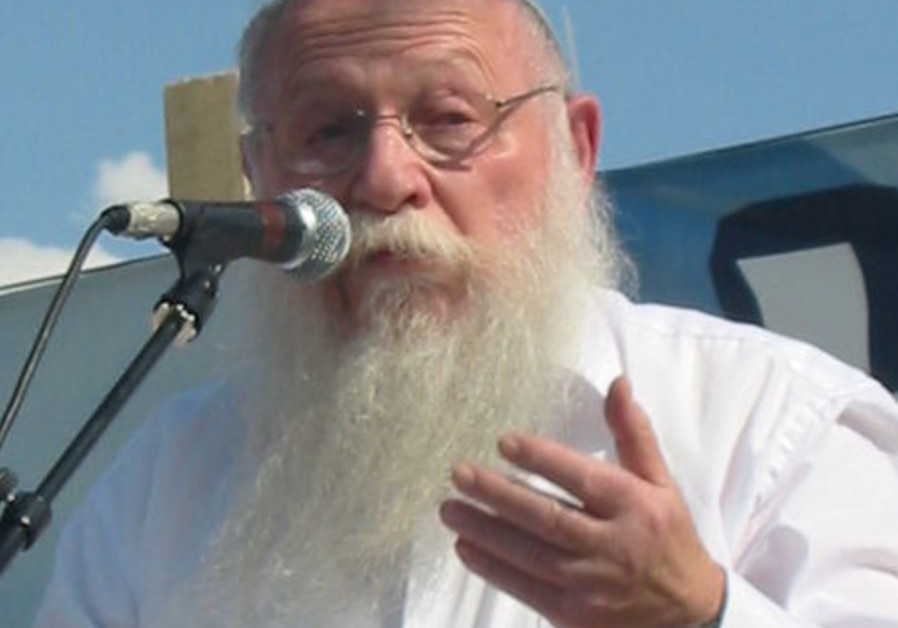
Rabbi Haim Druckman
Rabbi Haim Druckman

A major philanthropist who has contributed millions of dollars to Bnei Akiva and its various institutions as well as other national-religious organizations has frozen donations to the organization, The Jerusalem Post has learned, because of the expected participation of Rabbi Haim Druckman at the movement’s upcoming world conference.

Druckman, chairman of Bnei Akiva yeshivas and seminaries – and perhaps the most influential rabbi in the national-religious sector – has been heavily criticized for having publicly backed Rabbi Moti Elon after he was convicted of sexual molestation in 2013, stated that the judge was wrong to convict him, and inviting Elon to lecture at his Ohr Etzion Yeshiva in Merkaz Shapira.

Druckman has faced further criticism in recent week for failing to apologize or express regret for that support, after evidence arose several weeks ago of new incidents of sexual abuse by Elon in the last 12 months.

The philanthropist, who wishes to remain anonymous at this time, stated in an email obtained by the Post that he was “dismayed” at Druckman’s refusal to publicly condemn Elon, saying that he was even more upset that Druckman would be a attending Bnei Akiva’s 14th World Conference next week.

The philanthropist said he was therefore freezing financial support to Bnei Akiva until it acts on the issue, stating explicitly that the organization must not provide a platform of any kind for “Elon supporters.”

On Thursday evening, Hadashot News quoted a letter sent recently by Druckman to a third party who had ostensibly written to him about their disappointment in his actions.

Hadashot quoted Druckman’s reply where he said: “I feel your true pain over my silence regarding the new information that emerged about Rabbi Mordechai Elon,” adding that he had also been pained by the criticism directed at himself.

He said, however, that “I thought that from the perspective of truth I needed to act and not necessarily speak.”

Druckman said that as soon as the information reached him, he together with other rabbis instructed Elon to stop delivering lessons, halt all public activities and to stop holding personal meetings with youths. He added that anyone who had been harmed by Elon could approach him for help.

In December, the Uvda investigative reporting program revealed that allegedly Elon had sexually molested a youth in a private meeting with him. The youth had audio and video evidence which he presented to Druckman, and to rabbis Yaakov Ariel and Shmuel Eliyahu.

The three rabbis subsequently told Elon to cease all public activity, as Druckman related in his letter.

On Thursday, former Bnei Akiva chairman Daniel Goldman said he was boycotting the upcoming world conference because Druckman was going to be an honorary guest.

Goldman said he could not “in all conscience” attend “alongside Rav Druckman, until he is prepared to accept responsibility for his decisions with respect to Rav [Mordechai] Elon.”

Earlier this week, the Post reported on another alleged victim of Elon who said he was molested by the rabbi in 2002 when he was the dean of the prestigious Horev Yeshiva high school.

https://www.jpost.com/Diaspora/Bnei-Akiva-donor-freezes-funding-over-Rabbi-Druckmans-conference-attendance-577014


Thursday, January 10, 2019

Two Zonas With Beards Walk Into A Jewish Wedding...

Sex offender rabbi ‘negotiated with deputy minister’ for public comeback


Recording shows Eliezer Berland’s aides offering followers’ political backing in Jerusalem mayoral race in exchange for photo op with ultra-Orthodox leaders


Rabbi Eliezer Berland (L), a convicted sex offender, meets with UTJ's Meir Porush at a Beit Shemesh wedding on January  6, 2019 (courtesy)
Rabbi Eliezer Berland (L), a convicted sex offender, meets with UTJ's Meir Porush at a Beit Shemesh wedding on January 6, 2019
A popular rabbi convicted of sexual offenses has been negotiating his public rehabilitation with ultra-Orthodox politicians in exchange for his followers’ political support, according to a television report on Tuesday. 

After evading arrest for three years, Eliezer Berland, 80, was sentenced to 18 months in prison in November 2016 on two counts of indecent acts and one case of assault, as part of a plea deal. He was freed after five months, in part due to ill health.

Now, his associates are working to bring him back into the fold, according to a recording obtained by Hadashot.

In the recording, captured before the October municipal elections in Jerusalem, an aide to Berland, Natan Bezenson, is heard speaking with United Torah Judaism’s MK Meir Porush.

The TV report was aired days after Deputy Education Minister Porush was photographed speaking with Berland at a wedding, sparking an outcry.

UTJ is comprised of two parties, the ultra-Orthodox Agudath Israel and the Lithuanian Degel HaTorah. The parties ran separately in the local elections, and Berland’s supporters apparently made use of this rivalry to offer the support of his followers in exchange for legitimization.

“Today in the ultra-Orthodox community [Berland] is an outcast,” Bezenson says in the recording. “We really have a very simple demand, very simple, a single demand: that [leading rabbis] will accept him.”

He then suggested a photo op where Berland will meet with Hasidic leaders and call to vote for Agudath Israel in the local elections.

Porush responded that this would be unlikely to happen, and the aide pressed him. “They need to make some effort to honor him, some minimal show of respect, some minimal recognition. If he’s not a human being, then why do you need his votes?”

Bezenson went on to threaten to “ally with your enemies” and bring down Agudath Israel.

The offer did not appear to go ahead, and Berland eventually supported an independent slate in the first round of municipal elections in Jerusalem, which did not win a significant number of votes. He later supported Shas’s preferred candidate in the mayoral runoff, Moshe Lion, after Shas leader Aryeh Deri sent several associates to be photographed with the rabbi.

Porush was heavily criticized in online ultra-Orthodox forums for meeting with Berland this week during the Beit Shemesh wedding of Berland’s great-grandson.

The two were photographed conversing during the event.

Long considered a cult-like leader to thousands of his followers from the Bratslav sect, Berland fled Israel in 2013 amid allegations that he had molested several female followers, one of them a minor.

According to the indictment, Berland would often receive people in his homes in Jerusalem and its suburb Beitar Illit, and hold private meetings intended for spiritual guidance, counseling or benedictions. The rabbi would sometimes take advantage of the meetings and of his position in the community to engage in sexual acts with women, including minors, according to the charges against him.

He was on the run from authorities until 2016, avoiding several Israeli attempts to extradite him. He moved between Zimbabwe, Switzerland, the Netherlands and South Africa, accompanied by a group of devout followers numbering around 40 families. Berland was apprehended by South African authorities, extradited to Israel, and detained upon his arrival at Ben-Gurion International Airport in July 2016.

https://www.timesofisrael.com/sex-offender-rabbi-negotiated-with-deputy-minister-for-public-comeback/


Wednesday, January 09, 2019

In New York, the infection is spreading primarily among Orthodox Jewish communities in Brooklyn and Rockland County ...


“What about the people who clean and sweep in the school?” argued Kamenetzky. “They are mostly Mexican and are unvaccinated. If there was a problem, the children would already have gotten sick.” “I see vaccinations as the problem. It’s a hoax. Even the Salk vaccine [against polio] is a hoax. It is just big business.”

Worst measles outbreak in decades sweeps New York as cases surge in Oregon, Washington and abroad


  • At least 160 people in New York have been infected with measles 
  • One in 20 children that get the highly-contagious virus develop pneumonia, and one to two per 1,000 die  
  • The disease can only be prevented by vaccination 
  • Over 90 percent of babies in the US are vaccinated 
  • But people of certain religions and ideologies sometimes refuse to get their children vacccinated 
  • In New York, the infection is spreading primarily among Orthodox Jewish communities in Brooklyn and Rockland County 

Cases of measles have reached a 20-year high in several New York counties amid an outbreak that threatens to reach epidemic proportions, experts say. 

At least 160 people have been infected by the virus, which typically strikes children, in New York and unusual outbreaks have been reported internationally. 

The worst affected areas so far are Rockland County - where 105 cases have been reported - and an Orthodox Jewish neighborhood in Brooklyn, where at least 55 have been infected. 

Meanwhile, 25 other states have reported outbreaks, with numbers climbing particularly high in Oregon and Washington. 

A body-covering red splotchy rash is the tell-tale sign of the measles infection that has struck at least 160 people in New York - and outbreaks have been reported in Oregon and Washington
Measles is only preventable by vaccination, and health officials in the worst affected areas are scrambling to speed up shots schedules in the most blighted areas. 

Among other countries, Israel has seen a recent resurgence in measles.  

In October, the sudden uptick in cases in New York City was linked to an unvaccinated traveler from Israel. 

Though the details of the Oregon and Washington cases have not been released as publicly, the Washington outbreak was traced to an unvaccinated child who had traveled to the state from another country. 

The measles vaccine was introduced in the US in 1963 and, ever since, the virus has been a minimal threat. 

But among those not inoculated against it, measles is among the most contagious diseases in the world and can be life-threatening. 

Measles often begins with a fever, sore throat, runny nose and cough but there are a few tell-tale signs of the infection. 
Eventually, a rash composed of large red blotches materializes, first on the face, spreading until it eventually covers the whole body. 

As the infection worsens, complications can include diarrhea, lung infections and brain swelling. 
Some one in 20 children that contract measles develop pneumonia, making it highly dangerous to young kids.

WHAT ARE THE POSSIBLE COMPLICATIONS OF MEASLES?


Babies are supposed to get the shot in two doses. The first dose should be given between the first 12 and 15 months of life, and the second between ages four and six, as per the Centers for Disease Control and Prevention's (CDC) recommendations. 

As of May 2017, the CDC estimated that about 91 percent of children under three had received at least their first dose of the MMR shot.  

In recent years, however, there has been a growing - though largely unfounded - movement against vaccinations. 

Some populations have a longer history of reticence against shots. 

Some members of both the Amish and Orthodox Jewish faiths believe that their religions' edicts, histories or some combinations of the two prohibit them from getting their children vaccinated. 

One of the arguments made by Orthodox Jews is that if a dangerous disease becomes rare - thanks to high rates of vaccination among the general population, typically - then getting shots for their children may do more 'harm' than good and thus be against Orthodox Jewish law. 

But in 2013, for example, a measles outbreak struck the neighborhood of Williamsburg in New York City's Brooklyn borough. The 58 infections were contained entirely in the Orthodox Jewish community there. 

The outbreaks that have emerged in recent months have followed a similar pattern. 

One unvaccinated child from Brooklyn reportedly traveled to Israel, contracted the virus, then returned to its home in New York and spread the infection to other unvaccinated kids in the community. 

In Oregon, there has been a moderate influx of Orthodox Jews (particularly in Portland). However, it is less clear what is fueling the outbreaks there or in Washington.

There has been some increase in the number of children not getting vaccines, but the majority of the population in both states is still protected.  

Rockland County, New York, is home to a number of all-Orthodox villages and the population of Orthodox Jews has been growing rapidly throughout the area in recent years. 

John Lyon, spokesperson for the Rockland County Health Department said that the outbreak has struck unvaccinated communities there.

'We're making some progress, but this is one of the most contagious diseases out there in unvaccinated populations,' he told Daily Mail Online. 

So far, the county has given over 11,000 vaccinations to children there, but is still struggling to contain the virus's rapid spread.   


Tuesday, January 08, 2019

2 Jews - A Few Thousand Opinions!


By Daniel Greenfield

In 2016, a poll showed Trump beating Hillary Clinton 66% to 22% among Orthodox Jews. This wasn’t as unusual as it sounds. In New York City, Orthodox Jewish neighborhoods light up as islands in a lefty sea.

Romney won over 90% of the vote in some Orthodox Jewish areas.

Traditional religious beliefs are associated with conservative politics among Jews the same way that they are among Christians. 60% of Jews who attended weekly religious services disapproved of Obama while those who didn’t, mostly supported him. Why do American Jews lean much more to the left? Because only 11% of American Jews attend weekly synagogue services. Well below the 40% national average.

Only 34% of American Jews are certain that they believe in G-d. What do they believe in? When asked what it means to be Jewish, 56% mentioned social justice, 42% comedy and only 19% percent mentioned anything involving religion. Meanwhile 63% of Israeli Jews believe “completely” in G-d.

Last year, Trump’s approval rating among Orthodox Jews was at 71%. The American Jewish Committee’s Survey wrote the results up glumly as “We have seen the future, and it looks Orthodox".

Establishment Jewish groups, which suddenly woke up and realized that the majority of Jewish children in New York City were Orthodox Jews, are preparing to fight that future. If those children are allowed to grow up Orthodox, the end of the Jewish Left will have arrived. And so they came after the children.

The New York State Department of Education now threatens to shut down Jewish schools and report parents who refuse to send their children to leftist government schools to child protection authorities. As in the Soviet Union, giving a child a Jewish education would be treated as evidence of child abuse. The government would be able to abduct children for the crime of receiving a Jewish education.

The new "Indian Residential Schools" had arrived.

Jewish schools aren’t the only targets of this discriminatory campaign by the educational establishment. Catholic schools have also come under attack with the Archdiocese of New York posting an editorial that declares, “Leviathan has now focused its attention on religious schools here in New York, with the clear intention of either forcing them to submit to its authority or face destruction.”

The public face of the campaign against Jewish schools is YAFFED or Young Advocates for Fair Education. Its members claim to be the products of Orthodox Jewish schools whose poor education left them so unprepared for the real world that all they were able to do was launch an extremely effective statewide campaign whose press releases and talking points are quoted verbatim in every single media outlet.

As in March for Our Lives, young faces are used to hide the agendas of the old lefties behind the curtain.

While Naftuli Moster, YAFFED’s executive director, plays its equivalent of David Hogg, speaking to media outlets and appearing at forums to discuss the incredible intellectual disadvantage that the same educational system that produced generations of visionary thinkers and geniuses burdened him with, Hannah Rothstein, a not remotely “young” Baruch College prof, serves as its president.

Hannah Rothstein also serves on the board of Footsteps, an organization working to secularize Orthodox Jews and transition them to an irreligious lifestyle. She’s a Trump critic and an Obama supporter.

She has also donated to Barack Obama, Nancy Pelosi, Al Franken, Beto O’Rourke and Cory Booker. Her repeated out of state donations, some through ActBlue, show a woman passionate about the Left. And the growing Orthodox Jewish population poses a threat to everything that Rothstein has been funding.

Moster, YAFFED’s public face, is also a Footsteps graduate. Pesach Eisen, a Yaffed member who testified in its cause, is a Footsteps member and a fellow with the radical leftist Jews for Racial & Economic Justice which denies the existence of lefty anti-Semitism even as it defends leftist anti-Semites. Eisen demonstrates how Footsteps and YAFFED act as arms of the broader anti-Jewish Left.

And Moster has, in turn, defended the anti-Semitic Women’s March.

Anita Altman serves on the Board of Directors of YAFFED and her bio boasts of helping numerous Footsteps clients. In 2014, she had signed an angry letter, declaring, “AIPAC speaks for Israel’s hard-line government and its right-wing supporters, and for them alone; it does not speak for us.” The signatories included a range of anti-Israel activists, supporters of BDS and defenders of anti-Semitic terrorism.

Altman has also signed a letter backing anti-Semitic Farrakhan supporter Linda Sarsour.

Altman is, unsurprisingly, no fan of religious Jews. In a bizarre interview, which repeatedly warns of a "khasidic takeover", she complained that there is "fear" when "it comes to government dealing with these fundamentalist communities." Then she compared Orthodox Jews to Iran.

That’s the medieval bigotry behind YAFFED and the war on Orthodox Jewish schools.

YAFFED’s bid is all about lefties using the government to deal with “fundamentalists” under the guise of helping the few formerly Orthodox members of Footsteps being used as fronts for the hateful operation.

Altman isn’t the only anti-Israel activist in YAFFED. Its communications director, Abigail Beatty, also allegedly works for the anti-Israel NIF, an organization notorious for its funding of leftist and BDS group.

YAFFED claims to advocate for “the rights of Hasidic and ultra-Orthodox children”. But it appears to be another face of Footsteps: an organization advocating against the traditional religious practices of Orthodox Judaism.

The people behind YAFFED have the right to advocate for discriminatory policies targeting the Orthodox Jewish community, in order to force Jewish parents to take their children out of Jewish schools.

They have the right to do so in the name of their radical leftist politics and hatred of religion.

But they have no right to masquerade as an organization fighting for the rights of the very people they are persecuting. Instead of highlighting these obvious connections, the media has chosen to act as the echo chamber for YAFFED while denying the Jewish communities targeted by Altman and her ilk, a voice.

Anonymous stories and bots have been used to manufacture a group of Orthodox Jewish parents and children who are “suffering” in the Jewish school system, but oddly, choose not to leave it.

These astroturf tactics are being used to justify discrimination and harassment of a religious community.

It’s about more than just the bigotry of Anita Altman, obsessed with recreating Philip Roth’s Eli the Fanatic. Behind the fresh young faces, there are elderly veterans of the lefty political establishment, many with backgrounds in education and academia, who see religious Jewish education as a threat.

An economic threat and also a political threat.

In a letter to a Democrat councilmember, David Bloomfield, claimed that the war on Jewish schools would enable their students to “vote outside the confines of their deterministic communities”.

Bloomfield has written a number of articles and appeared at Yaffed forums attempting to pressure the government into cracking down on Jewish schools.

At stake are two very different visions of education and the future.

Secretary of Education Betsy DeVos recently visited Orthodox Jewish schools and touted them as models of school choice. There is no word in the English language that the Left hates more than “choice”.

The education lobby has gone to war against charter schools. And Orthodox Jewish schools are seen as even worse than charter schools. They don’t bow to the teachers’ unions. The money their parents spend on education doesn’t end up in the pockets of union bosses and their Democrat political allies.

The Orthodox Jewish community has helped drive the expansion of voucher programs. And school choice is an existential threat to the educational establishment and the political power of the Left.

Orthodox Jewish communities have fueled support for school choice not only in New York, but in swing states like Ohio, Pennsylvania and Florida, endangering presidential elections.

Something had to be done about those pesky Jews. Now something is being done.

The Left’s vision of the educational system is Footsteps and Yaffed writ large, a machine for destroying communities, undermining their traditions, and crushing parental authority so that academics can reinvent the children in their own cultural and political image. That’s what happened to American Jews.

Now the same people who a century ago turned a generation of immigrants from believers in G-d to believers in social justice see another Jewish demographic threat and want to do it all over again.

On Sabbath, hundreds of thousands of Orthodox Jews will read the story of how an ancient Egyptian leader grew disgusted with rising Jewish demographics. "Behold, the numbers of the children of Israel are too many," he tells his political allies. "Come, let us deal cunningly with them, lest they multiply."

On Fifth Avenue, the establishment pharaohs, whose faith is not in Isis or Hathor, but in progressive social justice, look at the children in Jewish schools across New York City and bitterly echo his words.


Link to Sultan Knish

Monday, January 07, 2019

There Are Two Sides To This Story....Agudath Israel knows this. But they have lost their way, and are about to drag the entire community down with them.

The Truth About the Struggle For Secular Education in Yeshivas


You won’t see this in the Jewish Press, Flatbush Jewish Journal, etc.


For several weeks straight, FJJ and other Agudath-Israel-influenced media outlets have run headlines like these.

Since the New York State Education Department released their revised general education guidelines for private schools on November 20th 2018, various Orthodox newspapers, websites, and advocacy groups have been spreading fear and misinformation.

While the new guidelines were written by the state without substantial input from Yaffed, most of the attacks from Agudath Israel and Yeshiva leaders have focused on Yaffed. These attacks are baseless, burdened by inaccuracies and slander. In the ensuing storm, the intentions of both Yaffed and the state have been misrepresented. Furthermore, the approach taken by Agudath Israel and others is counterproductive and exposes the community to unnecessary dangers.

Yaffed was founded in 2012 by graduates of Hasidic Yeshivas who came together to change the status quo of little to no secular education in Hasidic Yeshivas. None of us came from askonis (advocacy) backgrounds or had any big connections to machers in our communities. Initially we met with some Yeshiva leaders, Rabbis, and organizations that funnel funds to Yeshivas. Those who supported our work were afraid to do so publicly, and the remainder either opposed our efforts or argued it was unnecessary, pointing to outlier Hasidic yeshivas that offered secular studies.

We came to realize there was no way community leaders would make changes in the Yeshivas just because a few Yeshiva graduates requested it. And even if a model Hasidic yeshiva existed, what about the rest? There would still be tens of thousands of Jewish kids without an education.

In 2013, when I was receiving a scholarship from the UJA, the reception’s keynote address was delivered by David Zwiebel, the executive vice president of Agudath Israel. After his speech, in which he extolled the importance and benefit of education, I walked over and asked him to do something about this issue. I will never forget his response. He said he believed graduates are perfectly capable to pursue what they wanted, noting that he had become an attorney following his Yeshiva education. Zwiebel, of course, did not attend a Hasidic Yeshiva.

This dismissive attitude is what I encountered again and again, and it became clear that, despite the constant refrain that “change must come from within,” no one from within was willing or bold enough to actually pursue that change. After all, I grew up in this community and I am well aware of the consequences people face if they don’t toe the line. Case in point, my family is concerned that my involvement with Yaffed is harming the reputation of my siblings, who will struggle to find Shiduchim and Yeshivas willing to accept their children. Rather the claim that change must, or will, come from within is being used to indefinitely postpone any change.

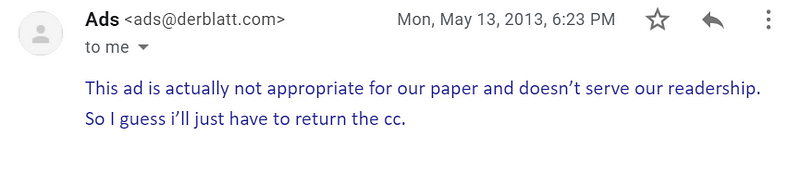
In 2013, Yaffed put up a billboard with the Talmudic phrase “chayav odom lelamed es benoi umnus” (“a father must teach his son a trade”) on the Prospect Expressway, which garnered a lot of attention. But once again our critics complained that it aired the dirty laundry out in the public. Little did they know, or want to believe, that prior to that we tried to place the ads in local Jewish newspapers but were turned down.


Ad placed on Prospect Expressway billboard after ultra-Orthodox newspapers rejected it


Der Blatt, Der Yid, and others rejected our ad

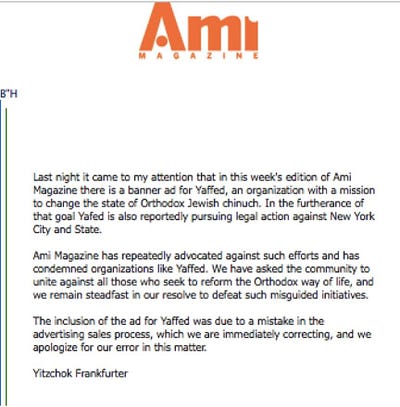
One Orthodox magazine mistakenly published our ad, and apologized to their subscribers less than 24 hours later and again in the following week’s issue.


Ami Magazine published our ad but immediately apologized to their readers.
So let’s review: we are told change must come from within, so we speak to Rabbis and local elected officials and they either tell us to go away or they say they too are afraid to speak up. So we tried to speak directly to the community, but then we were shut out from local newspapers. So we put up a billboard, which was sensitive to the community, and people still found fault with it.

So we turned to the New York City Department of Education and the New York State Education Department, the entities tasked with enforcing the law without fear or favor. When we were first contemplating a lawsuit, we decided not to sue individual Yeshivas because we believed our issue was with the state and complacent school districts.

In July 2015, we filed a complaint with the New York City Department of Education, which was signed by 52 Yeshiva graduates and parents, and it included a handful of former teachers as well. We named 39 Yeshivas that were clearly not compliant with the law. Yaffed asked the city not to publicize the names of the Yeshivas because public shaming was not our goal; our goal was to provide evidence to the city that this was a real problem. The city then announced it was launching an investigation.


As I did with secular media outlets, I reached out to Orthodox news outlets and offered to do interviews and discuss the complaint we filed with the city, but they ignored my offer. One reporter responded in a degrading manner.

Shortly after, I reached out to David Zwiebel and he agreed to meet with me. At the meeting he conceded that secular education is important. He claimed even science should be taught because kids need to understand the “Niflaos Haboreh (wonders of G-d).” He also made the case that people go off the derech because they feel betrayed for not having received a secular education. Yet he admonished me for going to the DOE, despite all our efforts to solve this problem internally.

I explained to him that it’s not too late, and that for the sake of avoiding further Chillul Hashem Jewish leaders, including Agudath Israel, should begin working to remedy the problem. At which point he claimed that Agudath Israel has no jurisdiction over Hasidic Yeshivas. I replied that this wasn’t true, as Agudath Israel helps secure funding for Yeshivas, including Hasidic ones.

Months later, Zwiebel co-founded PEARLS, a group that at first presented itself as trying to improve Yeshivas, but their actions ever since, as well as more recent statements, indicate they were created to shield Yeshivas. Their strategy was to stonewall the city’s investigation by claiming they are making improvements, including through new curricula and textbooks. In a recent report the city acknowledged PEARLS’ claims of new curricula and textbooks, but added that the city inspectors have not gotten access to all those materials. Both Mayor Bill de Blasio and NYC Schools Chancellor Richard Carranza have publicly disputed PEARLS’ claim that no Yeshivas have denied access to city investigators.

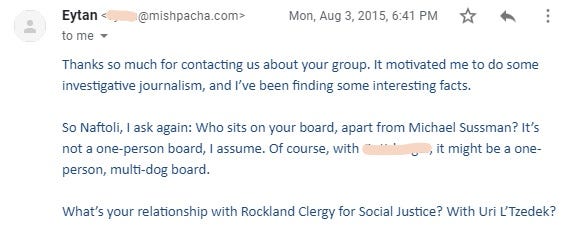
I have since reached out several times to David Niederman from the United Jewish Organizations of Williamsburg (UJO), a top Satmar leader, who co-founded PEARLS with Zwiebel, yet he not once got back to me.


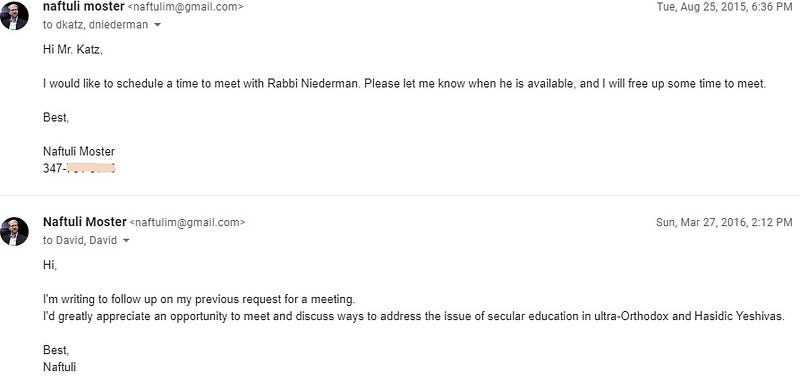
Several attempts to reach Rabbi David Niederman from UJO


Meanwhile, the state decided it was best to make the guidelines clearer, so that districts have no excuses, driven by political considerations, to delay enforcement.

Despite their claims to the contrary, Agudath Israel was included in the process, as they sit on the commissioner’s advisory panel for non-public schools. In a recent letter they acknowledged having seen an early draft of the revised guidelines. But because they had decided to protect failing Hasidic Yeshivas, which refused to improve their secular education even marginally, they helped Satmar and others orchestrate what was one of the dirtiest political tricks in New York history. They had Simcha Felder, who at the time was a powerful state senator, hold up the New York State budget until he secured an exemption for Yeshivas from having to meet the same “substantial equivalency” standards as all other non-public schools.

To my dismay, I have heard David Zwiebel in Yiddish present Felder’s legislative maneuver as a major win, so that Yeshivas can continue providing little to no secular education. Publicly, of course, he expressed bewilderment as to why Yaffed was opposed to the amendment since it was codifying into law that Yeshivas do need to meet basic standards.

The truth is, the change in the law had one purpose, and that was to undermine the forthcoming guidelines for the benefit of Yeshivas. Everyone who followed the issue understood that, and a few weeks ago, the Satmar Rebbe admitted that before thousands of people — in Yiddish, of course.

When the guidelines were issued in November and there seemed to be confusion over how many hours of secular instruction the state was requiring of Yeshivas, Yaffed was the first to call on the state to clarify that they weren’t requiring seven hours of secular education per day. We recognized that schools can accomplish a lot in fewer hours, as we have often pointed to the modern Orthodox schools, to many Litvish schools, and even to some Hasidic girls’ schools as proof that you can provide a solid secular education by splitting the day with the Judaic studies.

Now, to be clear, everyone knew the state wasn’t requiring Yeshivas to teach more secular studies than public schools. This was an obvious case of unclear bureaucratic directive that required clarification. Yet Agudath Israel exploited the weeks of uncertainty to rally unsuspecting people, including some Modern Orthodox Jews, to the defense of the most failing Yeshivas in our midst. The only beneficiaries of that fear-mongering campaign are school leaders who want to maintain the failing status quo.

The state, to no one’s surprise, has since clarified that it is only requiring half that amount of secular studies in those grades, yet the damage Agudath Israel has caused is done. Some parents are convinced the state is out to turn their Yeshivas into public schools or worse.

These are the facts, and despite the smokescreen put up by Agudath Israel and the censorship by their enablers, the truth will continue to shine through.

Imagine if David Zwiebel had heeded our calls years ago and agreed to avoid an embarrassing public battle by helping address this issue from within (with some assistance and monitoring from the state to ensure the improvements are real and not just lip service), how much negative press could have been avoided? How many hundreds of thousands of dollars could’ve been saved? We, of course, have continued to engage parents and students who believe Hasidic Yeshivas are providing them with an inadequate education, even as we advocate the state enforce the law as it existed prior to the Felder Amendment.

Yet instead of realizing this, Agudath Israel is doubling down. They are now gearing up to help failing Yeshivas sue the state in court. I cannot overstate how foolish this is. Not only do court battles cost money and resources, but there is great potential for unnecessary embarrassment to be revealed during the legal process.

With lawsuits, all bets are off. Every program, every dollar, every contract is up for discovery and scrutiny, not only by the parties involved but also by the media and the public.

Agudath Israel knows this. But they have lost their way, and are about to drag the entire community down with them.


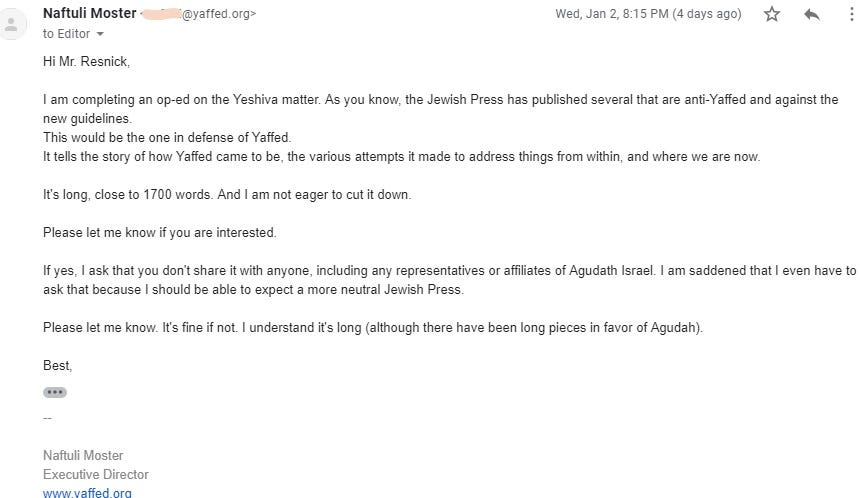
P.S. I pitched the story to the Jewish Press’ opinions editor as a response to their incessant negative reporting about Yaffed. But consistent with the one-sided reporting we get from Der Yid, Der Blatt, Di Tzeitung, Flatbush Jewish Journal, Yeshiva World News and others, the Jewish Press’ editor refused to even entertain publishing this piece. I therefore ask that you share this far and wide to make up for the extreme censorship we’re facing.


Friday, January 04, 2019

You can spend 80 years of a life with as much free time as you want and still not get out of it as much as someone who only lived for 40 years but managed to appropriately direct attention to the things that mattered to them...


Technology is destroying the most important asset in your life


“Money isn’t the most important thing in the world. Your time is.

Parents, teachers, and mentors all around the world have spoken these words to us, in one form of another, throughout our lives. It makes sense, too.

Most of us come to realize at some point that money is a means, not an end. It affords opportunities, but as research has shown, there are diminishing returns to what it can do for you. In fact, the strongest link between money and well-being comes from its ability to buy you time through conveniences.

Our time is limited, and the prevailing wisdom is that the more we have of it, the more opportunities there are for us to experience joy and fulfillment. But is that the whole story? Is time really what adds more to life?

I’d argue otherwise. The most important asset in your life isn’t time, but attention. The quality of the experiences in your life doesn’t depend on how many hours there are in the day, but in how the hours you have are used.

You can spend 80 years of a life with as much free time as you want and still not get out of it as much as someone who only lived for 40 years but managed to appropriately direct attention to the things that mattered to them. Although time is indeed limited, with attention, it can be diluted to expand beyond what most other people get out of the same quantity.

Unfortunately, this happens to be harder than it sounds.

The World Is Designed Against You

One of the biggest problems of our generation is that while the ability to manage our attention is becoming increasingly valuable, the world around us is being designed to steal away as much of it as possible.

The internet and the technology companies that are built on it have democratized opportunity. It’s hard to argue that the net effect of these innovations isn’t positive. That said, it doesn’t mean that there aren’t costs. Smartphone addictions are real. Technology-induced stress is real.

Companies like Google and Facebook aren’t just creating products anymore. They’re building ecosystems. And the most effective way to monetize an ecosystem is to begin with engagement. It’s by designing their features to ensure that we give up as much of our attention as possible.

Last year, Tristan Harris, a former Design Ethicist at Google, shared how designers create product functions that exploit our mental impulses. They find blind spots in our perception, and they use them to influence our behavior without us realizing. Every notification you receive, every email you get, and every website you browse is carefully created to ensure that you maximize the time you’re engaged with the company’s product.

Today, more than ever, we need our mind back. Fortunately, there are ways to get it. Here are 3 methods that will improve the quality of your life.

1. Mindfulness Meditation

In the Buddhist tradition and modern psychotherapy training, meditation is used to cultivate mindfulness as a means of being unconditionally present. The idea is to sit quietly in a space with your eyes closed focusing and observing what is occurring in your body and in your mind. It’s used to inspire relaxation, stress-reduction, and detachment from distractions.

The practice is fairly straightforward. You simply sit and focus on a single thing in your surroundings. For most people, it’s their breath. They breathe in, and they breathe out, and they keep their attention on doing just that. Thoughts and a wandering mind are natural. The point isn’t necessarily to remove any sort of mental activity. It’s to observe it in the present.

With time, this becomes easier, but if that doesn’t work, I’ve personally seen similar results by restricting my attention to a singular part of my surroundings while exercising or doing other simple, repetitive chores. By forcing yourself to focus your mind on one thing, you train your brain to develop a sense of control over your attention. Studies are continuing to show promise, with some suggesting notable results in as soon as 8 weeks.

2. Ruthless Single-Tasking

Contrary to what some people believe, multi-tasking is rarely an effective way to be productive, especially not when it comes to mentally taxing work. Not only that, but it’s also harmful to your brain. Every time you move from one task to another while engaged in more than one thing, there is a cognitive cost that weights your mind down and causes needless stress.

Even switching between multiple projects and work environments over longer periods leaves behind what business-school professor Sophie Leroy calls “attention residue,” and it affects your ability to focus on the new task. Single-tasking with deep focus for extended periods helps fight these adverse side-effects. It’s both more productive and more attention-friendly.

In fact, the effects of single-tasking are similar to those inspired by mindfulness, and the more you do it, and the better you get at it, the greater your ability to purposefully direct your attention to where it matters.

3. Routine Detachment

Impulsively checking notifications and mindless web-browsing may seem innocent enough, but they often lead to subtle, reactive tendencies.

Every time you pull out your phone to scan your social media accounts, and every time a 10-minute internet break turns into an hour-long binge, your brain is building a habit loop that reinforces itself to encourage such behavior.

Naturally, these devices and technologies are an important part of modern life, but in order for them to be a net positive force in your life, you have to set boundaries. Routine detachment isn’t just ideal, but it’s critical.

I personally try not to check my notifications and emails until at least 3PM, and on the days that I succeed, I feel a notable difference in the level of control I have over my day. I also routinely go a full 24 to 48 hours without touching my computer or my smartphone.

Different things will work for different people, but you don’t quite realize how much of your daily attention is being hijacked until you step away.

The Stakes Have Never Been Higher

As the legendary psychologist Mihaly Csikszentmihalyi says in his seminal book, Flow: The Psychology of Optimal Experience:
“Control of consciousness determines the quality of life.”
Attention has the power to make you happier by helping you appreciate the little things that are easily neglected in day to day life.

Attention can allow you to bypass the limitations imposed by death because it inspires you to better use the time you already have.

Attention can guide you to a fulfilled life by forcing focus onto the things that really matter to you, rather than the things that steal you away.

Happiness, productivity, presence, and fulfillment all find their roots in your ability to proactively control where you direct your mental energy.

Although the world around us is working harder and harder to take it away from us, with awareness, practice, and the right habits, we can fight back, and we can take control of our own minds. If you protect and cultivate your attention, there is almost nothing stopping you from living the life you want, because that’s where it all begins. In fact, it may just be the only thing in your way.

Want to think and live smarter? Zat Rana publishes a free weekly newsletter for 10,000+ readers at Design Luck.

https://qz.com/1091883/technology-is-destroying-the-most-important-asset-in-your-life/?utm_source=pocket&utm_medium=email&utm_campaign=pockethits