EVERY SIGNATURE MATTERS - THIS BILL MUST PASS!

EVERY SIGNATURE MATTERS - THIS BILL MUST PASS!
CLICK - GOAL - 100,000 NEW SIGNATURES! 75,000 SIGNATURES HAVE ALREADY BEEN SUBMITTED TO GOVERNOR CUOMO!

EFF Urges Court to Block Dragnet Subpoenas Targeting Online Commenters

EFF Urges Court to Block Dragnet Subpoenas Targeting Online Commenters
CLICK! For the full motion to quash: http://www.eff.org/files/filenode/hersh_v_cohen/UOJ-motiontoquashmemo.pdf

Monday, September 09, 2019

The best way to reintroduce Torah im Derech Eretz is to restore R’ Hirsch’s ideals, both in theory and in practice, at the high school level. Specifically, this includes teaching R’ Hirsch’s classic sefer, “The Nineteen Letters,” which contains the core of R’ Hirsch’s views on the world and Torah. R’ Shraga Feivel Mendlowitz told his students in America, “I cannot understand how it is possible for an American yeshiva student to be Jewish without ‘The Nineteen Letters’” ...

Return to Basics: A Call to Revitalize R’ Hirsch’s Torah im Derech Eretz



How is it that over the past few decades, Yeshivos all over the United States have produced students that are “un-Jewish” (to use a Hirschian phrase)?

 By that I mean that, after twelve years of a Jewish education, many of them are not committed to Judaism at all. Not until after high school, when students learn in Bais Medrash/Seminary for a year or two (often in Israel), do they become committed to a Torah lifestyle. A second problem that presents itself comes as a result of the Yeshiva day school system naturally feeding into a kollel lifestyle. This lifestyle has become automatic for many Yeshiva/Bais Yaakov graduates: they do not decide as individuals whether or not a kollel lifestyle is appropriate for them. These two problems not only afflict the Yeshiva world; they also affect the insular Chassidish world.

Based on my own experiences in Yeshiva and upon anecdotal evidence heard from neighbors and friends, I can list a number of reasons why these problems exist. These include: Appearances (some parents force their children to fit into a “Yeshivish lifestyle” regardless of their child (ren)’s personality and leanings); Peer Pressure (both students and their parents desire to be like everybody else, which has resulted in a “cookie cutter” society); Apathy (today’s students are indifferent toward Judaism due to either superficial study or multiple distractions/outside temptations); Judgmentalism/ Fear (intellectually curious students are often branded as heretics for asking questions); and Insularity (studying anything other than Gemara is considered, at best, a waste of time). These ideas are probably familiar to the reader from his/her own personal experiences.

An effective solution to “un-Jewish students” or to students who have mindlessly “chosen” a kollel lifestyle, is a return to R’ Samson Raphael Hirsch’s educational system. Both the modern day Yeshiva system for boys and the Bais Yaakov movement for girls are based on R’ Hirsch’s ideal of Torah im Derech Eretz. In fact, without R’ Hirsch’s successful educational program (in the 1800s in Germany), the Bais Yaakov movement would likely not have been started and the modern day Yeshiva system would not exist as it does. Unfortunately, today’s Yeshivos and Bais Yaakovs have strayed far from their original forebear’s weltanschauung. This is undoubtedly due to a takeover of the Yeshiva system and its ideology into every phase of life – and the Hirschian school of thought has seemingly lost this struggle. To a large extent, even the supposed successors of R’ Hirsch have given up on him. What then, can be expected of everybody else?

If one learns and examines R’ Hirsch’s works, one understands that R’ Hirsch’s writings are as apropos now as they were in the 1800s. Although we do not need to confront the (now dying) Reform movement (as R’ Hirsch did), similar conditions to R’ Hirsch’s era (religious, political, technological, and social) continue to develop and expand in today’s society.

What does Torah im Derech Eretz have to offer? It provides one with an ability and wherewithal to regulate one’s interaction with this secular and material world in every phase of one’s busy and active life through Torah. Although many branches of today’s Yeshiva system choose to replicate the model of the pre-Churban Eastern European Ghetto, by rejecting this world and insulating themselves against it (these see the yeshiva/the Jewish home as a ‘taivah’), most students today seek to engage the world around them. They wish to replicate the Western European model of R’ Hirsch’s day, where Jews were out in the secular world and needed to blend their Torah values with their lives within general society. My experience has found that teenagers, in particular, are not willing to ignore the world around them, nor should they need to do so. In fact, a careful examination of the pre-Churban European Yeshiva system reveals that it was initially meant to create an elite group of Torah giants.

Most members of European Orthodox Jewish society were not expected to be successful in this elite system. Although most frum Jewish men strove to incorporate daily Torah study within their busy lives, most were not considered to have the ability to be part of that elite group of Bais Medrash/Kollel students. R’ Hirsch’s Torah im Derech Eretz system, on the other hand, is applicable to every Jewish individual and shows each one, on his/her own level, how to live a life of Torah. R’ Hirsch’s view of life is a “middle of the road” path available to all.

The best way to reintroduce Torah im Derech Eretz is to restore R’ Hirsch’s ideals, both in theory and in practice, at the high school level. Specifically, this includes teaching R’ Hirsch’s classic sefer, “The Nineteen Letters,” which contains the core of R’ Hirsch’s views on the world and Torah. R’ Shraga Feivel Mendlowitz told his students in America, “I cannot understand how it is possible for an American yeshiva student to be Jewish without ‘The Nineteen Letters’” (Klugman, 1998). Study of this seminal work will form the basis for a strong Hashkafic underpinning for all yeshiva/Bais Yaakov students. 

In order to prevent conflict and confusion in a student’s mind, secular studies must be approached from a Torah perspective. R’ Hirsch advocated having Rabbaim and frum individuals teach as many secular courses as possible. In fact, a general paradigm shift in our community’s approach to secular studies is needed. Students must be able to make a connection between secular studies and Torah. Why should students, especially young men, feel as if they are wasting their time (bittul Torah) all afternoon? One brief example as to how one aspect of secular studies broadens one’s mind will suffice. R’ Hirsch stresses how closely history is related to Torah. This means that one can see how HaShem runs the world by examining history: if one understands Torah (the foundation of all of history for all mankind), man’s place in the world, and the place of our nation, we can see HaShem’s guiding hand throughout time.

 By beginning one’s study of history with the careful study of Tanach, one sees that history is nothing more than HaShem’s hashgacha. If one does not study history with this focus, a student will not be able to truly know him/herself, nor his/her place within society. Also, by emphasizing the creation of all beings by the Oneness of the Divine Being, one’s appreciation of oneself, of all humanity, and of all facets of creation, is increased.

Once the importance of all Jewish individuals and their individual talents and endeavors is taught, a work ethic can be reinstituted. Instead of the “working boy/earner” being disparaged, as in our current yeshiva system, respect can be restored to those who combine Torah values within their workplace ethic. R’ Hirsch acknowledges that not every individual must be an exact replica of every other individual within a Torah community. In R’ Hirsch’s system, every type of individual is needed for every position. Whatever work one is doing is not considered bittul Torah; it is part of an active avodah of how one serves HaShem, as the Torah calls all Jews to an active life in this world. R’ Hirsch expresses this idea beautifully when he describes how different each of the Shevatim was (each had a unique path to HaShem), yet all twelve Shevatim were the sons of Yaakov Avinu. The Jewish people needs every kind of individual working in its “labor” force. (See for example, R’ Hirsch’s Collective Writings, Volume II, pages 361-362; Volume VII, pages 325-326; and R’ Hirsch on Bereshis 49:28).

R’ Hirsch was never afraid to examine any subject under the light of Torah. If an idea did not stand up to Torah, he dismissed it. If it did stand up under the scrutiny of Torah, that idea gave insight into HaShem’s universe. Today’s students often have keen questions in which they seek to resolve conflicts between Torah and secular perspectives. Our schools desperately need individuals who are expert enough in Torah and secular subjects, who are able to answer such questions and can assist students to examine the world with a discerning eye. Students have the right to ask questions and to receive honest answers. More importantly, students themselves have the right to be empowered to achieve this understanding. To quote R’ Hirsch:

On the other hand, it is equally true that the requirements of the child’s future occupation, and the specialized and general skills that will prepare him for it, must not in any manner be neglected. We say this not merely out of deference to his future secular career, but because our calling as Jews, the preservation of Torah-true Judaism in our era, urgently demands that its adherents must not in any way lag behind when it comes to modern, secular education. Again, this is necessary not merely so that they may be able to represent their sacred heritage in a manner that will command respect from wider social circles but, above all, in order that they may be able to view the intellectual, ethical and social developments of their time in true perspective, neither overrating nor underrating their significance but seeing them from the vantage point of Judaism in their rightful place within the Kingdom of God. Knowledge will protect our children from preconceived notions and from the errors in either direction to which the ignorant inevitably fall prey. Only the ignorant can be dazzled by spurious glitter or intimidated by empty pretense. Conversely, only the ignorant can be moved to throw away what is good and true in modern developments along with what is empty and evil. The only weapon against these pitfalls is knowledge (Hirsch, 1997).

Baruch Hashem, the study of Torah continues to be on the rise. This study of Torah must be balanced with action. As mentioned earlier, R’ Hirsch constantly stressed how Torah is applicable to the world, here and now. He neither advocated living an insular lifestyle nor keeping focused solely on the world to come. This idea of engaging with our world, which runs throughout the Torah, is in sharp contradistinction to the ideas of Christianity and Islam that stress asceticism in this world and a focus on the next world. Rabbaim must teach their students how to conduct themselves in this world and not to let the world pass them by. To quote R’ Hirsch, “I almost believe that all you homebodies would one day have to atone for your staying indoors, and when you would desire entrance to see the marvels of heaven, they would ask you, ‘Did you see the marvels of God on earth?’ Then, ashamed, you would mumble, ‘We missed the opportunity’” (Hirsch, 1997). To R’ Hirsch, putting Torah into action is its purpose.

Will R’ Hirsch’s answer be a solution for every single person? Undoubtedly, a solution that fits every single individual does not exist. Those elite individuals who desire to be completely involved in Torah exclusively are to be commended. However, demanding that level of commitment from every Jew is neither possible nor desirable. The Gemara in Brachos (35b), states that while many tried, unsuccessfully, to follow Rabbi Shimon ben Yochai, many others successfully followed Rabbi Yishmael. R’ Breuer, in his essay, “The Relevancy of the Torah im Derech Eretz Ideal,” ponders the following pertinent question: “How many victims may have been claimed by the rejection of the Torah im Derech Eretz ideology?” (Breuer, 2010). The attrition rate away from Judaism by those who have followed R’ Hirsch’s system is extremely minimal. Unfortunately, the same cannot be said of the Yeshiva system. This fact has been recognized both by proponents of and antagonists to Torah im Derceh Eretz (such as Rav Eliyahu Eliezer Dessler (see Tradition, Spring 1997, R. Shimon Schwab: “A Letter Regarding the “Frankfurt” Approach”).

R’ Hirsch’s words are as pertinent now as ever, “…but Torah im Derech Eretz is nevertheless the one true principle conducive to “truth and peace,” to healing and recovery from all ills and religious confusion. The principle of Torah im Derech Eretz can fulfill this function because it is not part of troubled, time bound notions; it represents the ancient wisdom of our Sages that has stood the test everywhere and at all times.” Like it or not, we live in the ultimate Western World. Today’s latest social and technological challenges (for example, cell phones, smart technology, and the Internet) can be met utilizing R’ Hirsch’s approach. A return to a pre-technological age (for example, banning use of technology) is neither practical nor effective. Such measures will not return disaffected Jews to Judaism. Torah im Derech Eretz is an alternative, proven approach. It has already saved the world once; it is time we allow it to do that again.

Daniel Adler studied at Yeshiva Gedolah of the Five Towns. He attained his Bachelor’s Degree from Touro College in Psychology and is currently pursuing his Master’s Degree in Speech-Language Pathology. He has taught for CAHAL at Yeshiva Darchei Torah in Far Rockaway, is an ardent follower of R’ Hirsch’s Torah im Derech Eretz ideal, and has created a syllabus to teach R’ Hirsch’s ‘Nineteen Letters’.

https://tidesociety.blogspot.com/2019/09/r-shraga-feivel-mendlowitz.html

19 LETTERS OF RAV HIRSCH:
https://www.sefaria.org/Nineteen_Letters.1?ven=Bernard_Drachman_translation,_1899&lang=bi

Even more difficult to assess, as far as spreading the word of Hirsch is concerned, is Shraga Feivel Mendelovitz. Despite vocal opposition from his Eastern European colleagues, Mendelovitz taught Hirsch’s writings to his students at Torah Vodaath and hired likeminded educators to teach at his school.74 And, like Bernard Drachman, Mendelovitz, according to his biographer, encouraged his students to learn German in order to study Hirsch’s original writings.75 Mention should also be made of the support and encouragement lent by Mendelovitz to Philipp Feldheim, when the latter established his fi rst bookstore on Manhattan’s Lower East Side in 1939. Feldheim was most instrumental in disseminating English translations of Hirsch’s writings in America, but not until a sizable German Orthodox community emerged in America.76 Nonetheless, Mendelovitz’s lasting infl uence on Torah Vodaath was mitigated by Eastern European elements that took control of the school and steered the institution away from Western thinkers like Hirsch.77

MORE: http://traditionarchive.org/news/_pdfs/0035-0053.pdf

Wednesday, September 04, 2019

Charging Up To $1800 Per Seat, and $100,000 for a Suite, At An Upcoming Orthodox Jewish Gathering Is Not Rooted in Jewish Tradition, Reeks of Hypocrisy, Lacks Jewish Values, is Not Just--- and Smacks of Christian Events!

THIS SAME GROUP OF RABBIS CAME OUT WITH A DECREE AGAINST "OVERBURDENING FINANCIAL STRAIN ON OUR NEIGHBORS, FRIENDS AND FAMILY" - "OUR LIVES ARE GOVERNED BY TORAH VALUES AND MUST BE INFORMED BY RESTRAINT"....
Toward a Just Religious Leadership


Rabbi Marc D. Angel


"And you shall not take a bribe; for a bribe blinds the eyes of the wise and perverts the words of the righteous."

The Torah demands as high a level of justice as is humanly possible. It calls upon judges to be fair--not to tilt away from justice due to favoritism or external pressures. Our commentators note that right after instructing judges to be honest, the Torah forbids idolatrous acts. They conclude: the sin of perversion of justice is equated to the sin of idolatry.  When a society has corrupt judges, the entire social system is undermined--materially and spiritually. God's name is profaned.

The Torah knows that bribery will lead to overt or subconscious influence on the judge. Judicial independence is compromised. But bribery can take different forms. It need not be simply a cash payment to the judge.

A judge might be "bribed" by the desire to gain popularity among various constituents; or to advance professionally; or to do that which is "politically correct" rather than that which is right and true. All sorts of external pressures may be brought to bear by one party or the other--or both.  

What if we felt we could not trust the impartiality and fairness of our judges, our rabbis, our religious authorities? What if we thought that their decisions were tainted by external pressures,  by their desire to conform to the opinions of an "in-crowd" rather than to stand up for truth in its purity? What if we came to think that religious leadership--whether in Israel or the diaspora--was unduly influenced by political and financial considerations, and that they no longer have the courage to withstand the "bribes"?  What if we concluded that many of their decisions were not rooted in justice and compassion, but were dictated by the pressures on them not to appear less "religious" than the most stringent of rabbinic decisors?

If people come to think that the religious establishment is corrupt and is susceptible to undue external influence, then the foundations of religious life are seriously eroded. If religious leaders sell out their independence in the desire to curry favor with this or that religious "in-group"--then Judaism and the Jewish people suffer the consequences.

I often remember a conversation I had with Rabbi Haim David Halevy, of blessed memory, in 1984. He served for many years as Chief Sephardic Rabbi of Tel Aviv-Yafo, and was one of the most prolific and brilliant rabbinic authors of his generation. Because of his incredible strength of character, Rabbi Halevy was not willing to play politics, or to compromise his halakhic independence. He sought Truth. He tried to judge clearly, fairly, independently.  Because of his independent views, he often felt isolated in rabbinic circles. He lamented the tendency toward conformity and authoritarianism, recognizing that this tendency served to suppress independent and honest judgment.  There was a "thought police" that blackballed those who did not conform to the rulings and views of a certain clique of right-wing rabbis.  

The Torah commands judges to be just. But it also commands the community to ensure that it appoints judges who have integrity.  Ultimately, the community bears responsibility for the religious leadership that it has. If the community tolerates an unjust system then the community as a whole shares in the responsibility for the corruption of justice and religion.

If we want judges/rabbis/religious leaders who are just and good, independent and courageous--then we need to appoint such people to positions of leadership and depose those who do not meet these standards of excellence. We need to be sure that our religious leaders are not susceptible to bribes or external pressures--but that they can devote themselves fairly and honestly to the pursuit of justice and truth.

If we are to have a religious leadership that reaches for the ideals espoused by the Torah, we need a religious community that insists on implementing these ideals. 

 Closing our eyes to the problems we face is not a viable option.

https://www.jewishideas.org/toward-just-religious-leadership-thoughts-parashat-shofetim


PREMIUM VIP SEATS / COACHES CLUB

$1,800
The Siyum in comfort at $1,800 per seat.
The Amudei HaSiyum club seats offer the ultimate Siyum experience. Enjoy executive-level amenities, including VIP parking, security lanes, and entrances, and access to the exclusive Coaches Club. Stretching more than 18,000 square feet, the fully-heated Coaches Club provides unmatched panoramic views of the program and stage, dozens of video monitors throughout, and exclusive ground-level access. The upscale ambience and exceptional sightlines of the clubs will take your Siyum experience to the next level.

As an Amud HaSiyum, you will receive access to the fully-catered, spacious interior of the Coaches Club with other dignitaries, to elevate The Siyum for yourself and your family. Amudei HaSiyum VIP seats come with easy access to dancing, and are wide and padded, so that you can enjoy The Siyum in comfort at $1,800 per seat.

VIP Area Access
Enjoy the Siyum with access to an exclusive heated indoor area with screens and food

Wider, Padded Seats

Gourmet Catering
Full selection of hot dishes

VIP Seats with easy access to dancing

HaSiyum Magazine Recognition

Expedited Security

Priority Parking


Monday, September 02, 2019

Full Disclosure: While I Contributed and Corrected Some Misinformation - I Have No Idea What Is Contained In The Book. Rabbi Dalfin Is a Historian - I do Believe He Has Attempted To Be Accurate - But I Also Believe That His Leanings Are Chabad Oriented. In Addition - I Have Not and Will Not Receive Any Monetary Compensation Ever.


Torah Vodaas and Lubavitch - New Book - Discover the Inner Workings of these two great Yeshivos and Movements - Beautiful Gift for upcoming Holidays


1. 250 pages
2. Hard Color Cover
3. Footnotes
4. Bibliography
5. 30+ Pics & Images
6. Off White Paper
7. Made in USA
8. Strong Binding
Contact Rabbi Dalfin To Pre-order: info@rabbidalfin.com
whowholubavitch@verizon.net


Torah-Vodaas-and-Lubavitch-cover

1. 25 page 2. Hard Color Cover 3. Footnotes 4. Bibliography 5. 30+ Pics & Images 6. Off White Paper 7. Made in USA 8People in Book
Yosef Abrahams
Mordechai Altein
Yehoshua Balkany
Avraham Barnetsky
Yisrael Belsky
Philip Berg
Yehuda Biston
Zalman Blesofsky
Moshe Bogomilsky
Shmuel P Bogomilsky
Yitzchak Brandwein
Yaakov Peretz Bluming
Eli Chaim Carlebach
Shlomo Carlebach
Yossi Chazan
Yitzchak Chinn
Hirshel Chitrik
Mechel Diament
Mendel Feldman
Pinchus Feldman
Sholom Feldman
Yitzchak Feldman
Moshe Feller
Yitzchak Flohr
Yosef Flohr
Hershel Fogelman
Yehoshua Geldzahler
Alexander Gross
Zanvil Gertner
Nosson Elye Gertzulin
Nissan Gordon
Sholom Ber Gordon
Abba Gorelick
Yerucham Gorelick
Meir Greenberg
Sholom B. Gurary
Yaakov Halberstam
Berel Havlin
Avraham Hecht
Moshe Hecht
Peretz Hecht
Shlomo Zalman Hecht
Sholom Hecht
Yaakov Yehuda Hecht
Joel Hess
Azriel Heuman
Shimshon Heuman
Yoel Kahan
Joseph Kaminetsky
Moshe Kannar
Chaim Leib Katz
Eliezer Katzman
Yitzchak Kolodny
Moshe Y Konikov
Gedalia Korf
Shmuel Kuselewitz
Issac Lefkowitz
Shnayer Zalman Leiman
Berel Levy
Shmuel Lew
Alexander Linchner
Chaim Meir Lustig
Hershel Lustig
Menachem Mandel
Yaakov Mayteles
Feivel Mendlowitz
Paul Mendlowitz
Shmuel Mendlowitz
Shraga Mendlowitz
Avraham Pam
Meir Plotkin
Yehuda L Posner
Zalman Posner
Nesanel Quinn
Yosef Raices
Shmuel D. Raichik
Moshe Rapaport
Moshe Dovber Rivkin
Yisrael Rubin
Shraga Schiff
Gedalia Schorr
Yaakov Schorr
Velvel Schildkraut
Simcha Schustel
Elias Schwartz
Chaim Septimus
Louis Septimus
Menachem Shaingarten
Mordechai Sharfstein
Zelig Sharfstein
Hershel Shusterman
Elimelech Silberberg
Dovid Thaler
Nosson Meir Wachtfogel
Bentzion Weberman
Pinchus Weberman
Yehuda Weberman
Shlomo Weg
Chaim Werner
Simcha Werner
Binyamin Wilhelm
Yehoshua Wilhelm
Avraham Weingarten
Yaakov Winter
Dovid Yarmush
Meir Zainitz
Asher Zeilengold
Eliezer Zirkind


Friday, August 30, 2019

Fake Rabbis Then - Fake Rabbis Now - Some Things Never Change!

The clever fake rabbis who made millions off of Prohibition - The 1920s liquor ban left a loophole for sacramental wine -- suddenly it paid to be Jewish in America 


 The Roaring Twenties was a raging headache for Jewish leadership. 

RSFM FOUGHT AGAINST VILE CORRUPTION IN THE RABBINATE


READ IT ALL: http://theunorthodoxjew.blogspot.com/2010/03/i-accuse-very-great-rabbis-leaders-of.html

The kashrus question has recently been discussed in the Yiddish press, but only one side of the question, viz. concerning the unscrupulous butchers who sell treifos without a hechsher or with a false one. The press has remained silent, however, concerning the second side of the question, about the treifos being sold under rabbinical supervision and under rabbinical signs in butcher shops.

The press is silent about this problem, perhaps because of the honor of the rabbis, or, perhaps, because of other reasons. The honor of the rabbis is dear to me too. But, the honor of the Torah which is lying in the garbage, and the honor of the truth, which is trodden under foot, are dearer to me. Where there is chillul Hashem we do not impart honor to a rabbi, I, therefore come forward with an accusation.

I Accuse!

I accuse many rabbis, who grant hechsherim, who knowingly or otherwise, or out of neglect, permit non-kosher meat to be sold under their stamp of approval both wholesale and retail; the seller is an unscrupulous person with Torah sanction.

***

The 18th Amendment, which prohibited the “manufacture, sale, or transportation of intoxicating liquors,” soared through state legislatures and into law in 1919 fueled by the efforts of groups like the Women’s Christian Temperance Union and the Anti-Saloon League. It resulted in a period of angst, imposters and outrage — but not for the reasons you might imagine.

Suspicion abounded in the 1920s, especially among Jews and Catholics, that Protestants were seeking to cleanse America of immigrants and racial religious minorities. Prohibitionists claimed that ridding the nation of “demon rum” and other intoxicating liquors would cure social ills such as domestic violence, but others suspected the temperance movement was another example of a Protestant establishment shackling American Jews and Catholics.

Regardless of intent, politicians did not foresee the incentives that would lead to all kinds of subterfuge — the growing class of “fake rabbis,” for one.

Because wine plays a role in both Catholic and Jewish rituals and customs, leaders of both faiths felt prohibition would violate their First Amendment rights. The Volstead Act provided the details of how the 18th Amendment would be enforced, including allowing an exemption for sacramental wine.

This exemption allowed for the use of wine by permitted individuals in religious functions and likely was a concession for the Jewish and Catholic vote. Catholic priests were permitted to serve wine in the church. Given that Jews conduct some ceremonies in the home, rabbis served as middlemen for their congregations, submitting a list of their congregation membership to Prohibition officials in exchange for permits for their members to purchase 10 gallons of wine per year from authorized dealers.

This workaround led, perhaps unsurprisingly, to a rapid expansion in Jewish congregations and the number of rabbis. Rabbi Rudolph I. Coffee of San Francisco told Prohibition officials that “for the first time in the history of the Jewish religion, there are black, yellow and even red members of the Jewish faith.” This growth was due not to an increased desire to share and understand the Torah, but rather the working of fake rabbis.

In some states, a person only needed 10 signatures to a petition attesting that he was a rabbi in order to get a rabbinical license from the secretary of state. License in hand, the only obstacle to the wine permits was a list of congregation members. Fake rabbis took names from city directories, phone books and other public listings to create congregations.

According to a Sept. 9, 1922 article in the San Francisco Examiner, The Jewish World newspaper had claimed Irish, Swedish, Scottish and Greek residents of San Francisco were getting monthly supplies of sacramental wine “under the names of Goldstein, Blumberg, Silverstein, Levinsky and other adopted Jewish cognamens.”

Banning booze did not halt its demand, and thus offered ample opportunity to intemperate spirits. Running — that is, smuggling — liquor paid better than manufacturing in the 1920s, making the former relatively more lucrative.

The decision to participate in an illegitimate business is based upon a simple cost-benefit analysis, and for many poor young men, the math just made sense: One former junk dealer from Denver made more than $100,000 in profits by selling wine under a permit issued by the government — nearly $1.5 million in 2019 dollars. Fake rabbis often sold permits to restaurants for $200 to $500 ($3,000 to $7,500 today) apiece.

The likelihood of getting caught was reduced by enabling and participating law enforcement officials and politicians. Furthermore, for those who were caught caught, the punishments were not severe.  For example, the Volstead Act stated that the fine was at most $500 for a first violation, which barely made a dent in what many violators typically made selling the illicit drinks.  

Officials tried to make getting permits more onerous to deter imposters and prohibit rabbis from storing wine outside of their homes, but the measures were no match for the potential profits.

Some Jewish leaders began calling for a removal of the sacramental wine exemption, so that the Jewish religion could no longer be used as an “instrument of convenience and nefarious practice for bootleggers, hijackers and all the vicious and criminal elements connected with the liquor traffic,” as The Wisconsin Jewish Chronicle put it in a May 1, 1925 article titled “The Wine Evil Should be Abolished to Protect the Good Name of the Jew.” These rabbis believed that Judaism could be followed well enough without sacramental wine, particularly if it meant stopping the imposters.

They were not successful in this endeavor, but the illicit liquor market was dashed by the passage of the 21st Amendment in 1933, becoming the first and only constitutional amendment repealing another.

Altering human behavior is a messy business and often begets nasty side effects. The unforeseen incentives provided by the 18th Amendment wrought crime, graft and harmed thousands of Americans. It would behoove politicians to remember that people are clever, and troublesome laws can often inspire an individual to change his or her behavior in unforeseen ways.

https://blogs.timesofisrael.com/the-clever-fake-rabbis-who-made-millions-off-of-prohibition/?utm_source=The+Blogs+Weekly+Highlights&utm_campaign=blogs-weekly-highlights-2019-08-29&utm_medium=email

Thursday, August 29, 2019

Many Orthodox Jews are dissatisfied with how Orthodoxy is practiced today and this will prompt change. “The 1990 National Jewish population survey indicated that ‘among those raised Orthodox, just 24 percent are still Orthodox.’”

Orthodox Judaism is Changing: A Book Review


Professor Chaim Waxman, a prominent and highly respected sociologist of contemporary Orthodoxy, has made a superb assessment of the history, development, and current and future situation of Orthodoxy in his relatively short but comprehensive 178-page book, “Social Change and Halakhic Evolution in American Orthodoxy,” with 48 additional pages of bibliography and index. Readers will receive a wealth of information from the book and much in it will surprise them, especially the finding that Orthodoxy is changing and different styles of Orthodoxy exist in different countries. The following is a summary of a few of the many insights that he offers in his insightful book.

A few statistics of Jews in the US
Waxman quotes the Pew Center Survey that estimates that 1.5 percent of US citizens, about 3,638,000, are Jews by religion. Pew also estimates that about 12 percent of this number, 437,000, are Orthodox. Of these 12 percent, 66 percent, about 291,000 are ultra-Orthodox, and half this number, 33 percent, about 146,000, are Modern Orthodox. Orthodox Jews have an average income lower than non-Orthodox Jews, and ultra-Orthodox have a lower income than Modern Orthodox. Pew found that the percentage of divorced or separated Orthodox Jews, 9 percent, is lower than that of Mainline Protestants, 12 percent, and Catholics, 10 percent. Pew also found that among Jews with no denominational affiliation, only 31 percent had a Jewish spouse, while the figure for Orthodox was 98 percent. Surprisingly, while 79 percent of ultra-Orthodox are married, only 52 percent of Modern Orthodox are married, a slightly lower rate than that of Conservative Jews.

The origin of Orthodoxy
The term Orthodox did not exist before the nineteenth century. It was invented by Reform Jews in eastern Europe who used it to disparage what they considered backward, old style, more observant Jews. Soon thereafter, the more observant Jews accepted the title as a badge of honor. The term Orthodox is based on Greek words: ortho = right or true, and dox = belief or opinion.

 Despite what Orthodox means, many Orthodox Jews in the past and today are not literally people who agree with the traditional “beliefs and opinions.” They are Orthopractic, Jews who have decided to continue all or many of the traditional “practices” of Judaism. They accept many ancient Jewish laws and traditions “but not meticulously or rigidly so.”

Among Ashkenazi Orthodox Jews, those descendant from Europe, there are two main groups today, each divided into sub-groups: Ultra-Orthodox and Modern Orthodox. The former is subdivided into yeshivish who contend that Jewish males should separate themselves from modernity as much as possible and spend their life studying Talmud, and hasidish who follow the demands of Hasidic leaders called Rebbes. Modern Orthodox is subdivided into Centrist Orthodox and Open Orthodox, with the last adopting less restrictions and are more open to the involvement of women in the synagogue.

The Orthodox in America have a stronger attachment to Israel than do non-Orthodox American Jews. Orthodox Jews place greater emphasis on the law focusing on humans, bein adam ladam, while the ultra-Orthodox emphasize laws that focus on God, bein adam lamakom, generally ignoring the former. Thus, for example, 56.9 percent of Modern Orthodox feel that homosexuality should be accepted by society, but only 35.6 percent of ultra-Orthodox agree.

Rabbis
Contrary to what people suppose, ancient rabbis did not have a significant role in synagogues, they were “viewed as talmudic scholars and halakhic experts. Particularly in the area of isur veheter, ritual law, which includes kashrut, sexual conduct, sabbath observance, and so on.

However, when it came to questions relating to broader matters, such as issues of communal policy, most people gave no special weight to the rabbi’s opinions and did not consult with them.” Rabbis “did not reign supreme” as they do today. The current notion that rabbis are elite individuals whose views must be followed did not exist in America until the twentieth century, is not a traditional teaching, but a copy by Orthodox Jews of the Hasidim and the Hasidic Rebbe.

Also contrary to what many think, “customs start with the masses, and go from the bottom up, sometimes to the point where they become actual laws.” Thus, despite the recent powers given to rabbis, we can expect that the more educated Orthodox Jews of today will bring about changes in laws and behavior. Many Orthodox Jews are dissatisfied with how Orthodoxy is practiced today and this will prompt change. “The 1990 National Jewish population survey indicated that ‘among those raised Orthodox, just 24 percent are still Orthodox.’”

In the recently published “Megillat Esther Mesorat Harav,” Rabbi Joseph B. Soloveitchik recognized this phenomenon. He is reported as recognizing that Purim was instituted as a holiday by common people, not rabbis nor Jewish leaders, and it was only after the people instituted the practice that the rabbis accepted it. He is right. This is how the book of Esther portrays what happened.

Turning to the right
Just as the Orthodox swerved to the right in copying the Hasidic view concerning rabbis, they did so also regarding education. While Rabbi Joseph B. Soloveitchik is highly respected in Modern Orthodox circles, and despite his co-educational classes in his Maimonides School in Boston, many Modern Orthodox day schools today separate boys and girls in different classes. Similarly, because the ultra-Orthodox insist on their own “higher” standards for the laws of kosher, many certifying agencies require food sellers to bow to their requests to obtain their certification resulting in much higher prices for kosher foods, often twice the price of non-kosher foods. Still another radical change was pioneered by ArtScroll and Mesorah Publications which publishes many books on Judaism and Jewish history, “Critics have argued that ArtScroll censors its books to present only Orthodox accounts and Perspectives.” 

Also, lamentably, many Orthodox synagogues have recently rejected the teaching of Maimonides, who quoted the Greek non-Jew Aristotle in his writings, and who explained that “The truth is the truth no matter what its source,” and replaced the highly respected “Pentateuch” by Chief Rabbi J. H. Hertz with the censored ultra-Orthodox ArtScroll Chumash because Rabbi Hertz included explanations of the Torah from non-Jewish scholars. Many other examples of mistaken turnings to the right can be cited, such as the new stringencies that the Chief Rabbinate in Israel have placed on conversions.

Waxman states: “The ‘turn to the right’ in American Orthodoxy was in large measure, a reflection of the broader turn to the right and the rise of fundamentalism in a variety of different countries and continents.” This seems to put the lie to the claim of many Orthodox Jews that they are not affected by non-Jews. “Much as many might deny it, Orthodoxy is affected by and does respond to its social environment. This is why American Orthodoxy today is different from what it was a century ago, and it is different from Orthodoxy in the United Kingdom, Europe, and even Israel.”

Torah from heaven
As late as fifty years ago, Orthodox Jews were united in believing that both the Written Torah and the Oral Torah were given by God to Moses at Sinai, with some, “such as Joseph B. Soloveitchik and Moshe Tendler, [who] went so far as to axiomatically assert a literal version of both parts of the credo, while others simply expressed a general allegiance to the credo itself without discussing the detailed implications.” But, “Today the situation is dramatically different.” Orthodox Jews in America, and even more so in Israel, are accepting many critical views about the Torah, as can be seen on the website “The Torah.com.” Waxman attributes the change to “the emergence of a generation of college-educated Jews” in the second half of the twentieth century. Orthodox schools, including yeshivas, in the past were like the Catholics of the Middle Ages who prohibited the translation of the Bible because they felt that when the masses read the Bible, they can be misled away from Catholicism. Like them and for the same reason, Orthodox schools did not teach Torah only Talmud and selected books on ethical behavior in the past. But now, there is an “increase in the [study of the] Bible within the religious and traditional communities since the 1960s.”

Similarly, while Orthodoxy in the past rejected the idea of evolution and even called it heresy, most Orthodox Jews today accept it as a fact: “in 2005, even the [Orthodox] Rabbinical Council of America issued an, admittedly very guarded, pro-evolution position.”

Conclusion
Waxman concludes: “As has been shown throughout this book, American Orthodoxy is anything but static. It has changed and will continue to do so…. Although we cannot know precisely what the group will be like in the future, one thing is certain: it will not be the same as it is now.”

https://www.jewishideas.org/article/orthodox-judaism-changing-book-review

Wednesday, August 28, 2019

If a person with measles walks into a room, the pathogens can linger there for two hours after the person has gone. In the New Square shul, this meant that as many as seven thousand people had shared airspace with the young man from Israel. It was fortunate that the room was so big and even, perhaps, that the women (and their small children) were in the balcony, away from the men and Patient Zero; pregnant women and small children are at the greatest risk....


The Message of Measles

As public-health officials confront the largest outbreak in the U.S. in decades, they’ve been fighting as much against dangerous ideas as they have against the disease.

“It’s shocking how strong the anti-vax movement is,” Zucker said. “What surprises me is the really educated people who are passionately against vaccinations. I see this as part of a larger war against science-based reality. We need to study vaccine hesitancy as a disease.” 


One day in the early sixties, Saul Zucker, a pediatrician and anesthesiologist in the Bronx, was treating the child of a New York assemblyman named Alexander Chananau. Amid the stethoscoping and reflex-hammering of a routine checkup, the two men got to talking about polio, which was still a threat to the nation’s youth, in spite of the discovery, the previous decade, of a vaccine. At the time, some states had laws requiring the vaccination of schoolchildren, but New York was not one of them. In his office, on the Grand Concourse, Zucker urged Chananau to push such a law, and shortly afterward the assemblyman introduced a bill in the legislature. The proposal encountered resistance, especially from Christian Scientists, whose faith teaches that disease is a state of mind. (The city’s health commissioner opposed the bill as well, writing to Chananau, “We do not like to legislate the things which can be obtained without legislation.”) To mollify the dissenters, Chananau and others added a religious exemption; you could forgo vaccination if it violated the principles of your faith. In 1966, the bill passed, 150–2, making New York the first state to have a vaccination law with a religious exemption. By the beginning of this year, forty-six other states had a version of such a provision; it has proved to be an exploitable lever for people who, for reasons that typically have nothing to do with religion, are opposed to vaccination. They are widely, and disdainfully, known as anti-vaxxers.

Saul Zucker died in June, five months short of his hundredth birthday. Less than two weeks later, the New York Legislature voted to remove the religious exemption, after a contentious debate during which anti-vaxxers harangued from the galleries. Governor Andrew Cuomo signed the bill that night. Following all this on a live stream was Howard Zucker, Saul’s son. Zucker is a doctor—a pediatrician and an anesthesiologist, like his father, and a cardiologist—as well as a lawyer. He is also New York State’s commissioner of health. For more than six months, he’d been at the forefront of an effort to beat back the anti-vaccination movement, as a result of a measles outbreak in the state. Its severity had goaded politicians to change the law, with his support. Because of the success of the anti-vaccination movement, measles cases have since turned up in twenty-nine other states, but New York has had by far the most cases: 1,046 as of last week, out of a national total of 1,203. This has threatened to wind back decades of success in the containment of the disease since the first measles vaccines were introduced, in 1963—an era when the United States saw between three million and four million cases a year. In 2000, the U.S. declared that measles had been eliminated in the country; if this outbreak isn’t contained by October, it could jeopardize the nation’s so-called measles-elimination status. This would be a dire step back for our public-health system, and a national embarrassment. (Britain, well acquainted with national embarrassment, lost its elimination status this year.)

The outbreak began last October, in the Rockland County village of New Square, an enclave of roughly eighty-five hundred Hasidim founded in 1954, on an old dairy farm, by Grand Rabbi Yaakov Yosef Twersky and his followers, who had moved there from Williamsburg, Brooklyn. (Like the many other ultra-Orthodox hamlets that have sprouted up in the area, it is technically in the town of Ramapo.) Twersky’s sect originated in the Ukrainian town of Skvire; when the village in New York was incorporated, Skvire became “Square.” His son David Twersky, who has been the Grand Rabbi since 1968, lives in a house that abuts the New Square synagogue. On religious holidays, Skvire Hasidim come from all over the world—New Square has fifteen sister cities—to worship with him. Although you wouldn’t be wrong to say that New Square is a small, insular monoculture, in epidemiological terms it has the characteristics of an international city.

One such traveller, a fourteen-year-old boy from Israel, became Patient Zero in the state’s largest measles outbreak since 1992. On October 1st, in observance of Simchat Torah, he attended services at the synagogue, for the fifth time in four days. The shul is more than twenty-two thousand square feet and holds seven thousand people, and the bleachers that ring the inside of the building from floor to ceiling were full, as was the gallery upstairs, where the women sit. Feeling ill, the boy left the synagogue and walked up the hill with his father to the Refuah Health Center, which has been delivering medical services to the community since 1993. Most of the clinicians there had never seen a measles case, but they had observed, for a decade, the growth, among their patients, of misgivings toward vaccines. The boy had the telltale rash. Refuah administrators, even before the blood work had come back, notified the county department of health, which advised them to isolate the patient and shut down the health center.

It wasn’t hard to determine where the measles had come from. The boy had caught it in Israel. The theory was that he’d got it from another Israeli, who had travelled to the city of Uman, in Ukraine, for the Rosh Hashanah pilgrimage known as the Hasidic Burning Man. Because of a low vaccination rate, there have been more than fifty thousand cases of measles in Ukraine in the past year. Patient Zero had not been fully vaccinated, but not because of any objection on his parents’ part. In Israel, which is experiencing a measles outbreak of its own, vaccinations are administered in school, and, according to a patient advocate at Refuah, on the day the boy’s classmates had received their shots for measles, mumps, and rubella (known as M.M.R.) he was home sick. The boy’s twin brother, and the rest of his family, had been vaccinated.

It was harder to figure out, in a necessarily timely manner, who’d been exposed. The state and county health departments sent a pair of epidemiologists to New Square—both of them male, out of deference to Hasidic customs of gender separation. The state’s man was Robert McDonald, a doctor and Epidemic Intelligence Service officer from the Centers for Disease Control and Prevention, who had embedded with the state for two years and had, with Zucker and others in the health department, dealt with various recent crises, such as drug-resistant fungus and a hepatitis-C outbreak. McDonald began working on a so-called line list of anyone who might have shared airspace with the boy. He started at the synagogue, where he was greeted by Yitzchok Sternberg, a rabbi with the Khal Mishkan Yosef congregation, whose wife, Chanie Sternberg, is the C.E.O. of Refuah. McDonald drew a map of the interior of the synagogue and set about learning where the boy had been and when, and who else might have been there, too.

Earlier this summer, I visited the New Square synagogue with Rabbi Sternberg, a wry and genial fifty-eight-year-old with a reddish beard. The interior of the shul features arched windows, chandeliers, and a linoleum floor. Rows of tables and plastic chairs face an ornate wooden pulpit, or bimah. (A new, much bigger temple is being built on an adjacent lot. “The day we drove in the last nail on this one, it was too small,” Sternberg said.) Morning prayers were winding down; Rabbi Twersky’s grandson had got married there the night before.

“Bobby McDonald was able to ascertain exactly where we would need to suspect that potentially contagious people had gone and come from,” Sternberg told me. “ ‘O.K., he was standing over there? What was his path? He went from that door to that door? Who was standing here, who was standing there?’ ” The boy had been halfway up the bleachers just to the right of the bimah. Sternberg indicated the path the boy had taken to the door.

McDonald and his counterpart from the county set out to reach everyone who might have been exposed. The task was complicated by the religious holiday; the congregants, and a lot of the other passengers on the boy’s flight from Israel, weren’t answering their phones. But, as soon as the holiday was over, the officials managed to inform those who were at risk and to establish, for the most part, who among them had been vaccinated. The vaccination records, especially among people from the era of paper files, were far from perfect. For every new case of measles, public-health workers have to engage in these painstaking forensics; it’s a little like working dozens of murders at once.

“We had no idea what to expect,” Sternberg said, referring to the number of transmissions. “We were afraid it would be in the hundreds. The day it happened, no one knew anything.” Synagogue members, ignorant of how the virus works, had the whole building scrubbed. “They took the towels off the racks and changed the water in the ritual bath. Not a bad idea anyway, but all this had nothing to do with measles.”


Measles, often called the most contagious disease on earth, is an airborne virus. If a person with measles walks into a room, the pathogens can linger there for two hours after the person has gone. In the New Square shul, this meant that as many as seven thousand people had shared airspace with the young man from Israel. It was fortunate that the room was so big and even, perhaps, that the women (and their small children) were in the balcony, away from the men and Patient Zero; pregnant women and small children are at the greatest risk. Still, McDonald told me, “people are very close. A cough or a sneeze by someone higher up in the bleachers would have the opportunity to dispense to a great number of people.”


READ ENTIRE ARTICLE:
https://www.newyorker.com/magazine/2019/09/02/the-message-of-measles?utm_source=pocket-newtab

Tuesday, August 27, 2019

“What if there is no ‘next level?’ What if it’s just an idea you made up in your head? What if you’re already there and not only are you not recognizing it, but by constantly pursuing something more, you’re preventing yourself from appreciating it and enjoying where you are now?”

The Disease of More


tim-gouw-167127-unsplash.jpg

Success is often the first step toward disaster. The idea of progress is often the enemy of actual progress.

I recently met a guy who, despite having a massively successful business, an awesome lifestyle, a happy relationship, and a great network of friends, told me with a straight face, that he was thinking of hiring a coach to help him “reach the next level.”

When I asked him what this elusive next level was, he said he wasn’t sure, that that’s why he needed a coach, to point out his blind spots and show him what he’s missing out on.

“Oh,” I said. And then stood there awkwardly for a moment, gauging how brutally honest I was willing to be with someone I just met. This guy was very enthusiastic, clearly ready to spend a lot of money on whatever problem someone decided to tell him he had.

“But what if there’s nothing to fix?” I said.

“What do you mean?” he asked.

“What if there is no ‘next level?’ What if it’s just an idea you made up in your head? What if you’re already there and not only are you not recognizing it, but by constantly pursuing something more, you’re preventing yourself from appreciating it and enjoying where you are now?”

He bristled a bit at my questions. Finally, he said, “I just feel like I need to always be improving myself, no matter what.”

“And that, my friend, might actually be the problem.”

There’s a famous concept in sports known as the “Disease of More.” It was originally coined by Pat Riley, a hall of fame coach who has led six teams to NBA championships (and won one as a player himself).

Riley said that the Disease of More explains why teams who win championships are often ultimately dethroned, not by other, better teams, but by forces from within the organization itself.


Riley said the 1980 Lakers didn’t get back to the finals the next year because everyone became too focused on themselves.
The players, like most people, want more. At first, that “more” was winning the championship. But once players have that championship, it’s no longer enough. The “more” becomes other things — more money, more TV commercials, more endorsements and accolades, more playing time, more plays called for them, more media attention, etc.

As a result, what was once a cohesive group of hardworking men begins to fray. Egos get involved. Gatorade bottles are thrown. And the psychological composition of the team changes — what was once a perfect chemistry of bodies and minds becomes a toxic, atomized mess. Players feel entitled to ignore the small, unsexy tasks that actually win championships, believing that they’ve earned the right to not do it anymore. And as a result, what was the most talented team, ends up failing.

More is not always better

Psychologists didn’t always study happiness. In fact, for most of the field’s history, psychology focused not on the positive, but on what f@#$% people up, what caused mental illness and emotional breakdowns and how people should cope with their greatest pains.

It wasn’t until the 1980s that a few intrepid academics started asking themselves, “Wait a second, my job is kind of a downer. What about what makes people happy? Let’s study that instead!” And there was much celebration because soon dozens of “happiness” books would proliferate bookshelves, selling millions of copies to bored, angsty middle-class people with existential crises.

But I’m getting ahead of myself.

One of the first things psychologists did to study happiness was a simple survey. They took large groups of people and gave them pagers (remember, this was the 80s and 90s), and whenever the pager went off, each person was to stop and write down two things:

1) On a scale from 1-10, how happy are you at this moment? 

2) What has been going on in your life to cause these feelings?

They collected thousands of ratings from hundreds of people from all walks of life. And what they discovered was both surprising, and actually, incredibly boring.

Pretty much everybody wrote ‘7,’ like, all the time, no matter what.

At the grocery store buying milk. Seven. Attending my son’s baseball game. Seven. Talking to my boss about making a big sale to a client. Seven.

Even when catastrophic stuff did happen — mom got cancer, missed a mortgage payment on the house, junior lost an arm in a freak bowling accident — happiness levels would dip to the 2-5 range for a short period, and then, after a certain amount of time, promptly return to seven.


This was true for extremely positive events as well. Lottery winners, dream vacations, marriages, people’s ratings would shoot up for a short period of time, and then, predictably, settle back in around seven.


This fascinated psychologists. Nobody is fully happy all the time. But similarly, nobody is fully unhappy all the time either. It seems that humans, regardless of our external circumstances, live in a constant state of mild-but-not-fully-satisfying happiness. Put another way, things are pretty much always fine. But they could also always be better.


But this constant ‘seven’ that we’re all more or less always coming back to, it plays a little trick on us. And it’s a trick that we all fall for over and over again.


The trick is that our brain tells us, “You know, if I could just have a little bit more, I’d finally get to 10 and stay there.”

Most of us live most of our lives this way. Constantly chasing our imagined 10.

You think to be happier, you need to get a new job, so you get a new job. And then a few months later, you feel like you’d be happier if you had a new house. So you get a new house. And then a few months later, it’s an awesome beach vacation, so you go on an awesome beach vacation, and while you’re on the awesome beach, you’re like, “YOU KNOW WHAT I F@#$%  NEED? A GDDAMN PIÑA COLADA? CAN’T A F@#$%  GET A PIÑA COLADA AROUND HERE?” And so you stress about your piña colada, believing that just one piña colada will get you to your 10. But then it’s a second piña colada. And then a third. And then… well, you know how this turns out. You wake up with a hangover and are at a three.

But that’s OK.

Because you know that soon you’ll be back at that seven.

Some psychologists call this constant chasing of pleasure the “hedonic treadmill” because people who are constantly striving for a “better life” end up expending a ton of effort only to end up in the same place.

But wait… I know what you’re saying:

W-T-F, Mark. Does this mean that there’s no point in doing anything?

No, it means that we need to be motivated in life by something more than our own happiness. It means that we have to be driven by something greater than ourselves.

Otherwise, you will simply run and run towards some vision of your own glory and improvement, towards your perfect 10, all the while feeling as though you’re in the same place. Or worse, like Riley’s championship teams, slowly undermining what got you there to begin with.

Self-Improvement as a Glorified Hobby

Back in my early 20s, when I was what I would characterize as a “self-help junkie,” one of my favorite rituals every year was to sit down around new years and spend hours mapping out my life goals, my vision for myself, and all of the amazing shit I was going to do to get myself there.
I analyze my desires and values and end up with a sexy and impressive-sounding list of largely-arbitrary goals, filled with stuff like taking a bongo class or making a certain amount of money or finally nailing that ever-elusive six-pack.

But I eventually learned that the funny thing about self-improvement for the sake of self-improvement is that it doesn’t inherently mean anything. It’s just a glorified hobby. It’s something to keep you occupied and to enthusiastically discuss with other people who have the same hobby.

It took me a long time to accept the fact that just because something can be improved in my life, does not mean that it should be improved in my life.

The improvement is not the problem, it’s the WHY that’s motivating the improvement that matters. When one compulsively looks to improve oneself, without any greater cause or reason driving it other than self-aggrandizement, it leads to a life of immense self-preoccupation, a light and beneficent form of narcissism where one’s constant attention and focus is on oneself.
And ironically, this will probably make your life worse off.


Years ago, a friend of mine once told me: “The best decision I ever made in my life was to join a support group. Three years later, the best decision I ever made in my life was to stop attending my support group.”

I think the same principle is true with all forms of self-improvement. Self-improvement tools should be used like bandages, only to be opened and applied when something is hurt or seriously wrong, and with the goal always being to eventually remove them.

Life is not a Game of Improvement, but Rather a Game of Tradeoffs

I think many people see life in terms of linear growth and improvement. This is probably only true when you’re young.

As a kid, your knowledge and understanding of the world grow massively each year. As a young adult, your opportunities and skills grow rapidly as well.

But once you hit adulthood, once you’re established and have developed expertise in certain areas, because you’ve already invested so much time and mental energy into your skills and assets, life is no longer simply a question of improvement, but rather of trade-off.

I’ve spent 10 years developing my ability as a writer. I’ve managed to conjure a successful writing career for myself. If I turned around and wanted to become a DJ, on the one hand, you could argue, I’m “improving” myself, by expanding my talents and skill set, but to put the hundreds of hours to become competent at an entirely new artistic endeavor would force me to give up some opportunities as a writer. That 500-hours or whatever is necessary to DJ competently could be spent writing another book, starting a column at a prestigious magazine, or simply shitting out a bunch more of these blog posts.

The same was true with the NBA players who won championships. In their eyes, they were just moving up in the world. Yesterday, they won their first championship. Today, they’re getting more commercials, a better locker, a big, brand new house.

What they didn’t realize is what they were trading off. Their time and energy, now occupied by all sorts of new luxuries, was no longer able to focus on the nitty-gritty of basketball. And as a team, they suffered.

Which brings me back to the guy in search of a coach I met a couple weeks ago.

Ultimately, my advice to him was simply to be careful. Be careful with the drive to improve for the sake of improvement, the desire for more for no other reason than it’s more. Be careful adopting new dreams and goals that could harm the success and happiness you’ve already built for yourself today.
Or as the cliche goes, be careful what you wish for, because you just might get it.

Life is not a checklist. It’s not a mountain to scale. It’s not a golf game or a beer commercial or whatever other cheesy analogy you want to insert here.

Life is an economy. Where everything must be traded for something else and the value of all things rise and fall with the amount of attention and effort you put into them. And in that economy, we each must eventually choose what you’re willing to trade based on what you value. And if you’re not careful with your values, if you are willing to trade things away for the sake of another hit of dopamine, another temporary trip to your own personal psychological 10, then chances are you’re going to f@#$ things up.

https://getpocket.com/explore/item/the-disease-of-more?utm_source=pocket-newtab

Monday, August 26, 2019

Starting the following year, students split off into studying one of the two languages intensively. There are also a few different religious studies tracks kids can choose — from world religions to Jewish studies to a more intensive, four-day-a-week traditional Jewish track run by Rabbi Chaim Steinmetz, director of Chabad Lubavitch of Sarasota & Manatee Counties, that will have a handful of kids this year.

 You Can't Make This Stuff up!


Chabad Lubavitch of Sarasota & Manatee Counties


At this Florida Jewish day school, half the students aren’t Jewish


SARASOTA, Florida (JTA) — Most American Jewish day schools go all in on Hanukkah, in part to remind their students that Jews have a winter holiday of their own.

But when December rolls around at the Hershorin Schiff Community Day School in southwestern Florida, you’re almost as likely to see kids drawing Christmas trees as menorahs or dreidels. That’s because the school asks its students to design their own holiday plates — and almost half the students at this Jewish day school are not Jewish.

“Even though we only teach about Hanukkah, if they say, ‘we’re excited that we have a Christmas tree and a menorah in our house,’ if it’s important to our kids, we’re going to honor that and create a space for them to share that,” said Dan Ceaser, the head of school. “So while we’re teaching our Jewish traditions, we are creating a space for families to share their traditions and we are honoring those as well.”

The school has always been open to non-Jews, but it began emphasizing that inclusiveness — including a mission statement welcoming “children of all faiths” — when Ceaser, in his first job at a Jewish school, came on in 2015. Since then, Community Day’s enrollment has more than tripled, from 67 students in 2015 to 275 in the upcoming school year. It has students from preschool through eighth grade in a city with about 20,000 Jews.

The school is trying to strike a balance between teaching Jewish values, culture and practice on the one hand, and remaining inclusive on the other. In addition to its Judaism, the school appeals to families by emphasizing its diversity (students’ families hail from 40 countries) and a philosophy of independent, project-based learning.

The school is explicitly trying to serve as a model for other Jewish day schools as non-Orthodox Jewish schools struggle with rising costs and declining affiliation. Another experiment in pluralistic Jewish education, the American Hebrew Academy boarding school in North Carolina, closed abruptly this year, citing financial challenges.

For more than a decade, Hebrew-language charter schools have pursued a similar model. They’re open to students of all faiths and backgrounds and, in order to accept public funding, emphasize Israeli culture, not religious identity. What sets the Sarasota school apart is that, unlike charter schools, it is explicitly Jewish. Students pray, eat kosher-style food and celebrate Shabbat. Tuition is on a sliding scale, but averages $9,300 per child.

“The best way to fight anti-Semitism and injustice is not just to educate Jews but to educate non-Jews about the importance of advocating for all,” Ceaser said. “We welcome you as you are and we’ll celebrate what you bring to us. That’s in terms of faith, affiliation, culture, ethnicity, families that identify as non-traditional.”

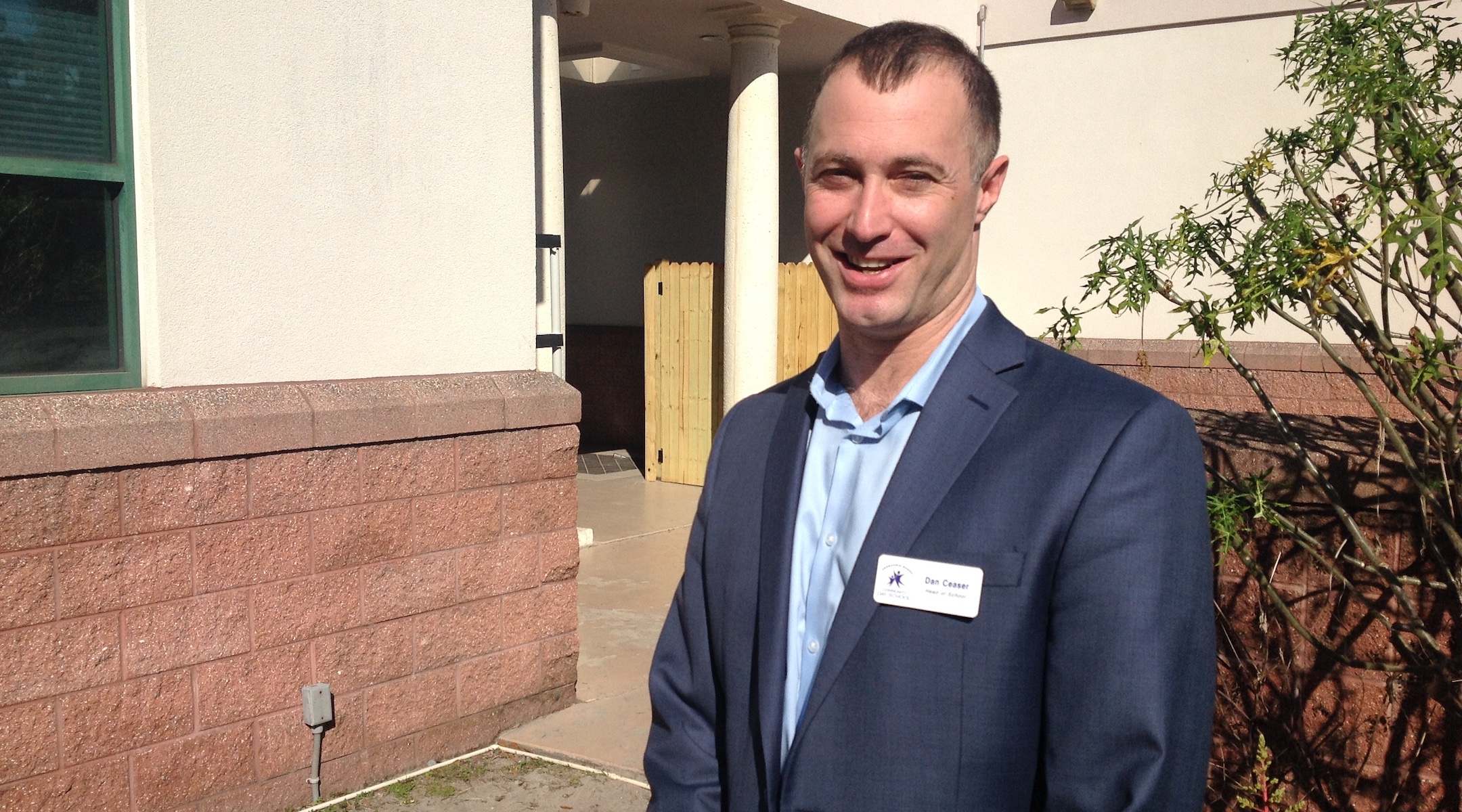
Dan Ceaser, the head of school of Hershorin Schiff Community Day School, has made the school's diversity a centerpiece of its message. (Ben Sales)


Dan Ceaser, the head of school of Hershorin Schiff Community Day School, has made the school’s diversity a centerpiece of its message. (Ben Sales)
Students at the school learn about the Jewish calendar, holidays and Israel, and pray each morning. Through second grade, they all study English, Hebrew and Spanish. 

 Starting the following year, students split off into studying one of the two languages intensively. There are also a few different religious studies tracks kids can choose — from world religions to Jewish studies to a more intensive, four-day-a-week traditional Jewish track run by Rabbi Chaim Steinmetz, director of Chabad Lubavitch of Sarasota & Manatee Counties, that will have a handful of kids this year.

“It’s kind of cool to compare the two religions,” said Matthew Cook, who will be entering 8th grade at the school and is a practicing Catholic. “The challah and the wine, there’s something a lot similar, it’s bread and wine — almost the same thing. Just [to me] it represents the body of Christ and the blood.”

In Hebrew class, the emphasis is on learning how to order falafel, or listening to classic Israeli singers, said Snait Ben-Herut, a Hebrew teacher. Ben-Herut said she gives kids an overview of Jewish history, which can get them interested in the language. Middle schoolers also travel to Israel every other year.

“The emphasis is less on writing and reading and more on the possibility of expressing yourself in Hebrew,” she said. “There’s an emphasis on the cultural side — Israeli slang, Israeli music, Israeli food. There’s an emphasis on Hebrew as a living, relevant language.”

The school also tries to cater to its diverse student body by being flexible in general. Classes will often have students from multiple grades. The curriculum is project-based, so students can (literally) get their hands dirty in a garden, choosing which vegetables to plant, or can devise a way to build a chicken coop on school grounds — a thing that actually happened.

Eric Pressman, who is Jewish and has two children at the school, appreciates that he can place them in a Jewish environment that does not cloister them away from the country’s non-Jewish majority.
“It allows our children to be raised with Jewish values, but it still embraces a multicultural feel,” he said. “It allows for children to prepare to engage in a diverse community, whether they do so academically or multiculturally or whether they do so occupationally. We don’t live in a Jewish microcosm.”

The school has a hallway of flags representing the 40 countries its students' families hail from. (Ben Sales)

The school has a hallway of flags representing the 40 countries its students’ families hail from. (Ben Sales)
Rev. Kelly Fitzgerald, who leads the First Presbyterian Church of Sarasota, began sending her three kids to Community Day two years ago and is now on the school’s board of trustees. She appreciates the school’s project-based learning and gardening lessons, but also sees value in sending her Christian kids to a Jewish school.

Recently, she was walking with her daughter in the supermarket and pulled a prepackaged school lunch of meat, cheese and crackers off the shelf. Her daughter made her put it back: It wasn’t kosher. Her kids also asked to light a menorah on Hanukkah.

“I don’t feel threatened in going to a Jewish school,” Fitzgerald said, “There’s maybe some understanding in the [Christian] community that that wouldn’t be a faithful choice, but I think it’s where we need to live as a society, in an interfaith culture.”
Ceaser said the school’s atmosphere and philosophy aim to make the students empathetic to each other’s divergent experiences, religious or otherwise. One hallway in the school displays the flags of all of the students’ families’ home countries. Ceaser remembers when, after the flags were hung, a group of seventh-grade girls approached him urgently in the hallway to demand that the Nepali flag be rotated. It was hanging in the wrong direction, they said, and could hurt the feelings of their Nepali friend.

“They’re like, ‘No, we need to talk to you now,’” he recalled. “‘You hung that flag and our friend, we feel like if she sees it hung upside-down, she’s going to feel really disrespected.’ I’m the principal, and they’re stopping me to advocate for one of their friends.”

https://www.jta.org/2019/08/19/united-states/at-this-florida-jewish-day-school-half-the-students-arent-jewish?utm_source=JTA%20Maropost&utm_campaign=JTA&utm_medium=email&mpweb=1161-12981-21723