EVERY SIGNATURE MATTERS - THIS BILL MUST PASS!

EVERY SIGNATURE MATTERS - THIS BILL MUST PASS!
CLICK - GOAL - 100,000 NEW SIGNATURES! 75,000 SIGNATURES HAVE ALREADY BEEN SUBMITTED TO GOVERNOR CUOMO!

EFF Urges Court to Block Dragnet Subpoenas Targeting Online Commenters

EFF Urges Court to Block Dragnet Subpoenas Targeting Online Commenters
CLICK! For the full motion to quash: http://www.eff.org/files/filenode/hersh_v_cohen/UOJ-motiontoquashmemo.pdf

Monday, November 02, 2020

"It is a phenomenon that has existed for many, many years within the ultra-Orthodox society. But the crisis, the closure of yeshivas and partial studies for ultra-Orthodox youth has only intensified and exacerbated the phenomenon.”

Ultra-Orthodox facing 'unprecedented' crisis as young people drift away


New study suggests that drop-out rate partly explains sector's violations of virus regulations; researcher warns country must tackle 'alienation and marginalization' that leads many who leave their Haredi lives to end up on streets


Haredi youths in an Israeli entertainment store
 Many young members of the Haredi community in Israel are abandoning the ultra-Orthodox lifestyle in favor of living on the margins of society, while the drop-out rate in religious Jewish schools is three times higher than that of state-run institutions, a new study finds.
 
The study was conducted on behalf of the Israel Democracy Institute and included 38 in-depth interviews with the heads of yeshivas and ultra-Orthodox associations and organizations, and education and welfare officials.
 
According to a number of rabbis and ultra-Orthodox parents who took part in the study, there is an unprecedented number of young people abandoning the community, an issue that was prevalent in the sector even before the pandemic began.
 
"The ultra-Orthodox youth just fall between the cracks," says Dr. Asaf Malchi, who led the study.
 
Malchi describes "disconnection, alienation and marginalization" of young people within the ultra-Orthodox community, leading to "delinquency, detachment and many other unhealthy situations."
 
According to the study, the state has failed in its response to marginalized ultra-Orthodox youth for a range of reasons, including failures by the Education Ministry and the Ministry of Social Affairs and Social Services.
 
"Young people dropping out of religious institutions is not a phenomenon that began during the coronavirus crisis," says Malchi. 
 
"It is a phenomenon that has existed for many, many years within the ultra-Orthodox society. But the crisis, the closure of yeshivas and partial studies for ultra-Orthodox youth has only intensified and exacerbated the phenomenon.”
 
Contact with the “outside” world and a sense of boredom have led to "a huge crisis within ultra-Orthodox society,” says Malchi. 
 
“The ultra-Orthodox community does not give legitimacy to secular education for Haredi teens, and this is one of the great crises facing ultra-Orthodox society today. Therefore, ultra-Orthodox rabbis are insisting on opening yeshivas and Torah studies to prevent this drift away."
 
Unofficial data shows that 15.20% of all Haredi students have partially dropped out of the ultra-Orthodox educational system and are attending their respective yeshivas only partially.
 
The distress caused by the crisis has led to extreme statements among the ultra-Orthodox mainstream. For example, by Rabbi Shimon M. who claims the health regulations are a plot by the authorities to harm the ultra-Orthodox way of life.
 
"I have no doubt that the government and other factors have found the opportunity to disrupt the proper functioning of our yeshivas," the rabbi says. "They simply want to create a situation in which the ultra-Orthodox public is crumbling.”
 
Rabbi Shlomo B., who works at a small yeshiva highlights focuses on the harm he says is caused by smartphones that "have changed the rules of the game."
התקהלויות חרדים באשדוד
Ultra-Orthodox men protest coronavirus restrictions in Ashdod
“Among the students there is always one who does not necessarily belong to the core of yeshiva, it is he who has a smartphone,” the rabbi says. 
 
“The first time the students see this unclean device they are shocked; the second time the shock abates and they even peek at the screen; the third time they are already asking to hold it. Watching the content on the device drags them like a whirlwind to other undesirable places, and they may even ultimately end up on the street.”
 
The rabbi also says, however, that smartphones are not necessarily the only issue. 
 
“Take me, for example. I never listened to the radio before. I didn't have time for that. Since the virus broke out I found myself listening to the news every day. This is definitely a side effect of the coronavirus."
 
Unlike in the yeshiva world of the '90s, the content available from the "outside" world is readily accessible and available to anyone.
 Yeshiva students in Bnei Brak studying in capsules during the pandemic
Yeshiva students in Bnei Brak studying in capsules during the pandemic

"You used to have to travel, change clothes and buy a movie ticket," says Yonatan, who works in a yeshiva in Beit Shemesh. 
 
"Today you can keep your shtreimel and sidelocks and still have access to everything at the push of a button. I met a boy who left the yeshiva next to ours during the pandemic and today he is on the streets."
 
Malchi has a series of suggestions to deal with the phenomenon of ultra-Orthodox youths abandoning their studies only to find they have no place to go.
 
One such solution is the establishment of an ultra-Orthodox youth directorate in the Education Ministry, which would provide education and training for Haredi young people wishing to integrate into the general population and the labor market.
 
“The state has a lot to do to tackle the phenomenon,” says Malchi.
“I have to say that this is a phenomenon that is too big for ultra-Orthodox society to deal with alone. We will see it intensify during this difficult period of the pandemic if left untreated."
 
https://www.ynetnews.com/magazine/article/SJOPjI4uP?fbclid=IwAR1-gwb3jmPcfMYm_xxNN-0-VDWtT_Eb5yqqrT2nsLCJ-fQJr9as9fqmiVQ

Sunday, November 01, 2020

Ultra-Orthodox Jews’ Greatest Strength Has Become Their Greatest Weakness

In Israel and the U.S., this isolated community is thriving. The coronavirus pandemic has shown why this may be its biggest problem.

TEL AVIV — In early October, Gov. Andrew Cuomo of New York ordered schools to close in some areas with large populations of ultra-Orthodox Jews because of coronavirus outbreaks. 


Some of the schools refused, and the governor threatened as a consequence to withhold state funding. At about the same time in Israel, a rabbi commanded his followers to open ultra-Orthodox schools, in defiance of government shutdown orders. Israel’s health minister warned these schools that they could face “heavy fines.” Two countries, two different systems of government — and a similar challenge: how to deal with ultra-Orthodox Jewish communities that while having high infection rates also refuse to take the necessary precautions. 


 Jews and gentiles must be careful not to single out the ultra-Orthodox, who look different and act different from most of us. I will try my best to be cautious. I will also state that I see much to admire in the ultra-Orthodox way of life: the sense of community and mutual responsibility, the emphasis on study, the devotion to tradition. And yet, I also feel an urgent need to advise ultra-Orthodox Jews to adapt to a new reality, one in which ultra-Orthodoxy’s great success — its ability to thrive in a modern world — has become its great challenge. Ultra-Orthodox Judaism today is based on strict adherence to Jewish law, a highly conservative worldview and a rejection of many components of the modern world (from evolutionary science to television), with the aim of erecting a shield against secularization and assimilation. In shorthand, the ultra-Orthodox are called Haredi — based on the Hebrew word for “trembling,” because these Jews tremble before God. On its own terms, ultra-Orthodoxy in Israel and the United States has been highly successful in achieving its goals.


 What were those goals? To establish an undisturbed and vibrant community of mitzvot (commandments) and Torah study. Seventy years ago, with the destruction of most ultra-Orthodox communities in Europe in the Holocaust, some assumed that the end of this branch of Judaism was near. However, with stubbornness and sophistication, high birthrates and social cohesion, ultra-Orthodox communities are growing and thriving. This success hasn’t come without many challenges. 


The first is economic: Ultra-Orthodox Jews tend to be poor by design. They prioritize study over work, and thus rely heavily on philanthropy and public support. The second is civil. Especially in Israel, where Haredi Jews both rely on public funds and still enjoy exemption from military service, there is a general feeling that this community does not pull its weight. Editors’ Picks On ‘S.N.L.’, Jim Carrey Reads a Spooky Election Update of ‘The Raven’ Will ‘Mank’ Be Netflix’s First Best-Picture Winner? A Podcast Answers a Fast-Food Question That Nobody Is Asking The third challenge is the relationship Haredi communities have with their surroundings.


 A demographic rise of the Haredi world makes the population both more noticeable and more influential. In a democracy, numbers have meaning, and in Israel and New York, the Haredi are a highly effective voting bloc. Socially, Haredi neighborhoods and towns tend to be less than hospitable to outsiders, and as the neighborhoods expand, clashes with neighbors are common. So these communities are gradually becoming harder to ignore. And the pandemic might be the ultimate demonstration of the emerging problem. In Jerusalem and New York, where these Jews live in great and fast-growing numbers, a puzzled public begins to feel these communities have become too independent. Haredi Jews have large families and live in densely populated areas. 


This enhances their model of togetherness and separateness. It also makes them more vulnerable to the coronavirus. By and large, like many closed communities, Haredi Jews are suspicious of outside institutions. (Some of this is born of a long history of persecution.) When outsiders demanded they shut down schools or cancel weddings or stop attending their synagogues, many of the leaders were thinking that such a decree could come only from people who do not understand the importance of these practices. They refused to comply. To these characteristics we must add Haredis’ suspicion of science (a feature of modernity) and their general stiff-necked mentality — the essence of resisting the temptations of a changing outer world. So it is not surprising that a sudden demand to change their community’s behavior was met by many Haredi Jews — and, notably, by many important Haredi leaders — with suspicion and open revolt. Some of them refuse to wear masks; some evade testing. Others send their children to school even when it is prohibited or attend mass funerals, where they clash with the police in New York and Jerusalem. Many attend crowded synagogues. 


No wonder that the rate of infections in ultra-Orthodox communities has skyrocketed. Haredi Jews are well practiced in defying the larger society in which they live, and defiance is the tool they pulled out when new pandemic rules were dictated. They did it by using political clout and harsh rhetoric, arguing that the authorities were being discriminatory. 


 Of course, they have every right to use political clout to make their case. It is also reasonable to assume that in some cases Haredi Jews are being singled out. (The fact that they are easily identifiable because of their distinctive clothing makes it almost inevitable.) And yet it is time for Haredi leaders to realize that their model of isolation from the larger public is becoming archaic. Not because it failed, but because it succeeded. The Haredi model in Israel and the West over the past century was meant to keep a threatened enclave from being wiped out by a cultural tsunami. It was tolerated as such by a generally indifferent public in relatively tolerant countries, and in Israel, where Jewish sentimentality added another layer of commitment of the state to the survival of the Haredi world. 


In short, it was designed for a weak group attempting to prevent decline. But as a model for a strong and thriving community it is flawed and dangerous. The thriving of the Haredi world in recent decades was made possible by an ability to be different, without being threatening; to reject the influence of the outside world, without being disruptive. Indeed, the disobedience of a weak minority can be tolerated. 


But the disobedience of a strong community — particularly one that could affect the health of the larger public — is more difficult to defend. Few things prompt hatred, fear and vengefulness like a pandemic. What we have witnessed in recent months is dangerous, first and foremost for the future of the ultra-Orthodox world. If Israelis completely lose patience with the Haredi lifestyle, the consequences for the community could be drastic. If Americans become hostile to the community, the consequences could be even graver. Anti-Semitism, already on the rise, feeds on fear and suspicion.


 So Haredi Jews are playing with fire. That is because they are not truly that powerful. Not if the world turns against them. No wonder that those of us who see value and beauty in the Haredi world — those of us who watch with admiration their prioritization of compassion over personal success, who identify with their prioritization of study over wealth and who respect their resistance to assimilation look at recent events with a growing sense of apprehension.


 Shmuel Rosner (@rosnersdomain) is a contributing opinion writer, a senior fellow at the Jewish People Policy Institute and the author, most recently, of “#IsraeliJudaism: Portrait of a Cultural Revolution.” 


https://www.nytimes.com/2020/10/29/opinion/ultra-orthodox-jews-coronavirus.html

Wednesday, October 28, 2020

Our country is seeing a surge in COVID; there have been almost half a million new confirmed COVID cases in the US in just one week.

Today, 3:43 PM 

 To:Paul Mendlowitz

(email truncated)


October 27, 2020.
 
Dear PAUL,
 
Our country is seeing a surge in COVID; there have been almost half a million new confirmed COVID cases in the US in just one week. While the number of new cases per 100,000 residents in New York remains low relative to other states, New York State is not in a hermetically sealed bubble. 
 
COVID is still here and continues to spread in communities in New York, particularly when people do not follow the safety protocols in place to control the virus. We continue to see outbreaks linked to mass gatherings at houses of worship, at weddings and funerals, and other events where too many people gather.
 
We cannot let our guard down and risk sliding backward in New York. We all must remain vigilant as the weather gets colder and as we are up against "COVID fatigue." Stay NY Smart: Wear a mask, socially distance and follow the public health guidance. It's there to save lives.
 
Chart of the Day: The statewide test positivity rate (the orange line) remains under 2 percent.
 
The positivity rate in the "micro-cluster" focus areas was 3.65 percent yesterday. The statewide positivity rate excluding these areas was 1.53 percent. Of the 111,618 tests reported yesterday, 1,991, or 1.78 percent, were positive. There were 1,083 total hospitalizations. Sadly, we lost 15 New Yorkers to the virus. 
 

Ever Upward,
 
Governor Andrew M. Cuomo

Tuesday, October 27, 2020

The rabbis are assigning higher priority to 'customer retention' than to the clear halakhic imperative to preserve health and life!

Ultra-Orthodox non-compliance rests on fear

The rabbis are assigning higher priority to 'customer retention' than to the clear halakhic imperative to preserve health and life
Following authorization from their rabbis, ultra-Orthodox Jews of the Toldot Aharon sect attend a computer and Internet lecture in Ramat Gan. February 2, 2012. (Yossi Zeliger/FLASH90)

The ultra-Orthodox “revolt” of the last lockdown, which continues until today, is most clearly expressed in the opening of their elementary schools for boys.

This violation of the rules brings to light two phenomena: the first is the unmistakable priority granted to abiding by communal and religious values over complying with the laws of the state. Second, and just as strong, is fear. The behavior of the ultra-Orthodox, as some of their leaders candidly acknowledge, stems from the recognition that if they leave their flock without supervision, even briefly, the whole system is liable to fall apart. This insight, which shows ultra-Orthodox society in a sad light, reveals that it is clearly in need of internal soul-searching. But it also sprouts hope for the integration of the ultra-Orthodox into Israeli society in the future.

The conduct of the ultra-Orthodox since the onset of the pandemic, and all the more so during the recent lockdown, has left many Israelis rubbing their eyes in disbelief. Besides the anger at the irresponsibility and flagrant lack of solidarity displayed by most of the ultra-Orthodox, many outside the community simply cannot understand why its rabbis and leaders, who certainly do not want their followers to fall sick or die, are knowingly endangering their health. Indeed, the morbidity and mortality figures among the ultra-Orthodox have skyrocketed, to the point where this sector has become a world leader in coronavirus infections.

One possible explanation — admittedly, rather shaky — is that Jewish values oblige us to continue public prayer and Torah study in a public setting, whatever the health risk. This is a dubious explanation, since one need not be a great talmudic scholar or an eminent halakhic adjudicator to understand that, in Judaism, the supreme value, overriding all else, is the sanctity of life. This is expressed in the halakhic dictum that the precepts (mitzvot) were given to live by (meaning that individuals must live in order to fulfill them), rather than to die for (as a result of keeping them). This principle is the beacon that lights the path of each and every Jew.

The second explanation, less obvious but more convincing, is fear. There are two ways to enforce an ascetic lifestyle that demands personal sacrifice, of the sort followed by the ultra-Orthodox. One is an ardent belief, shared by all members of the community, that theirs is the right path; the other is by building up high walls to insulate the community and — enforce a draconian regime within them. The COVID-19 pandemic makes it glaringly clear that the ultra-Orthodox community’s existence and sustainability is grounded in rigid and uncompromising regimentation, as well as in fear.

Ultra-Orthodox life revolves around a close-knit community framework that defines the parameters of its members’ lives and their choices, from the cradle to the grave. Prayers, group study, the rabbis’ gatherings and receptions for their followers, and all the other community events guarantee that individuals will be under close supervision at almost every moment of their lives. The rabbi, the teacher, the spiritual supervisor in the yeshiva, the man in the next pew in the synagogue, the neighbors in the park — all of them are always watching, keeping their eyes on everyone else, making sure that they toe the line, and do not deviate in the slightest bit from the straight and narrow path. Every wig that does not keep a married woman’s hair wholly out of sight; every failure to show up for daily services, is cause for concern. Any seriously deviant behavior constitutes the grounds for harsh community sanctions, ranging from exclusion from the synagogue to condemnation and ostracism of the “criminal” and his family. For those born into this communal reality, this is a punishment too cruel to bear.

And then came the coronavirus pandemic. To comply with the rules of social distancing imposed by the government, the ultra-Orthodox, like all other Israelis, have to stay home and manage without key elements of their community life. Yes, you can pray with a minyan of only 10 men in the courtyard of your apartment building. Yes, you can study Talmud at home. But when men of all ages are at a distance from the community circle, its watchful eye no longer has them in constant view. Confined at home, without the rabbi or neighbor to keep tabs on them, they are liable to go downhill, discover that there are other ways to live, and to find their way out of the community.

This truth, which most rabbis have preferred to keep under wraps, was revealed by several among them who openly acknowledged that their followers are too weak to stay within the fold without close supervision. Their calculation was simple. There is no doubt that the pandemic endangers life; but the threat of dropout from the community and of spiritual damage that cannot be remedied is far greater and far more terrifying. Such a threat may shake the foundations, the regime, the community. The rabbis are assigning higher priority to “customer retention” than to the clear halakhic imperative to preserve health and life.

This fear, which lies behind the willingness of many ultra-Orthodox rabbis to sacrifice their followers’ lives — and those of other Israelis — is clear evidence of their doubt as to their followers’ commitment to the path, and of their sense that without close supervision and high walls, everything could fall apart. From a broader Israeli perspective, if this is indeed the true picture, perhaps there is hope for the future. Perhaps the broader and deeper integration of the ultra-Orthodox into Israeli society is not impossible after all.


https://blogs.timesofisrael.com/ultra-orthodox-non-compliance-rests-on-fear/?fbclid=IwAR31u4LNHhvt1dCUht2xbdjGBYOFuRpMWaRZdePbP4U8q-uk3a2tjk8F2Ts

Monday, October 26, 2020

In Brooklyn’s Borough Park, home to a diverse Orthodox Jewish community, one Yiddish robocall told residents that “even if they force you, even if they beat you like the Jews in Israel, and especially not voluntarily, and one must also not go get tested because this raises the statistics in our neighborhoods.”


In the course of about a month, the Hasidic village of Kiryas Joel, N.Y., managed to drop its rate of positive tests for coronavirus infection by a dramatic 30 points — from 34.2% in the last week of September, to 4.2% this week, according to state data released Wednesday.

Town leaders and New York Gov. Andrew Cuomo chalked the change up to the effect of coronavirus restrictions in Kiryas Joel, after Cuomo designated it a “red” zone on October 6, requiring schools and nonessential businesses to close, and for worship services to be capped at 10 people.

But Dr. Irina Gelman, the health commissioner for Orange County, which includes Kiryas Joel, a dense town of 26,000, has a different explanation: Village residents with coronavirus symptoms are refusing to get tested.

She said in emails to the Forward that doctors from hospitals, primary care providers and urgent cares have told her, as well as the state’s task force to stem the spread of coronavirus, that people showing coronavirus symptoms are foregoing tests altogether, including for flu and strep throat.

“This is not a typical declination in percent positive rate, which would be more gradual and over a longer period of time,” Gelman wrote in response to emailed questions. “I suspect there is some degree of correlation between the physician reported patient refusal to test and the dramatic decline in the currently reported test positive percent.”

Gelman says further investigation is needed before she can determine what exactly caused what she called the “drastic” drop in Kiryas Joel’s positive rate.

But she said that the village has seen a decline in the overall number of coronavirus tests administered to residents, even as hospitalizations have increased — two signs that the actual rate of coronavirus infection in the village has either not decreased at the rate suggested by the reported percentage of positive tests, or is in fact increasing.

Gelman’s office did not provide recent data on hospitalizations, total test volume or percent positive test rate from Kiryas Joel or its ZIP code, which includes the largely non-Hasidic town of Monroe.

Publicly available data for all of Orange County shows that overall tests have dropped somewhat over the past two weeks. The county’s rate of hospitalizations related to COVID-19, the disease caused by the novel coronavirus, has also ticked up since the middle of September.

A representative for the New York Department of Health did not respond to emailed questions about Kiryas Joel’s data or Gelman’s assertions.

Gedalye Szegedin, the town administrator for Kiryas Joel, did not comment after being contacted by the Forward.

Two major health providers serving Kiryas Joel did not respond to requests for comment.

Joel Petlin, the head of Kiryas Joel’s public school, which serves children with special needs, said that even if some residents are refusing coronavirus tests, discomfort with the tests is widespread.

“I don’t know that that problem is a uniquely KJ issue,” he said, using a common abbreviation for Kiryas Joel. “It’s probably a problem throughout the state and the country, for people who don’t want to be tested because of the intrusion, or don’t feel they’re overly sick.”

When asked why a Kiryas Joel resident might refuse a coronavirus test, Petlin said, “Because they’re human.”

Kiryas Joel is one of several designated red zones throughout the New York City region with high rates of positive coronavirus tests, all of which center around areas with large Orthdoox communities. Red zones face the harshest restrictions, with “orange” and “yellow” zones facing somewhat relaxed restrictions.

Orthodox Jews have repeatedly expressed frustration and anger at the restrictions, saying that the community felt unfairly singled out by Cuomo, and that the restrictions were unnecessary and overly burdensome.

On Wednesday, Cuomo relaxed restrictions on two once-red zones, in the borough of Queens. The red zones in Kiryas Joel, as well as the ones centered on the upstate Hasidic community of Monsey and in South Brooklyn, will remain intact, Cuomo said, because they did not fall below the state’s designated 3% threshold for positive coronavirus tests. Orange zones around those red zones have been downgraded to yellow, allowing schools and nonessential businesses to open.

“We have it managed,” Cuomo said. “We know how to do this.”

Despite Kiryas Joel’s reported drop in positive coronavirus cases, its positive test rate suggests that the village is still in a precarious place, and requires continued restrictions, said David Abramson, a professor of public health at New York University.

“The 34 number is an extremely high number. In fact it’s a set-your-hair-on-fire number,” Abramson. “The four is still much higher than we’d be comfortable with.”

Abramson said that in this second wave of the virus in the New York City region, younger people are expected to be infected at a higher rate than older people. In an overwhelmingly young, densely populated village like Kiryas Joel — about 61% of the village is under 18, according to Census data from 2019 — that could mean wide infections with few hospitalizations.

But, Abramson said, “If the number of hospitalizations is not going down, but the test rate is dropping, they’re probably trying to limit the number of tests that they take.”

Orthodox neighborhoods in New York City have seen less testing than others, despite having high rates of positive coronavirus tests, which health experts worry could mean that these hotspots are hotter than the data suggest.

Orthodox residents have received robocalls and text messages urging them to avoid testing so as to game the health data, according to audio and text messages obtained by the Forward.

In Brooklyn’s Borough Park, home to a diverse Orthodox Jewish community, one Yiddish robocall told residents that “even if they force you, even if they beat you like the Jews in Israel, and especially not voluntarily, and one must also not go get tested because this raises the statistics in our neighborhoods.”

Gelman said that doctors have told her that their patients are refusing tests for many reasons. Some believe their community either has or should achieve herd immunity, the point at which enough people in Kiryas Joel have contracted the coronavirus and developed antibodies to prevent its spread.

Others may have heard misinformation that one cannot be infected twice with the disease, or are simply experiencing “pandemic-related fatigue” over medical intrusions, Gelman said.

Health experts have said that herd immunity from the coronavirus is likely impossible, since antibodies developed by those who have it often wear off after several months. Abramson said that trying to achieve herd immunity is akin to playing “Russian roulette.”

Petlin suggested that Gelman’s statements might stoke antisemitism, pointing to early spikes in the virus in upstate Hasidic communities in the spring that led to instances of antisemitism in the area and an anti-Orthodox backlash on social media, even though he said he did not believe that was her intention.

In an emailed response to the question of whether she is concerned that her statements could stoke antisemitism in the county, Gelman said that the county’s health department “takes the health and safety of all of our residents very seriously, even more so during the worst public health crisis in a century.”

“These are not anecdotal accounts, and there is an inherent, serious population-wide health risk that impacts all residents of our county,” Gelman added.

Ari Feldman is a staff writer at the Forward. Contact him at feldman@forward.com or follow him on Twitter @aefeldman

https://forward.com/news/457072/hasidic-coronavirus-kiryas-joel-orange-county/?fbclid=IwAR2wcDE_DCqnEvYMEZQjbn9Bhhqomcks2Cz8rnyUvyajMpXY9pHNv7Wv19M

Sunday, October 25, 2020

Yehuda Kolko Dead!

READ:
https://www.pressreader.com/usa/new-york-daily-news/20161028/281629599818408

 On The Rabbi's Knee:

“Does it hurt?” the boy recalls the teacher saying, over and over. His voice was urgent but also oddly indifferent, as if he were asking about the weather. “Does it hurt?”

The boy was panicked now, desperate to open the car door and run into the school for help. But he was 12 years old, and the teacher was older and stronger, and, after all, he was a teacher.

All the boy wanted was to fit into his new world. The sooner this ended, he thought, the sooner he could forget it ever happened.

 READ IT ALL:

https://nymag.com/news/features/17010/

Wednesday, October 21, 2020

For the ultra-Orthodox to complain that they're being discriminated against when they come under extra scrutiny is essentially to complain that it's anti-Semitic to notice what they're doing.


When Covid-19 rules are flouted by ultra-Orthodox Jews, it isn't anti-Semitism to call it out

When the Jewish community says that it is, it obscures true anti-Semitism while providing leeway not to comply with restrictions needed to stop the spread of the virus.
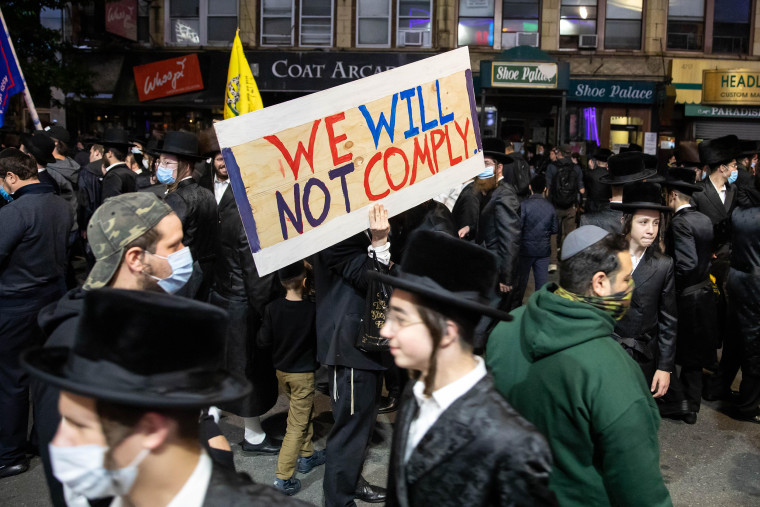
Image: COVID-19 Hotspot Protest in Borough Park, Brooklyn, NYC
A sign reads "we will not comply" at a protest against Covid-19 restrictions in an ultra-Orthodox Jewish neighborhood of New York City on Oct. 7.Michael Nagle / Redux

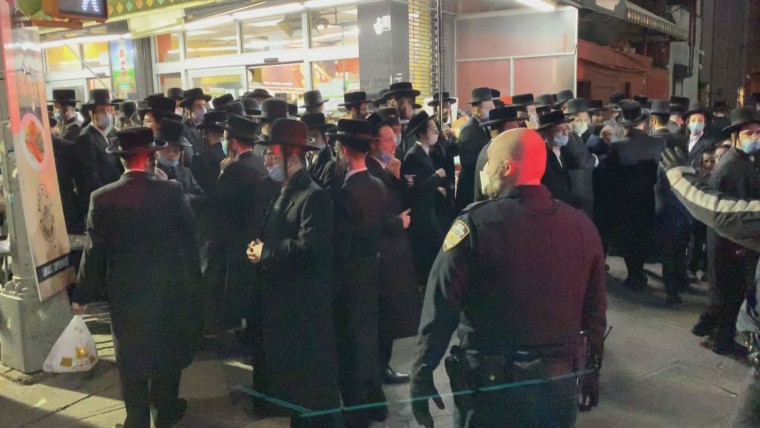
As authorities scramble to confront a second wave of Covid-19 building across America, anger is mounting against government efforts to stop the spread within a population among those hardest hit by the pandemic: the sprawling ultra-Orthodox Jewish community of metropolitan New York.

For the ultra-Orthodox to complain that they're being discriminated against when they come under extra scrutiny is essentially to complain that it's anti-Semitic to notice what they're doing.

With the pandemic in its eighth month and restrictions cutting into the religious practices of the tight-knit, strictly observant subculture, it's understandable that weariness and impatience would set in. Unfortunately, that's leading to a growing sense in the community that it is being singled out unfairly for deprivation of its religious rights, often accompanied by open complaints of anti-Semitism as the cause for the lockdowns.

It's a dangerous misperception, for both the ultra-Orthodox and their neighbors. The virus doesn't single out groups by religion, race or national origin; it's an unbiased scourge. Nor are New York officials' containment efforts guided by any such bigoted motives. Enforcement goes where the germs are. And the germs, tragically, are hitting ultra-Orthodox Jews with special fury.

From the beginning of the crisis in March, densely populated ultra-Orthodox neighborhoods in Brooklyn, Queens and key suburbs emerged as leading viral hot spots in hard-hit New York. Their outsize vulnerability was due in large part to a traditional religious culture built on a continuous cycle of obligatory, large-scale gatherings for prayer, study, weddings and funerals, all cherished rituals that can and apparently did serve as super-spreader events.

Compounding these risks has been the mundane physical structure of the insular ultra-Orthodox lifestyle, built on large families' living in cramped homes packed into dense neighborhoods, making social distancing extraordinarily difficult.


But because those are religious obligations and cornerstones of their Jewish identity structure, government-mandated lockdowns and social distancing can and too often did look from an ultra-Orthodox perspective like government assaults on the religion itself.

It might seem surprising that the community's behavior hasn't been dictated from start to finish by the fundamental Jewish principle known as "protection of human life" — the commandment that nearly all religious rules be suspended if a human life is the balance. And, indeed, while many respected rabbis urged members of the community to follow that guidance, it appears that the principle was hard to visualize when the threat wasn't an enemy gun or a car crash — events that Jews regularly violate religious restrictions to address — but an invisible bug.

That difficulty wasn't helped by a small but influential minority within the community that has been nodding toward a competing principle — that of sanctifying God's name by openly defying oppressors' bans, even at risk to one's own life and limb. While rarely stated aloud right now, this notion has been encouraged by a handful of well-known rabbis, most of them Israelis with strong followings in the United States, and, more subtly, by a deep-seated distrust of the modern world and its dictates, which often take the form of medical directives.

After a long spring of cat-and-mouse police chases after clandestine synagogue services and other attempts by the ultra-Orthodox to evade quarantine, followed by the summer slowdown in infections, the New York City health department reported startling new statistics in late September showing that certain neighborhoods in Brooklyn and Queens, most of them featuring large ultra-Orthodox populations, were reporting virus test results averaging 4.7 percent positive, compared to just over 1 percent in the rest of the city. Two weeks later, the average jumped to more than 6 percent.


The nine "red zone" ZIP codes on the state map of the highest infection rates at that time — which carried the heaviest public restrictions as a result — were nearly all major ultra-Orthodox population centers. Among other things, houses of worship in red zones were limited to 10 attendees at a time under a policy announced by Gov. Andrew Cuomo.

Ultra-Orthodox community leaders maintain — and government authorities largely agree — that most ultra-Orthodox Jews are following government mandates and that violators represent only a minority. That minority, however, seems to be large enough to push the entire community into vastly disproportionate infection territory, given that observance by a vague "most" isn't sufficient to stop the virus.

Yet the reaction of much of the ultra-Orthodox community has been to protest the lifesaving government restrictions — sometimes violently — and to paint them as anti-Semitic. In a typical example, a weekly tabloid with a mostly Orthodox readership touted on its front page an essay headlined "De Blasio And Cuomo Have Declared War On Us," which accused the governor and New York Mayor Bill de Blasio of "treachery and blatant anti-Semitism" and claimed that they "want to destroy our schools and way of life."

And in a toned-down critique, Agudath Israel of America, the main advocacy body representing ultra-Orthodox Jews, argued that while the ban on large services "discriminates against all religions," it "disproportionately impacts the religious services of Orthodox Jews," who would be shut out from traditional synagogue observance of two major religious holidays.

But for the ultra-Orthodox to complain that they're being discriminated against when they come under extra scrutiny is essentially to complain that it's anti-Semitic to notice what they're doing. And in this case, defiantly maintaining tradition doesn't risk just their own lives, which is their prerogative, but their neighbors' lives, as well. The trap they're caught in is tragic, but society has a right and an obligation to protect its people's welfare.

Indeed, the greater anti-Semitism threat likely comes not from failing to defend Jewish rights but from trying too hard. When Jewish communities, Orthodox or not, ask for special accommodations to meet their particular needs, it's often seen by other communities as cutting in line, wheedling extra privileges while broader needs go unmet.

To be sure, part of the ultra-Orthodox misperception that anti-Semitism is at work comes from memories of long centuries when anti-Jewish powers forced Jews to give up their traditions or take them underground. These memories, and the alarms they trigger, are familiar to Jews of every religious and ideological stripe.

Throughout their history, Torah-observant Jews have faced emergencies that have forced them to compromise and bend some laws, sometimes permanently.

At the same time, it's precisely this history that should serve as a guide for the ultra-Orthodox community today in combating Covid-19. Throughout their history, Torah-observant Jews have faced emergencies that have forced them to compromise and bend some laws, sometimes permanently.

Disasters, usually in the form of anti-Semitic persecution, have forced them to drop some practices and amend others to survive until better times returned. So it was after the Roman destruction of Solomon's Temple in ancient Israel and during the Spanish Inquisition, the medieval Polish-Ukrainian pogroms, the Soviet era and the Holocaust.

But America isn't any of those things. Instead, it is the ultra-Orthodox community itself that right now poses the most danger to its own continuity.


https://www.nbcnews.com/think/opinion/when-covid-19-rules-are-flouted-ultra-orthodox-jews-it-ncna1243590?fbclid=IwAR3YjnZjZYtkTrPHaIcfwZWHLarBhPv75IGnKVAVhrA4ylDXWPcReqTvyvo

Monday, October 19, 2020

Agudath Israel To Governor Cuomo: In Our Shuls There Iz Problem....

 CLICK: https://youtu.be/5MAiVi-l2hY

https://youtu.be/DcGvB8-s4Fg

https://youtu.be/094SZQBLNc8


Agudah Chorus: We throw our Jews down the well,

by telling you to go to hell,
so our shuls can be free
to make big  funeral "pardee"

We can not go to shul to shmooze,
 we miss the kiddush clubs and all the booze,
The dead Jews are not our problem
most never pay their dues,
This year cuz of you we can not make tenksgiving party,
oy vey, what to do?

 Agudah Chorus : Governor - In our shuls there iz problem,
we will tell you to go to hell,
So we can go to shul
and drop dead, because we are fools

Give us more reasons to sue,
so we can pray together not to lose,
 as we gather our idiot flock,
all around the Boro Park block,
so we give people around the world more reason to hate the Jew...


Agudah Chorus : Governor - In our shuls there iz problem,
we will tell you to go to hell,
So we can go to shul
and drop dead, because we are fools

Friday, October 16, 2020

TURNING BACK: THE PERSONAL JOURNEY OF A “BORN-AGAIN” JEW -- A Lesson of Courage, Determination, and Sheer Smarts - A Must Read For All In These Especially Troublesome Times!


TURNING BACK: THE PERSONAL JOURNEY OF A “BORN-AGAIN” JEW


          Popular media never seem to get their fill of stories about jaded young men and women born into Orthodox Jewish communities who emerge – spiritually deprived and intellectually hungry – into the “normal” world of pop culture, non-marital relationships and complex “gender expression.” Deborah Feldman’s Unorthodox: The Scandalous Rejection of My Hasidic Roots was greeted with ecstatic reviews (notwithstanding the book’s manifest factual problems) and remained so popular that, eight years later, Feldman’s autobiography reappeared as a Netflix miniseries. Shulem Deen likewise found a ready audience for his memoir All Who Go Do Not Return, in which he describes his painful exodus from a Hasidic hell.

          But what about travelers in the opposite direction? Though it’s no secret that a great many Jews raised in secular surroundings have adopted Orthodoxy over the last few decades – the making of B.T.s, or ba’alei t’shuvah (“those who return”) has even been described as a “phenomenon” – their stories, when written at all, are generally addressed to a narrow Orthodox audience and told in such a way that outsiders to that community will not find much of interest in them.

          Michael Lesher’s beautifully-written and provocative memoir, Turning Back: The Personal Journey of a “Born-Again” Jew, is so startlingly different that the book, though easy to love, is not easy to categorize. It’s not a typical “B.T.” book: there’s no cheerleading for Orthodoxy, and no shortage of questions about its culture or the behavior of some of its adherents. On the other hand, Lesher has little patience with secularist dogma, and his skewering of Jewish “liberals” who can tolerate anything except traditional Judaism will not win him many friends among the politically correct. I also doubt that Lesher’s descriptions of his painfully awkward (and sometimes hilarious) experiences with Orthodox dating, sprinkled with sentences like “I was just a Jew with his nose in the Talmud and his imagination in Last Tango in Paris,” are calculated to find admirers for the book in the ArtScroll/Feldheim crowd.

          Turning Back is really what every first-rate book about religious transformation ought to be: intensely personal, rich in human detail, and alive with the tensions of changing lifestyles, personal collisions, doubts, desires, disappointments, surprises – and, among all that, an inner drive to get hold of an elusive reality that only a certain kind of religious life seems to offer.

Those in search of comfortable answers won’t find them here. But Lesher’s journey into Orthodoxy is so full of unforgettable details that the reader is likely to be grateful Lesher’s ride wasn’t easy. In fact, the book contains a kind of metaphor for the journey. On a late-night subway ride over a bridge from Brooklyn into Manhattan, tired and jaded after an unsuccessful date, Lesher watches as the lights of the city below him “leave a tantalizingly abstract pattern of red and white in neon, fireworks accidental in their combinations and all the more astonishing for that.” From the bridge it seems as though “appetite writes itself gorgeously over the depths of river and darkness.” But later, walking through the Lower East Side, Lesher writes, “Now that I’m closer to the city buildings, their beauty when seen from above is gone, and I register the sinister drabness that was masked in shadow in the view from the bridge.” Again and again in Turning Back, Lesher experiences a similar pattern: things lose at least part of their magic as he draws closer to them.

Not all of it, though. Lesher’s enchantment with the Talmud is contagious, as is his fascination with some very unusual people he meets at Ohr Somayach, the B.T. yeshiva where he goes to study in Monsey, New York. (It’s hard to imagine another place where you’d find a Peruvian mindreader, an aging skeptic obsessed with anti-Semitism and a newly-religious Israeli who says, “Business and government in America pollute the ground. Scientists in America pollute the soul” – all in a few short months.)

And Lesher makes it clear that there’s no simple way out either, whatever outsiders may imagine: he has as much trouble with his family during his transition as he does with some of his zealous fellow students. One brother intermarries while Lesher is studying in yeshiva. His father visits him – stirring painful memories of his parents’ divorce. Another brother has become an evangelical Christian. It’s all here: everything that makes contemporary Jewish life so messy, so full of collisions and tangents, and – when seen from the perspective of someone who is both inside and outside the traditionalist camp – so thoroughly uncanny and unpredictable. Lesher gives voice to all of it, and whether you agree or not with all of his personal choices, it’s hard to resist the way he tells the tale.

As it happens, I’ve known Michael Lesher for years, particularly as a campaigner for victims of child sex abuse and as the author of Sexual Abuse, Shonda and Concealment in Orthodox Jewish Communities, the first (and still really the only) book-length analysis of sex abuse cover-ups among Orthodox Jews. In other words, I’ve always known that Michael isn’t afraid to speak his mind and doesn’t hesitate to take up a subject that won’t make his life simpler.

That same spirit is abundantly in evidence in Turning Back. But this isn’t a book of facts and figures, not a collection of essays, not even a provocative treatment of problems in Orthodox Jewish culture. This, in Lesher’s own words, “is a book about life – about my life, to be specific – and not about movements, statistics or trends.” It’s also a book filled with surprises, humor, sadness, sharp insights, and characters that Lesher’s treatment of them renders almost larger than life. And in his extended narrative about the Crown Heights riots of 1991, Lesher manages to combine all of these things into a riveting meditation about life and death, Jews and anti-Semitism, fear and hatred, hope and despair, religion and modern America.

What can I say? No two people can have exactly the same experience of life inside Orthodox Judaism. But whatever you know about that experience, you’ll gain something from seeing it as Lesher sees it. His writing is consistently superb, and some of his insights are so fine I’m tempted to quote bundles of them.

Here’s one that follows an incident where Lesher, heading home late one night, gives five dollars to a Jewish beggar who confronts him on a deserted Manhattan street and then disappears after trying (unsuccessfully) to wangle more money out of him. Lesher writes:

Most money is given to beggars out of cowardice, says Nietzsche. Was I a coward? Needless to say, before my conversion I wouldn’t have dreamed of giving such a creature five dollars. So why had I handed it over now? Had I done it only to prove (to him? To myself? To the invisible eye of Orthodox social opinion, watching at all hours?) that I really had changed – that my new lifestyle was more than a style? Or was I just an ordinary dumbbell, taken in as all dumbbells are taken in?


At one level, I guess, the religious life amounts to a new set of devices by which we can be manipulated. And against which we must therefore learn to toughen ourselves. At the risk – it sometimes seems – of losing touch with exactly the fire and tenderness that was behind the appeal of that life in the first place.


We want to be saints, and end up as calculating nebbishes. We want to transcend the limitations of ego, and we find ourselves struggling for some way to unscramble our own motives. People who think of Orthodoxy as a simplifying creed have never lived in our skins.


No, Orthodoxy – as Lesher sees it – is not a simplifying creed. And Turning Back is not a simplifying book. It’s only a great book. And a book everyone ought to read.


The link to the book on Amazon is:


https://www.amazon.com/dp/1947187058?ref_=pe_3052080_397514860


Thursday, October 15, 2020

Who are the ultra-Orthodox community fooling, who are they killing?


The streets of Williamsburg, Brooklyn, one of the Orthodox neighborhoods in New York City where COVID cases have increased recently. Few people are wearing masks. 


By Passover we knew for sure. We were mourning the deaths of our dear family and friends. We were recovering from the virus ourselves.


When it all began sometime around Purim, we did not understand how deadly this novel virus would be. We couldn’t know. We couldn’t be blamed for not knowing. We didn’t realize that eating together, and singing and dancing together were the easiest ways to transmit this deadly disease. But that was Purim. By Passover we knew for sure. We were mourning the deaths of our dear family and friends. We were recovering from the virus ourselves. 
 
Seven weeks later, on Shavuot, COVID-19 was still raging. And on Rosh Hashanah, Yom Kippur, Sukkot and Simhat Torah it still raged.It’s not what we wanted, it’s not what we expected, but it is – as the saying goes – what it is.So why can’t the Jewish world, the haredi, ultra-Orthodox world in particular, accept this hard truth? Why do some people think that they are different from everyone else?As Jews, we know how to abide by rules and regulations: Shabbat, kashrut, the 613 commandments we obey on a daily, weekly, monthly and yearly basis.
 
 How is it that people either don’t realize or don’t care that by flaunting the rules being imposed on us by medical professionals, they are risking their lives, the lives of people about whom they care, even the lives of people whose names they now know but whose lives they have – because of their own selfish and self-serving needs and desires – altered forever.I’m angry. I’m more than angry. I’m enraged, and I’m embarrassed.My fellow Jews are rioting. They are burning protective masks, mocking social distancing and fighting with police. And the whole world is watching.And it’s been going on this entire pandemic. 
 
How can such people – the “People of the Book” – not realize that instead of saving lives as we are instructed, they are causing the loss of lives?Weddings are celebrated and then, about five days later, the parents or grandparents of brides and grooms are testing positive for the virus. They might die. Thousands of people attend a funeral of someone who died from COVID-19, and then hundreds become infected. Again, they might die. People mourn, sitting shiva – not Zoom shiva but real shiva, where well-wishers enter their homes to share condolences – and the mourners themselves end up sick, hospitalized or dead. A grandmother contracts it from a grandchild. An uncle catches it from a nephew and is admitted to the ICU.
 
 It is a deadly cycle.INCONVENIENCING OURSELVES in order to respect and honor the elderly and those most at risk should not be treated as a burden, it should be treated as a gift. When we have the ability to help save lives, why would people – our people – choose instead to engage in acts that will, ultimately and inevitably, take lives? Why?The haredi community believes they are being singled out and even persecuted, in the United States as in Israel, because they are different, because they stand out. They are right. They are being singled out. But not for those reasons. They have thrown the health recommendations out the proverbial window and their number of coronavirus cases has skyrocketed. That’s why.When the number of cases declined in Orlando, Florida – the home of Disney World, “the happiest place on Earth” – until this past week, there has to be a reason.
 
 Maybe it’s because it’s Sukkot, and Orlando was the destination of choice for thousands of Jews from haredi communities across the USA.Do they not see the correlation or can they just not accept the truth?The riots I am seeing on television and social media, the open disregard for the law of the land, is the stuff of anarchists and hate groups, not the Orthodox Jewish community. The logic is warped. The violence is real.Synagogues, stores and restaurants in some Orthodox communities are pretending to comply. They are posting large signs on their doors that say “CLOSED,” and in smaller letters, in Hebrew or Yiddish they write, “Use the back door instead,” as if the police don’t know what’s happening. 
 
The haredi community might not be fluent in the use of Google Translate, but the police certainly are. And in the end, who are they hurting? Who are they fooling? More importantly, who are they killing? Against whom are they committing the ultimate sin?Doctors and scientists still do not fully understand this virus, but there are some things they know. They know that avoiding large groups save lives. They know that wearing masks save lives. They know that social distancing saves lives. And they know the importance of hand-washing. It’s not rocket science, but it is science.Maybe, just maybe – if we all do our best to follow the advice of the health professionals and others who know what they’re talking about – by next Purim we will be able to sing and dance and dine and rejoice with no fear of spreading the virus.

https://www.jpost.com/opinion/who-are-they-fooling-who-are-they-killing-645369?fbclid=IwAR3ysc1fGJ2l_uZP8nyrOQuUI6d1Cmly6Shd0IE8OachGASFOzn-SO4bojs


Wednesday, October 14, 2020

In the present crisis as well, the same approach seems to have been adopted — one law for citizens in general, and another — for the ultra-Orthodox, providing their rabbis agree. As we see, this approach has failed miserably.


What do you do when there’s a hole in the boat?


Israel must reclaim its relinquished sovereignty over the ultra-Orthodox and cancel their rabbis' unlimited power brokering between their flocks and the state
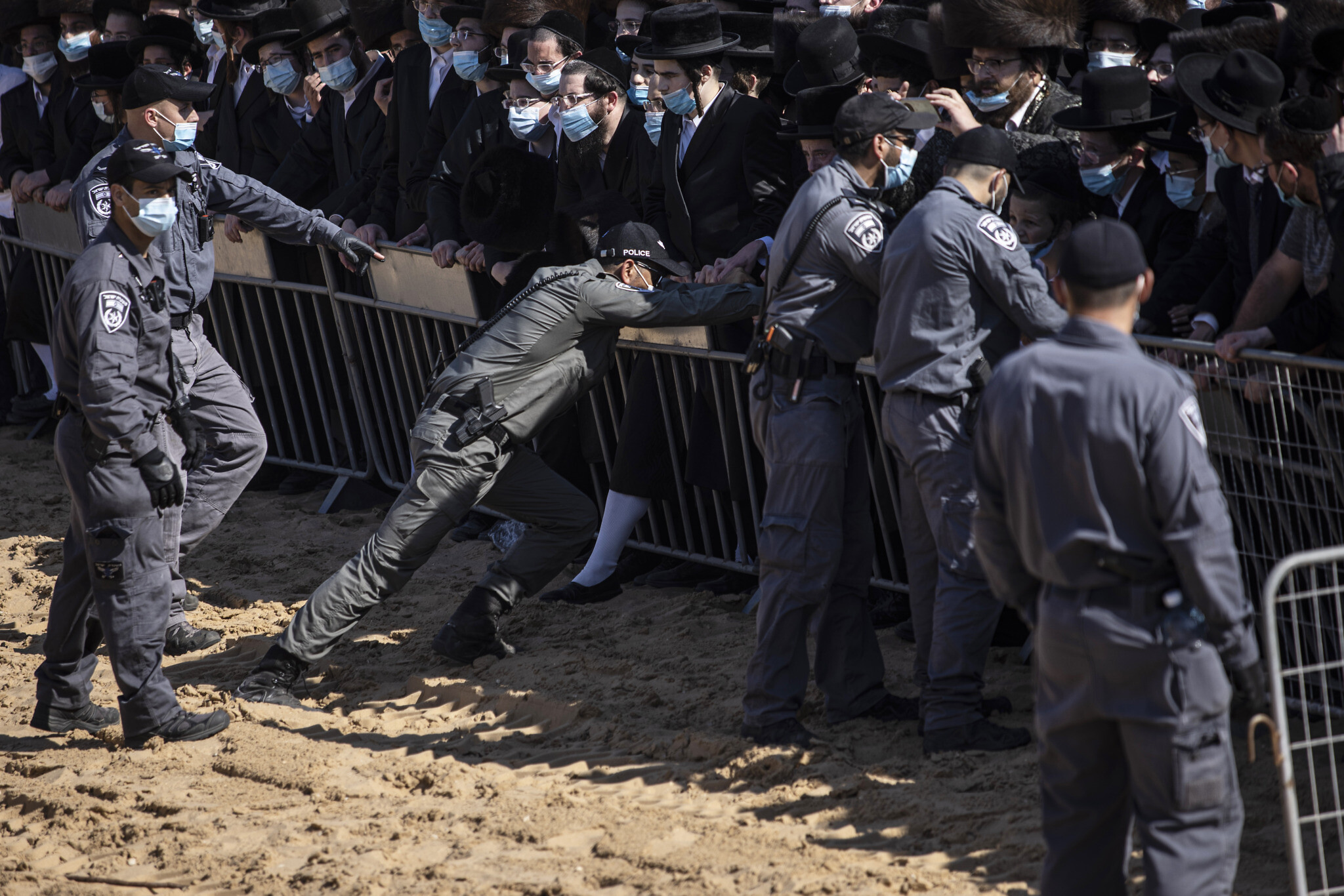
Israeli police try to control a crowd of mourners during the funeral of Rabbi Mordechai Leifer, the latest in a string of clashes between security forces and ultra-Orthodox Jews violating a national coronavirus lockdown order, in the port city of Ashdod, Israel, October 5, 2020. (AP Photo/Tsafrir Abayov)
Israeli police try to control a crowd of mourners during the funeral of Rabbi Mordechai Leifer, the latest in a string of clashes between security forces and ultra-Orthodox Jews violating a national coronavirus lockdown order, in the port city of Ashdod, Israel, October 5, 2020.
 

The recent data revealing that 40 percent of all confirmed cases of COVID-19 are members of the ultra-Orthodox sector impels all of us, and not just the ultra-Orthodox, to engage in serious self-scrutiny and soul-searching.

On the one hand, a fundamental principle of a pluralistic society respectful of human rights is honoring a minority’s right to its religion, its culture, and its language. Its members have a right to live according to their own values and culture, to conduct public prayers, and to educate their children as they see fit.

On the other hand, these rights, like all others, are not absolute. There are times when the minority’s autonomy must take a back seat in order to protect the citizenry as a whole.

Israel, like every other country, is battling the coronavirus pandemic. Extremely harsh restrictions on freedom of movement, on conducting business, and on the right to enjoy cultural events have been imposed on the public in recent weeks, in an attempt to curtail the spread of contagion and to ensure that it will be possible to provide proper treatment for those who contract the virus. From the start, the authorities defined certain exceptions to these restrictions in order to permit public prayer and Torah study in ultra-Orthodox yeshivot. In the last few days, we have seen that even the lenient rules set for services on Yom Kippur were brazenly flouted by many groups in the community, though not by all of the ultra-Orthodox.

We are not referring here to the behavior of individuals who decided to do whatever they please. And we must note that there are lawbreakers in every sector of the public. However, as the photos of the buses transporting yeshiva students home at the height of the strict lockdown reveal, in this case, we are dealing with organized activity. According to Major Gen. (res.) Roni Numa, in charge of overseeing the battle against the pandemic in the ultra-Orthodox sector, about 10,000 yeshiva students, out of the total of 40,000, did not adhere even to the rules adapted specifically to address their needs, and did not have themselves tested for the virus before they went home on vacation. In light of the high incidence of COVID-19 in the sector, there is a serious fear that the disease will spread to their families and to the public at large.

This isn’t a case of a handful of people who thumbed their noses at the restrictions, but rather a conscious decision by some of the ultra-Orthodox rabbis. The problem is that the risks involved do not threaten only the followers of that rabbi. They affect the public as a whole, the same public that will have to make use of the same limited resources available in the hospitals, if there is a sharp upswing in contagion. At this point, the self-segregation of ultra-Orthodox communities comes to a halt; most of their members will not hesitate to be admitted to public hospitals for treatment, if needed.

We must acknowledge that the handwriting was on the wall. Since the founding of the state, the “professional scholars” (“toratto omannutto”) deal, in its various forms, has made rabbis and yeshiva deans into middlemen between the state and the IDF on one side, and their students of draft age, on the other. A state’s sovereignty is expressed in the fact that all its laws apply to  all living within its territory. However, in many matters related to the ultra-Orthodox, the state seems to have pulled back from imposing its sovereignty, and accepted the convenience of “dialogue” and “consensus” with ultra-Orthodox leadership.

In the present crisis as well, the same approach seems to have been adopted — one law for citizens in general, and another — for the ultra-Orthodox, providing their rabbis agree. As we see, this approach has failed miserably.

Over the years, some have asserted that, in the name of tolerance towards the minority or in light of practical considerations, we must come to terms with the fact that young ultra-Orthodox men do not serve in the IDF and are exempted from having to do their part in rowing the national boat. But now we see that while most of us are frantically bailing the water out of the boat, many of the ultra-Orthodox are drilling holes in the hull, that may drown us all.

This situation requires a fundamental change of course — a U-turn — in the relationship between the state and the ultra-Orthodox. Developing a healthier relationship requires caution and consideration. Respect for the ultra-Orthodox lifestyle? Yes. Dialogue? That too is appropriate. The state renouncing its sovereignty and allowing rabbis to exercise unlimited power as the brokers between their flocks and the state? Absolutely not! We must put an end to this situation if we have the will to live.


https://blogs.timesofisrael.com/what-do-you-do-when-theres-a-hole-in-the-boat/?fbclid=IwAR3uB2krRZhWXQcfPdbT4Q05FTEJgkOyEnZJbAGka464tWqWx6CS9oEYEVE