Friday, July 09, 2021
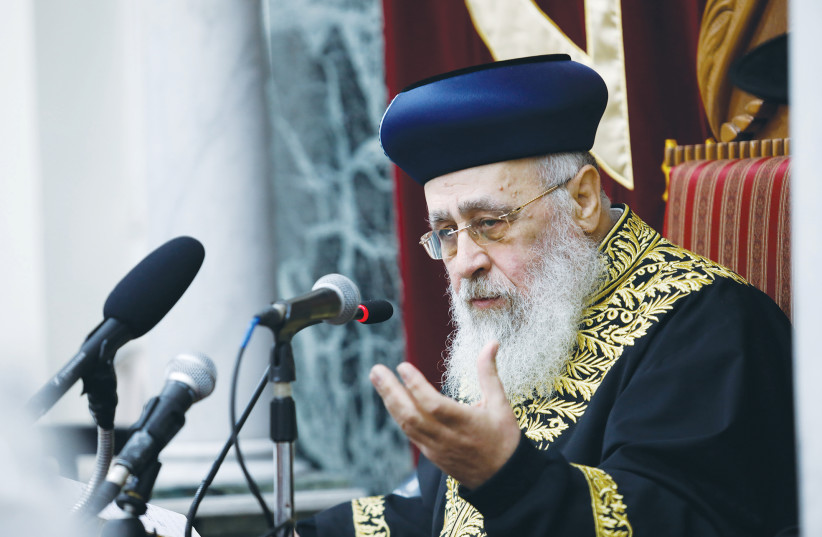
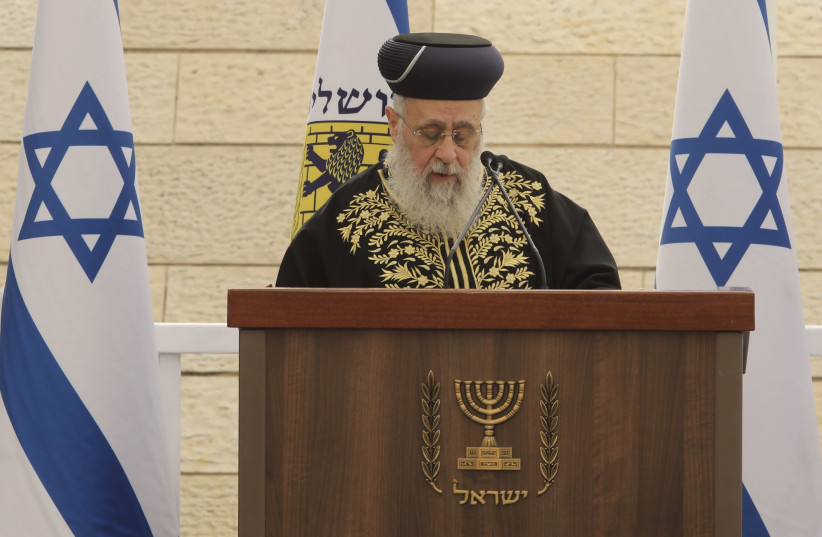
THE DISGRACE here is that Yitzhak Yosef essentially is promoting haredi dependence on government handouts and charitable donations instead of advancing self-reliance and community dignity through basic education.
Thursday, July 08, 2021
In the name of “woke” social policy, will some states soon, say, outlaw circumcision (child abuse); ban ritual animal slaughter (animal cruelty); force Orthodox schools to hire openly transgender staff (gender discrimination); mandate that Orthodox physicians participate in euthanasia for terminally ill patients (right to die); or compel yeshivas to excise “discriminatory” biblical passages from their curricula (hate speech)?
Can Orthodoxy Save American Jews—or even itself in the USA?
American Jews seem well on their way to withering into a white-dwarf star of a community. One with far less status than before.

During the 20th century, Jews made up as much as 3.7 percent of the U.S. population.
The prestige of the American Jewish community manifested itself in manifold ways: Clergyman of all faiths spoke of “Judeo-Christian” values; Yiddish words entered the English lexicon; cantors sang chazzanut on national television, and ballplayers like Hank Greenberg and Sandy Koufax received honor for not playing in major games on Yom Kippur.
Jews also became prominent, if not nearly pre-eminent, in diverse fields like entertainment, law, academia, science and medicine. Support for Israel among politicians was bipartisan.
Fast forward: Today, the percentage of Jews in America is just 1.8 and continues to plummet. The shrinkage is most evident among non-Orthodox Jews, who comprise around 90 percent of the Jewish population, many of them not halakhically Jewish.
Moreover, while Jews, for the moment, are still over-represented in entertainment and the professions, support for Israel is no longer bipartisan. The most activist elements within the Democratic party are overtly hostile to the Jewish state.
Jewish ballplayers seemingly do not skip games on Yom Kippur anymore.
All in all, American Jews seem well on their way to withering into a white-dwarf star of a community. One with far less status than before.
But what about Orthodox Jews, who adhere to the mesora, to the traditional tenets of Judaism? While comprising only 10 percent of American Jewry, Orthodox Jews bear at least twice as many children as other Jews.
Indeed, a Pew survey recently found that “a variety of demographic measures… suggest that Orthodox Jews probably are growing, both in absolute number and as a percentage of the U.S. Jewish community.”
Will the increased number of Orthodox Jews reverse the decline of Jewish relative population and status in the United States?
Do Orthodox Jews have a brighter future than their non-religious brethren in America?
Perhaps not.
First, any natural increase in the Orthodox community will be offset by disaffiliation. The drop-out rate may approach 20 percent.
Second, the number of Orthodox Jews, at least in the near future, will remain far too small, as a percentage of the general population, to preserve the standing that Jews have heretofore enjoyed.
Third, over 60 percent of US Orthodoxy is comprised of Haredim. Many fervently Orthodox Jews eschew secular culture. Therefore, they will likely not exert the same level of societal influence as did previous generations of American Jews, although they are politically and economically savvy and involved..
Finally, Orthodox Jews, because of their fealty to halakha (Jewish law), may be the Jews most vulnerable to the effects of changing societal norms.
Previously dominant “Judeo-Christian” values have collapsed. For instance, out-of-wedlock births have increased, from well under 10 percent of all births in 1964, to 40 percent in 2014. Same sex-marriage, previously unthinkable, is now the law of the land.
Mere public opposition to the new morality may render one a social outcast. Business owners who refuse to openly accede to the new thinking may find their businesses boycotted.
This moral upheaval, in and of itself, does not necessarily threaten the continued viability of the Orthodox community. After all, Jews are used to social isolation in galut (the diaspora).
However, American politicians and judges of late have been compelling traditionally religious people to not only live beside the new rules, but to adopt them. So far, the victims have been mainly Evangelical Christians. But can frum Jews be far behind?
For example, Colorado tried to effectively shut down Masterpiece Cakeshop, Inc., a bakery owned by a devout Christian baker. The baker refused to bake a same-sex wedding cake. The state deemed his refusal a violation of its civil rights laws.
A divided United States Supreme Court reversed Colorado’s sanctions on the baker. The justices, though, ruled only on procedural grounds. The majority found that Colorado failed to give the baker a fair hearing.
Ominously, the high court did not rule that Colorado could not compel the baker, or any other religious person, to violate his sincerely held religious belief against participating in a same-sex marriage.
Similarly, the Court did not rule that the baker’s right of free expression was curtailed by the state compelling him to design a cake that contained a message which he vehemently opposed.
Indeed, just last week, the justices refused to disturb a ruling of the Washington State Supreme Court that effectively shut down the floral business of a Christian woman in her mid-70s who refused to set up a flower arrangement at a same-sex wedding.
The implications of the Washington and Colorado cases for Orthodox Jews are staggering.
If the high court will not uphold the First Amendment in cases like these, Orthodox Jews may reasonably wonder what other restrictions on their religious freedom legislators may henceforth enact.
In the name of “woke” social policy, will some states soon, say, outlaw circumcision (child abuse); ban ritual animal slaughter (animal cruelty); force Orthodox schools to hire openly transgender staff (gender discrimination); mandate that Orthodox physicians participate in euthanasia for terminally ill patients (right to die); or compel yeshivas to excise “discriminatory” biblical passages from their curricula (hate speech)?
Some may dismiss this parade of horribles as alarmist. But the reality is that governments, both in the U.S. and in Europe, have already attempted to implement, or have actually implemented, many such policies.
If future legislation becomes hostile to Orthodox Jewish practice, would observant Jews defy the authorities and risk civil penalties, or even criminal prosecution?
Most probably, if the persecution became unbearable, the bulk of American Orthodox Jews would emigrate to Israel.
From a Zionist perspective, such an aliya might be a good thing. Only who would have thought, even 10 years ago, that the demise of American Jewry in the “Goldeneh Medina” might happen so soon?
Tuesday, July 06, 2021
Israel’s Critics are Repulsed by Jewish Sovereignty and Military Power - To see the Jews exercising dominion over Christians and Muslims in the Holy Land is a hard theological pill to swallow...
Israel’s Critics are Repulsed by Jewish Sovereignty and Military Power
After events like the recent Israel-Hamas war, people inevitably raise the question of why relatively minor skirmishes involving Israel capture so much of the world’s attention, while much bloodier and more geopolitically significant conflicts barely raise the world’s eyebrows.
I think the answer is obvious, though rarely provided: many people—including many Jewish and Christian Zionists, are captivated by Jews having a sovereign state and exercising military power. Many more people, however, are repulsed by Israel’s sovereignty and strength.
On the repulsion front, consider that traditional Catholic theology posited that Jews were doomed to wander the earth, stateless and homeless, as punishment for rejecting Jesus. To see the Jews exercising dominion over Christians and Muslims in the Holy Land is a hard theological pill to swallow, one that the Catholic Church itself took decades to resolve. While the Church has largely come around, many traditionalist Christians have not.
More liberal Christian theologies, meanwhile, remain wedded to the notion that martyrdom, as suffered by Jesus, is the highest form of virtue. These liberals acknowledge and regret the unjust suffering endured by Jews in the Christian world for centuries. However, they see this suffering as uplifting Jews, with Jews being the martyrs to Christian sin just as Jesus was for the world’s sins.
In the wake of the horrors of the Holocaust, Jews’ role was to use their martyrdom to be a prophetic voice for peace, indeed pacifism, and to work for humankind’s redemption. It was emphatically their role not to build a powerful state with a powerful military capable of inflicting military horrors of its own. Jews refusing to be victims is, ironically, seen as a betrayal of Christian ideals. This is why Christian critics of Israel so often accuse Jews of not learning anything from the Holocaust; in their mind, the Holocaust is a story about Christian sin and possible redemption via the actions of the victims; the fate of the Jewish people as a people is at best irrelevant.
Interestingly, many Jewish far-leftists find themselves in a similar ideological boat as the Christian liberals, albeit with a Marxist rather than Christian ideological underpinnings. Ever since Karl Marx himself stated as much, there has been a significant strand of left-wing thought suggesting that Jews aren’t a legitimate ethnic group, but simply forlorn Asiatic/European nomads who came to exist as a group solely to serve the class interests first of feudal rulers and then of capitalists, possessing neither a legitimate religion (because no religion is legitimate) nor a legitimate culture (because Jews) nor any claim to self-determination.
Having no other legitimate reason for existence, the only way for Jews to justify themselves continuing to exist as a collective is if they use the Jewish experience of injustice as a rationale for contributing to various liberation movements—so long as it does not include the Jewish liberation movement of Zionism. Jewish nationalism is nothing but reactionary nationalism based on either foolish sentimentality or, worse, racist notions of Jewish superiority. Exactly why Jewish solidarity is racist, but not solidarity among other groups, is never clearly explained, but if nothing else it means that Israel has no claim to the legitimate use of force to defend itself, because Israel itself cannot be legitimate.
In the Muslim world, the dominant narrative is that Mohammed, after showing his military prowess by massacring local Arabian Jewish tribes, beneficently allowed Jews to live peacefully under Muslim sovereignty. According to accepted myth, Jews and Muslims then lived harmoniously under Muslim rule for the next twelve hundred-plus years, until disrupted by Zionism.
Israel’s independence and military might, by contrast, strike at two related myths. One is that Muslim rule over Jewish dhimmis was benevolent, and therefore Middle Eastern Jews had no reason to seek and maintain independence. The other is that Muslims, as the Divinely favored religious group, would always rule over Jews and not vice versa. To see a Jewish army consistently defeating Muslim opponents, in contrast to Mohammed’s victories over Jews in the Koran, destabilizes many Muslims’ worldview.
Moreover, Mohammed started his empire with limited territory and a small army, only to expand throughout the Middle East and North Africa. There is undoubtedly some latent fear that Israel is a camel’s nose under the tent for Jewish expansionism. This of course misunderstands Zionism and Judaism, but the average Muslim knows little about Judaism. It’s therefore natural for them to assume that Judaism is expansionist and universalist like Islam.
Finally, it bears noting that the anti-Israel ideas above did not arise spontaneously, but are products in part of state-sponsored antisemitic campaigns run over the decades by the Vatican Czarist Russia, Nazi Germany, the USSR, and various Arab and Muslim states. The USSR’s propaganda rejecting Israel as an illegitimate colonialist state founded by “Zionists” who have no claim to represent the Jewish people has had especially long-lasting impact on world opinion. Young leftists today repeat slogans from Soviet propaganda organs Izvestia and Pravda of fifty years ago without even being aware of their provenance.
The most important conclusion from all this is that criticism of Israel’s use of military force cannot easily be reduced by Israel “behaving” differently. It’s not how Israel uses force that is the primary source of criticism, but ideologically based repulsion at Jews collectively exercising military power via their sovereign state, at all. This is why, in my experience, when critics of Israel claim that Israel is using “disproportionate” force, one can never pin down what level of force these critics would accept. If the IDF’s very existence is repulsive to them, and Israel is deemed inherently illegitimate, no amount of force can be acceptable.
Coming To A Ghetto Near You? Compulsory jabs: Pressure grows on anti-vaxxers
![]() |
| THESE GUYS THINK "COVID" IS A SEAT ON THE MIZRACH VANT! |
A growing number of countries and territories around the world are forcing people, often in specific sectors, to be vaccinated against COVID-19.
Here is a roundup:
Mandatory in Tajikistan, Vatican
Tajikistan and the Vatican are among the rare countries imposing vaccinations on all adults.
In ex-Soviet Tajikistan the official news agency has published a government decree obliging all over 18s to be vaccinated, without giving further details.
In the Vatican, the world's smallest state, vaccinations were made obligatory for residents and workers in February, with those refusing liable to be sacked.
Italy
Several countries or territories have imposed vaccinations on certain sections of the population.
Italian doctors and health workers in the public and private sector must get vaccinated or face being banned from working directly with patients.
A group of 300 Italian health workers have gone to court to try to get the obligation overturned and a hearing is scheduled on July 14.
Britain
On June 16 the British government announced all care home staff in England will need to be fully vaccinated.
If approved by parliament, the new legislation means anyone working in a care home must have two doses of a vaccine from October unless they have a medical exemption.
The rules will apply to all workers employed directly by the care home, as well as to agency workers and volunteers.
Russia
President Vladimir Putin is against mandatory vaccinations nationwide.
The mayor of Moscow Sergei Sobyanin ordered mandatory jabs for residents of the Russian capital working in the service industry on June 16.
Some 60 percent of all service industry workers in Moscow—just over two million people—were ordered to be fully vaccinated by August 15.
Since then other localities have taken similar measures, including badly-hit Saint Petersburg.
Kazakhstan
Kazakhstan on July 1 ordered mandatory coronavirus vaccinations for a wide range of workers who come into contact with others. Those who refuse will be restricted from working face-to-face with other people.
United States
The city of San Francisco has announced it will require all municipal employees to be vaccinated or they could face penalties up to and including dismissal.
The new rule will not take effect until the vaccines have received full approval from the US Food and Drug Administration, which has so far given the green light for their use on an emergency basis due to the pandemic.
More than 150 employees at the Houston Methodist Hospital in Texas have already been fired or resigned after failing to comply with orders to get a shot.
France
French Health Minister Olivier Veran has said that mandatory vaccinations are not yet necessary for all. But the government is working on a draft law to force health workers to be jabbed.
Saudi Arabia
In a number of places, while there is no formal requirement for vaccination, restrictions for the non-vaccinated mean there is a de facto obligation.
Riyadh has decided that anyone using public transport or entering a government or private establishment or sports venue must be vaccinated from August 1.
Only vaccinated employees in the public and private sector can enter their workplaces.
Pakistan
The southern Pakistani province of Balochistan on July 1 implemented a ban on unvaccinated people entering government offices, public parks, shopping malls and public transport.
The province of Sindh says it will refuse to pay government employees who have not been vaccinated from July, and neighbouring Punjab has said it will block the mobile phones of people refusing to get jabs.
https://medicalxpress.com/news/2021-07-compulsory-jabs-pressure-anti-vaxxers.html
Sunday, July 04, 2021
Halacha Instead of Morals: How ultra-Orthodox Sex Offenders Justify Their Actions
It was evening in Jerusalem, time for Friday night prayers at a synagogue in the city’s Bukharim neighborhood. A boy sat down next to an adult man. Other worshippers started yelling to the boy to get up and move, said Yitzhak Rosenblum, who witnessed the incident. “Not there. Sit somewhere else,” they urged the boy, who didn’t understand what all the fuss was about.
They also spoke to the man. “They told him, in a joking way, ‘You know this is a shul here. It’s not …,’” Rosenblum recounts, but the warnings were not more explicit than that. They didn’t tell the boy that he’d been sitting beside a convicted sex offender. “Nothing happened, but the way they were laughing, it was as if they were talking to someone who stole gum from a store or something like that, not someone who sexually assaulted children,” Rosenblum says.
Rosenblum wasn’t all that surprised by the incident, which occurred a few years ago. Besides being a master’s student in criminology at Hebrew University, he is also Haredi – ultra-Orthodox – and a father of eight. He is very familiar with this atmosphere in which a sex offender is accepted with relative nonchalance.
It’s not necessarily a matter of evil or lack of caring, he says, but due to the glaring lack of knowledge in Haredi society about the severe consequences of sexual assault. Rosenblum is not just speculating. A research study he recently conducted reveals the cognitive processes that facilitate the sexual assault of children by Haredi assailants – processes that cause the assailants, and their society too, to see their actions as justified.
The study points to three key characteristics, he says: lack of knowledge on the part of the assailants as well as the victims and the society as a whole regarding sex, and especially regarding sexual assault; a perception of sexual assault as a halakhic prohibition, meaning that it is contrary to Jewish religious law, and less as a moral prohibition; and moral-religious justifications that absolve the perpetrator of responsibility and reduce the severity of the violation (in his eyes).
These conclusions come from interviews Rosenblum conducted with 10 therapists, half of them Haredi, who specialize in treating sexual assailants who come from that community. Some of these therapists have treated hundreds of abusers. “They know Haredi culture and all of its unique nuances, things a nonreligious person wouldn’t understand,” Rosenblum says.
In his research, Rosenblum essentially obtained access to the inner logic of thousands of Haredi abusers. And he found out that many of them are completely unaware that this is what they are.
- The woman spearheading the fight against sexual assault in ultra-Orthodox society
- Sexual assault allegations rock an Israeli Hasidic community
- Why my Haredi community can't, and won't, deal with sex abusers
In the absence of basic sexual knowledge, including regarding sexual assault and its implications, and in the absence of any discussion about the subject in Haredi schools, ultra-Orthodox families and Haredi media, the warning signs simply do not appear.
“A lot of abusers said they had no idea that there was anything wrong with what they did,” said one of the therapists interviewed for the study. “They thought it was like when siblings roughhouse with each other, that there could be sexual things too. They don’t understand the meaning of sexuality, what its purpose is, why this kind of abuse is such a serious violation.”
But it’s not just a lack of knowledge. The study reveals that the potential offender often gives weight almost exclusively to the religious-halakhic aspect of the deed and not to the moral aspect of doing horrific harm to another person. “They come to me when the thing that bothers them the most is the ‘spilled seed in vain,’” said one therapist. “That is what they are most concerned about, at least at first.”
The abuser views their action as a transgression between man and God. And the possibility of seeking forgiveness from God is another thing that enables the abuse (unlike transgressions between man and his fellow man, in which the other person’s forgiveness is needed).
“This is a mechanism that reassures them,” one therapist explained, noting that this also increases the risk that the person will become a repeat offender. “The next time they get the urge, they’ll act on it, because their subconscious is basically telling them, ‘It turned out okay. You cried, you atoned for your sin, you asked God for forgiveness.’”
Other offenses, such as theft and murder, are seen as an offense against both man and God, i.e., something that cannot be atoned for just through fasting and prayers on Yom Kippur. But with sexual offenses, this angle is missing.
“This creates the illusion that there is no real violation of the other side,” Rosenblum says. “In Haredi society, sexual matters are not discussed, and if the subject does come up, it is only mentioned in halakhic or religious contexts and not in the context of morality and society. The related religious-halakhic literature is not studied.”
And when that is the case, the third characteristic – moral-religious justifications – seems almost inevitable. “If you’re not talking about sex and you’re not talking about sexual offenses and you’re not talking about legal consequences, then you’re also not talking from a moral standpoint about what it does to the victim,” said one therapist.

Other therapists described a similar problem. “The most significant thing is that the offender lives in a world where the question is what is forbidden and what is allowed, not what is the right thing morally, who am I hurting,” said one. “It’s not uncommon for such patients to struggle to understand just what offense they committed. They say, ‘Okay, I touched someone, but no homosexual intercourse took place, so where’s the prohibition here?’”
What happened in the dorm
The interviews Rosenblum conducted with the therapist were extensive and yielded a number of stories. Such as one about the dormitory of a well-known yeshiva where there was a serial sex offender. The principal took it upon himself to speak to one of the (Haredi) therapists. “He told me about a guy who ‘fools’ with boys,” he said. The therapist understood right away what was really happening and warned the principal to take action. But they decided to keep the student in the dorm.
“I was horrified, and realized there was nothing I could do,” the therapist said, adding that the principal’s behavior was in part a consequence of his Haredi education and lack of understanding of the issue.
And when the educational institutions don’t take a strong stand or do all they can to prevent abuse, the risk of someone who comes from this world committing such offenses is higher, said one therapist. Seven of the 10 therapists agreed, with one theorizing that the religious worldview could be more susceptible to errors of thinking in this regard.
Another problem is that the legal implications are perceived as less critical than the religious ones. “The presence of the halakhic aspect weakens and even neutralizes the legal aspect,” Rosenblum says. “So the Haredi offender does not ascribe due importance to the fact that this is prohibited by civilian law.”
Offenders were found to use various psychological defense mechanisms, such as emotional detachment. “I don’t know what came over me,” said one. “I wasn’t myself in those moments.”
Another mechanism is to claim helplessness – “I have an area where I’m weak, I don’t know what to do. It’s stronger than me,” another explained. Others attributed their actions to the “evil impulse” or a “foolishness” that came over them. As one put it, “That’s not me. Do you really think I would hurt someone? That I would do such terrible things”?
Education, information needed
So the question is – what can be done? “I recommended that the Haredi school system create educational material to raise the awareness of the severe effects that sexual assault have on both the victims and the offenders themselves,” Rosenblum writes. “Today there is much more openness in the Haredi community to this subject than there was in the past, but most of the education refers to ‘being protected,’ i.e., how to guard against sexual assault.”
He says this is a beginning, but the other side must also be addressed – people have to be taught how not to commit sexual offenses. And this needs to be done with a lot of explanation and raising awareness of the serious consequences of sexual assault. “This information campaign needs to address all the aspects that were discussed in the study – religious, halakhic, legal, moral and social.”
But meanwhile, the problem remains serious. How serious? That is not easy to answer.
“There is a problem that must be understood and addressed,” says Dr. Inbal Wilamoski of Hebrew University, Rosenblum’s research adviser, who adds, “There are many stereotypes about Haredim … but there is sexual violence and pedophilia in every community.”
In the past decade, and especially in the last few years, significant changes have occurred in Haredi society’s attitude toward sexual offenses. The change may still be incremental, but awareness is steadily growing. For one thing, Haredi media have begun to report on cases of sexual assault, though they use softened language which lessens the severity of it. And various organizations have been created to address the subject, with teachers in some Haredi schools being taught to recognize the problem if they see it.
“We have permission from all the Haredi rabbis and leaders,” says one person involved who prefers to remain anonymous. “But it is verbal consent, on condition that everything is done quietly.”
So while there has certainly been progress, it appears that Haredi society is still a long way from declaring war on sexual offenses.
https://www.haaretz.com/israel-news/.premium-ultra-orthdox-sex-offenders-rarely-feel-guilty-over-abuses-therapists-say-1.9957171Friday, July 02, 2021
Nachman Shai, the minister for Diaspora Affairs and the highest-ranking Israeli official in Surfside this week, evoked the closeness of the Jewish world—and thus the unusually global reach of what could seem like local troubles—this way: “It’s important for Jews in the diaspora to know that we care for them and that we will come any time they need us.”
The IDF Arrives in Surfside - No Questions Asked - Jew or Gentile!
Israeli rescuers are helping alleviate the suffering in Miami, showing that Jews (all Jews) can still resemble a family.
On Saturday, less than three days after the north side of the Champlain Towers in Surfside, Fl., collapsed, Telemundo released a video of a tense standoff between the mother of a missing 26-year-old woman and Florida governor Ron DeSantis during a closed-door briefing for families of those still missing. Ongoing fires and the instability of the surviving structure had slowed rescue efforts, leading to a toxic feedback loop of unknowing: The families, caught in a terrifying rupture in reality and starved for information about their loved ones, reached the natural and painfully human conclusion that not enough was being done.
Frustration boiled during the early days of the catastrophe, but there were many ways that this was expressed. But in her confrontation with DeSantis, the mother articulated a somewhat unexpected criteria for proving that every means of rescue was in fact being exhausted. “I was promised yesterday, and everybody else was promised, that the Israelis would be allowed in and that they are here,” she pleaded. “I have inside information they are not here and they are not working. Governor, it’s in your control, as I understand. You promised us and they’re not here.”
On Sunday morning, the Israelis arrived—a small team consisting of the top brass of the Israel Defense Force’s Homefront Command, including two colonels. They joined a psycho-trauma unit from Israel-based United Hatzalah, and paramedics from Magen David Adom and Zaka who had also traveled to Miami from the Middle East. “They [the families] said, now stuff is getting done,” an Israeli who had been working with the families recalled to me. “I thought, wait, things were already getting done!”
As Maor Elbaz-Starinsky, Israel’s Consul General in Miami, told me, “It’s not that we’re coming and running the scene and we’re these big guys who save the world,” adding, “We’re not here to save America. We’re here to show support, solidarity. America would have done exactly the same.” Elbaz-Starinsky said he hadn’t left Surfside since last Thursday morning, and had stolen a few hours of sleep in his car on some nights.
The IDF team has been an object of special fascination. On Wednesday, in a tented and muddy press area with a weird resemblance to a county fairground, media swarmed Elad Edri, a close-shaven and unflinchingly calm IDF colonel clutching a yellow hard-hat, angling for quotes even while DeSantis was speaking less than 100 feet away. “Oh yeah, Elad’s way more interesting than the governor,” Dovie Maisel, the leader of the Israeli United Hatzalah team told me, probably accurately.
Edri is not working on the pile—the pictures of olive-clad rescuers crouched over concrete are not of him. Rather, his job is to interact with family members, in order to obtain information that could help locate and identify the missing. “You have to give them the chance to be a part of the operation,” Edri explained. “They are really taking an active part in what we do, in our actions. We don’t send the rescue teams before we get the right information that we need from the families.”
Edri’s job is as sensitive as the one his colleagues at the Champlain Towers are charged with, and it might go an even longer way toward explaining what the Israelis are doing here, and why their mere presence helped calm a combustible situation. The tragedy is also unfolding away from the pile, at the Sea View Hotel in Bal Harbour where the families are currently gathered, beyond the view of the media and among the people whose loved ones are somewhere in the morass of concrete. The Israelis are here for the living, and in the story of how and why they got to Surfside, it’s possible to truly appreciate the breadth of the tragedy in South Florida, as well as how its living victims might begin to heal.
That the Israeli visitors have succeeded in alleviating anyone’s suffering shows what the Jewish state can mean to people thousands of miles away during the worst moment of their lives. Just weeks after an 11-day conflict with Hamas that raised fresh anxieties over a schism between Israel and the diaspora, the tragedy in Surfside shows that the connections between American Jews and the Jewish state are not merely political and go beyond the strictly rational. The bonds are resilient in ways that perhaps only a crisis can fully surface. In moments of need, all other contexts retreat into the background, and the Jews can still resemble a family.
The tragedy in Surfside shows that the connections between American Jews and the Jewish state are not merely political and go beyond the strictly rational.
When Baruch Sandhaus arrived at the Champlain Towers minutes after the collapse, he witnessed a dreadful reprise of something he had seen before, nearly twenty years earlier, as one of the first Hatzalah paramedics to arrive at the site of the World Trade Center on September 11, not long before the second plane hit: “A lot of debris on the ground, clouds of ash, layers on the road and on cars.” Sandhaus, an owner of a medical concierge service who left New York for Miami in 2005, is one of three co-founders of the all-volunteer Hatzalah of South Florida, and he coordinated the first on-site triage in Surfside in the early hours late last Thursday morning.
It was the human element of the tragedy that soon proved most challenging. Friday’s briefing for family members of the missing was widely seen as disastrous, with the authorities, however well-meaning, providing little in the way of useful information. They faced tearful inquiries about why so few rescuers appeared to be on the scene—even though the rubble was still on fire and the full collapse of the rest of the building was a distinct possibility. “On Friday, the temperature started getting hotter,” Sandhaus recalled. Family members wandered the second floor of the Grand Beach hotel all night—hardly anyone could sleep. The Florida Hatzalah team turned to what seemed like the only solution, which ended up being the correct solution. They walked to The Shul, the Chabad complex in the heart of Bal Harbour, and got Rabbi Sholom Lipskar out of bed at 1am on Saturday. The rabbi, who is in his late 70s, and who nearly died of covid last year, asked to be taken to the scene of the disaster, to see where several of his congregants were trapped.
Lipskar was sent to south Florida by the Lubavitcher Rebbe himself, the late Menachem Mendel Schneerson. Many credit Lipskar for the existence of a Jewish community in what had been seen as an unfriendly section of Miami Beach well into the 1980s (“Jews like to go where they tell us we can’t go,” said Zushie Litkowski, a longtime Bal Harbour resident and a post-disaster volunteer and fundraising organizer). Lipskar seldom smiles but is never angry, and he has seemingly inexhaustible stores of energy and focus. He exhibits little physical or emotional strain beneath his glasses and white beard, but is far from unfeeling, and in recent days he’s proven capable of shouldering impossible psychic, organizational, and spiritual burdens without appearing overwhelmed.
Early Saturday morning, Lipskar walked the perimeter of the site and talked to first responders. “I was shoving chairs under him to get him to sit down—he didn’t want to,” said Sandhaus, who estimated that the rabbi was on his feet for over four hours of his five hour visit. The site was far from safe. “Fires were still raging when we were there.” But Lipskar had a very specific mission in mind. As Sandhaus put it, “He wanted to be able to look the community in the eye to say to them definitively: All efforts are being done.” He left the site at 7:30am, to arrive back at The Shul in time for Shabbat morning services.
According to Sandhaus, Lipskar went to the site in part to assess whether the presence of an Israeli team would help the situation. He decided it would. Such is Lipskar’s status, Sandhaus said, that he “wasn’t gonna pull the trigger until [Lipskar] thought it was warranted.”
Hatzalah in South Florida contacted Magen David Adom in Israel, which maintains a close relationship with IDF Homefront Command, the branch of the army responsible for various forms of population management during a national emergency, with a mandate ranging from traffic control to urban search and rescue to earthquake preparation. As the Haaretz journalist Anschel Pfeffer once put it, the IDF, for all its flaws, and whatever else it might be, is the largest Jewish organization in the world. Nachman Shai, the minister for Diaspora Affairs and the highest-ranking Israeli official in Surfside this week, evoked the closeness of the Jewish world—and thus the unusually global reach of what could seem like local troubles—this way: “It’s important for Jews in the diaspora to know that we care for them and that we will come any time they need us.” In the official Israeli view, and in the view of many American Jews—including some in unimaginable distress in Surfside—the Jewish backyard extends for thousands of miles, meaning that every crisis is inevitably an intimate one, and that there is comfort to be had from people on the other side of the world feeling some responsibility for your pain.
Hatzalah in Florida made it clear that the IDF team would have to arrive immediately—such was the situation that there was almost no point in sending them if they couldn’t be in Miami by Sunday morning. The Israelis grasped the urgency. The IDF group was approved and mobilized in roughly two hours. The process of getting them to Miami began at around 5:30pm Israel time, and they were on a plane around midnight. They went straight from the airport to the pile.
I spoke to Sandhaus on Monday, in a Hatzalah van parked in front of the Grand Beach Hotel. He would look out the driver-side window and take long drags on a vape pen. Like nearly everyone I’ve met this week, he seemed a stray thought or two away from tears. In the midst of our conversation, we were suddenly boxed in by a city bus, which had arrived to transport families of the missing to the Sea View, the new briefing venue. A group of them walked right in front of us, their faces fixed in disembodying shock. It had rained nearly all day—nature wouldn’t relent for them.
“They’re still in the mindset of: They’re gonna find somebody,” Sandhaus said of the searchers six blocks south of us. “They’re in that mindset that they’re still gonna find that one person.”
Of all the unanswerable questions that the Surfside catastrophe poses, a good number stray into the realm of the practical. What possible comfort can the survivors and families feel right now? Could anything meaningfully lessen their suffering? On Sunday, groups of family members began visiting the site of the collapse, a partially successful test of one possible response to those dilemmas. The visitors shouted names and screamed goodbyes. But seeing the Israelis work on the pile, Sandhaus said, “provided them a sense of comfort.”
“In the first five minutes there were a lot of emotions and crying,” Yossi Harlig, a Miami police chaplain and a Chabad rabbi in Kendall, south of Miami, said. “But as the hour went on, you saw a sort of calmness. People started praying. We put on tefillin with people. And the reason is people felt they had another opportunity to be close to their loved one.”
Part of the Israeli theory of trauma reduction is that those at risk must be kept occupied. As United Hatzalah therapist Hadas Rucham explained to me, one of the group’s trauma protocols could be summed up in a single Hebrew world: ma’ase, which can mean either “make,” or “do.” “When people are stressed, make them do things. Make them be active.” The IDF’s presence could be thought of as part of the healing process: Describing the layout of an apartment, or a distinguishing physical feature or piece of jewelry or clothing to Edri or one of his colleagues is an activity that assuages one’s sense of helplessness, restoring some basic sense of agency and purpose in a world that’s suddenly lost all logic. On Tuesday afternoon, Elbaz-Starinsky estimated that 80 percent of the families, Jewish and non-Jewish, had talked to the IDF team.
Rucham works at the Laniado Hospital in Netanya, and is a national dispatcher for United Hatzalah’s psycho-trauma team in Israel, determining where the unit’s 500 volunteers are most needed. In October of 2018, she was with a Hatzalah team from Israel that traveled to Pittsburgh to offer support after the massacre at the Tree of Life Synagogue.
“In Pittsburgh they needed their security back, especially the children,” she recalled. The Jews needed to regain a lost sense of comfort within an environment that suddenly became destabilized, even threatening. “Here the need is mostly for information... when people have information they can cope. Without information they feel helpless, like nobody knows them, nobody sees them.”
The need to establish some basic certainty in the midst of a ceaseless horror extends beyond the families. Much of the community feels that need, and felt it from the moment they heard the news of the tower’s collapse. For many, the answer to uncertainty was action. At 2:30am last Thursday, about 80 minutes after the disaster, Zushie Litkowski and Svia Bension, both in their mid-30s, were already on the phone with a third friend, Efraim Stefansky, planning a relief fund, which launched about an hour later. The effort now has the support of Hatzalah of South Florida and The Shul, and its total now stands at over $1.3 million. On Wednesday, Bension was helping to coordinate a team that has grown to 250 volunteers, who are delivering items and sorting through donations. Both Bension and Litkowski say they’ve gotten two to three hours of sleep each night since the collapse. “More and more volunteers started to come in,” Bension recalled of the early hours of the crisis. “Someone asked, are you in charge? I said yeah, sure, why not.”
The Israelis are bringing their Israeliness.
Bension served for six years as an officer in Magav, the IDF’s border patrol unit, where she spent time as a SWAT team squad leader. She moved to Florida from New York last November. Israelis are unavoidable on the north end of Miami Beach, which would be the case if United Hatzalah, Magen David Adom, and the IDF had never traveled here. At the Bal Harbour Publix, a man shouted into a phone in Hebrew while he loaded ice into a golf cart; at the media tent, someone in a Miami-Dade Fire and Rescue uniform conversed with officers from the IDF team in the visitors’ native tongue. One of the leaders of Yedidim, a volunteer group that has been ubiquitous across Surfside, is an Israeli who arrived in Florida 18 years ago.
“The Israelis are bringing their Israeliness,” Elbaz-Starinsky said of the teams that had arrived in Miami. But the Israelis have been bringing their Israeliness to Miami for a while now. This week, Surfside and Bal Harbor have been an image of a Jewish world where the psychic distances were getting shorter and where Israel and the diaspora were direct extensions of each other rather than opposite poles, for reasons running far deeper than the political or religious climate in either context. Perhaps that would have been the case even if the tower were still standing, and the local Israeli-Americans hadn’t needed to snap into crisis mode, a condition that their native country had mastered through hard necessity.
The IDF is expected to stay in Florida through the middle of next week. No one can predict how long it will take to clear the rubble at the Champlain Towers. Residents speculate darkly about a weeks-long process, or about funerals being held every day for a month. Donated items are being moved out of The Shul, both because the synagogue’s day camp for children started this week and because the space will likely have to be used for shiva calls, though no one knows when those will begin.
It is the unknowing that still marks this tragedy, just as it did a week ago. Sandhaus recalled that during one of the family visits to the site, a relative of the missing came up to him and asked, “‘Be honest: Will I have something, anything to bury—a finger, anything?’ I did not know what to say.” Then a dog on the pile started barking. “I said, these dogs only bark when they sniff something. That’s your answer. It gave him comfort to know there’s hope. All he wanted was something to be able to bury.”
The worst possible form of closure constitutes hope in Surfside now, where 147 people remain unaccounted for, but the power of having a definite answer—along with the certainty of some basic final solace—should never be underestimated. Moments before I spoke with Rabbi Harlig, who wore a badge identifying himself as a police chaplain, a man approached him and another officer, and “opened a yellow envelope, and took out a picture of him and his son,” Harlig recalled. “He said, ‘I want to let you know that my son was in the building. And yesterday they notified me that they found my son. And he gives us a hug and says: Thank you so much for bringing back my son so that I could bury him.’”
https://www.tabletmag.com/sections/news/articles/armin-rosen-idf-surfside
Thursday, July 01, 2021
Meron, Karlin-Stolin, & Surfside - Why Is There No Message From God on Surfside?
Wait for it!
*
Floor by Floor, the Missing People and Lost Lives Near Miami
https://www.nytimes.com/interactive/2021/06/30/us/miami-building-missing-dead.html
Wednesday, June 30, 2021
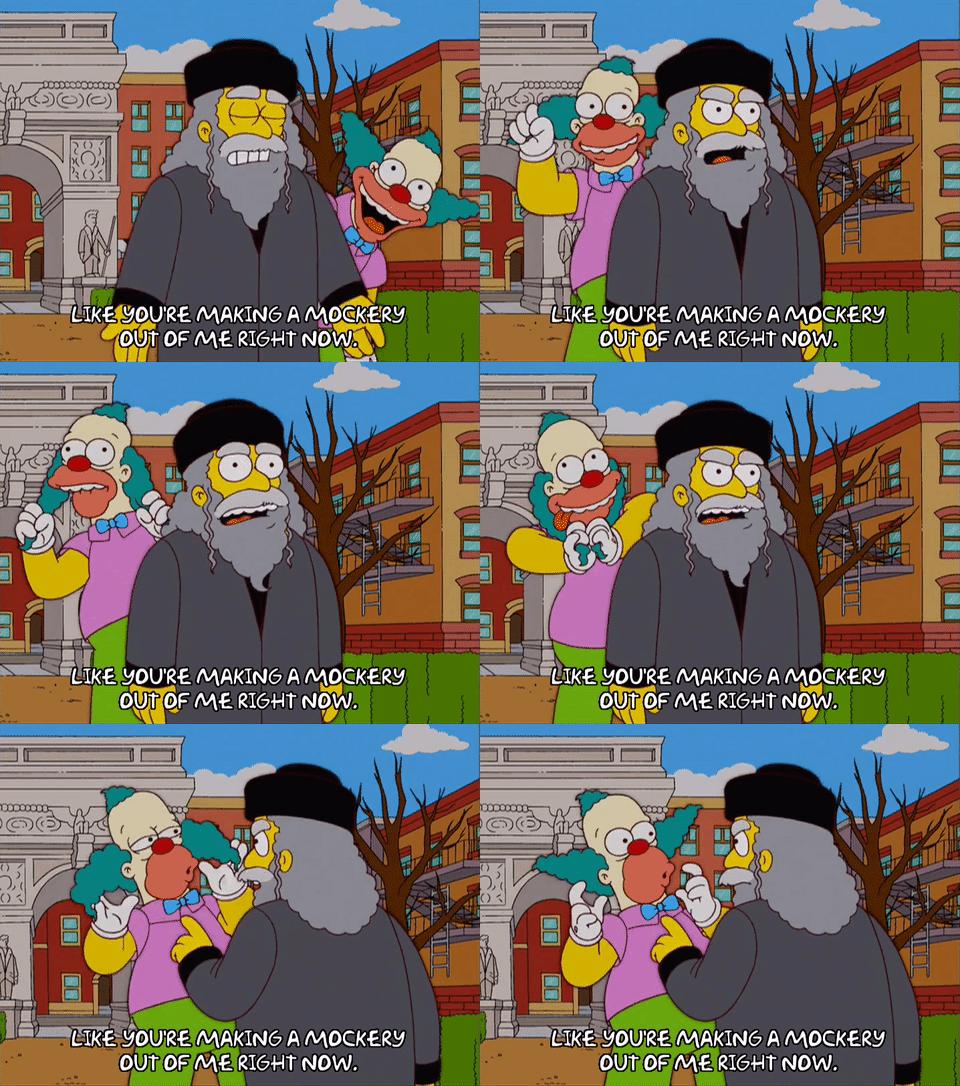
Like We Needed Nuch A Putz With No Sechel!
Chief Rabbi Yosef: Science, math are nonsense, study in yeshiva instead
The chief rabbi spoke proudly of not finishing school or having a high school diploma, and said learning Torah was far more important.
Tuesday, June 29, 2021
Two major Israeli haredi Orthodox rabbis said everyone aged 12 and over should be vaccinated against the coronavirus, according to The Jerusalem Post.
Major Orthodox rabbis in Israel say everyone 12 and up should be vaccinated
![]() |
| Eretz Nehederet, an Israeli satire show, aired a sketch on Jan. 27, 2021 portraying Rabbi Chaim Kanievsky, a top haredi leader in Israel, as controlling the Israeli government's lockdown enforcement. (Screenshot from Channel 12) |
(JTA) — Two major Israeli haredi Orthodox rabbis said everyone aged 12 and over should be vaccinated against the coronavirus, according to The Jerusalem Post.
Rabbi Chaim Kanievsky, the influential leader known as the “prince of Torah,” and Rabbi Gershon Edelstein approved the announcement in a message printed by Kanievsky’s personal physician, Meshulam Hart, in Yated Neeman, an Israeli haredi Orthodox newspaper. The announcement comes as Israel struggles with an increase in coronavirus cases as a result of the more contagious Delta variant.
The rabbis said everyone should be vaccinated both to prevent further deaths from the virus and to prevent additional closures of yeshivas by the government.
Though Kanievsky has consistently come out in favor of the vaccines, his varying directives to Israel’s haredi school system during the height of the pandemic made him a polarizing figure. At times, Kanievsky said the yeshivas should not close even as government officials ordered all schools shut to slow the spread of the virus. Kanievsky was even depicted on Eretz Nehederet, an Israeli sketch comedy show, as the real prime minister rather than the then-prime minister, Benjamin Netanyahu.
The haredi Orthodox community in Israel was among the hardest hit by the virus in the country, with one in 73 haredi Israelis over age 65 dying from the coronavirus during the first year of the pandemic, according to one report.
https://www.jta.org/quick-reads
Monday, June 28, 2021
Friday, June 25, 2021
This Post Was Taken From VIN News - Substitute out Levin, Ben-Gurion, Reform Rabbis and insert Kushners (Plural) and the Fraudulent Conversion by Hershel Schachter
![]() |
(Tanḥuma, Balak 10):
אף על פי שמשתבח אותו רשע ואומר ויודע דעת עליון פיו העיד בו ואמר לא ידעתי |
Open Letter To ‘Proudly Jewish’ Rep. Andy Levin, Married To Gentile, Who Thinks Judaism Is A Culture
NEW YORK— In 1958, David Ben-Gurion, Israel’s first prime minister, sent a letter to 51 Jewish intellectuals asking their opinion on how to identify who is a Jew.
Ben Gurion had both a personal and political interest in the question. In 1946, Ben Gurion’s son Amos, then serving in the British Army in Europe, married Mary Callow, a young Christian woman from the Isle of Man. Amos Ben-Gurion was wounded in battle; Mary Callow was his nurse in the British Army hospital in which he spent several months recovering. Before the wedding, Amos had consulted with his parents. His mother, Paula, objected to her son’s marriage to a non-Jew and asked her husband to “talk Amos out of it.” Ben-Gurion met with the bride and decided instead to find a way to convert her via a Reform rabbi visiting London, who quickly performed the conversion.
Ben-Gurion may have overcome his wife’s objections but realized that he had alienated the orthodox establishment irrevocably by recognizing other forms of Judaism. The question of identity loomed much larger after the Knesset passed the Law of Return in 1950. Ben-Gurion intended the law, which grants immediate citizenship to people of Jewish ancestry, to be as inclusive as possible, even allowing for gentiles married to Jews to gain citizenship. After Ben-Gurion’s approach was fiercely opposed by many other groups, he decided to send his letter.
The responses to Ben-Gurion’s letter were varied but 38 of the 46 responses Ben-Gurion received, even from secular scholars, called for following halachic Jewish law in registering Jews in Israel. For the orthodox scholars this was not even a legitimate question. Rabbi Aaron Kotler, founder of the Lakewood Yeshiva, opened his letter to Ben-Gurion in this way: “I am amazed at the fact that a question considering the purity and integrity of the Jewish people, whose preservation is the basis of our existence, should be posed as if it required some other solution or opinion from me. The question has a simple and explicit answer in the Holy Torah. … It is clear that a Jew is only someone who is a Jew according to the law of the Torah.”
While Ben-Gurion may have entertained hopes of establishing a “new Jew” in Israel who was not bound by halacha both in his personal life and in his choice of spouse, he realized that he would effectively be creating two nations within the fledgling state and stopped short of recognizing secular conversions or gentile spouses for the purpose of registering citizenship. Both of these were added later to the existing law, the former being adopted by Israel’ supreme court just a few months ago, raising concerns about future Jewish unity within Israel.
For many American Jews however, the question of their Jewish identity has never even been a troublesome dilemma. For them, Judaism is chicken soup and cheesecake, matzoh and gefilte fish, with a little celebration of festivals to add flavor. Anyone willing to sign on the dotted line stating he is Jewish will be happily accepted by numerous Reform, Conservative or Reconstructionist communal leaders who lead “culturally” Jewish communities, while his children could study in parochial Jewish schools and proudly identify as Jews.
One such proud Jew unfazed by Jewish identity issues is Rep. Andy Levin (D.-Michigan), a recent addition to Congress who identifies as a Reconstructionist. In a recent Haaretz interview, Levin stated that for him Judaism is “not just a religion. We’re a people, a culture, a food, a language, a history.” Levin is most concerned about one religious imperative: that of embracing the stranger, although somewhat patronizingly he believes that the stranger we most need to embrace is the Palestinians:
“Jews are great at the stranger who’s the immigrant or the African-American,” Levin claims. “We have to dwell on our most challenging stranger. I insist we can coexist. How amazing could that new chapter be if we see each other as human beings?”
True to his own beliefs, Levin embraces Rep. Ilhan Omar despite her recently equating Israel with the Taliban and Hamas. For Levin, this is merely a “call for accountability” for human rights abuses which he claims Israel and the US are evading by not submitting to ICC jurisdiction. “The one thing I cannot accept is assuming the U.S. or Israel are above accountability,” Levin asserts but for some reason omits a call for Palestinian accountability over firing rockets on civilian targets, payments to terrorists who slay and murder Israeli citizens and educating their children to become martyrs by killing Jews.
However if Levin is demanding a call for accountability, he should first demand it from himself. Claiming that Judaism is a religion means that it has a mandate of requirements for an individual, otherwise there can be no religious demand to embrace strangers. Among those mandates are Shabbat, Kashrut, family purity and Tefillin. Levin however would eschew a religion demanding any obligations from its adherents.
![]() | ||
| Josh Kushner & His Rebbetzin |
If he had troubled to study the Torah, the body of laws which comprises those eternal, immutable obligations, he would have found that the stranger mentioned in context with love is one who accepts the seven Noachide laws which proscribe murder, theft and illicit laws – surely not the Palestinians who engage daily in land theft, encourage murder of Jews and enact laws which enable the execution of those who sell land to Jews. Do they view Jews as human beings?
All this is of no concern to Levin, since for him Jews are simply “a people”. If we are a people we have an identity, as Ben Gurion realized, and it is not so simple to maintain. Levin himself married a gentile but is still convinced that his children are part of the Jewish people, but exactly how? Does eating a matzoh ball, identifying with spurious Palestinian national aspirations or lighting a menorah (with a Christmas tree in the background) make them Jewish?
As for language, Levin does not speak any language of the Jewish people, neither Yiddish nor Hebrew and if the Jewish nation’s historic bond is what maintains them, he should be aware that Rabbi Saadia Gaon defined the nation 1000 years ago: “Our nation is only a nation through its Torah.”
Levin will continue to pick and choose his Jewish identity as he pleases but he should stop short of declaring himself a proud Jew until he has thoroughly investigated what Judaism itself has meant for the past 3000 years: Devotion to G-d and his Torah, adherence to all of its precepts and belief in the right of the Jewish nation to its eternal birthright in the entire land of Israel.