EVERY SIGNATURE MATTERS - THIS BILL MUST PASS!

EVERY SIGNATURE MATTERS - THIS BILL MUST PASS!
CLICK - GOAL - 100,000 NEW SIGNATURES! 75,000 SIGNATURES HAVE ALREADY BEEN SUBMITTED TO GOVERNOR CUOMO!

EFF Urges Court to Block Dragnet Subpoenas Targeting Online Commenters

EFF Urges Court to Block Dragnet Subpoenas Targeting Online Commenters
CLICK! For the full motion to quash: http://www.eff.org/files/filenode/hersh_v_cohen/UOJ-motiontoquashmemo.pdf

Sunday, May 14, 2023

“But how come I need an orange wristband? This place is like my home. And now a police officer comes here and tells me: ‘Go here, go there?!’ It’s because we’re Haredim so the authorities feel they can walk all over us,” Kazin said.


At Meron pilgrimage, joy and grief mix as Haredi traditions and secular Israel clash


At renewed annual Lag B’Omer event, worshipers mourn the 45 attendees killed in deadly 2021 crush, while chafing at regulations meant to head off another disaster
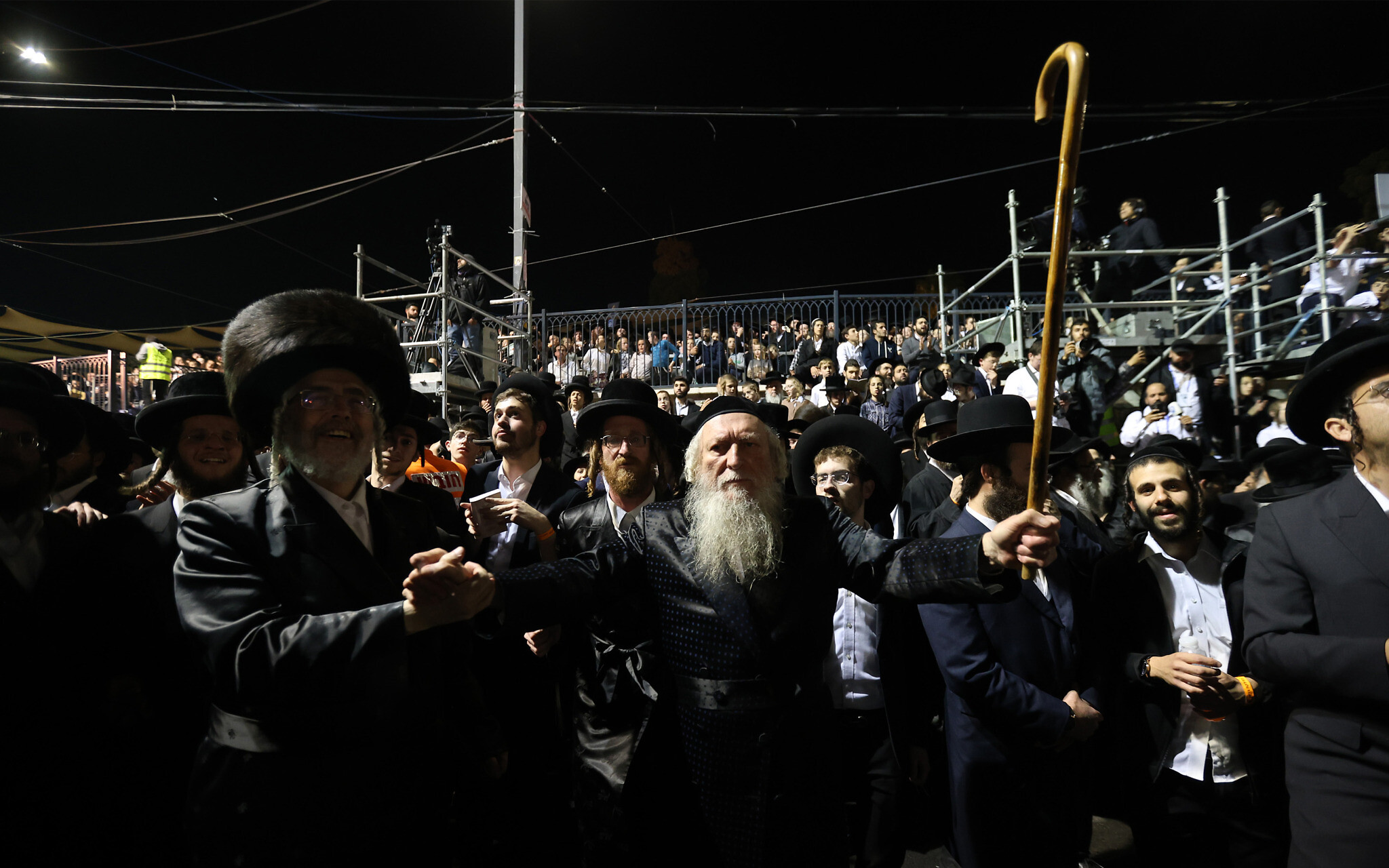
Haredi Jews celebrate Lag B'Omer at Mount Meron on May 8, 2023. (David Cohen/Flash90)
Haredi Jews celebrate Lag B'Omer at Mount Meron on May 8, 2023
 

The hilltop gravesite of Rabbi Shimon bar Yochai was already in sight for Yitzhak Kazin when two police officers stopped him from crossing over to the shrine through an impromptu checkpoint.

Irritated, Kazin, a 37-year-old Haredi garbage truck worker from Bnei Brak, showed them that he was wearing the orange wristband necessary for admission into the heart of the annual pilgrimage on the Jewish holiday of Lag B’Omer to the final resting place of the second-century sage, on Mount Meron.

The wristband, and the strict enforcement of the crowd control measures that it facilitates, were precautions implemented this year for the first time around the gravesite in northern Israel where 45 people died in a crush during the 2021 pilgrimage. The incident, caused by overcrowding, was the worst civil disaster in Israel’s history.

More than merely a technical crowd management issue, the security arrangements around Meron are a point of friction between strictly devout Haredi Jews, who live in insular communities led by rabbis, and the enforcement and regulation mechanisms of the more secular State of Israel. The state’s actions, policies and principles often clash with those of the ultra-Orthodox world.

“They don’t want us to come here, that’s the truth,” Kazin said after he entered the site. “So they divide us, send some of us here and some of us there. Because to them, we’re nothing but a nuisance,” he said of authorities.

“They want me to go downhill. I didn’t come from Bnei Brak to be on some hill. I came to be near Rabbi Shimon Bar Yochai,” Kazin said.
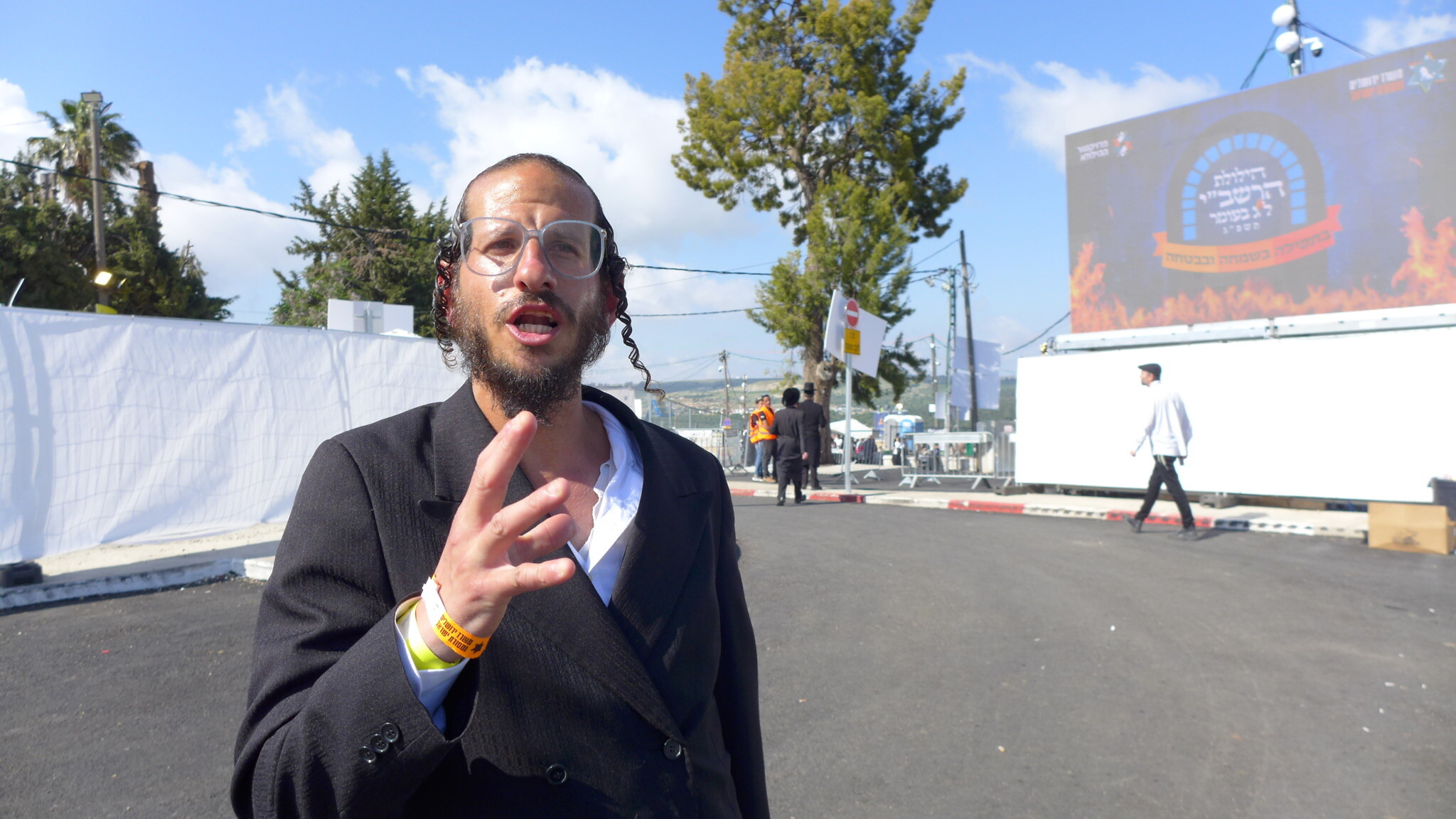
 

Yitzhak Kazin wear an orange wristband that allowed him to enter the gravesite of Rabbi Shimon bar Yochai on Mount Meron, Israel on Lag b’Omer eve, May 8, 2023


Following the 2021 catastrophe, several government ministries and branches overhauled how the pilgrimage is managed. Rabbis kept the 2022 event low scale amid preparations for adaptations that would allow a resumption of mass events.

Around 200,000 Haredi Jews were expected to attend this year’s pilgrimage to Meron on Monday night.

To prepare for the large numbers, authorities beefed up the deployment of police officers — there were 8,000 of them at the main Meron pilgrimage site on Monday — and rescue professionals. Thousands of stewards from the Haredi public were recruited to minimize friction and streamline interaction with the pilgrims, some of whom speak better Yiddish than Hebrew.

Another change was the introduction of stricter enforcement of safety capacities at the gravesite, which is situated atop a steep summit with a limited surface area and featuring topographic complications, and encouraging the unadmitted to celebrate instead at an open area farther downhill.
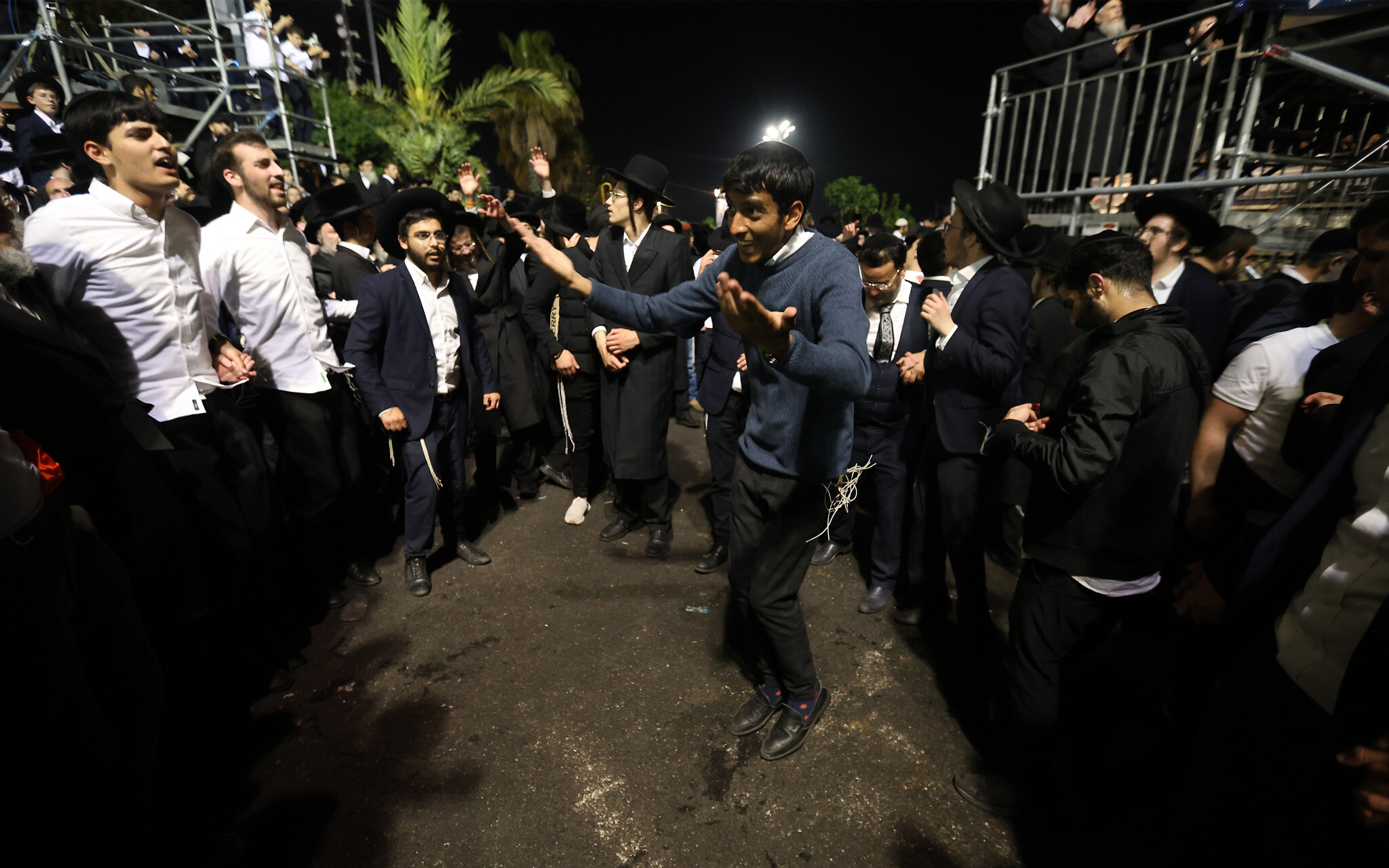
 

Lag B’Omer celebrations at Mount Meron on May 8, 2023
 

Some pilgrims, like Moshe Levy from Shiloh, near Jerusalem, accepted the new reality.

He came to the gravesite hours ahead of the main event, lighting a fire as is customary on Lag B’Omer, to avoid the evening rush and do his part in reducing the crowd numbers.

“I don’t need the shoving and pushing. The magic happens at the gravesite and that’s good enough for me,” Levy told The Times of Israel.

But others circumvented the new arrangements.

“He brought me in,” Asher Levy, who is not related to Moshe, said while pointing to the heavens when asked how he made it into the grave compound without a wristband. Pressed for more information, he said: “Oh, I just came down the mountain from a moshav.”


Others, like Kazin, complied with authorities’ requirements but did so under protest. He “pulled some strings” in Bnei Brak to get an orange wristband, Kazin said with some pride.

“But how come I need an orange wristband? This place is like my home. And now a police officer comes here and tells me: ‘Go here, go there?!’ It’s because we’re Haredim so the authorities feel they can walk all over us,” Kazin said.

 
Israeli rescue forces and police stand on the stairs where a mass of people were crushed to death and injured during the celebrations of the Lag B’Omer holiday on Mount Meron, in northern Israe

He also complained about the actions of “certain rabbis and people of influence within our circles, who help the snakes control us.” Asked whom he meant by snakes, he only said: “I don’t mean to offend. We’re all Jews.” Visibly upset, he added: “It’s all about control. Like they did when they made us wear masks.”

During COVID-19, many ultra-Orthodox ignored emergency regulations based on medical authorities’ policies that mandated wearing face masks in public, prompting outrage by many non-Haredim who accused the community of helping the pandemic spread.

Reflecting deep divisions around pragmatism and fatalism, the health and safety crises set the scene for an ideological clash over the right-wing policies of the government of Prime Minister Benjamin Netanyahu, which is dependent on the cooperation of the country’s two Haredi parties.

Other pilgrims, who did not make it into the gravesite compound, reacted violently to security arrangements, hurling objects at police, according to Haaretz. At one checkpoint, young men pushed past police, according to reports on social media.

Haredi Jews attend Lag B’Omer celebrations in Mount Meron on May 8, 2023
 

One worshiper allegedly bit Israel Diskind, whose brother, 23-year-old Simcha Bunim, died in the 2021 catastrophe. Diskind, a spokesperson for Heritage Minister Amichai Eliyahu, was reportedly suspected by some radicals of being an undercover police officer. The radicals confronted Diskind, leading to an altercation. Police detained the man who allegedly bit him but released the perpetrator to avoid further confrontations, the Kan broadcaster reported.

Some journalists were cursed at and some police cameras vandalized. Police said they believe some sites on Meron were exceeding their safety capacity.

Despite these issues, “generally it has been a peaceful event so far,” said Dov Maisel, deputy head of operations for United Hatzalah, a Haredi rescue and first response group that is accredited, along with Magen David Adom, at the event as responsible for medical issues.

United Hatzalah was working to encourage people not to stay at the gravesite and leave after half an hour to make room for others, Maisel said.
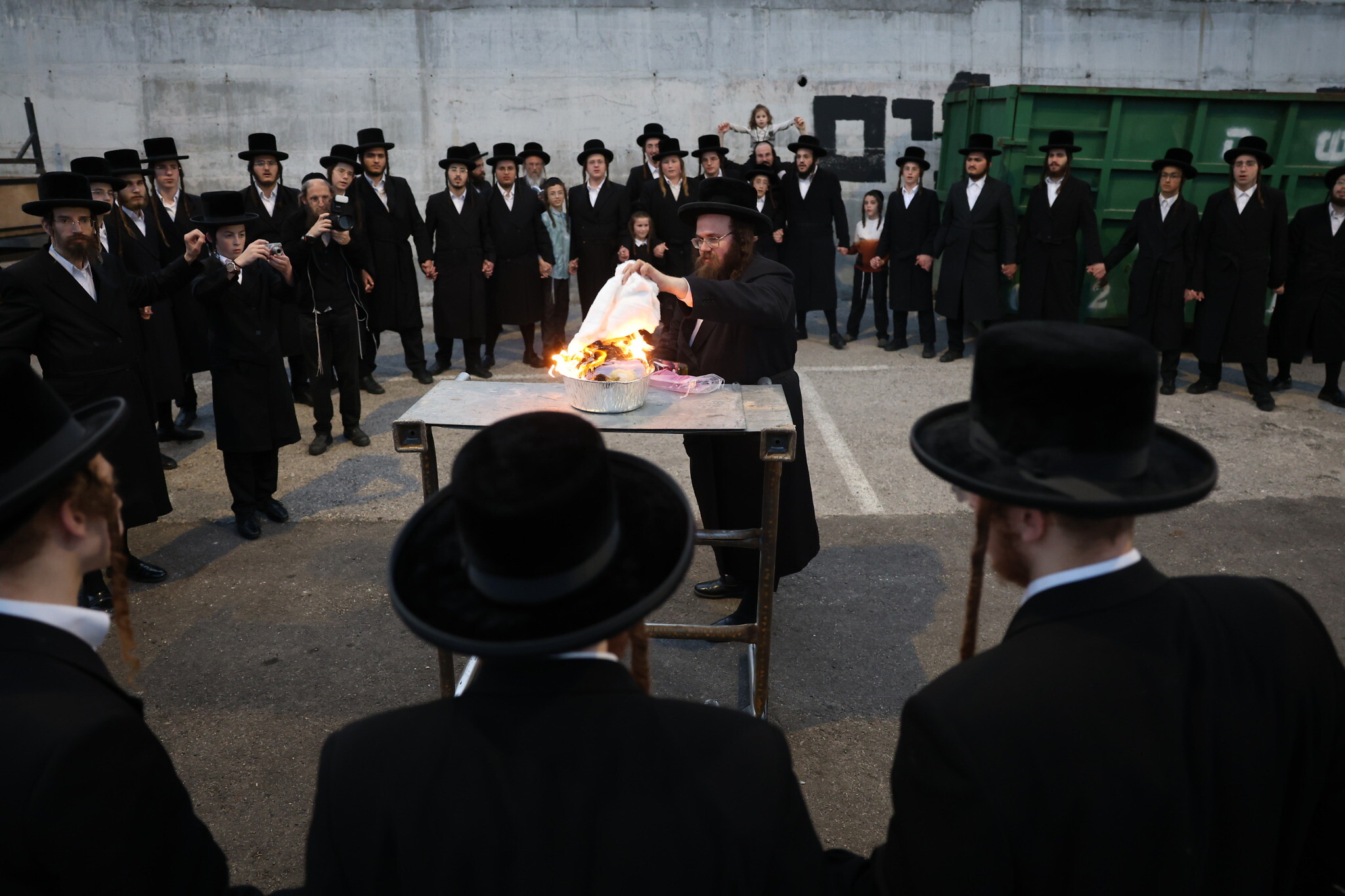
Worshipers light a bonfire a day before the Lag B’Omer celebrations, in Meron


Like the attitudes to the security arrangements around it, the holiday itself also reflects the split reality that Haredim and non-Haredim sometimes inhabit in Israel.

For many secular and national religious Israelis, Lag B’Omer is a minor holiday enjoyed mainly by children, who have bonfires on its eve, although that custom, too, is declining as authorities increasingly crack down on it due to safety and environmental concerns.

But for the Haredim, it is a major date that the Talmud ties to a plague that killed thousands of students of Rabbi Akiva, among the greatest early rabbinic figures, who legend has it was put to death by the Romans for defying their restrictions on teaching Torah. According to Jewish tradition, the plague ceased on Lag B’Omer, making that date a time of celebration.

Lag B’Omer is also believed to be the date of death of Bar Yochai, a prominent disciple of Rabbi Akiva and a major figure in Jewish mysticism, or Kabbalah, whose gravesite on Mount Meron is the locus of festivities year-round. Bar Yochai’s grave became a site for celebration because tradition has it that he asked his disciples to rejoice instead of mourn when they commemorate his death.

Celebrating Lag B’Omer is “refilling the fountains of the soul,” Moshe Levy, the pilgrim from Shiloh, said.
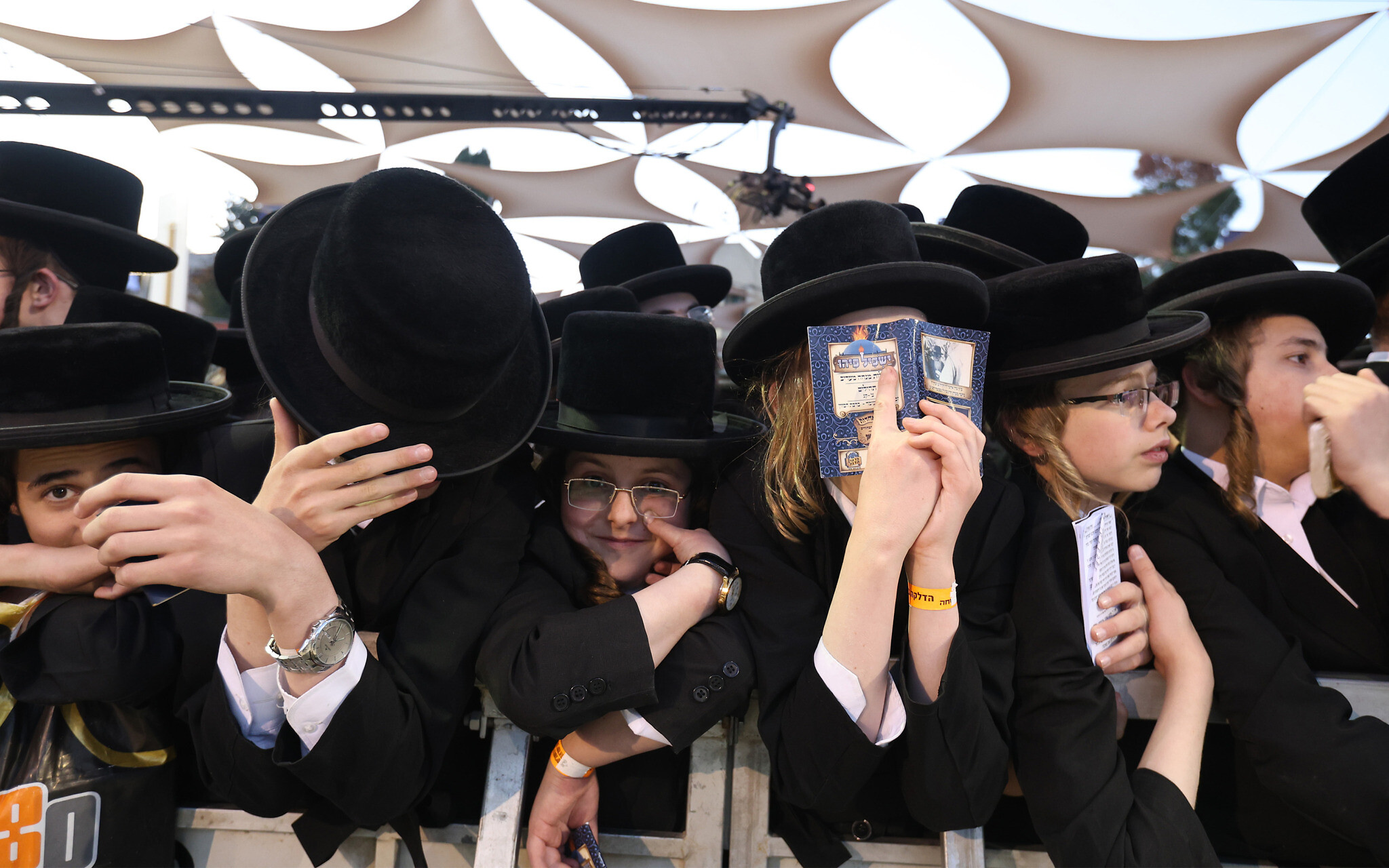
Haredi Jews attend Lag B’Omer celebrations, in Meron on May 8, 2023
 

At the main ceremony near the gravesite, 4,000 men gathered on Monday night around a tall metal cylinder full of wood and oil-doused textiles where the ceremonial fire was to be lit. The excitement was palpable as a cantor recited Mincha, the afternoon prayer many Jews say each day in the afternoon. The prayer was followed by a choir that sang Psalms, their strong tenors reverberating in the cool mountain air as their listeners swayed with delight.

A cantor then recited the names of the 45 victims of the 2021 crush, as the crowd listened respectfully. Nachum Dov Brayer, who heads the Boyan Hasidic dynasty, lit 45 candles in memory of the victims and the cantor then recited the Kaddish mourning prayer.

After some additional prayers, the fire was lit and the men’s section, bordering a packed women’s section, exploded into dancing to the sounds of a live band and choir, including row dancing and the signature synchronized bobbing jumps of Haredi groups.
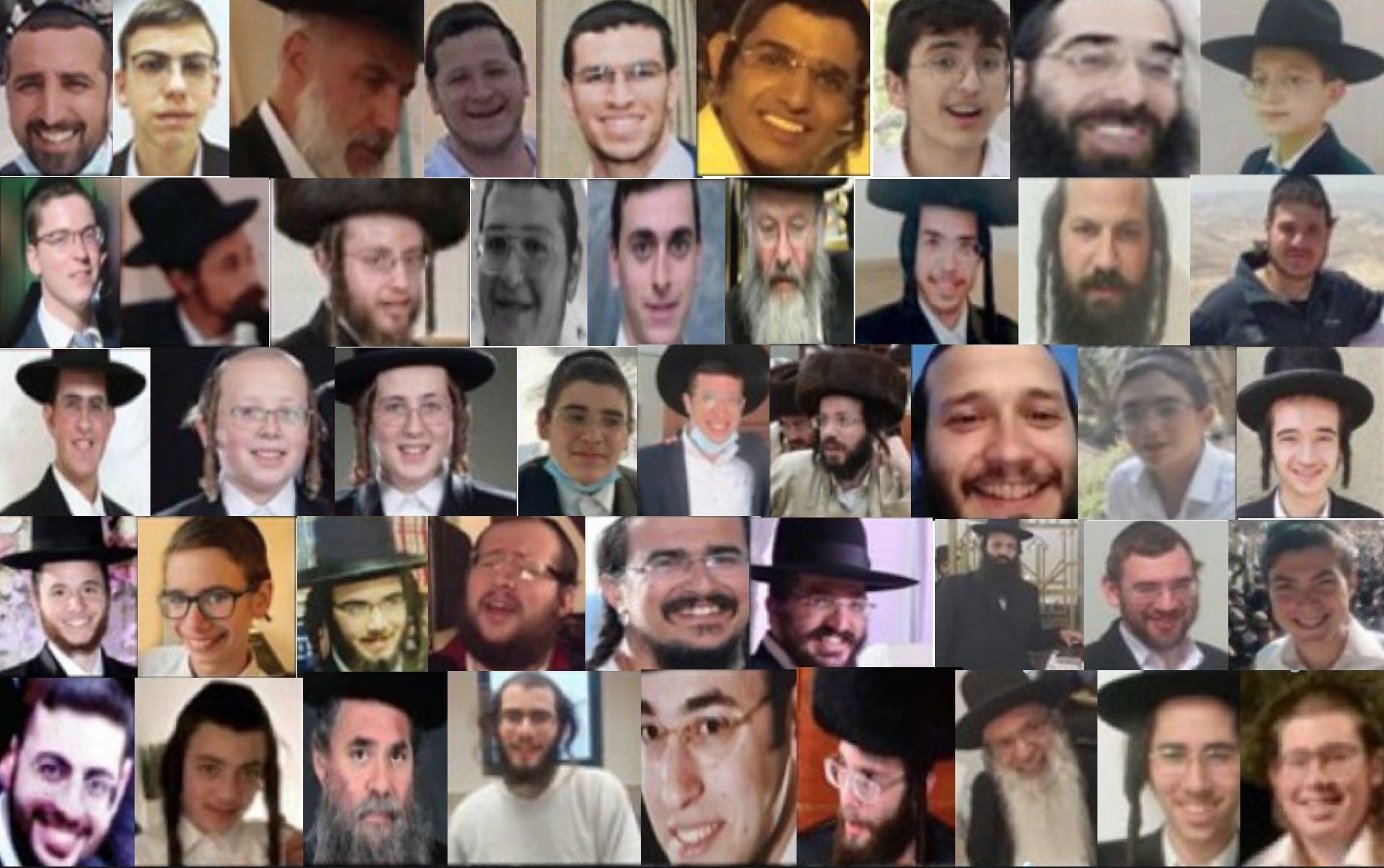
Victims of the April 30, 2021, Mount Meron disaster: Top row (L-R): Chen Doron, Haim Rock, Ariel Tzadik, Yossi Kohn, Yisrael Anakvah, Yishai Mualem, Yosef Mastorov, Elkana Shiloh and Moshe Levy; 2nd row (L-R): Shlomo Zalman Leibowitz, Shmuel Zvi Klagsbald, Mordechai Fakata, Dubi Steinmetz, Abraham Daniel Ambon, Eliezer Gafner, Yosef Greenbaum, Yehuda Leib Rubin and Yaakov Elchanan Starkovsky; 3rd row (L-R): Haim Seler, Yehoshua Englard, Moshe Natan Neta Englard, Yedidia Hayut, Moshe Ben Shalom, David Krauss, Eliezer Tzvi Joseph, Yosef Yehuda Levy and Yosef Amram Tauber; 4th row (L-R): Menachem Knoblowitz, Elazar Yitzchok Koltai, Yosef David Elhadad, Shraga Gestetner, Yonatan Hebroni, Shimon Matalon, Elazar Mordechai Goldberg, Moshe Bergman and Daniel Morris; 5th row (L-R): Ariel Achdut, Moshe Mordechai Elhadad, Hanoch Slod, Yedidya Fogel, Menahem Zakbah, Simcha Diskind, Moshe Tzarfati, Nahman Kirshbaum and Eliyahu Cohen.
 

Kazin was deeply moved by the gesture to the victims, he said.

But he disputed that the arrangements that irked him were effective attempts to prevent a repeat.

“We want police to help us. Not oppress. It can be done,” Kazin said. “But to shepherd us you have to know us. And the police don’t know us.”


https://www.timesofisrael.com/at-meron-pilgrimage-joy-and-grief-mix-as-haredi-traditions-and-secular-israel-clash/?utm_source=The+Weekend+Edition&utm_campaign=weekend-edition-2023-05-14&utm_medium=email

Friday, May 12, 2023

You Were Warned!


The more she learned about the community, the more disgusted Ojalvo became, she says. “In some ways it simplified the story for me. There are sex abusers in that community and they are being protected.”


Name Of The Father: New film on sins of a Charedi cult leader shown on BBC


A documentary about abuse in a sect that sparked outrage in Israel is to be shown on the BBC


articlemain

Moishe Shick in a scene from In the Name of the Father


W hen the documentary film Name of the Father aired in Israel a few weeks ago, it led to dozens of phone calls from men and women who had suffered sexual abuse in a Charedi community — and spurred national debate about how the country’s extremist communities can be better policed.

Now the three-part series, which details the rape, violence and child marriage that have taken place in a Strictly Orthodox Breslov community, has been adapted into a documentary for BBC’s Storyville. And it’s a harrowing watch.

In the 1980s, the Brooklyn-based Rabbi Eliezer Shlomo Shick, also known as the Mohorosh, set up his own town in Yavniel, in the north of Israel.

A charismatic speaker who often cried when he lectured, he mainly populated it with former secular Jews. Many of them had been in jail and had converted to his cause. Eventually, around 400 families lived in the town.

From his main base in America, the rabbi kept a tight control on his community. Closed-circuit cameras tracked members' every move, and they would write letters to him over the fax machine that he would answer in detail.

He succeeded in making every member of the community feel connected to him and when he died, in 2015, they continued to adhere to his rules. To this day, the ill-educated and poor community that is fed by the town’s soup kitchen, cannot envisage life outside it, says the film’s director Bat-Dor Ojalvo.

She stumbled across Yavniel while working on another programme exploring rape and how the Israeli police deals with the crime. “I soon realised we were looking at a cult,” she tells me.

When the first episode of the programme aired in Israel, Ojalvo got a phone call in the middle of the night from the Mohorosh’s only son Moishe.

He’d been cut off by many in the community after his father was recorded, on his deathbed, calling his son a murderer. “He said he wanted me to hear the whole truth, from his perspective,” says Ojalvo.

It was the first of what would be five years of transatlantic calls between them, as Ojalvo pieced together her film, which features Moishe and other former and existing members of the Yavniel community. “For the first 18 months, I didn’t’ trust him,” she tells me.

“I said ‘I’ll check every piece of information you give me. And if I find out you are a liar, it’ll be on television.’ ”

Moishe is compelling to watch. He grew up being treated like a hero simply because of who he was, but as he tells his story, we learn that his father always made him feel inadequate. Far worse, he did nothing to stop him being sexually abused by the son of another prominent rabbi.

Through Moishe, Ojalvo slowly found other former members of the community who shared heartbreaking stories of sexual assault, of rape and of being married off at the age of 13. In the programme, girls also recount being told they were whores if they showed a single bit of flesh.

“It was a very emotional experience to record what had happened to these people but they said to us, ‘we don’t have a voice so please shout for us,’ ’’ she says.

As payback, the director and her team received frequent death threats with assurances that people knew where she lived and also the names of her children.

One Yavniel leaver featured in the programme had their house set on fire.

The more she learned about the community, the more disgusted Ojalvo became, she says. “In some ways it simplified the story for me. There are sex abusers in that community and they are being protected.”

After the series had finished, she got a phone call from an elder in the community.

“I asked my husband to record the conversation because I was sure the man was going to say he was going to kill me,’ she recalls. ‘But he told me, ‘I am standing with you and I would like to tell you that one of my great granddaughters was sexually abused.’

“I didn’t tell him that it was likely to be many more than one, or that I knew one of his daughters had also been sexually abused as she had also rung me.’”

Since the series aired in Israel, some child marriages planned by the community have been stopped. But for Ojalvo and her colleagues, what is required now is wholesale change from Israeli authorities. They have been working closely with them, she says.

“There is no point in just going after the children who are being pushed into marriage,” she says. “You have to go for the head of the snake.”

‘In the Name of the Father’ is on BBC4 at 10pm on May 16, and on the BBC iPlayer after transmission.

Thursday, May 11, 2023

We're living in post-shame America...


A verdict against a sexual abuser and the indictment of a con-man fabulist are causes for optimism. But the fundamental indecency of the new American right marches on.


A Tempered Celebration


People who have polluted the waters of American politics have had a bad few weeks. Another gang of seditionists was found guilty of plotting against the United States. Donald Trump was found liable for the sexual abuse and defamation of E. Jean Carroll. And one of the weirdest phonies ever to bumble his way into a congressional seat, George Santos, has been booked by the Justice Department for a long list of alleged offenses. (He has pleaded not guilty to all of them.)

Unfortunately, I’m here to rain on your parade, because the struggle to restore basic decency in politics is still mostly a rearguard action.

But first, let’s drink in the good news that there is still some accountability for wrongdoing. The Justice Department secured yet more convictions for seditious conspiracy, this time against three leaders of the Proud Boys and their former chairman, Enrique Tarrio, who now joins the previously convicted Oath Keepers founder, Stewart Rhodes, as another walking example of the banality of evil. The government asked that Rhodes get 25 years in federal prison. For a man already in his late 50s, that sentence (if levied) basically amounts to “from now on.” (Attorneys for Rhodes, Tarrio, and the three Proud Boys leaders have indicated that they plan to appeal the verdicts.)

Back in January, George Santos’s arrival in the People’s House dented my already shaky faith in the People. Santos, however, has finally been ensnared by his own prevarications. As my colleague David Graham wrote today, Santos might have been better off losing and remaining just another unknown flake who took a run at elected office, but like so many people in the age of Trump, his thirstiness brought him both fame and legal attention. Santos remains a free man, but only because three unnamed people have put up half a million dollars of bail money while he awaits trial for 13 federal charges.

And justice, of a sort, snared Trump himself when he was found liable for sexually abusing and defaming E. Jean Carroll. Trump’s defenders, including his lawyer (who says that Trump plans to appeal the verdict), are emphasizing that the jury declined to affirm the claim of rape, but they are carefully not mentioning that this decision may have been colored by some confusion about how to apply the term rape. Trump’s own deposition probably helped sink him, and it provided a reminder that our 45th president is a surly, smug child who never admits to a moment of regret or responsibility.

One might hope that Trump’s loss in New York would lead him to slink away in shame, but we now live in post-shame America. Instead, Trump will sit for a town hall on CNN tonight, where he will field questions as if he is a normal person running for office instead of a sexual abuser who incited sedition and violence against the government he is once again seeking to control.

Trump, of course, has the self-awareness of a traffic cone, and he is seemingly incapable of remorse. But CNN’s decision to move ahead with the event, as if nothing has happened, is disappointing. A more defensible position would have been to scrap the town-hall format and tell Trump that he is still invited to sit, one-on-one, with a CNN reporter. To present him to voters as just another candidate, however, is the very definition of normalizing his behavior.

I understand why CNN, as a journalistic outlet, would give a town hall to every candidate. Trump is the leading contender for the GOP presidential nomination, and he is by definition newsworthy. (I will be watching, and I will likely write about it, so I am in something of a glass house here myself.) But Trump has just been found liable for a hideous act. This feels, to me, nearly as distasteful as if a network were interviewing O. J. Simpson on his views about the future of professional sports right after his loss in civil court to the families of Nicole Brown and Ron Goldman.

Trump and Santos are clowns, and sadly, we’ve gotten used to them. But their antics have also taken our attention away from the indecent behavior of other public figures. One might think, for example, that House Speaker Kevin McCarthy would be breathing a sigh of relief that Santos is reaching the end of his cringe-inducing political fan dance. One would be wrong. McCarthy, instead, is mumbling his way through fuzzy and shapeless expressions of concern.


https://www.theatlantic.com/newsletters/archive/2023/05/trump-santos-justice/674023/?utm_source=newsletter&utm_medium=email&utm_campaign=atlantic-daily-newsletter&utm_content=20230510&utm_term=The%20Atlantic%20Daily


Psychologists who studied shame around the world say it’s an essential part of being human:

https://qz.com/1420754/these-psychologists-studied-shame-around-the-world-and-now-think-its-an-essential-part-of-human-evolution

Wednesday, May 10, 2023

Abuse is still abuse even if a woman is too terrified in the moment to scream. Abuse is still abuse even if a woman does her best to carry on with her life. The list of lessons is long.


A Guilty Ex-President - It implicates our nation’s moral core.

A black and white photo of E. Jean Carroll entering Federal District Court in Manhattan.

From the beginning of the #MeToo movement both its advocates and good-faith critics have made a series of powerful, necessary points. The courageous women who blew the whistle on powerful men exposed a culture of impunity that still exists, decades after the development of workplace harassment law and generations after a dramatic increase in female workplace participation.

But they did more than merely blow the whistle — they also educated the public. Abuse is still abuse even if a woman is too terrified in the moment to scream. Abuse is still abuse even if a woman does her best to carry on with her life. The list of lessons is long.

At the same time, good-faith critics raised an important objection: In our zeal to expose abuse we cannot neglect due process. Abuse is evil and can destroy lives. False accusations can destroy lives as well, and the press is a poor place for adjudicating disputes. Whenever possible we should resolve disputes in courtrooms, where rules of evidence control.

And this brings me to E. Jean Carroll. On Tuesday afternoon a jury in Manhattan unanimously determined that Donald Trump sexually abused Carroll during an encounter at a Manhattan department store in the 1990s. It also found that he defamed her when he called the case a “complete con job” and her claims a “hoax and a lie.” And it finally determined that, despite the finding of sexual abuse, Carroll had not proved her claim that Trump raped her.

It’s important to note that this was a civil case, not a criminal trial. The burden of proof in civil cases is lower. The jury was charged with determining whether Carroll proved her claims with a preponderance of the evidence, not beyond a reasonable doubt. In other words, it had to decide whether Carroll’s claims were more likely true than false.

But the case was not a simple matter of “he said, she said.” Carroll provided her own testimony, of course. But she also presented evidence that she had told others about the assault at the time, as well as evidence from other women that Trump had assaulted them and touched them without their consent.

Trump declined to testify at the trial, but the jury did see his videotaped deposition, during which he denied Carroll’s claims but also doubled down on his assertions in the infamous “Access Hollywood” video. “I just start kissing them,” he said on the tape, “It’s like a magnet. Just kiss. I don’t even wait. And when you’re a star, they let you do it. You can do anything.” He added: “Grab ‘em by the [genitals]. You can do anything.”


In the deposition, Carroll’s lawyer, Roberta A. Kaplan, asked Trump specifically about that quote. “Well, historically, that’s true with stars,” he responded. When she pressed him, he doubled down: “Well, that’s what — if you look over the last million years, I guess that’s been largely true,” Mr. Trump said. “Not always, but largely true. Unfortunately or fortunately.”

I spent decades litigating cases, including a number of sexual harassment cases, and as I watched the evidence accumulate, I reached a tipping point — I would have been surprised by any verdict other than the one we received Tuesday. Juries can always surprise you, of course, but what made the verdict truly notable wasn’t the outcome. It was the identity of the defendant. In an important moment for the rule of law, a jury heard evidence against a former president and reached exactly the conclusion that it likely would have reached for anyone else.

Now America faces an all-too-familiar challenge. The court system has once again delivered an outcome supported by the law and by substantial evidence. But will that change Republican hearts and minds?

If past performance can predict future results, I’m skeptical. After all, we watched as even Trump-nominated judges ruled time and again against Trump’s election challenges, yet a majority of Republicans still do not believe that Joe Biden legitimately won enough votes to carry the 2020 election. When the choice is between the law and the evidence or Donald Trump, Republicans have consistently picked Trump.

But is sexual abuse different? Can an actual jury verdict — after a trial featuring all the due process that American law requires — finally break the bond with Trump?

Here is the darkest possible outcome to the case, one that I fear is more likely than not. The Republican public will either shrug at the result or will simply choose to disbelieve the jury, assuming without evidence that it was biased against Trump. Indeed, when asked about the verdict, Senator Marco Rubio told a Bulwark reporter, “That jury’s a joke.” Senator Lindsey Graham said he questioned “the whole process” and told Punchbowl News, “I think you could convict Donald Trump of kidnapping Lindbergh’s baby.”

But would a jury so hopelessly biased against Trump reject Carroll’s rape claim? Or is that an indication that the jury actually weighed the evidence supporting each charge?

I hope and pray that Republicans don’t shrug. There are conservative women (including my own wife) who are themselves victims of sexual abuse and have watched, aghast, as Republicans have wrapped their arms around a man who’s faced an avalanche of allegations of sexual misconduct. Yet there was always an explanation, a rationalization for the continued support. They’re all lying, Trump’s defenders would claim. Nothing has been proven. Why didn’t they take him to court?

But E. Jean Carroll did. She did exactly what Trump’s defenders demanded. She went to court, faced cross-examination, looked the jury in the eye and made her claims. She provided witnesses who supported her story, under oath. The court gave Trump a chance to answer, to do the same thing — to look the jury in the eye and state his case. He declined.

The jury’s verdict echoes beyond politics. It implicates our nation’s moral core. Donald Trump had his day in court. He lost. Now the G.O.P. faces a very different kind of trial, one conducted not before a jury, but before a watching nation. It’s a test of decency, integrity and respect, and it is a great tragedy of our time that no one can presume that it’s a test the party will pass.


https://www.nytimes.com/2023/05/10/opinion/e-jean-carroll-donald-trump-verdict.html

Tuesday, May 09, 2023

Would David Twersky aka Skver Rebbe Go To Dr. Rosenberg If He Needed The Absolute Best Eye Care Treatment Available Today? Faster Than A Blink Of The Eye!


Artificial Intelligence Creates Inroads to Ophthalmology Clinical Practice


SKVER REBBE AND HIS JUDGES BAN AI UNDER ALL CIRCUMSTANCES


— Expanding opportunities to hone precision care, reduce burnout, improve patient satisfaction

SAN DIEGO -- As some experts sound the alarmopens in a new tab or window about the potential dangers of artificial intelligence (AI), ophthalmologists have begun embracing AI as a means to improve the quality and efficiency of patient care.

During a first-of-its-kind session at the American Society of Cataract and Refractive Surgeryopens in a new tab or window meeting, speakers discussed ongoing efforts to develop and apply AI to clinical decision-making related to diagnosis, treatment, follow-up, and prognosis of multiple ophthalmologic conditions.

"Whether you're a seasoned professional or a curious newcomer, we invite you to join us on our journey to revolutionize eye care," said program co-chair Eric Rosenberg, DO, of SightMD in Long Island, New York, at the opening of the inaugural Digital Ophthalmic Society (DOS).

Co-chair John W. Kitchens, MD, of Retina Associates of Kentucky in Lexington, said the DOS presence in the ASCRS program affirms a "call to action ... that crosses all specialties, professions, boardrooms, and even political borders."

The utility of AI begins with data points, said Karl Stonecipher, MD, of Laser Defined Vision in Greensboro, North Carolina. The more data loaded into a computer or network, the more AI can help with patient care.

Dry Eye Diagnosis

As an example of how to use AI in clinical practice, Stonecipher described the application of AI to the diagnosis of dry eye, using a software platform known as CSI Dry Eye. The program has general information about the condition, and the ophthalmologist adds patient-specific data gleaned from a 50-item questionnaire that is automatically incorporated into the software.

Additional data come from patients' subjective scoring on two dry eye risk factor surveys. Photos representing different levels of severity are added to the mix. The platform offers the flexibility to allow a practitioner or group to add other data elements, including personal preferences, that are meaningful to their clinical practices and to specific patients.

"I don't have to do everything, and I don't have to have every machine to do everything," said Stonecipher. "I just want you to be able to do everything that you want to do. Put in as much [data] as you can, because that makes the machine more robust."

The data form the basis for ongoing studies to develop computer models of dry-eye severity and dry-eye type. In the current phase of work, the models inform decision making related to dry eye diagnosis, but the long-term goal is to develop aids for making diagnostic and treatment decisions.

Almost 500 doctors are contributing data and using the computer platform. Data from 25,000 assessments and 22,000 questionnaires have been input. A recent analysis showed that the severity model had an area under the receiver operating characteristic curve (AUC-ROC) of 0.79 and AUC-precision recall (AUC-PR) of 0.61 for predicting dry eye severity. The type model had an AUC-ROC of 0.91 and AUC-PR of 0.94.

"So how is this helping me?" said Stonecipher. "If I am better able to diagnose a problem then I'm more likely to get to the final point of success. We're now inputting everything that we can possibly know... . What I think this software will help you with is making the correct diagnosis but also, ultimately, the correct treatment."

Outcomes with Intraocular Lenses

Another ongoing developmental program applies AI and machine learning to outcomes in cataract and refractive-lens surgery. The goal is to provide personalized medicine based on a large pool of data with objective inputs and conclusions, said Mark Packer, MD, co-founder of Oculotixopens in a new tab or window, a start-up that has the goal of developing AI to achieve the personalized medicine goal.

"I've been doing multifocal and premium lenses for 25 years, and it's still not perfect," said Packer. "I cannot guarantee a happy patient, but I feel pretty good about my results after all that time. But I'm still human. What happened yesterday is going to impact how I feel today. If I have a patient who is very unhappy and wants a lens explanted tomorrow, I think I'm probably going to be more cautious about recommending that lens to the next person who comes down."

"But that's a fallacy that has no real validity because it's just my experience from yesterday, not pulling in my experience over the 10,000 multifocal lenses I have implanted over the last 25 years. Wouldn't it be nice if I had a tool that would give me a fresh start with each patient, based on all the data, not only that I have generated, but that all of you have generated... . That's what we'd like, to get to his [patient's] personalized medicine based on a large pool of data with a more objective set of inputs and conclusions rather than just based on what happened to me this week."

The concept behind Oculotix is to have a "helper" take the optics of different intraocular lenses (IOLs) and use machine-learning, based on outcomes of previous patients, and suggest an optimal outcome for a specific patient, Packer continued. The platform also incorporates patient-reported postoperative outcomes that are reported through a cellphone app.

"We have a more objective way to integrate patient-reported outcomes into the feedback loop to help us achieve higher levels of patient satisfaction," he said.

Natural Language Processing

Ophthalmologists recognize the abbreviation NLP as "no light perception," but in the world of AI, NLP refers to natural language processing, said Gurpal Virdi, MD, an intern at the University of Missouri in Columbia, and founder and CEO of EyeLabs AIopens in a new tab or window, a company that develops AI solutions for eye care.

"Natural language processing is a subfield of AI and linguistics that helps computers to understand, interpret, and generate human language that is both meaningful and useful," said Virdi. "This can be done in the form of spoken word or written."

Typically, NLP is created by means of transformer neural network architectureopens in a new tab or window, a deep-learning model that can generate and understand human language. The advanced technology allows input, analysis, and interpretation of larger amounts of text, as compared with earlier, slower forms of architecture that processed text on a word-by-word basis. Transformer architecture can be trained on large-text data and fine-tuned for specific NLP tasks, said Virdi.

A variety of NLP tasks have evolved. One common task is named entity recognition, which refers to identification and classification of names, dates, medications, surgical procedures, and words or terms in a body of text, such as clinic notes, Virdi continued. Sentiment analysis can recognize the emotional tone within text, recognizing whether the tone is positive, negative, or neutral.

Speech recognition has been around for years. With respect to NLP, speech recognition included not only translating spoken words into text but voice-based interaction with digital systems. NLP also can perform text summarization of long documents and large amounts of text, such as surgical notes or research papers.

Most recently, NLP has evolved to include chatbots and conversational agents that can be trained to help with patients with preoperative and postoperative questions and to assist with scheduling.

Within the field of ophthalmology, NLP transformers can be trained to identify valuable information from free-text narratives, such as clinic and operative notes and abbreviations, Virdi continued. NLP can be trained to extract meaningful insights from unstructured data, for example, key terms and language patterns. Common tasks, such as prior authorization requests, can be automated with the aid of NLP. The technology also can be trained to identify social determinants of health, such as "can't afford medication" in clinical notes.

Still other tasks within the realm of NLP include surgical planning, summarization of notes to simplify and contextualize terminology to improve understanding and prevent errors, note review for patients assessed for clinical trials, and development of ophthalmology-specific digital scribes to improve documentation, reduce physician burnout, and increase patient satisfaction.

Future directions in NLP include a great opportunity to develop ophthalmology-specific large language models (LLMs) to replace current open-source LLMs that are expensive and not HIPAA compliant, said Virdi. Transforming vast amounts of electronic health record data to LLMs has the potential to improve patient care and enhance research.

Other speakers during the session described the use of AI to perform power calculations for IOLs and choose the best IOL formula for any eye, develop a framework for surgical guidance, enhance ophthalmic imaging, perform retinopathy screening, and predict conversion to neovascular age-related macular degeneration.

https://www.medpagetoday.com/meetingcoverage/ascrs/104379?xid=nl_mpt_DHE_2023-05-08&eun=g2011045d0r&utm_source=Sailthru&utm_medium=email&utm_campaign=Daily%20Headlines%20Evening%202023-05-08&utm_term=NL_Daily_DHE_dual-gmail-definition

Friday, May 05, 2023

THE EMBARRASSING truth is that the Mount Meron feast is not part of the Jewish faith, not to mention Jewish law. Invented by Galilean Kabbalists in the 16th century, this holiday is not mentioned in the Mishna and Talmud.


Idolatry: The Jewish version


MIDDLE ISRAEL: Regardless of its safety hazards, the Mount Meron jamboree is a pagan perversion of Judaism.

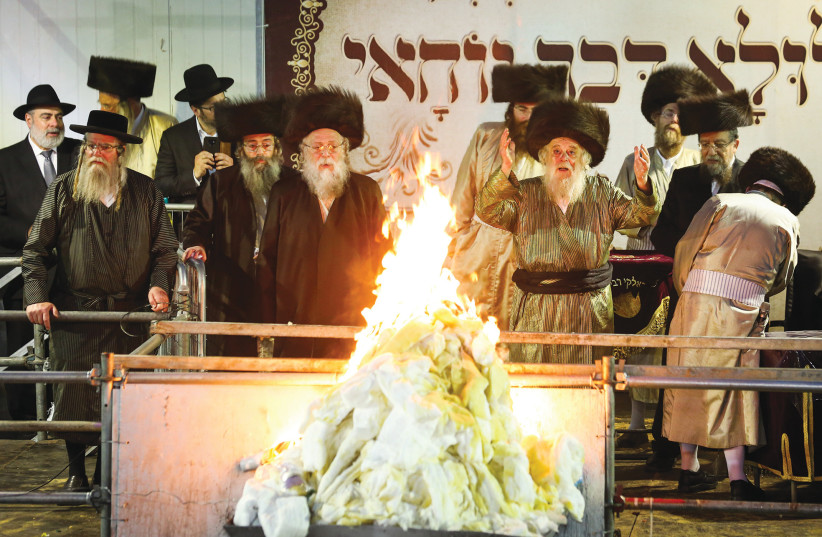
 DAVID KAHN, grand rabbi of the Toldos Aharon hassidic dynasty, lights a bonfire during Lag Ba’omer celebrations on Mount Meron in May 2019.  (photo credit: David Cohen/Flash90)
Grand rabbi of the Toldos Aharon hassidic dynasty, lights a bonfire during Lag Ba’omer celebrations on Mount Meron
 

I turn my eyes to the mountains,” wrote the psalmist (121:1), and then asked: “From where will my help come?”Sung by the Levites on the Temple’s stairs, this line encapsulated the gap between the pagan mindset and the Jewish faith.

Mountains have unsettled mankind from the dawn of history. Looking from afar at Mount Olympus, the ancient Greeks believed it was god’s nest. So did the Japanese when they looked at Mount Fuji, and the Chinese in the face of five mountains spread along their east. In the same spirit, biblical Israel’s Aramean neighbors suspected that “their god is a god of the mountains” (I Kings 20:23).

That is not what Israel was told. The prophets believed God is limitless and is thus confined to no location, no matter how lofty, foggy or pristine. However, what the prophets thought was one thing, and where the people went was another. That is why the Bible repeatedly rebuked the Israelites who “set up pillars and sacred posts… on every lofty hill” (II Kings 17:10).

Our forebears, like the surrounding civilizations, included impressionable people who were lured by idolatry’s manipulation of the senses through size, color, fire and death.

Now the idolatry that plagued our forebears is back at play in the Promised Land, as next week’s pilgrimage to Mount Meron will attest.


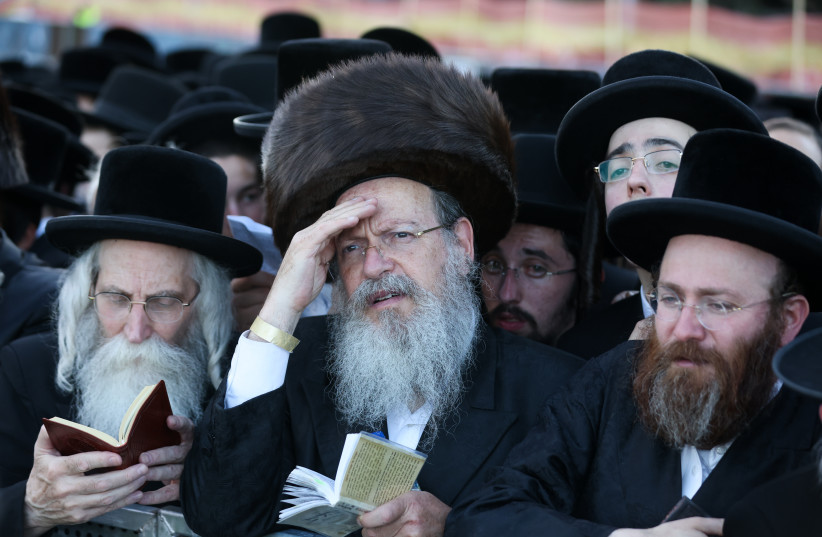
 Ultra orthodox jews attend Lag Baomer celebrations, in Meron on May 18, 2022.  (credit: David Cohen/Flash90) 
Ultra orthodox jews attend Lag Baomer celebrations, in Meron
 

HOW MANY will arrive at the Galilee’s highest peak for this year’s Lag Ba’omer feast remains to be seen. Last year’s attendance plunged to 130,000, as opposed to more than half a million who flocked to the largest annual event in Israel until the 2021 stampede in which 45 people, mostly ultra-Orthodox pilgrims, were killed.

The Mount Meron Disaster, as it came to be known, convinced thousands to avoid the pilgrimage and made the Bennett government control the crowds’ ascendance to the tomb of Rabbi Shimon Bar-Yochai, the ancient mystic whose commemoration is at the heart of the jamboree on the mountain.

So massive was the convergence on the mountain that it deployed 1,000 buses which brought pilgrims not only from the country’s North, South and Center but also ones who flew especially from abroad, much the way Muslims voyage from afar to touch the Kaaba, and Catholics journey to see the pope.

Just what will happen by the mountain next week is hard to predict. The minister overseeing the event, Meir Porush of United Torah Judaism, sounded so complacent this week that he found time to attack Prime Minister Benjamin Netanyahu on another matter (Likud’s foot-dragging on passing the draft bill).

One can only hope the mountainside happening will end as peacefully as Porush apparently assumes it will. The insurance industry is less confident; so much so that no company was prepared to insure the event that crams a multitude on a thickly forested mountain with poor infrastructure and planning.

Yet beyond public safety looms the religious question: What, actually, is this whole psychosis about, why does it attract such a multitude, and what – if anything – justifies the risks it involves?

The Mount Meron feast is not part of the Jewish faith

THE EMBARRASSING truth is that the Mount Meron feast is not part of the Jewish faith, not to mention Jewish law. Invented by Galilean Kabbalists in the 16th century, this holiday is not mentioned in the Mishna and Talmud.

Rabbinical Judaism’s most iconic luminaries, from Rashi and Maimonides to the Vilna Gaon, never observed it. European Jewry hardly knew of this novelty; and when it did become known, the great ultra-Orthodox leader Rabbi Moshe Sofer (1762-1839) banned its celebration.

Still, the Kabbalists of Safed revered Shimon Bar-Yochai, the sage buried within the mountain opposite their town, a Roman-era scholar who, so they believed, wrote the Zohar, a foundational Kabbalistic work. Historians and philologists think the voluminous work was written more than 1,000 years after his time – but that kind of reality check is often ineffective in the face of the pagan urge.

What exactly the date of Lag Ba’omer has to do with Bar-Yochai’s life is unclear – it may have been the day of his birth, the day of his marriage, or the day he was ordained as a rabbi – but whatever its biographical role, the springtime holiday became a celebration upon a grave.

Now, wrapped in glowing bonfires, cacophonous music and the smell of roasting meat, one can imagine Moses watching this feast and responding the way he did when the sight of the pagan celebration at Mount Sinai’s foothills made him shatter the tablets. Such was, and remains, the collision between his religion of law, rationality and introspection, and paganism’s worship of sensation.

Moses himself chose to be buried in an unknown location, lest his grave spark worship. Jews indeed avoided building mausoleums like those designed to deify many non-Jews, from Lenin and Chiang Kai-shek to Kim Il-sung and Ataturk. The only such structure ever built for a Jewish leader – King Herod – was later destroyed so thoroughly by Jewish believers that it took generations of archaeologists to find its shards.

Yet people, including Jews, want to worship what they can see, hear, smell and feel. That’s why pagans made so much of fire, and that is why fire plays such a central role on Mount Meron, where competing rabbis festively kindle bonfires separately, each for his own blind followers.

The same pagan spirit is what makes so many people replace the Jewish journey to God and His laws with a journey to the bricks above a dead man’s bones, the bricks on which they sprinkle oil and throw candles, seeking this way not the meaning of life but the spirit of death.

Surveying Monday night’s bustle, smoke and fire at Mount Meron, Middle Israelis will recall the psalmist’s search for God beyond the mountains and wonder: If rabbis won’t fight idolatry, who will?

https://www.jpost.com/israel-news/article-742130?utm_source=ActiveCampaign&utm_medium=email&

Thursday, May 04, 2023

Imagine the New Supreme Court Judges!


Government will ‘fall apart’ without law on Haredi military exemption, warns minister


As the PM drags his feet on the issue, UTJ officials tell ultra-Orthodox weekly that an ‘alternative’ coalition can be formed


CLOCKWISE - LAUREL & HARDY, MOE, LARRY, CURLY, SHEMP


Housing and Construction Minister Yitzhak Golknopf, head of the United Torah Judaism party, said Prime Minister Benjamin Netanyahu’s coalition could collapse if a law that exempts members of the ultra-Orthodox community from military service does not pass, in remarks set to be published in Haredi media Thursday.

“If the [military] draft outline is not settled, the government will fall apart,” the headline for Goldknopf’s interview with the Mishpacha weekly magazine read. The remarks came as Netanyahu’s ultra-Orthodox allies have turned up the heat on this divisive issue in recent days.

Haredi Knesset members have leveraged the upcoming vote on the 2023-2024 state budget in late May to push for progress on the exemption law. The budget must be passed by May 29 to prevent the Knesset’s automatic dissolution, resulting in snap elections.

Housing and Construction Minister Yitzhak Golknopf, head of the United Torah Judaism party, said Prime Minister Benjamin Netanyahu’s coalition could collapse if a law that exempts members of the ultra-Orthodox community from military service does not pass, in remarks set to be published in Haredi media Thursday.

“If the [military] draft outline is not settled, the government will fall apart,” the headline for Goldknopf’s interview with the Mishpacha weekly magazine read. The remarks came as Netanyahu’s ultra-Orthodox allies have turned up the heat on this divisive issue in recent days.

Haredi Knesset members have leveraged the upcoming vote on the 2023-2024 state budget in late May to push for progress on the exemption law. The budget must be passed by May 29 to prevent the Knesset’s automatic dissolution, resulting in snap elections.

The coalition agreement between Likud and UTJ stipulates that a Basic Law enshrining Torah study as “a foundational value in the heritage of the Jewish people” and legislation allowing for blanket exemptions from IDF service for ultra-Orthodox yeshiva students would pass before the state budget was brought to a vote.

The demand for the Basic Law on Torah study is designed to prevent the High Court of Justice from striking down the blanket exemptions law, as it has done on three occasions in the past on the basis that such exemptions violate the principle of equality for all citizens since all other Jewish men are obligated to perform military service.

 Netanyahu’s right-wing, religious coalition is seeking to pass new legislation that would lower the age after which men are exempt from military service from 26 to 21 years old.

While soldiers are generally drafted from age 18, many yeshiva students are thought to remain in religious study programs longer than they normally would in order to dodge the draft by claiming academic deferments until they reach the age of final exemption. According to Netanyahu’s most recent proposal from mid-April, by lowering the permanent exemption age, the government hopes to spur those Haredi men to leave the yeshiva and enter the workforce at a younger age. The current age of exemption has prevented yeshiva students from entering the workforce until after the age of 26, even if they were no longer interested in continuing with their religious studies.

The military opposes such a stark drop in the age and analysts speculate that the sides will have to meet somewhere in the middle.

Ultra-Orthodox politicians, in recent days, have said Netanyahu must honor the coalition agreement or risk the coalition.

“Contrary to what it seems, alternatives can be put together,” UTJ officials told Mishpacha in the forthcoming article, suggesting that an alternative coalition was possible. It’s not immediately clear with which parties.

UTJ MK Moshe Roth warned on Tuesday that Netanyahu would have to take concrete steps on the matter if Likud wants the ultra-Orthodox party’s support on the state budget. Such measures, Roth said, would likely need to include the submission of a draft bill on the issue, which has yet to be drawn up, as well a statement on the timetable for the final passage of the law.

Likud has been seeking to delay passing the law, fearing additional public pushback if it works to pass unpopular legislation after losing significant support over the manner in which it has advanced a deeply controversial judicial overhaul plan, which has now been paused to allow for ongoing compromise talks with the opposition.

As part of the government’s intended judicial remaking, Netanyahu’s ultra-Orthodox allies are looking to finalize a so-called override clause allowing the Knesset to re-legislate legislation struck down by the High Court of Justice, or shielding certain bills from High Court review from the outset. Another key part of the judicial legislative package will bring most judicial appointments under political control.

The override clause is seen by the ultra-Orthodox parties as a further necessity to ensure that the military service exemptions become a permanent fixture of Israeli law. Critics of the overhaul say it would undermine Israel’s democratic foundations by handing the government unrestrained powers.

As frustrations mount over these issues, Jerusalem Affairs Minister Meir Porush, also from UTJ, said Netanyahu should either honor the agreement or go home.

Earlier this week, reports said the ultra-Orthodox parties had backed down from their demands and agreed that passing the budget and ensuring the stability of the government was the best way for them to eventually pass military draft exemption legislation later this year.

 https://www.timesofisrael.com/government-will-fall-apart-without-law-on-haredi-military-exemption-warns-minister/?utm_source=The+Daily+Edition&utm_campaign=daily-edition-2023-05-04&utm_medium=email

Wednesday, May 03, 2023

A Better Understanding of NDE - Thanks to Medical Science...


New study may explain bright light, familiar faces in near death experiences


Scientists observed that parts of the brain in charge of internal visual experience have increased activity at the moment of cardiac arrest.

Illustrative image of a bright light at the end of a tunnel. (photo credit: RAWPIXEL)
Illustrative image of a bright light at the end of a tunnel.

A sudden increase in brain activity at the moment of cardiac arrest may be what causes people to see a bright white light while experiencing near-death experiences, according to a new study published on Monday.

The study, which was published in the peer-reviewed Proceedings of the National Academy of Science journal, examined the brain activity of four dying patients.

Between 10 and 20% of people who survive near-death experiences tend to describe the moment as a bright light or say that they saw dead loved ones among other visual experiences. Many people look on this skeptically, but the new study may have found a scientific explanation for this phenomenon.

What did the researcher see in dying people's brains?

Using EEG, the researchers observed that cardiac arrest or acute asphyxia led to high levels of gamma activities in the brain among both humans and animals. Gamma power in the brain is an indicator of consciousness and tends to be associated with intense focus, problem-solving and other brain activity that requires mind power.

Specifically, the activated areas of the brain that the scientists observed among dying patients are similar to the areas of the brain that handle internal visual activity like dreaming. This could explain the bright light or faces of loved ones. While the patients are not seeing these images actually materialize in front of them, they are essentially dreaming them as they pass away.


 The brain (illustrative). (credit: PIXABAY)

Two of the four patients observed in the study exhibited the increased brain activity while the other two did not. This could explain why only 10 to 20% of near-death experience survivors report visual experiences. The study did not, however, examine what caused this phenomenon among some people more than others.

Dr. Jimo Borjigin, who led the study, told New Scientist that if the two patients that had increased brain activity had survived, they "might have had some story to tell."

"How vivid experience can emerge from a dysfunctional brain during the process of dying is a neuroscientific paradox," said Dr. George Mashour to the Daily Record. "Dr. Borjigin has led an important study that helps shed light on the underlying neurophysiologic mechanisms."

"Dr. Borjigin has led an important study that helps shed light on the underlying neurophysiologic mechanisms."

Dr. George Mashour

The researchers emphasized that their findings were not conclusive because they could not ask the subjects what they had seen when the increased brain activity had been noted.

In order to make more grounded conclusions, they would need to observe the brain activity of patients who survive near-death experiences and can recount what they saw in the moment of cardiac arrest.


https://www.jpost.com/health-and-wellness/mind-and-spirit/article-741912?_ga=2.163195706.700128905.1682769673-103014047.1667283256&

Tuesday, May 02, 2023

A Fool of a Rabbi or a Rabbi of a Fool....or a "Coronation Chicken" Combo?


UK chief rabbi: Coronation is the 'greatest event that has happened in decades'


UK Chief Rabbi Ephraim Mirvis discussed the halachic issues and Jewish elements of the coronation of King Charles III.


How will the UK chief rabbi participate in the royal ceremony on Shabbat, and what was Buckingham Palace’s creative solution for his arrival at the coronation in lieu of a car?

King Charles III’s coronation ceremony will have a number of Jewish elements to it, including that microphones won’t be used during a joint prayer of faith leaders.

During a quick visit to Israel, UK’s Chief Rabbi Ephraim Mirvis sat down with The Jerusalem Post and told of the behind-the-scenes Jewish aspects for the coronation this Saturday.

“In the British mindset, the coronation is the greatest event that has happened in 71 years,” Mirvis told the Post in a Jerusalem hotel on Thursday. “I think if the Messiah comes at the time of the coronation, it will be on the back page,” he said, laughing.

“Nothing is going to get in the way of this, every tiny detail; and we welcome the fact that the inclusion of other faiths in this event is a feature of the coronation. It was not a feature in the previous one – just the church; after all, the essence of the coronation is a religious service in Westminster Abbey.”

“I think if the Messiah comes at the time of the coronation, it will be on the back page. Nothing is going to get in the way of this, every tiny detail; and we welcome the fact that the inclusion of other faiths in this event is a feature of the coronation. It was not a feature in the previous one – just the church; after all, the essence of the coronation is a religious service in Westminster Abbey.”

Ephraim Mirvis

Britain's Chief Rabbi Ephraim Mirvis (credit: TOBY MELVILLE/REUTERS)

What are the halachic issues for Jews at King Charles' coronation?

Orthodox Halacha forbids Jews to enter a church because it is considered a house of “idol worship.” Religious Jews also don’t participate in events that include the use of microphones, live music or electronic devices on Shabbat.

Mirvis explained that, for entering a church, “we have a very clear, well-established code of conduct for chief rabbis: when there is an invitation, stroke or command from the palace, we do it.”

He said that often the invitations from the palace are worded, “His Majesty commands,” triggering the halachic reality of “mishum eiva” [“on account of hatred”]. Mirvis explained the term: “We sometimes find it appropriate that the chief rabbi should attend church. I have attended a number of services.”

The second halachic issue, he explained, is that “even if you can walk to the ceremony, it is not exactly what Halacha calls the ‘spirit of Shabbat,’ since there is live music and the whole occasion isn’t what we do on Shabbat.” Yet “on both of those accounts, it is clearly the right thing to do. As well, this is a decision that I don’t make alone; our beit din [rabbinical court] has decided this. We assess all situations very carefully.”

Mirvis said, smiling, that “in King Charles, we have a genuine friend of the Jewish people and somebody who goes out of his way to champion the members of other faiths to practice the tenets of their faith with pride.” He added that he has “seen this in practice on umpteen occasions,” and “through my own friendship with the king and conversations with him at the royal household.”

He emphasized that “they [the monarchy] genuinely and sincerely want us to practice our faith.” According to the chief rabbi, “this is exactly what led the king and queen to invite [my wife] Valerie and I to spend Shabbat in a royal residence.” They will be staying in St. James’ Palace, and Mirvis explained that “they are providing a kosher caterer for our food over Shabbat and looking after every small detail.”

He said there is “a very interesting, historic parallel” with the upcoming coronation.

“In 1902, the coronation of King Edward VII was put off because he was ill. So the actual date of termination fell on Shabbat. Then-chief rabbi Hermann Adler walked to the coronation and, fascinatingly, Buckingham Palace contacted me to say they would like me to walk along the same route,” and that is the route that Mirvis will be taking.

Mirvis laughed, remembering a recent phone call his staff received from Buckingham Palace. It went something like: “The chief rabbi won’t go in a vehicle [because of Shabbat], so we’d like to put on one of the royal horses and carts for him, in order for him to be part of the parade.”

There will be two parts to the coronation that are religious rituals: “The first part is a very soft touch – the presentation of regalia, part of the state elements of the ceremony, where the king is presented with certain historic items, which he touches and then they are taken from him.” The items will be later also brought by four members of the House of Lords, Jewish, Muslim, Hindu and Sikh. The Jewish representative is Baroness Gillian Merron, who will present the “Robe Royal.”

At the end of the coronation service, there will be a procession out of the abbey, and “at the head of the king and queen there will be eight faith leaders,” Mirvis said. He will be the only Jewish faith leader at this service. He explained that “we will stand in a line, the king will come in his full regalia and in his historic 16th-century crown, which is only worn at coronations, and he will stand in front of us. We will give him a blessing in unionism, a pair of blessings, which is okay, or, shall I say, kosher for all of us.

“He might chat with us and if he does, that would be wonderful, but he might not. There will be an official blessing message, which we will all recite together,” Mirvis said, and added that “the words we are saying are pretty simple, but very powerful.”

He told the Post that his favorite Jewish element of the religious parts of the coronation is the fact that “there will be no microphones, because they don’t want to put me in a compromising position. They even thought of this issue before they came to us.”

The chief rabbi shared that he will wake up early on Shabbat morning and participate in the early prayer service at Western Marble Arch Synagogue.

“I’ll pray at 6 a.m. in order to reach the abbey by 9 a.m., in time for the ceremony that starts at 11 a.m.,” he said.

Mirvis and his wife will be offering the king and queen two gifts “for Shabbat,” as Mirvis described them: “Valerie is baking biscuits for the king and queen, which are the biscuits we know that they like and enjoy.”

The second gift is a certificate “that a grove of trees will be planted in our United synagogue forest in honor of the coronation,” Mirvis said. “Of course, the king is known to be a particularly passionate environmentalist.”

Mirvis said he already knows what the menu for this upcoming Shabbat at the royal residence will be, since they already chose it – “a dish called Coronation Chicken.” This type of chicken was invented for the coronation of Queen Elizabeth II in 1953, a dish of diced chicken with a creamy sauce and a touch of curry powder. Mirvis will be getting the kosher version.  


https://www.jpost.com/diaspora/article-741809?_ga=2.226830107.700128905.1682769673-103014047.1667283256&