As
Trump prepares to take office, the MAGA movement is divided over the
app. ‘Their kids are studying calculus and our kids are being told to
chew Tide Pods.’
The Free Press
is in D.C. for inauguration weekend, and the one thing dominating the
conversation—even more than president-elect Trump—is TikTok.
On January 17, the Supreme Court ruled unanimously
that Congress’s law forcing a divestiture of TikTok “is necessary to
address [Congress’s] well-supported national security concerns regarding
TikTok’s data collection practices and relationship with a foreign
adversary” and thus did not violate the First Amendment. This meant that
TikTok, since it had failed to secure a sale to a buyer not controlled
by a “foreign adversary,” needed to shut down by Sunday.
On
Saturday, TikTok announced that the app was going dark. Soon
thereafter, news broke that president-elect Trump might even be open to nationalizing half the social-media app.
By
Sunday around noon, after the previous night’s brief shutdown, Trump
had promised to issue an executive order on Monday to “extend the period
of time before the law’s prohibitions take effect.” TikTok announced that
“In agreement with our service providers” the company “is in the
process of restoring service. We thank President Trump for providing the
necessary clarity and assurance to our service providers that they will
face no penalties providing TikTok to over 170 million Americans and
allowing over 7 million small businesses to thrive.”
Whew.
Left
unexplained was how Trump could do this given the law’s plain language,
which allows the president to grant such a reprieve for 90 days only if
he can certify "evidence of significant progress" toward a sale. And
that’s a big reason that, even before Trump takes office, disagreements
are breaking out between Republican national-security hawks and
tech-world interests that—for the moment—seem to have Trump’s ear. Of
TikTok’s restoration of service in the U.S., Senator Tom Cotton said:
“Any company that hosts, distributes, services, or otherwise
facilitates communist-controlled TikTok could face hundreds of billions
of dollars of ruinous liability under the law, not just from DOJ, but
also under securities law, shareholder lawsuits, and state AGs. Think
about it.”
In other words, TikTok may be pursuing a perilous path—regardless of any assurances Trump has just issued. Some are warning this all ends with a Meta monopoly on apps like TikTok.
What will happen next? For now, TikTok has restored service and posted the following message to its users, crediting Trump:
“As a result of president Trump's efforts, TikTok is back in the U.S."
In a frank and freewheeling conversation with The Free Press on Saturday, Senator Ted Cruz (R-TX) weighed in on the fast-moving furor over TikTok’s legal status.
The below reflects Senator Cruz’s comments on TikTok’s future.
Bari Weiss: If TikTok is a national security threat, how can that national security concern be waived for 90 days?
Senator Cruz: Because the statute provides
that it can be waived for 90 days. And the statute provides that it can
be waived in order to facilitate a sale. So I don’t know what Trump is
or isn’t going to do on this. If we are sitting here 91 days from now
and TikTok is still live and China is still owning and controlling it,
that will be a very dangerous situation because the Chinese communist
government uses TikTok—number one for espionage, and number two to push
propaganda and very harmful content to our children that pushes
self-harm, suicidal ideation, substance abuse, antisemitism,
anti-Americanism and anti-capitalism. It is a potent propaganda tool.
The Chinese variant of TikTok, for their kids—number one, the hours they
can use it are limited, and number two, they’re pushing things like
math and hard work and discipline.
Weiss: It’s like Khan Academy.
Cruz:
It really is astonishingly harmful. So their kids are studying calculus
and our kids are being told to chew Tide Pods. That’s a problem.
To YU’s Rabbi Ari Berman: The inauguration is not your stage
Is Yeshiva University sacrificing its chartered values or will it
use the moment in Trump's limelight to call for reflection and
redirection?
Yeshiva University faces a pivotal moment that will define its legacy.
President Rabbi Dr. Ari Berman is scheduled to deliver a benediction
at the inauguration of President-elect Donald Trump. This choice, while
perhaps politically expedient, raises troubling questions about the
values that guide Yeshiva University today.
This is the same university that once conferred honorary degrees
upon Albert Einstein, Nobel laureates, US presidents, and Israeli prime
ministers — leaders who embodied the intersection of intellectual and
moral excellence. Yet this president’s inaugural stage is not theirs,
nor is it ours. It belongs to a man whose history of divisive rhetoric
and actions — against women, minorities, the press, and even Jews —
stands in stark contrast to the ethical and spiritual ideals YU was
founded to uphold.
Perhaps the calculus is simple: Israel’s security and the fight
against antisemitism demand pragmatic alliances. Throughout history,
Jews and Jewish leaders have presented menorahs and blessings to various
leaders under the guise of diplomacy. In darker times, rabbis acted as
pawns for power, their prestige used to confer legitimacy upon troubling
regimes. Is this another chapter in that story?
Maybe I don’t fully see the picture. Perhaps the moment requires
alliances with imperfection. President-elect Trump’s past statements,
dining companions, and veiled threats to Jews might pale in comparison
to the perceived benefits: standing with Israel against its existential
threats, confronting Iran’s nuclear ambitions, or addressing the surge
of antisemitism in America. If those desirable deeds materialize, would
YU consider honoring him, as it did other presidents? The irony would
lie in honoring a man whose record also includes divisiveness, criminal
conviction, and accusations of sexual misconduct. And that contrast is
both painful and profound.
Elie Wiesel once implored Ronald Reagan in 1985 not to visit the
Nazi cemetery at Bitburg, saying, “This is not your place.” I echo that
sentiment. This stage, this moment, is not one for a rabbi, particularly
one whose institution still wrestles with its own moral failures.
YU’s
president leads a university embroiled in one of the largest alleged
abuse scandals in New York State history — a scandal marked by decades
of silence, alleged coverups, and continued apparent resistance to
accountability. Survivors of abuse have watched their alma mater
seemingly prioritize image over integrity, burying truths and deflecting
justice.
The juxtaposition is striking: a university that once championed
Jewish moral and intellectual leadership now standing on a stage that
symbolizes anything but. That a Jewish university’s rabbi-president, who
has presided over the alleged continued coverup of alleged abuse crimes
would appear on this stage is as ironic as it is troubling.
And yet, on second thought, perhaps it’s a perfect match. This
moment encapsulates what Yeshiva University has become: an institution
willing to sacrifice its chartered values on the altar of expedience. It
is a tragic reflection of how far the storied university has strayed
from its mission to uphold Jewish moral and ethical principles.
The Yeshiva University charter, once a beacon of intellectual and
spiritual integrity, now feels like a junk bond. The only question that
remains is whether YU will recognize this moment as a call to
reflection and redirection — or double down on its path toward moral
bankruptcy.
Survivors, alumni, and history itself are watching.
More than $5 billion spent on Catholic sexual abuse allegations, new report finds
(RNS) — During the 20 years of surveys, the
respondents reported 16,276 credible allegations of sexual abuse of
minors by priests, deacons or religious brothers.
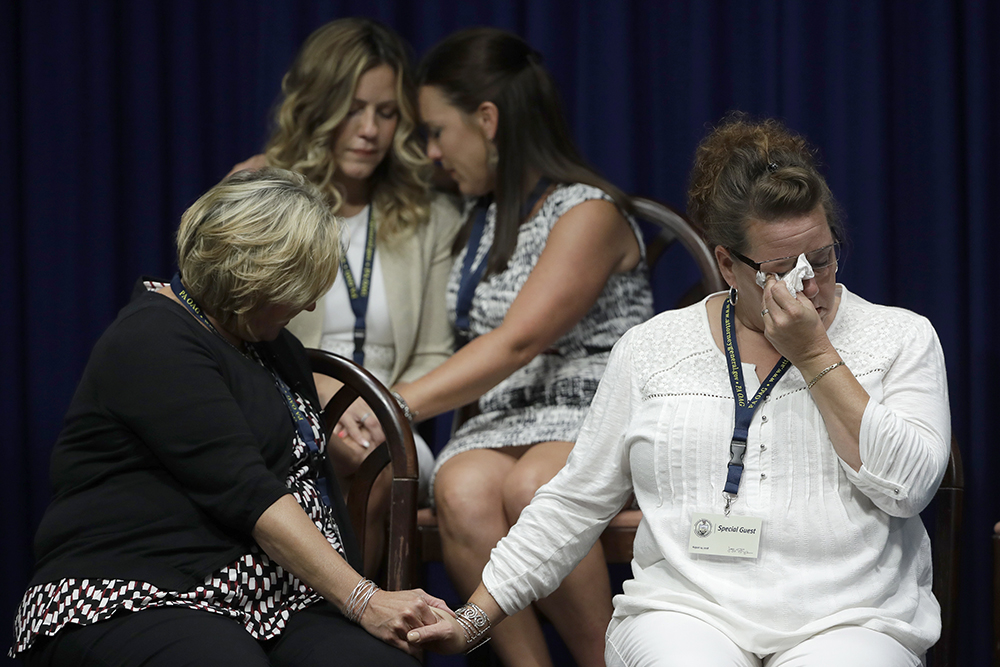
Victims of clergy sexual abuse, or their family
members, react as Pennsylvania Attorney General Josh Shapiro speaks
during a news conference at the Pennsylvania Capitol in Harrisburg on
Aug. 14, 2018. A Pennsylvania grand jury’s investigation of clergy
sexual abuse identified more than 1,000 child victims in the state. The
grand jury report said that number comes from records in six Roman
Catholic dioceses.
(RNS)
— Over two decades, Catholic dioceses, eparchies and men’s religious
communities spent more than $5 billion on allegations of sexual abuse of
minors, according to a new report released Wednesday (Jan. 15) by the
Center for Applied Research in the Apostolate at Georgetown University.
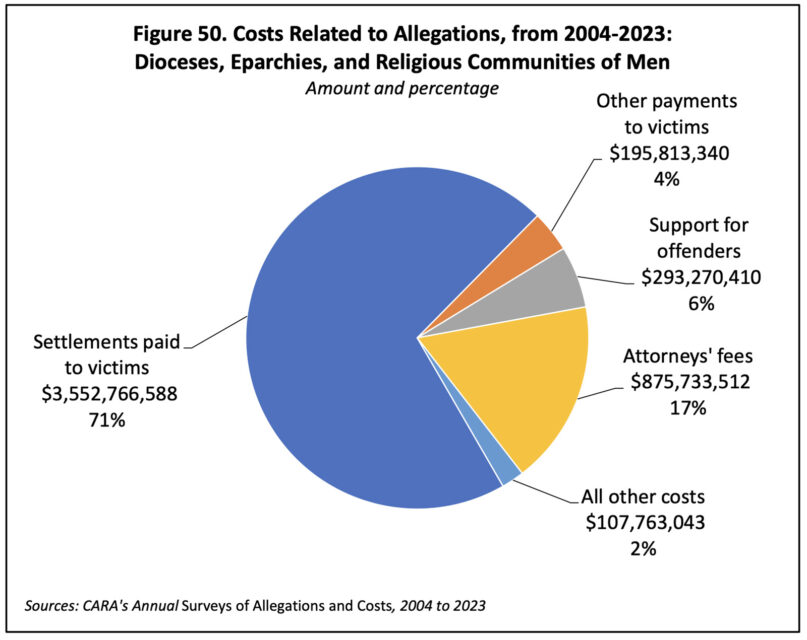
Between 2004 and 2023, three-fourths of the $5.025 billion reported
was paid to abuse victims. Seventeen percent went to pay attorneys’
fees, 6% was in support for alleged abusers and 2% went toward other
costs. On average, only 16% of the costs related to the allegations was
borne by insurance companies.
The CARA report combined 20 annual surveys sent to dioceses and
eparchies within the U.S. Conference of Catholic Bishops (which excludes
some parts of the U.S., such as Puerto Rico, Guam and American Samoa),
as well as U.S. religious communities belonging to the Conference of
Major Superiors of Men. The report does note that some alleged
perpetrators were assigned outside the U.S. The USCCB commissioned the
survey in 2004.
Jonathon Wiggins, a lead researcher on the report, told RNS that the
report represented the Catholic Church’s superlative commitment to
transparency. The report “is unprecedented by any non-governmental
organization and is the largest effort of its kind,” the report’s
authors wrote in a statement.
Wiggins told RNS that this report may have some overlap in cases with
the groundbreaking 2004 research study on the nature and scope of
sexual abuse in the church, conducted by the John Jay College of
Criminal Justice, but that it has a different methodology.
During the 20 years of the survey, the respondents reported 16,276
credible allegations of sexual abuse of minors by priests, deacons or
religious brothers. Those allegations represent slightly less than
two-thirds (65%) of total allegations that dioceses, eparchies and men’s
religious communities reported receiving.
Though the surveys come from the 2000s, the majority of credible
allegations were for abuse that began before 1980. Ninety-two percent of
credible allegations were for abuse that began before 1989. In
contrast, 542 credible allegations represented abuse that began after
the year 2000. The report defines credible allegations as bearing the
“semblance of truth” and having been sufficiently substantiated to
forward the allegations to the Vatican’s Dicastery for the Doctrine of
the Faith.
Of the credible allegations, 4 in 5 victims were male, and one-fifth
were female. More than half were between the ages of 10 and 14. About a
quarter (24%) of victims were between 15 and 17 years old and another 1
in 5 was age 9 or younger.
The response rate for dioceses and eparchies averaged 99%, while
men’s religious communities had an average response rate of 72%.
In addition to tracking the money spent on allegations of abuse, the
report totals the amount of money spent on abuse prevention, including
for safe environment coordinators and victim assistance coordinator
salaries, administrative expenses, training programs and background
checks, totaling nearly $728 million.
The report tracks that the abuse prevention expenses have risen over
time, with the amount spent from 2014 to 2023 representing an 80%
increase compared with the expenses from 2004 to 2013.
“Costs Related to Allegations, from 2004-2023: Dioceses, Eparchies, and Religious Communities
The financial costs of the abuse crisis have reshaped the Catholic
Church in the United States. Marie T. Reilly, a professor at
Pennsylvania State University Law School, has tracked
40 Catholic dioceses and religious organizations that have sought
bankruptcy protection, and many dioceses have cited the expense of
settling abuse claims as part of their decision to declare bankruptcy.
Those financial troubles have led dioceses throughout the country to
sell diocesan property, including diocesan headquarters, seminaries,
schools and churches. In the Diocese of Rockville Centre, New York,
every parish had to pay amounts ranging from five figures to more than
$1 million toward a bankruptcy settlement.
Of all the survey years, 2019 had the highest number of credible
allegations reported, with 2,506 credible allegations reported that
year. That year came after a flood of revelations about the extent of
sexual abuse in the church.
Many state investigations were opened after an August 2018 Pennsylvania grand jury report found that there were more than 1,000 victims of child sexual abuse in that stateand that Catholic bishops and other leaders had participated in a cover-up.
2018 was also the year that several dioceses found
that the allegation that Cardinal Theodore McCarrick had sexually
abused a minor was credible, leading to McCarrick’s removal from the
clerical state in February 2019.
Over two decades, the survey’s questions changed in ways that may
impact the total count of credible allegations. Before 2013, the survey
did not include allegations of abuse by religious brothers, who are
considered lay people in the Catholic Church.
Before 2016, all allegations were sorted into “credible” and
“unsubstantiated/obviously false” categories. In 2016, a third category,
“unable to be proven,” was introduced, which decreased the proportion
of allegations deemed “credible.”
Based on the allegations deemed credible, the report estimates 4,490
alleged perpetrators, of whom 80% were diocesan priests, 15% were
priests from religious orders, 4% were religious brothers and 1% were
deacons.
In the years that the perpetrators were reported by dioceses,
eparchies and men’s religious communities, 86% of the perpetrators were
already dead, removed from ministry, laicized or missing. The other 14%
were removed from ministry or retired from ministry during the survey
year.
Thank you to The Times of Israel for putting together this article on our BTJ alumnus, Sgt. First Class Mulugeta “Mulu” Gadif, 29 who lost his life heroically protecting Kibbutz Be’eri on October 7, 2023.
Israel
is on the brink of striking a deal with Hamas. After more than a year
of on-and-off negotiations, hours ago came the news that Hamas’s
military leader, Mohammed Sinwar, had approved the agreement.
The
deal is complicated and is structured in three phases over a 42-day
period. In the first phase, which can begin as early as Sunday, Hamas
will release 33 hostages—women, the aged and infirm, and children, among
them the Bibas babies.
The subsequent two phases will see the release of all 98 hostages,
living and dead, and the withdrawal of Israeli forces from the entire
Gaza Strip. The war will officially end. But the fulfillment of the
second and third phase is contingent on the successful implementation of
the first.
Should
it succeed, the deal will be greeted cacophonously in Israel. Boundless
joy will mix with anger and pain, relief with fear and searing
disappointment.
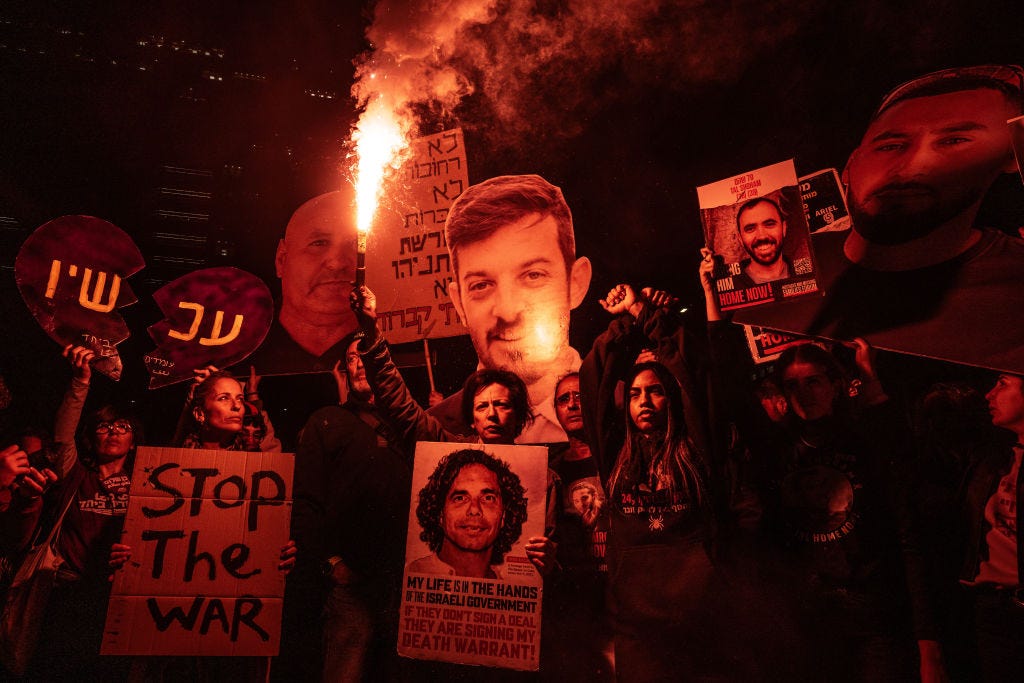
Rallies
in favor and protests against the deal enveloped Tel Aviv and Jerusalem
on Tuesday night. Broadly speaking, the Israeli left in Tel Aviv
supports ending the war in Gaza in exchange for the release of hostages.
The Israeli right welcomes the hostages’ return, but insists that
Israel prioritize winning the war.
In
Tel Aviv, crowds flooded the streets calling on the government to “seal
the deal” and asking “how much blood must be spilled” before it does.
In Jerusalem, demonstrators claimed the government had no mandate to
“surrender” to Hamas. “A freed terrorist is tomorrow’s murderer,” right-wing opponents of the deal bellowed as they blocked traffic near the prime minister’s office.
Such discordance is inevitable.
From
day one—October 7, 2023—Israel’s twin goals in Gaza were fundamentally
irreconcilable. Israel could not, as its leaders pledged, simultaneously
destroy Hamas and secure all of the hostages’ release. The terrorists
who regarded the hostages as the key to their survival would hardly give
them up for less than an Israeli commitment to end—and therefore
lose—the war. Israelis, for their part, were torn between those who felt
that they could not send their children to the army as long as hostages
remained in captivity and those who held that, if Hamas wins, Israel
will not have an army at all.
Still,
Israel believed that by increasing military pressure on Hamas, it could
compel the terrorists to free the hostages. The strategy appeared to
work when, in November 2023, Hamas released 105 of its 251 hostages in
exchange for a weeklong ceasefire and the freeing of 240 Palestinian
prisoners from Israeli jails. Israel reasonably assumed that ratcheting
up its operations in Gaza, especially in Hamas’s Rafah stronghold, would
yield similar results.
But
Hamas thought otherwise. Surprised by Israel’s determination to resume
fighting after the ceasefire and convinced that mounting international
condemnation of the war’s conduct would soon force the Israelis to
surrender, the terrorist group dug in its heels. Israeli forces would
enter Rafah and several refugee camps, kill senior Hamas leaders, and
dispel the terrorists’ hope of the opening of a second front with
Hezbollah in Lebanon—yet no new hostage deal ensued. Hamas still
insisted on an unlimited ceasefire and a complete Israeli withdrawal
from the strip. Instead of buckling to military pressure and releasing
hostages, the terrorists shot them.
People
in Tel Aviv, Israel, gather to demand a ceasefire and the resignation
of Israeli Prime Minister Benjamin Netanyahu in Gaza on January 11,
2025. (Mostafa Alkharouf via Getty Images)
The
schisms within Israeli society meanwhile deepened. Tens of thousands
took to the streets weekly not to protest Hamas’s inhumanity but their
own government’s alleged intransigence. Prime Minister Netanyahu, they
claimed, desperate to preserve his coalition with radical rightists
opposed to any deal, blocked it by adding unreasonable preconditions.
Netanyahu, they protested, doomed the hostages. Only the Biden administration, an often-fierce critic of Israeli policies in Gaza, placed the bulk of the blame on Hamas.
Other
Israelis, mostly from the right, applauded the government’s refusal to
accede to an agreement that rewarded terror and guaranteed Hamas’s
victory. Many of Hamas’s leaders, they recalled, among them October 7
mastermind Yahya Sinwar, were released
in previous hostage-for-prisoner exchanges. The terrorists freed in
this deal, its opponents predict, will kill countless Israelis in the
future.
Yet
now, suddenly, a breakthrough deal is looming. Both Israel and Hamas
have reportedly softened their positions and bridged formerly
insuperable gaps.
What
has changed? Although the White House deserves credit for persevering
in the hostage-release talks, the deal probably owes much to the soon
incoming president’s threats to visit “all hell” on Hamas and his ability to press Netanyahu.
President
Biden could say “don’t,” and everybody in the Middle East—Iranians,
Arabs, and Israelis alike—did. Not so with Donald Trump. One meeting
with his special Middle East envoy Steve Witkoff reportedly persuaded
Bibi to accept conditions he had long rejected.
Still,
if and when the ceasefire breaks down, the Israeli government is
counting on the Trump administration’s unbridled support in completing
the destruction of Hamas. Hamas is banking on international action to
prevent the war from reigniting. Most of the world will applaud.
The
response of the Israeli public will, by contrast, be fragmented. While
the vast majority will celebrate the homecoming, their joy will be
tempered by the unspeakable tortures the hostages suffered and their
long, if not endless, road to recovery.
While
33 hostages will be released in the first stage, dozens—alive and
dead—will remain in Gaza, prolonging their families’ suffering. The
relatives of those killed by the Palestinian terrorists now going free
will also be shattered. So, too, will the Israelis who still see
soldiers dying in Gaza almost daily while Hamas rocket fire continues.
What were all of Israel’s sacrifices for, they will ask. As with
previous deals, this one will only encourage further terror and
hostage-taking, they’ll warn, and set the stage for a future attack,
like October 7.
Perhaps
this outcome was unavoidable from the beginning. Perhaps the deal is
the only way of reconciling Israel’s mutually exclusive goals of
annihilating Hamas and repatriating the hostages. Perhaps, despite
Israel’s subsequent military triumph, this is the price for the failures
of October 7.
Michael
Oren, formerly Israel’s ambassador to the United States, Knesset
member, and deputy minister for diplomacy in the prime minister’s
office, is the founder of the Israel Advocacy Group and the author of
the Substack Clarity.
I am posting Rabbi Dov's essay after the ceasefire "deal" has been announced. As a parent and a human, of course, I am conflicted. Having said that, Dov's essay has very much merit in my eyes.PM
Catastrophe
To
save 33 tragically kidnaped hostages (and they won't all be alive),
Israel will be consigning thousands of Jews to their future deaths. This
is not "maybe." This is guaranteed. It happens every time.
They are talking about inking a deal between Netanyahu and Hamas. As I write, the deal is not yet done. In the Talmud, Masekhet (Tractate) Brakhot,
King Chizkiyah (Hezekiah) actually lectures the Prophet Yishaya
(Isaiah), who had been sent to him by G-d to tell him that his life soon
would be over.
The
King, upon learning the sin for which he was being punished, declared
his repentance. The Prophet said it was too late; the decree had been
issued. The King responded with a fundamental Jewish concept: even when a
Jew has a murderer’s knife pressed on his throat, it still is not too
late to pray. Accordingly, until such a Netanyahu-Hamas deal is done, it
is not too late to pray. Even if — G-d forbid — such a deal is inked,
it will not be too late to pray.
Or to act.
The
media reports say Israel will be agreeing to a three-phase deal. Phase
One would include (i) an immediate six-week ceasefire, (ii) the Arab
release of 33 (but not all) of their kidnaped hostages, some alive and
some dead, and (iii) Israel releasing hundreds of convicted Arab
murderers. But, in Netanyahu’s show of great "fortitude", he will not
release the corpse of Yahya Sinwar under any circumstances. Only living
Arab murderers with documented blood on their hands, just waiting to get
back in the game.
Much of Israel
will be celebrating wildly. Dancing in the streets. Champagne, though
not from Milchin, will be flowing. Cigars, though not from Milchin, will
be puffing. Channels 11, 12, and 13 will be leading the celebrations.
Front pages will cheer at least from Haaretz to Maariv to Yediot and maybe Makor Rishon.
Those who would cheer are fools.
They
cheered after Sharon’s 2005 Disengagement, and they lived to weep while
burying their children who died for the moment of joy 18 years earlier.
It
is a HORRIBLE, TRAGIC deal. One Hundred of Israel’s leading rabbinic
authorities have publicly declared what almost every Torah scholar who
supports IDF service knows: The Halakha (Judaic law) forbids endangering
the nation even for the precious mitzvah of redeeming the captives.
Tractate Gittin sets forth laws and limits on Pidyon Shvuyim (Redeeming
Captives). One does not — may not — pay just any price. The Shulchan Arukh
(Code of Jewish Law), at 252:4, declares: “Captives are not to be
ransomed at an unreasonable cost, for the safety of society.” Read the
letter of the 100 Torah Sages here and see the [Hebrew] letter of organizations such as the Heroism Forum, Hope Forum, Reservists Forum and more.
The
mainstream left-wing media in Israel, who brainwash half the
population, are thrilled with the agreement. Much of the Likud
government coalition love it, too, because Likud Members of Knesset
(MKs) follow Netanyahu like lemmings. He dispenses their crumbs,
committee assignments, ministries — even who gets to be a consul or
ambassador in a country although he barely speaks their language, who
gets a free trip to America at government expense, who gets to be on the
next election list in a safe spot so as to build up a millionaire’s
lifetime pension. So they will vote like lemmings as others did for
Sharon.
The Haredi parties in the government coalition will support the deal not because the halakha
demands Pidyon Shvuyim “at any cost” — it does not and they know it —
but because, as the IDF soldiers come back from Gaza, it will reduce
pressure on Haredim to shoulder their proper responsibility in the
defense of the nation, beyond their incredibly holy and blessedly
critical Torah learning, as do Yeshivat Hesder boys. Israel cannot
survive without their Torah learning, their yeshivot and kollelim.
Absolutely. But they don't want even the haredi young men who are not
learning, of which there are many, to join the army. But the return of
the soldiers will relieve their shoulders.
Meanwhile,
Gideon Sa'ar's four votes will support it, too, so Sa'ar can remain
Foreign Minister and take a shot at Bibi’s seat some day.
That
leaves the two on the right, Smotrich's Religious Zionist Party (RZP)
and Ben-Gvir's Otzmah. One does not bring down a right-wing-oriented
Israeli government over a budget cut. However, one does do so over a
perfidy to the nation and to future generations. Smotrich and Ben-Gvir
surely will denounce the deal and will have their 14 MKs vote against
it. However, it is not clear whether they will quit the Coalition. If
they do, great. But what will that achieve? Will it risk losing momentum
on further building in Judea and Samaria? Does that matter enough?
If
Smotrich and Ben-Gvir remain in the Coalition but simply vote against
this deal, the deal would pass easily anyway. The leftist opposition all
will vote for it -- especially the two Arab parties. Lapid, who
promised a safety net for the vote, may even offer to hand over some
natural gas properties to Hamas. So, if Netanyahu proposes it, it will
pass smoothly with more than 100 votes of the 120. Think back to the
Gaza Disengagement. To all the retreats.
The
deal would free 300 or more Hamas murderers right away, some held in
prison for more than a decade. Some sentenced to 20 and more life
sentences without parole. (What a joke!) So, to save 33 tragically
kidnaped hostages (and they won't all be alive), Israel will be
consigning thousands of Jews to their future deaths. This is not
"maybe." This is guaranteed. It happens every time.
To
save one precious Jewish life who previously was taken hostage by Arabs
(not his fault at all, but his father and the willing media's fault,
and I feel bad for him that his name always is mentioned in this regard,
so I won’t), Israel ultimately released a lop-sided thousand of these
same types of Arab cutthroats. One was a guy named Yahya Sinwar. A whole
bunch of Arab psychopaths like him. That led to Intifada in Judea and
Samaria, to building of Hamas, to several deadly wars, and now to the
over 2,000 who have died since October 7, 2023 (1,200 that day and over
800 Israeli soldiers since).
Yahya Sinwar in Gaza-remember him? Freed in Schalit deal
It is a terrible
deal. It leaves Hamas alive to govern Gaza and to fight again in five
years, with all their old pals back in the fray. Hamas will dance in the
streets, a scene we see after every “ceasefire” that they regard as an
Israeli “capitulation and surrender.” It eliminates the restored specter
of Israeli invincibility and deterrence. It shows that Israel is afraid
to win. It emboldens other Arabs. So the question is "Why"? Netanyahu
always declared he would not leave without "Nitzachon Mushlam" ("Complete Victory"). My best guess:
Biden
is irrelevant. He is out in less than a week. He cannot do anything. An
embargo? Trump can overrule it his first day. A UN vote for a "Two
State"? No UN vote matters, just as Obama's and Kerry's Security Council
Resolution 2334 of December 2016 never ended up mattering, even though
it was the Security Council, not just the General Assembly, declaring
that Israel is barred from the eastern part of Jerusalem, even the
Kotel. It meant nothing. Soon after, America was moving its embassy into
Jerusalem and declaring that Israeli communities anywhere in Judea and
Samaria are totally legal as long as Israel’s Supreme Court does not say
otherwise.
So Biden and Blinken do not matter. Therefore, again, one asks: “Why the Netanyahu perfidy this time?”
I have only one guess that I can process. Nothing else is remotely conceivable to me. My guess. It is only a hunch:
Trump
forced Netanyahu to do the deal in order for Trump to brag that it
happened because of his threat that "all Hell would break loose" if a
deal was not done by January 20. (Biden will brag, too, but that was
like Jimmy Carter, of accursed memory, y'rakvu atzmotav, bragging that he freed the Iran hostages as Reagan was being sworn in.)
For
Netanyahu to agree to such a terrible thing -- and he knows how
disastrous this is -- I can only guess that, in return, Trump promised
Netanyahu that, if Israel does the deal to make Trump look good, then
Trump will assist Netanyahu in wiping out Iran's nuclear sites and maybe
even in assassinating Khameini and maybe even in taking down the whole
Iranian regime. (Trump would not send American troops because he is
committed to avoiding all future ruinous wars that other presidents
before him have entered. But he could send bunker-busting bombs and
aerial support and all kinds of stuff, and twist NATO arms including
Turkey, as when he assassinated Qassen Soleimani and Abu Bakr
al-Baghdadi.)
Thus, maybe Netanyahu
did an analysis: “If I let the 300 bestial Arab murderers out, that will
lead to, say, the murder of 3,000-5,000 Jews over the next 10 years. On
the other hand, if Iran's nuclear system is knocked out and Khameini is
assassinated and the Khameini regime taken down, that will save more
than multiples of 5,000 Jews who could get killed by Iranian nukes. It
also could strangle all the Iranian proxies (Hamas, Hezbollah, Houthis,
and Abbas in the AEJS, the Arab Entity in Judea and Samaria,)
That's
my best guess. It offers the only rationale I can grasp. Netanyahu’s
heart is in the right place, but Bibi likes to over-think himself into a
cleverness that means well and that makes him proud that he is the
smartest guy in the neighborhood — but is not. Like letting Qatar send
Hamas a billion shekels a year so that Gaza and the AEJS each would be
led by a competing murderous government that never would be able to
unite as a pretextual “Palestine.” Or clever ceasefires that always kept
the Arabs divided, with Hamas alive to threaten Abu Mazen (Mahmoud
Abbas). Clever. But it didn't work, did it?
A
further wistful thought: And maybe Trump would agree to recognize
Israeli annexation of Judea and Samaria? That would help make some sense
of all this, but I don't think so. Ambassador Mike Huckabee would push
for it. Secretary of State Marco Rubio would back it. So would Defense
Secretary Pete Hegseth. Vivek Ramaswamy supports it, too. Musk could be
persuaded. But I don’t think that’s in this deal’s background. Nor would
even that justify this catastrophic deal.
My
prayer is that Hamas somehow insanely will turn down and sabotage the
proposed deal at the last moment. A similar hopeless moment came when
Clinton forced an all-too-willing treacherous Ehud Barak to give Arafat
97% of the land he demanded for a country to be called "Palestine,"
including the eastern part of Jerusalem and the Temple Mount, plus land
within interior Israel in the primarily Arab-populated Galilee Triangle
comprising territory equal in size to the 3% of Judea and Samaria Barak
could not cede. Clinton and Barak offered Arafat -- on a silver platter
-- a nightmare of a deal.
And, by
G-d's miracle, He hardened the heart of Pharaoh, and Arafat turned down
the deal. That made no sense then and is one of the greatest Divine
Miracles I have seen in my lifetime, that Arafat turned down everything
he asked for.
That's my hope. But we
do not rely on miracles. And lightning does sometimes strike twice.
Especially when Israeli prime ministers get the insane idea that they
will be advancing Israeli security by giving Arabs territory that
belongs to Israel and that Jewish, Druze, and even some Arab boys and
girls died for on Israel’s behalf.
Subscribe to Rav Fischer’s YouTube channel here at bit.ly/3REFTbk and follow him on X (Twitter) at @DovFischerRabbi to find his latest classes, interviews, speeches, and observations.
To
be attend any of his three weekly Zoom classes — Sundays on the past
week’s events impacting Israel and world Jewry, and Tuesdays and
Thursdays on the Tanakh (Bible) and Jewish law — send a request to rabbi@yioc.org
Dr. Offit is a pediatrician specializing in infectious diseases at the Children’s Hospital of Philadelphia.
The
news media labels Robert F. Kennedy Jr. a vaccine skeptic. He’s not.
I’m an actual vaccine skeptic. In fact, everyone who serves with me on
the Food and Drug Administration’s vaccine advisory committee is a
vaccine skeptic. Pharmaceutical companies must prove to us that a
vaccine is safe, that it’s effective. Then and only then will we
recommend that it be authorized or licensed for use by Americans.
Mr.
Kennedy, on the other hand, is a vaccine cynic, failing to accept
studies that refute his beliefs. He claims that the
measles-mumps-rubella vaccine causes autism, despite more than a dozen studies performed in seven countries on three continents involving thousands of children showing that it doesn’t.
He has claimed that “there is no vaccine that is safe and effective.” (Childhood vaccines have prevented more than one million deaths and 32 million hospitalizations over the past three decades.) He has encouraged people
not to vaccinate their babies: “I see somebody on a hiking trail
carrying a little baby, I say to him, ‘Better not get him vaccinated.’”
When asked about the polio vaccine,
Mr. Kennedy claimed that it caused an “explosion in soft tissue
cancers” that killed, “many, many, many, many, many more people than
polio ever did.” Setting aside the fact that an “explosion in soft
tissue cancers” hasn’t occurred, studies
comparing children who received early batches of polio vaccines with
unvaccinated children found no differences in cancer incidence. By 1979,
paralytic polio was eliminated from the United States. When Mr. Kennedy
says he wants vaccines to be better studied, what he really seems to be
saying is he wants studies that confirm his fixed, immutable,
science-resistant beliefs. That’s not skepticism.
Here’s
what good-faith vaccine skepticism looks like: In June 2022, I was one
of the F.D.A. advisory committee members who voted against authorization
of bivalent Covid vaccines (updated vaccines targeting both the
original strain and the Omicron variant). I wasn’t convinced
they were any better than the vaccines we already had, which targeted
only the original strain. While the committee ultimately voted to
approve the shots, the vigorous debate around the data — as well as the
debates my colleagues and I have had on other issues, such as the merits
of Covid booster shots for healthy young adults — shows the value of
rigorous discussion about vaccines.
Vaccine
skepticism is baked into the systems with which health experts monitor
vaccines after they’re authorized for use. We know that clinical trials
are not enough; we need to constantly ask questions and examine new
data. That’s why we have surveillance systems that can detect problems
too rare to be picked up in clinical trials. It’s how we know the mRNA
Covid-19 vaccines caused the heart condition myocarditis in about one in
50,000 people and that the Johnson & Johnson Covid-19 vaccine
caused dangerous clotting in about one in 250,000 people. Detecting such
risks allows us to weigh these rare harms against the enormous benefits
of these vaccines.
Parents
have a right to be skeptical, to ask tough questions. In the first few
years of life, children can receive as many as 25 inoculations to
protect against diseases that many parents have never seen using
biological fluids they don’t understand. When I speak with parents who
are concerned that all these shots can overwhelm a young child’s immune
system, I try to respond with data and compassion.
I
tell them: Yes, vaccines prompt an immune response, but so does every
bite of food you eat; so do the billions of bacteria living on your skin
and in your intestines. Also, because of scientific advances, the total
number of components in vaccines that induce an immune response, across
all the vaccines given to children today, is less than what was in a
smallpox vaccine given a hundred years ago. Yes, vaccines can cause side
effects, but forgoing vaccination is also a risk. (Look at the case of the unvaccinated man
in New York who got paralytic polio in 2022.) I try to explain that
there are no risk-free choices. I talk people through the research
studies and data, and I’m honest about any risks and trade-offs.
Mr.
Kennedy makes these conversations harder. He has grossly misrepresented
studies he has cited and ignored data that doesn’t support his
conclusions. I fear what will happen in America, which is already seeing
a rising mistrust of vaccines, if he becomes health secretary.
In
his book “The Real Anthony Fauci: Bill Gates, Big Pharma, and the
Global War on Democracy and Public Health,” Mr. Kennedy reveals one
possible source of his anti-vaccine fervor. He casts doubt on the germ
theory — the idea that specific germs cause specific diseases and that
the prevention or treatment of those infections can be lifesaving (which
is unequivocally true). He writes: “The ubiquity of pasteurization and
vaccination are only two of the many indicators of the domineering
ascendancy of germ theory as the cornerstone of contemporary public
policy.” Rather, Mr. Kennedy seems to favor the idea that fortifying the
immune system through nutrition and reduced exposure to environmental
toxins may be enough to prevent infections.
It
is, perhaps, this belief that explains his penchant for drinking
unpasteurized milk and his view that vaccines are not beneficial. It may
also explain another particularly disturbing fact: He seems to doubt
that H.I.V. causes AIDS. In his book, Mr. Kennedy cites AIDS denialists
who believe that AIDS wasn’t widely spread, was not transmitted from
person to person and was most likely caused by recreational drugs like
poppers and the antiviral drug AZT. He calls the use of AZT “mass
murder.”
"Donald Tree Stump" said he would let Mr. Kennedy “go wild on health.” There’s plenty he could do.
Mr. Kennedy could undermine school vaccine mandates, further eroding vaccine uptake. Or he could instruct the C.D.C. to no longer recommend certain vaccines. His lawyer recently filed petitions to the F.D.A. to halt the use of the stand-alone polio vaccine and hepatitis B
vaccine. He could remove some or all vaccines from the federal program
created to prevent frivolous civil litigation. Doing so could return us
to the days when baseless lawsuits drove many pharmaceutical companies
out of the vaccine-making business altogether.
Given
the lack of appropriate guardrails that would normally prevent an
anti-vaccine activist, science denialist and conspiracy theorist from
heading the country’s most important public health agency, it’s a
dangerous time to be a child in the United States.
These false messiahs,
whether individuals, movements, or ideologies, often exacerbate existing
tensions rather than resolving them, leading to cycles of destruction
and disillusionment.
UOJ OPINION:
The
connection between the concept of a "Messiah" and contemporary wars or
tragedies has become a frequent theme in recent podcasts, reflecting the
intersection of religious eschatology, current events, and human
psychology. These discussions often explore how apocalyptic beliefs or
messianic expectations influence global or local conflicts and shape
societal responses to crises.
Throughout
history, the concept of a "messiah" has been a powerful and enduring
symbol—a savior or liberator anticipated to bring salvation, peace, and
justice. Yet, alongside the genuine hope for deliverance, history also
reveals a recurring pattern of false messiahs who exploit fear,
suffering, and uncertainty for personal or ideological gain. This
phenomenon remains relevant today, particularly when examining its
intersection with modern crises such as the wars in the Middle East and
the persistent wildfires devastating California. These false messiahs,
whether individuals, movements, or ideologies, often exacerbate existing
tensions rather than resolving them, leading to cycles of destruction
and disillusionment.
A false messiah typically
emerges during periods of widespread crisis or upheaval. Promising
solutions to complex problems, these figures often rely on charisma,
rhetoric, and a superficial appeal to divine or ideological authority.
Historically, they have appeared in contexts of war, famine, social
instability, and natural disasters.
What unites them is their
exploitation of desperate populations, offering simple answers to
intricate issues while ignoring, falsifying, or manipulating underlying complexities.
The
Middle East, with its deep historical, religious, and geopolitical
significance, has often been a stage for the emergence of false
messiahs. In modern times, figures and movements have claimed divine or
ideological mandates to justify violence. From extremist leaders who distort religious
texts to secular autocrats promising stability, these actors prey on the
vulnerabilities of war-torn societies.
On the other side of
the world, California’s wildfires offer a different but equally
poignant stage for false messianic rhetoric. The fires, fueled by
climate change, urban sprawl, and decades of environmental
mismanagement, have destroyed homes, ecosystems, and lives. In this
context, certain political and corporate actors emerge, presenting
themselves as saviors while often contributing to the underlying
problems.
Some propose quick fixes, such as
deregulation or superficial reforestation programs, that fail to address
the systemic drivers of the crisis. Others exploit the situation to
push profit-driven agendas, such as land redevelopment or resource
extraction, under the guise of rebuilding and recovery. These false
messiahs capitalize on the public’s desperation for safety and
stability, offering short-term relief at the expense of long-term
sustainability.
The allure of a false messiah lies in
the promise of immediate resolution. In the Middle East, this might
manifest as the promise of Islamic rule or political utopia. In
California, it might take the form of a quick technological or economic
fix to environmental devastation. In both cases, the results are often
disillusionment, as the promised salvation fails to materialize, leaving
behind deeper fractures and more entrenched problems.
Moreover,
false messiahs often distract from genuine solutions. By focusing
attention on their promises and narratives, they sideline the difficult
but necessary work of systemic change, collaboration, and
accountability. This diversion is particularly harmful in interconnected
crises like wars and climate change, where comprehensive, coordinated
action is crucial.
Countering the influence of false
messiahs requires fostering a culture of critical thinking, resilience,
and community-oriented leadership. True leaders acknowledge the
complexity of crises and work transparently to address their root
causes. They prioritize the collective good over personal gain or
ideological purity, recognizing that meaningful change often requires
patience, sacrifice, and cooperation.
The
persistence of false messiahs reminds us of humanity’s vulnerability
during times of crisis and the enduring appeal of simple answers to
complex problems. Whether in the war-torn landscapes of the Middle East
or the fire-ravaged hills of California, these figures and their
promises often lead to deeper suffering and division. By recognizing
their patterns and investing in genuine, collaborative solutions,
society can move beyond the illusions of false salvation toward a more
resilient and equitable future.*
Charedi leaders don’t believe their own rhetoric and neither should you
The Children’s Wellbeing and Schools Bill is
urgent and does what it says on the tin: it ensures the wellbeing of all
youngsters, including Charedi children
Hundreds of Strictly Orthodox Jews protested outside Westminster as MPs
inside Parliament debated a bill which could outlaw the Charedi
practice of educating their children in religious Jewish institutions
not currently recognised by the government
The second reading of the Children’s Wellbeing and
School’s Bill has drawn a fresh round of protests that have been both
feverish and tone-deaf.
London protests were mirrored by parallel demonstrations at the
British Consulate in New York, with protesters wearing black and white
scrubs reminiscent of concentration camp uniforms. One widely circulated
explainer of the draft Bill drew a sickening comparison between the
Nazi practice of tattooing numbers on the arms of Jewish people and the
Bill’s intention to allocate single unique identifiers to children,
which will enable health, education, and other public services to work
together to safeguard children.
The previous government’s Independent Inquiry into Child Sexual Abuse found that the lack of regulation
of unregistered educational settings – which Charedi yeshivas largely
are – leaves children vulnerable to abuse. But extremist elements of our
community are attempting to persuade the government to ignore these
findings, brandishing the only card they have: religious exceptionalism.
Determined to prevent children from accessing a basic, secular
education, crowds of Charedi men and boys outside parliament have
protested a bill that has children’s wellbeing at its heart, in order to
undermine the wellbeing and prevent the safeguarding of Charedi
children. This dismal situation should invite the urgent and critical
attention of the wider Jewish community.
The regulatory improvements that this Bill provides, as they pertain
to Charedi children, are simple: Yeshivas will no longer be able to
continue to claim that they are not schools, despite being places of
education for children of school age, and will be required to
register, bringing children into line of sight of safeguarding
authorities. In addition, the Bill proposes a register of homeschooled
children.
It makes provisions for local authorities to ensure that parents who
are genuinely educating their children at home are free to continue to
exercise that right. There are also provisions to identify those who are
cynically claiming to do so, when their children are, in fact, spending
long days studying exclusively religious studies with no access to
maths, English, or science education.
Yeshivas run on schedules that do not plausibly allow for adequate
home education once the Yeshiva day has ended, even for parents who are
inclined to arrange it.
This dismal situation should invite the urgent and critical attention of the wider Jewish community
Home education has long been the go-to, if implausible, explanation
rolled out to explain how Charedi parents whose children are not on any
school register are fulfilling their legal duty to educate their
children. But those who assert that children are genuinely being
homeschooled rely on challengers being inhibited in further
investigating such obvious inconsistencies. They also rely on the rest
of the Jewish community, who would never accept their own children
suffering the indignity of such neglect, not being willing or confident
enough to draw attention to the way Charedi children are treated.
The Children’s Wellbeing and Schools Bill is urgent and it does what
it says on the tin: it ensures the wellbeing of all children, including
Charedi children. The Bill ensures they are known to the authorities, so
that they can be certain that these children have proper access to
education. There is nothing controversial about supporting it. Those who
ask you not to are relying on you doing a cost benefit analysis in
which you attach less value to the wellbeing of Charedi children than
you do to smooth inter- and intra-community relations.
What the “Yellow Star” protestors want you to forget is
that ordinary Charedi parents want their children to have access to
adequate schooling, but the social cost of expressing this desire is
extremely high
What the “Yellow Star” protestors want you to forget is that ordinary
Charedi parents want their children to have access to safe, adequate
schooling, but that the social cost of even expressing this desire has
intentionally been made extremely high. It is simply not safe for
Charedi parents to say, out loud or in writing, that they want their
children to be educated in a Jewish school where they learn as much
about their faith as possible, whilst simultaneously receiving a broad
and balanced secular education. On the day of the second reading, a
Charedi father of eight with children in yeshivas and Charedi
(registered, independent) primary schools texted me to say: “Most
people want the changes, but we are scared and silenced. We are under
tight control, with no freedom and no ability to voice independent
opinions”.
The control this man speaks of is by design and, I argue, testifies to the lack of faith that Charedi leaders photographed protesting
at the second reading have in their own rhetoric: it appears they do
not believe that anyone able to make an educated choice would actually
stay within the community.