EVERY SIGNATURE MATTERS - THIS BILL MUST PASS!

EVERY SIGNATURE MATTERS - THIS BILL MUST PASS!
CLICK - GOAL - 100,000 NEW SIGNATURES! 75,000 SIGNATURES HAVE ALREADY BEEN SUBMITTED TO GOVERNOR CUOMO!

EFF Urges Court to Block Dragnet Subpoenas Targeting Online Commenters

EFF Urges Court to Block Dragnet Subpoenas Targeting Online Commenters
CLICK! For the full motion to quash: http://www.eff.org/files/filenode/hersh_v_cohen/UOJ-motiontoquashmemo.pdf

Wednesday, March 17, 2021

After decades of allegedly raping and sexually abusing men, women, boys and girls in the ultra-Orthodox community, Meshi-Zahav’s past is finally catching up with him.


Tackling sexual abuse among ultra-Orthodox is especially difficult - analysis


How his activities did not come to light sooner?
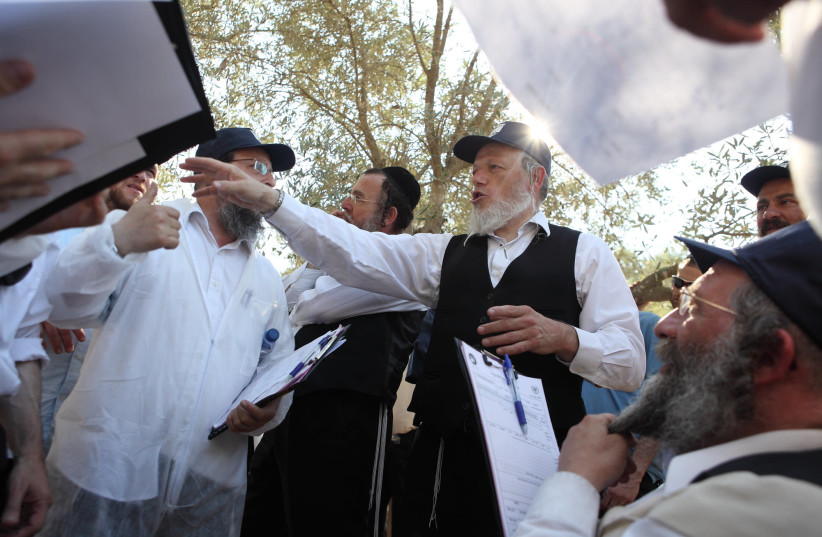
ZAKA leader Rabbi Yehuda Meshi-Zahav and members of ZAKA, attend a simulation drill on June 21, 2011. Members of ZAKA, most of whom are Orthodox Jews, assist ambulance crews, aid in the identification of the victims of terror, road accidents and other disasters, and where necessary gather body parts (photo credit: YAAKOV NAUMI/FLASH90)
ZAKA leader Rabbi Yehuda Meshi-Zahav and members of ZAKA
 

The harrowing details of the allegations of rape and sexual abuse against Zaka founder Yehuda Meshi-Zahav have made for horrifying reading in recent days.
 
In a lengthy investigative piece in the Haaretz daily, the testimony of six alleged victims detailed abuse conducted by Meshi-Zahav going back decades, starting in the 1980s.
 
About 10 others have come forward and spoken to other media outlets since the article was published last week, and it is believed that the number of total victims could be many times greater.
 
With such a large number of apparent victims and with Meshi-Zahav allegedly committing his sexual crimes over such a long period of time, the question is being asked how his activities did not come to light sooner.
 
Several reports have noted that so-called “Modesty Police” organizations in the ultra-Orthodox neighborhoods where Meshi-Zahav lived and operated were aware of the abuses he was committing but did not do enough to stop him and failed to report him to the police.
 
And the police reportedly conducted a secret investigation back in 2013 but were unable to make progress, in part because none of his victims had been willing to testify.
 
After decades of allegedly raping and sexually abusing men, women, boys and girls in the ultra-Orthodox community, Meshi-Zahav’s past is finally catching up with him.
 
Shana Aaronson, director of Magen for Jewish Communities, which assists sexual abuse victims in Israel and the Diaspora and assisted Haaretz with its investigation, says that victims of sexual abuse across all sectors of society are often very reluctant to come forward and inform the authorities of what happened for several reasons.
 
Victims can feel that they will not be believed, that their family will be angry with them, that they might be the only person their attacker is abusing, or because they are simply shamed by what had happened, Aaronson said.
 
In cases where the abuser is an influential individual or in a position of power or authority, concerns that the claims will not be believed or even of reprisals and revenge by the attacker can be further reasons not to come forward.
 
Aaronson cites cases such as that of convicted serial rapist Larry Nassar, who worked as a USA Gymnastics national team doctor and who is believed to have sexually assaulted at least 265 girls and women.
 
Allegations against Nassar surfaced in the 1990s but it was not until 2016 that public accusations were made against him.
 
On average, victims of sexual abuse will wait ten years before reporting their abuse Aaronson said.
She notes that even though this phenomenon is widespread across many sectors of society, there are other factors in the ultra-Orthodox community which can exacerbate it.
 
The highly conservative nature of the community in general and the great reluctance to talk about any aspect of sex, sexuality, or even the human body, engenders a greater sense of shame about all such matters, all the more so when it comes to sexual abuse.
 
Ultra-Orthodox society also places a heavy focus on the importance of “marrying well,” and even the smallest infractions of religious norms can harm someone’s marriage opportunities.
 
Being the victim of sexual abuse could certainly have a negative impact on someone’s marriage options, and Aaronson says this could be an additional reason for someone not to step forward.
In addition, there is a strong focus on the importance of virginity, which victims would obviously compromise if they publicly acknowledge having been raped or abused.
 
“Sexual activity is a completely private matter. Discussion of sex, including sexual abuse and the privacy of the body, is ignored in every way possible,”  
 
This effectively turns ultra-Orthodox society into a target-rich environment because many young people are unaware that the sexual abuse they are experiencing is even wrong or forbidden.
 
In some ultra-Orthodox communities, children and teenagers are often not able to even describe their different body parts and therefore lack the language to describe their abuse.
 
Indeed, some of the testimony that has surfaced about Meshi-Zahav corroborates this problem.
One alleged victim cited in the Haaretz article as Aleph said he was 14 when Meshi-Zahav started abusing him, and said he had no idea “how children are brought into the world.”
 
Said Aleph: “As a young child with sexual curiosity, I did not understand that I was being sexually abused.”
 
“Many victims do not have the language to express what’s happening to them,” says Aaronson.
 
“Their gut feeling is that what’s happening is something bad but they have so little awareness that they can’t even tell someone if they wanted to.”
 
Aaronson said that children, in particular, are “unbelievably vulnerable to the manipulation of an abuser.” If an abuser says, for example, that something is normal for friends to do together, a child will easily believe them.
 
“Ayin,” another of the alleged victims cited in the Haaretz investigation, said that he was just five years old when he says Meshi-Zahav began to abuse him – abuse which carried on for two years.
 
“I didn’t realize that this was something forbidden and I didn’t try and stop it or move him off of me. For years, I didn’t even ascribe this any importance,” he said.
 
Efforts by Magen and other organizations have been afoot for several years now to change the culture in ultra-Orthodox society regarding how to deal with and educate about sexual abuse.
 
These efforts will be critical for addressing and exposing the appalling abuse that can take place when predators operate in such environments.
 

Tuesday, March 16, 2021

Why American Ḥaredim have responded so differently from other Jews to the pandemic.


What Happened in Lakewood

Why American Ḥaredim have responded so differently from other Jews to the pandemic.

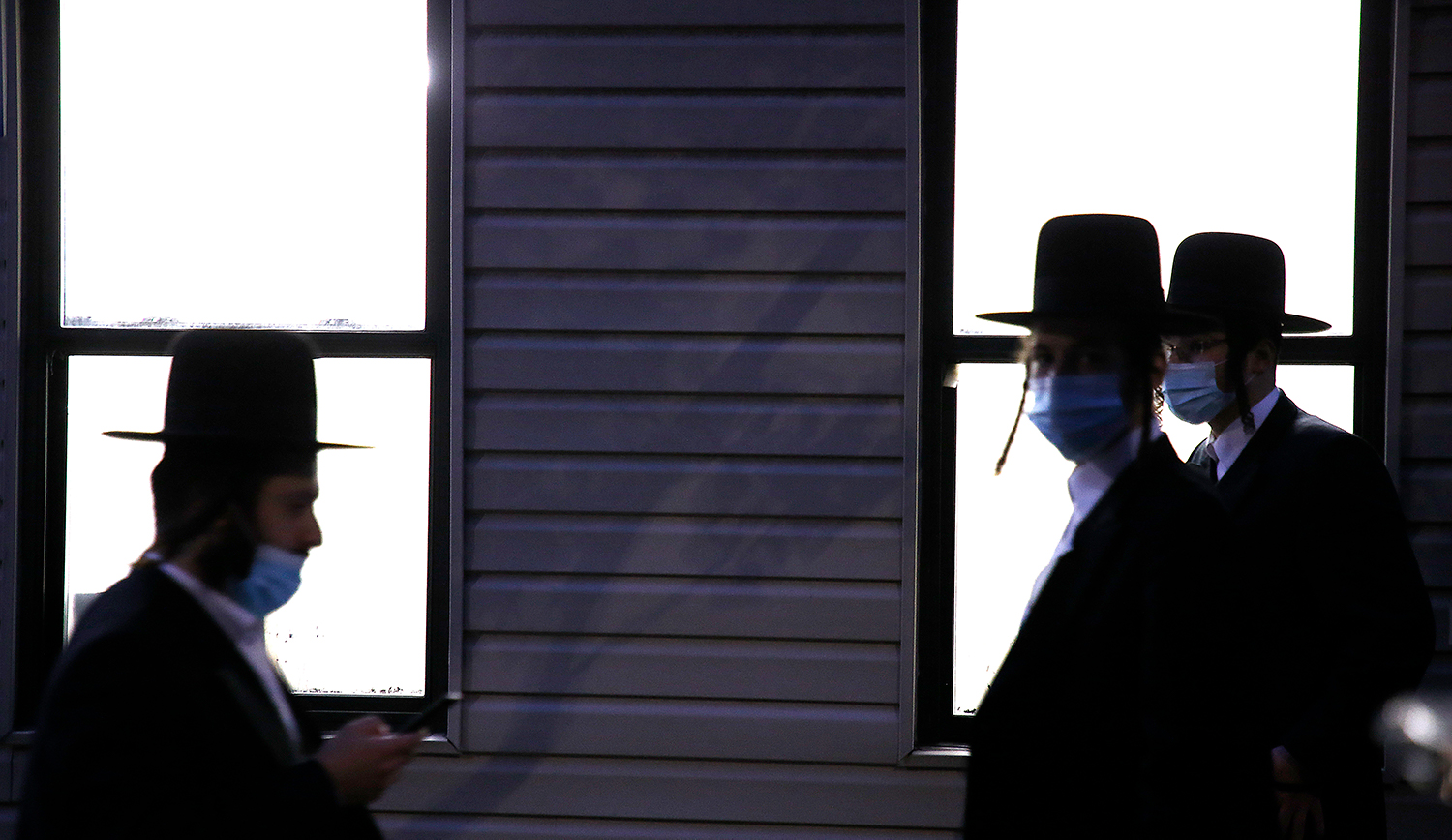
Ḥaredi Jews in New York on October 19, 2020. John Lamparski/NurPhoto via Getty Images.


“It is not difficult to build a sanctuary,” wrote the great 19th-century German rabbi Samson Raphael Hirsch. “It requires a moment of inspiration and a mood of generosity. But it is much more difficult to generate an enduring enthusiasm to be retained for years—or even a lifetime. Without such support, the structure itself would remain cold and lifeless. Enthusiasm for the Sanctuary must never subside. The Sanctuary and its goals must never be considered out of date.”

Hirsch, the pioneer of synthesizing modern secular culture with Orthodox Judaism, was writing about the annual half-shekel donation for the upkeep of the Jerusalem Temple, deriving from this commandment—observed only symbolically in the Temple’s absence—a vital lesson about the role of the synagogue.

In writing the story of how the COVID-19 pandemic has changed Jewish communal life in in the U.S., Jack Wertheimer acknowledges that in his research he did not attend to the dramatically different effects it had on American Ḥaredim. But an examination of the latter can be instructive in making sense of the broader situation of American Jewry. In providing such an examination, based on my own experiences, I also hope to correct misconceptions about ḥaredi life during the pandemic, and to explain why Ḥaredim insisted on keeping their houses of worship open while others were closed. But first it’s necessary to say something about the ḥaredi conception of the synagogue, which is different from that of other American Jews.

The word synagogue derives from the Greek, which is, as Wertheimer notes, a direct translation of the Hebrew beyt knesset, meaning “house of assembly.” These terms describe how most Jews see its purpose: as a place of gathering. Over the years, ancillary functions have been added to its core use as a place of prayer, which has become a major part of what synagogues do. In this way, the synagogue has become a place of gathering at least as much for its own sake as it is a place to gather for worship. The closures of synagogues, or their replacement with virtual simulacra, thus becomes a social issue as much as a religious one.

Interestingly enough, Ḥaredim do not refer to a house of worship as a synagogue or beyt knesset. Instead they call it either a beyt midrash—a house of study—or a shul—the Yiddish term that derives from the German word for school. As it is outside of ḥaredi communities, prayer is the building’s primary function, but unlike other American synagogues, its secondary use is not for social life, but for study.

That this is so is due to the distinctive ḥaredi understanding of religious obligation as well as the structure of American ḥaredi society. Ḥaredim believe that the continual lifelong pursuit of the study of Torah—considered, like prayer, a form of service to God—defines these buildings and congregations. In ḥaredi shuls, only worship and study are acceptable activities. The Shulḥan Arukh, the standard code of Jewish law, contains an entire section dedicated to regulations about what is and is not permitted in the synagogue. While it is typical for other denominations’ synagogues to use their main sanctuary for affairs of a secular nature, such as hosting political or educational figures or community events, this is much less common among Ḥaredim. And while ḥaredi shuls often provide social services, such as meals for the needy, these activities are just as often left to other communal organizations.

Indeed, the ubiquitous presence of such organizations speaks to the close-knit nature of ḥaredi society, which allows shuls to have a more focused purpose. Because ḥaredi life is so deeply communal, there are charities, neighborhood-watch groups, schools, and a great many other institutions that serve purposes that in other communities are assigned to the synagogue. Similarly, Ḥaredim don’t need the synagogue to create opportunities to socialize with other Jewish families. They tend to live in their own neighborhoods, frequently attend weddings and engagement parties, and have constant opportunities for social interaction with coreligionists. Thus the purpose of the ḥaredi shul is not to create a community; it instead emerges as a place of study and prayer within a preexisting, fully alive Jewish community. Yet even as the function of the ḥaredi shul is narrower, its presence in the life of a typical ḥaredi male, who attends shul at least three times each day, and sometimes more, is greater.

Film screenings, cooking and yoga classes, and programs “to discuss questions of racial justice, equity, and the preservation of democratic norms” might find a place in a synagogue, but they are anathema to a ḥaredi shul. If a ḥaredi Jew attends a cooking class, or a yoga class, it would likely be with other Ḥaredim, just not in a synagogue. And although members often pay dues, the ability to collect dues factors into considerations in a very minimal way. Precisely because shul attendance is seen as a fundamental need, those with means often see the support of their shuls as a necessary investment, and their voluntary contributions go far to cover expenses.

For many synagogues, the migration out of physical buildings and into a virtual world driven by the COVID-19 pandemic has highlighted just how unnecessary the physical facilities are. If synagogues are merely social centers or locations for the Jewish aspects of life, why not replace them with online spaces? If anything, experiencing Jewish religious behavior in the home might lead to a firmer Jewish identity for those who would otherwise only engage in a synagogue, as some of Wertheimer’s interlocutors indeed suggested.

Suppose there is another pandemic, with a virus even more contagious that COVID-19, that requires a truly drastic response. Would we be able to get the needed buy-in from the ḥaredi community, which has rediscovered its deep need for its shuls when they were shuttered, while becoming far more skeptical of expert advice? That’s what keeps me up at night.


https://mosaicmagazine.com/response/religion-holidays/2021/03/what-happened-in-lakewood/?newlyregistered=true

Monday, March 15, 2021

And Cuban told CNBC that people should use the money to pay off their debts, especially credit card debt. If there is any money left over after that then he says to put it in the bank.

 Advice On How To Spend Your Stimulus Check


.....As for those stimulus checks which American will soon be getting, Mark Cuban has some advice on how to spend the money. Under the plan, every American with an adjusted gross income below $75,000 is eligible for $1,400, and married couples filing jointly below $150,000 will get $2,800. And Cuban told CNBC that people should use the money to pay off their debts, especially credit card debt. If there is any money left over after that then he says to put it in the bank.

This would seem like a no brainer, especially if you have been out of work due to the Coronavirus crisis. Then you probably saw an increase in your credit card debt. Why use the money on anything frivolous. Credit card interest rates are high. If you keep on owing then you just keep on throwing money out the window covering the interest payments alone. So pay off as much of what you owe as possible.

https://jewishbusinessnews.com/2021/03/14/mark-cuban-offers-up-advice-on-how-to-spend-your-stimulus-check/?utm_source=feedburner&utm_medium=email&utm_campaign=Feed%3A+JewishBusinessNews+%28Jewish+Business+News%29


Friday, March 12, 2021

POSTED ONE YEAR AGO - MARCH 12, 2020


Thursday, March 12, 2020

This suggests that anyone in a position of power or authority, instead of downplaying the dangers of the coronavirus, should ask people to stay away from public places, cancel big gatherings, and restrict most forms of nonessential travel.


Cancel Everything!


In an email to my children dated Monday February 24 - 5:24 PM

 My suggestion is that everyone should have at home a 2-4 week supply of non-perishable food. Matzo, water, all canned foods...keep it in the garage or basement. There are over 200 cases in EY, and known 36 cases in the US. There's a run on food in the Asian countries and starting in Europe. Costco/Amazon...Stuff that you would eat anyway. It will come here.

Love 


***********


DO NOT PAY ATTENTION TO THIS GROUP OF RABBIS ON THIS ISSUE - THE MEDICAL COMMUNITY IS THE ONLY SOURCE OF INFORMATION FOR HEALTH  RELATED MATTERS - THEY ARE TELLING EVERYONE TO KEEP YOUR CHILDREN AT HOME!


 Daily Jewish Community Novel CoronaVirus Updates as They Happen: 
 
CLICK: https://www.jta.org/2020/03/05/global/the-latest-jewish-coronavirus-updates-el-al-downsizes-services-move-online-and-more?utm_source=JTA_Maropost&utm_campaign=JTA_DB&utm_medium=email&mpweb=1161-17628-21723
 
 
We don’t yet know the full ramifications of the novel coronavirus. But three crucial facts have become clear in the first months of this extraordinary global event. And what they add up to is not an invocation to stay calm, as so many politicians around the globe are incessantly suggesting; it is, on the contrary, the case for changing our behavior in radical ways—right now.

The first fact is that, at least in the initial stages, documented cases of COVID-19 seem to increase in exponential fashion. On the 23rd of January, China’s Hubei province, which contains the city of Wuhan, had 444 confirmed COVID-19 cases. A week later, by the 30th of January, it had 4,903 cases. Another week later, by the 6th of February, it had 22,112.

The same story is now playing out in other countries around the world. Italy had 62 identified cases of COVID-19 on the 22nd of February. It had 888 cases by the 29th of February, and 4,636 by the 6th of March.

Because the United States has been extremely sluggish in testing patients for the coronavirus, the official tally of 604 likely represents a fraction of the real caseload. But even if we take this number at face value, it suggests that we should prepare to have up to 10 times as many cases a week from today, and up to 100 times as many cases two weeks from today.


The second fact is that this disease is deadlier than the flu, to which the honestly ill-informed and the wantonly irresponsible insist on comparing it. Early guesstimates, made before data were widely available, suggested that the fatality rate for the coronavirus might wind up being about 1 percent. If that guess proves true, the coronavirus is 10 times as deadly as the flu.

But there is reason to fear that the fatality rate could be much higher. According to the World Health Organization, the current case fatality rate—a common measure of what portion of confirmed patients die from a particular disease—stands at 3.4 percent. This figure could be an overstatement, because mild cases of the disease are less likely to be diagnosed. Or it could be an understatement, because many patients have already been diagnosed with the virus but have not yet recovered (and may still die).

When the coronavirus first spread to South Korea, many observers pointed to the comparatively low death rates in the country to justify undue optimism. In countries with highly developed medical systems, they claimed, a smaller portion of patients would die. But while more than half of all diagnosed patients in China have now been cured, most South Korean patients are still in the throes of the disease. Of the 7,478 confirmed cases, only 118 have recovered; the low death rate may yet rise.

Meanwhile, the news from Italy, another country with a highly developed medical system, has so far been shockingly bad. In the affluent region of Lombardy, for example, there have been 7,375 confirmed cases of the virus as of Sunday. Of these patients, 622 had recovered, 366 had died, and the majority were still sick. Even under the highly implausible assumption that all of the still-sick make a full recovery, this would suggest a case fatality rate of 5 percent—significantly higher, not lower, than in China.

The third fact is that so far only one measure has been effective against the coronavirus: extreme social distancing.

Before China canceled all public gatherings, asked most citizens to self-quarantine, and sealed off the most heavily affected region, the virus was spreading in exponential fashion. Once the government imposed social distancing, the number of new cases leveled off; now, at least according to official statistics, every day brings more news of existing patients who are healed than of patients who are newly infected.

A few other countries have taken energetic steps to increase social distancing before the epidemic reached devastating proportions. In Singapore, for example, the government quickly canceled public events and installed medical stations to measure the body temperature of passersby while private companies handed out free hand sanitizer. As a result, the number of cases has grown much more slowly than in nearby countries.


These three facts imply a simple conclusion. The coronavirus could spread with frightening rapidity, overburdening our health-care system and claiming lives, until we adopt serious forms of social distancing.

This suggests that anyone in a position of power or authority, instead of downplaying the dangers of the coronavirus, should ask people to stay away from public places, cancel big gatherings, and restrict most forms of nonessential travel.

Given that most forms of social distancing will be useless if sick people cannot get treated—or afford to stay away from work when they are sick—the federal government should also take some additional steps to improve public health. It should take on the costs of medical treatment for the coronavirus, grant paid sick leave to stricken workers, promise not to deport undocumented immigrants who seek medical help, and invest in a rapid expansion of ICU facilities.

The past days suggest that this administration is unlikely to do these things well or quickly (although the administration signaled on Monday that it will seek relief for hourly workers, among other measures). Hence, the responsibility for social distancing now falls on decision makers at every level of society.

Do you head a sports team? Play your games in front of an empty stadium.
Are you organizing a conference? Postpone it until the fall.
Do you run a business? Tell your employees to work from home.

Are you the principal of a school or the president of a university? Move classes online before your students get sick and infect their frail relatives.
 
All of these decisions have real costs. Shutting down public schools in New York City, for example, would deprive tens of thousands of kids of urgently needed school meals. But the job of institutions and authorities is to mitigate those costs as much as humanly possible, not to use them as an excuse to put the public at risk of a deadly communicable disease.

Finally, the most important responsibility falls on each of us. It’s hard to change our own behavior while the administration and the leaders of other important institutions send the social cue that we should go on as normal. But we must change our behavior anyway. If you feel even a little sick, for the love of your neighbor and everyone’s grandpa, do not go to work.

When the influenza epidemic of 1918 infected a quarter of the U.S. population, killing hundreds of thousands nationally and millions across the globe, seemingly small choices made the difference between life and death.

As the disease was spreading, Wilmer Krusen, Philadelphia’s health commissioner, allowed a huge parade to take place on September 28; some 200,000 people marched. In the following days and weeks, the bodies piled up in the city’s morgues. By the end of the season, 12,000 residents had died.


In St. Louis, a public-health commissioner named Max Starkloff decided to shut the city down.

Ignoring the objections of influential businessmen, he closed the city’s schools, bars, cinemas, and sporting events. Thanks to his bold and unpopular actions, the per capita fatality rate in St. Louis was half that of Philadelphia. (In total, roughly 1,700 people died from influenza in St Louis.)

In the coming days, thousands of people across the country will face the choice between becoming a Wilmer Krusen or a Max Starkloff.

In the moment, it will seem easier to follow Krusen’s example. For a few days, while none of your peers are taking the same steps, moving classes online or canceling campaign events will seem profoundly odd. People are going to get angry. You will be ridiculed as an extremist or an alarmist. But it is still the right thing to do.

https://www.theatlantic.com/ideas/archive/2020/03/coronavirus-cancel-everything/607675/?utm_source=newsletter&utm_medium=email&utm_campaign=atlantic-daily-newsletter&utm_content=20200311&silverid-ref=NTk0NjUwMDEzMDAyS0

 READ COMMENTS ON ORIGINAL POST:

https://theunorthodoxjew.blogspot.com/2020/03/this-suggests-that-anyone-in-position.html

The Police, Crime, Sentencing and Courts Bill closes a legal loophole under so-called position of trust laws, to cover religious leaders. The law, which already applied to teachers and doctors, makes sexual relationships between people in these roles, and those they supervise, illegal.


Sexual abuse safeguarding laws extended to places of worship


Jewish campaigners welcome move with Chief Rabbi Mirvis says 'nothing could be more vital than keeping young people in our communities safe and the closing of this loophole'


Synagogue (Photo by Lainie Berger on Unsplash)

Campaigners for Jewish victims of sexual abuse have welcomed changes to child abuse laws announced in Parliament this week.

The Police, Crime, Sentencing and Courts Bill closes a legal loophole under so-called position of trust laws, to cover religious leaders.

The law, which already applied to teachers and doctors, makes sexual relationships between people in these roles, and those they supervise, illegal.

“The move follows an extensive review which raised concerns that predators could exploit the particular influence these roles can often have in a young person’s life – making them vulnerable to abuse”, the government’s website says.

The move to extend the law to religious leaders was welcomed by Chief Rabbi Ephraim Mirvis, who said: “Sadly, wherever relationships of trust exist, there follows the danger for those relationships to be exploited in the most destructive way. Nothing could be more vital than keeping young people in our communities safe and the closing of this loophole, as recommended by the Independent Inquiry in Child Sexual Abuse, sends an important message in that regard.”

Reform Judaism welcomed the move, with Rabbi Celia Surget, Chair of the Assembly of Reform Rabbis and Cantors UK, saying: “We are absolutely in support of the widening of the laws outlined in this new legislation”.

“We welcome it wholeheartedly and look forward to seeing its implementation at the earliest possible time”.

This comes after the government stepped in last week to protect victims of religious divorce, trapped by abusive husbands who refuse to grant a ‘get.’

Yehudis Goldsobel, who in 2013 established Migdal Emunah, a charity that supports victims of sexual abuse, backed the “exciting and welcome change to legislation. Over the years I have had the privilege to work with colleagues from other faiths in advocating for more robust safeguarding in faith and religious organisations.”

This is a first step towards better safeguarding standards and I look forward to further recommendations being implemented in the near future. I am optimistic to see the recommendations from IICSA (Independent Inquiry into Child Sexual Abuse) in their final report.”

https://jewishnews.timesofisrael.com/sexual-abuse-safeguarding-laws-extended-to-places-of-worship/

Thursday, March 11, 2021

Accused child molester extradited to NYC after fleeing to Israel in 2010


A Brooklyn man who fled to Israel in 2010 amid accusations of child molestation was extradited back to the Big Apple on Thursday, officials said.


Gershon Kranczer, 65, was arraigned at Brooklyn Supreme Court for the alleged sexual assault of two minor female relatives, according to the Brooklyn District Attorney’s Office.

The suspected predator is accused of molesting one relative several times from August 1996 — when she was 6-years-old — to February 2003, prosecutors said.

Kranczer, of Midwood, is also alleged to have sexually abused an 11-year-old child between March 2001 and September 2002.

In 2010, as Kranczer was under investigation, he fled to Israel in an alleged bid to escape the law, prosecutors and sources said.

The NYPD alerted Interpol of Kranczer’s departure. The department’s Intel Bureau International Liaison Unit then got involved, coordinating with Israel police in an attempt to track down the suspect, sources said.

After spending over a decade overseas under the disguise of an alias, Kranczer was caught by authorities in February 2020, sources said.

Brook1

The US Marshals, the Brooklyn DA’s office, and the Department of Justice’s Office of International Affairs were also involved in catching Kranczer.

Kranczer fought extradition back to the states for over a year, sources said. After he lost his final appeal, he was extradited.

He is charged with sexual conduct against a child, criminal sexual act and sexual abuse, authorities said.

At his Thursday arraignment, he was ordered held without bail.


WATCH VIDEO:

https://nypost.com/2021/03/11/accused-child-molester-extradited-to-nyc-after-fleeing-to-israel/

Haaretz report cites six allegations against Yehuda Meshi-Zahav over nearly 40-year period, some made by minors....


ZAKA emergency group co-founder accused of multiple cases of rape, sexual abuse


Yehuda Meshi-Zahav, co-founder of ZAKA, speaks at a conference in Jerusalem, March 7, 2021. (Yonatan Sindel/Flash90)
Yehuda Meshi-Zahav, co-founder of ZAKA, speaks at a conference in Jerusalem, March 7, 2021. 
 

The co-founder and chairman of the ZAKA volunteer emergency response group was accused Thursday of sexual assault, rape, and abuse by six people in a report by the Haaretz daily, which said there are likely many more cases.

The allegations against Yehuda Meshi-Zahav were made by both men and women, some of whom were minors at the time of the alleged events.

Meshi-Zahav is a prominent figure in the ultra-Orthodox community who earlier this month was awarded the Israel Prize’s lifetime achievement award. ZAKA is a major part of Israel’s emergency response services at home and abroad.

Meshi-Zahav took advantage of his status, power, money, and even the organization he heads to commit sexual assault, the Haaretz report said.

One alleged victim said he forcibly undressed her and raped her after offering financial aid. The woman said that while Meshi-Zahav forced himself on her, he threatened, “If you talk, a ZAKA jeep will run you over.”

Another said Meshi-Zahav repeatedly abused him when he was a teen, only realizing years later he was his “escort, a prostitute in the full sense of the word,” he told Haaretz.

The report said several other women have testified that he masturbated in front of them and touched them sexually.

Meshi-Zahav denied the allegations, telling the paper the claims “are baseless” and will cause “irrevocable damage” to his good name.

Of the six allegations reported, the earliest is from 1983, and the latest from 2011. The report added that many residents of several ultra-Orthodox neighborhoods in Jerusalem knew of Meshi-Zahav’s actions but did not say anything or report him to authorities.

At least one case reached police, but was closed in 2014 due to a lack of evidence.

The case also involved Meshi-Zahav’s brothers, Moshe and Rami. Rami was eventually convicted of raping a relative and imprisoned, the report said.

Moshe and Yehuda were suspected of assaulting 16-year-old girls, and Yehuda was suspected of rape, which he denied. Moshe fled the country after the case was opened, returned a few months ago, and died shortly after.

The investigators turned up one alleged rape victim, a woman in her 20s, but she refused to file a complaint against Meshi-Zahav, as did the other women he was suspected of assaulting in the case. The investigation was closed and its existence was not made public.

Magen for Jewish Communities, a non-profit that works to support survivors of sexual abuse, said the alleged assaults were especially shocking due to Meshi-Zahav’s community standing.

“It’s always incredibly painful to hear terrible stories of sexual abuse by a trusted figure in a victim’s life,” the group’s director, Shana Aaronson, told The Times of Israel. “In the case of Yehuda Meshi-Zahav, many in the community find it incomprehensible to imagine that a man who is so well-known and beloved could be capable of such horrific acts against innocent and vulnerable children and adults.”

“As difficult as it is to hear these allegations, it is far more painful to have experienced them. As a community, we need to rally around the victims whose lives have been devastated by not only the abuse, but the secondary trauma of knowing that their abuser is known and heralded by many as a hero,” Aaronson said.

Yehuda Meshi-Zahav. (courtesy of ZAKA)

Earlier this month, Meshi-Zahav was declared a winner of the Israel Prize’s lifetime achievement award for his contributions to Israeli society.

Education Minister Yoav Gallant announced that the prize would go to Meshi-Zahav for his decades of work in ZAKA.

The prize selection committee said in a statement that Meshi-Zahav has made an “outstanding” contribution to advancing assistance at disaster events and creating unity in Israeli society while having “a sense of purpose and a true belief in the need to build bridges and hold dialogue.”

For three decades now Meshi-Zahav has led Zaka, which has become an essential element of Israeli’s emergency response operations at home as well as abroad, the statement said, and he “is an example and role model for the spirit of volunteering in Israeli society in all its forms.”

Meshi-Zahav also made headlines in January when his parents both died of COVID-19 within days of each other and less than a month after his younger brother died of a different cause.

He was a vocal critic of some of the ultra-Orthodox leadership during the pandemic, as some prominent community figures downplayed the virus, including in an October interview with The Times of Israel.

Founded in 1989, ZAKA is one of Israel’s most recognizable emergency response groups and has responded to various disasters in other countries.

In addition to providing emergency response services and assisting in search and rescue operations, ZAKA also helps in the grim task of finding and identifying body parts following terror attacks, air crashes and other disasters.

https://www.timesofisrael.com/zaka-emergency-group-co-founder-accused-of-multiple-cases-of-rape-sexual-abuse/?utm_source=The+Daily+Edition&utm_campaign=daily-edition-2021-03-12&utm_medium=email

What Hershel Schachter Has Wrought To The "Orthodox" Conversion Process! Kabbalat Ol Mitzvos - Optional!


Shlepping The Kids To Church On Saturday With Jew/Dunce in Tow!

Trump At Church Services on another Saturday

Orthodox Rabbis  Standing  in  Solidarity 
​with  Reform  and  Conservative  Jews


We the undersigned are Orthodox Rabbis and educators committed to fostering a more inclusive and pluralistic Orthodoxy that can attract Jews and strengthen Jewish identity of the widest spectrum of Jewry in Diaspora as in Israel. 
 
 We are individuals, members of a rabbinical association called Torat Chayim which brings together around 350 men and women in Israel and Diaspora to advance these values. However, this letter is written and signed by us as individuals and does not represent an official statement of the organization.

We want to express our support for the High Court of Justice decision that Reform and Conservative conversions done in the state of Israel must be recognized by the Interior Ministry for citizenship purposes and full rights to make aliyah to Israel under the law of return. We support this decision because we share the broad Zionist commitment to Israel as both a Jewish and a democratic state. This decision strengthens the democratic character of the state by treating all Jewish denominations as equal in this particular matter.

This decision does not require the established Rabbinate to accept the conversions. These conversions may not be acceptable halachically. But in a democracy, there should be freedom of religion and the right of all citizens to join a denomination or religion that they choose without suffering discrimination. 

We are deeply disappointed that some community, rabbinic and political leaders have reacted hostilely to the Supreme Court decision. We thank the court for upholding Israel’s democratic values, especially after the Knesset failed to act on this matter for almost 15 years. We condemn the words spoken vituperatively and degradingly about liberal Judaism and Reform and Conservative Jews. These words are a violation of the Torah’s commandment to love all Jews (“love your neighbor as yourself”) - especially since liberal Jews overwhelmingly participate in the covenant of fate of the Jewish people (sharing history, suffering, feeling responsibility and taking action to help all Jews ). These attacks are also a chillul Hashem. They bring disgrace to God and Torah.

Strengthening democracy - providing equality and justice for all its citizens - strengthens Israel as a Jewish state with which Jews of the whole world identify and are inspired. The democratic character of the Jewish state is the single strongest bond between all Americans and the state of Israel and undergirds America’s remarkable support for Israel.

We urge everyone to turn from the way of religious coercion and suppression to accepting the spirit of democracy, extending equality and dignity for all. This will bring greater respect for God, Torah and the Jewish tradition - a cause to which we all give our love and commitment.

Signed,

Rabba Dr. Carmella Abraham 
Rabbi Dr. Jehoschua Ahrens 
Rabbi Yitzhak Ajzner 
Rabbi Marc Angel
Rabbi Shraga Bar-On
Rabbi Benjamin Berger
Rabbi Shimon Brand 
Rabbi Dr. Nathan Lopez Cardozo
Rabbi Michael Chernick 
Rabbi Barry Dolinger 
Rabbi Yehoshua Engelman 
Rabbi Dr. Zev Farber 
Rabbi Dr. Reb Mimi Feigelson 
Rabbanit Dr. Esther Fisher 
Rabbi Avidan Freedman 
Rabbi Daniel Geretz 
Rabbi David Glicksman 
Rabbi Mel Gottlieb 
Rabbi Steve Greenberg 
Rabbi Yitz Greenberg 
Rabbi Dr. Meesh Hammer-Kossoy
Rabbi Avram Herzog 
Rabbi Akiva Herzfeld 
Rabba Batya Jacobs 
Rabbi David Jaffe 
Rabbi David Kalb
Rabbanit Rachel Keren
Rabbi Frederick Klein 
Rabbi Dr. Eugene Korn
Rabbi Daniel Landes  
Rabbi Isaac Landes
Rabbi Aaron Leibowitz 
Rabbi Hayim Leiter 
Rabbi Asher Lopatin
Rabbi Avram Mlotek 
Rabbi Jack Nahmod 
Rabbi Dina Najman 
Rabbi Marianne Novak 
Rabbi Micha Odenheimer
Rabbi Avi Poupko
Rabbi Hanan Schlesinger 
Rabbi Gabriel Kretzmer Seed 
Rabbi Chaim Seidler-Feller  
Rabbi Aaron Shub 
Rabbi Yair Silverman  
Rabbi Raphael Silverstein 
Rabbi Michael Stein 
Rabbi Alana Suskin 
Rabbi Dr. Shmuly Yanklowitz 
Rabbi Alan Yuter 
 

Wednesday, March 10, 2021

The Israeli Medical Association called on Wednesday for a criminal investigation into threats and incitement from antivaxxers against health care professionals working to encourage vaccination.


"YOU KNOW MINE KINT THE MEASLES AND POLIO VACCINE IS A HOAX?"


‘Worse than Mengele’: Medics reveal antivaxxer threats as union calls for probe


Health Ministry condemns messages as doctors are told they are ‘Hitler’s future neighbor in hell’ and will ‘soon pay the price’


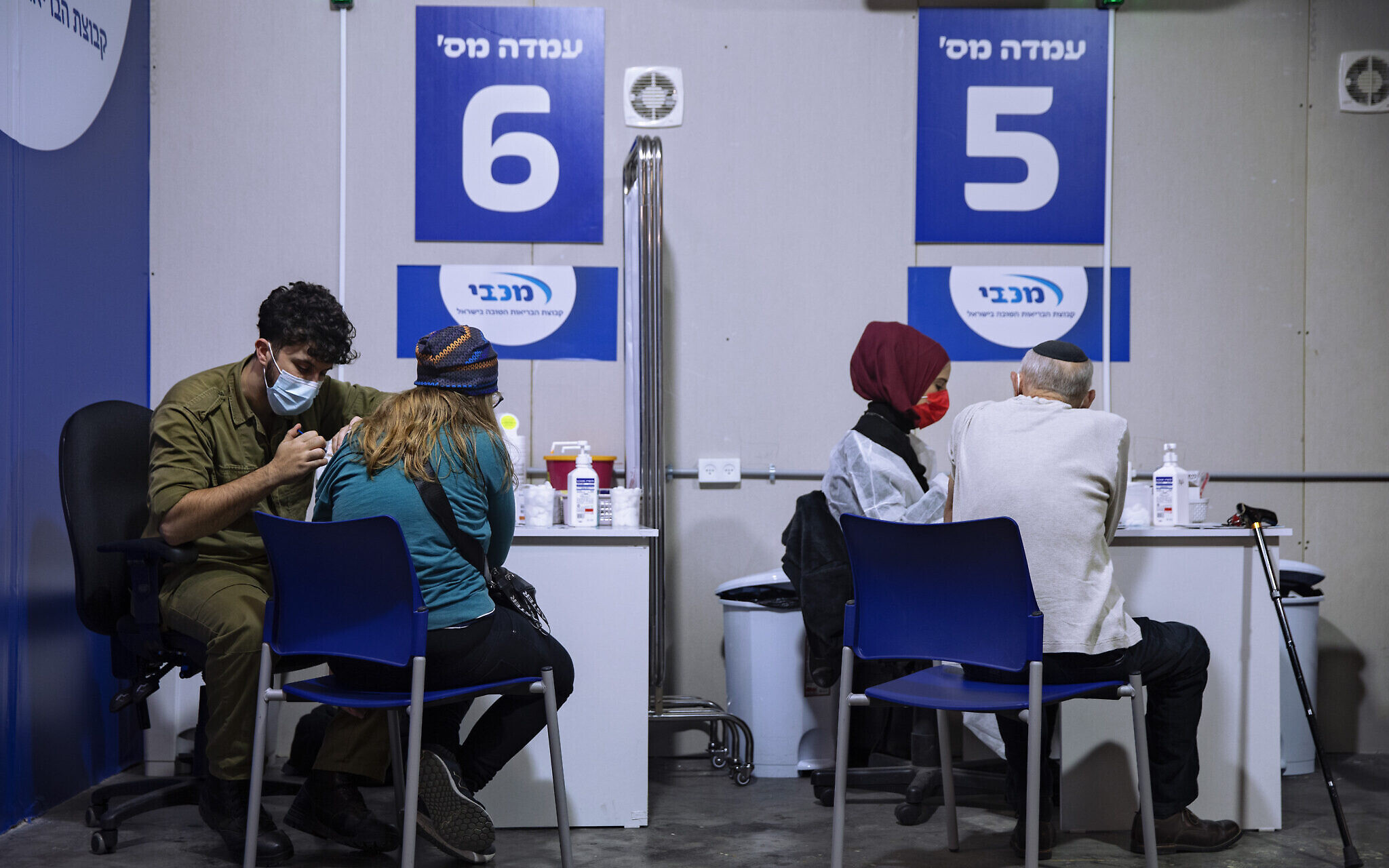
A woman receives her second Pfizer-BioNTech COVID-19 vaccine from an army medic, left, at a vaccination center set up on a mall parking lot in Givataim, central Israel, during a nationwide lockdown to curb the spread of the virus, January 20, 2021. (AP Photo/Oded Balilty)
A woman receives her second Pfizer-BioNTech COVID-19 vaccine from an army medic, left, at a vaccination center set up on a mall parking lot in Givataim, central Israel, during a nationwide lockdown to curb the spread of the virus, January 20, 2021

The Israeli Medical Association called on Wednesday for a criminal investigation into threats and incitement from antivaxxers against health care professionals working to encourage vaccination.

The statement came the day after the revelations that Prof. Galia Rahav, a member of the Health Ministry panel that has been advising on vaccinations, was receiving threatening messages from antivaxxers.

“Galia, I hope and long for a day when God will soon take you,” read one message, while another described her as “Hitler’s future neighbor in hell.”

The Health Ministry said in a statement of condemnation that the messages were “shameful and a disgrace.”

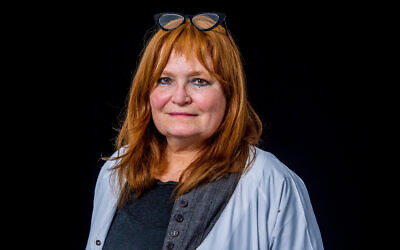
Portrait of Israeli Prof. Galia Rahav in Tel Aviv on June 22, 2020

Tomer Lotan, a senior official in the Health Ministry, told the Kan public broadcaster that the threats were “outrageous and it makes the blood boil.”

“This is a dangerous red line that must not be crossed,” Lotan said.

Channel 12 news found that the head of public health at the ministry, Sharon Alroy-Pries, was also receiving inciting messages on social media.

“Soon Sharon Alroy-Pries will pay the price,” read one comment.

“Slowly it turns out that we are imprisoned in a psychopathic experiment run by her and it will not end until she is released,” read another.

Doctors also said they were compared to Nazis. Epidemiologist Prof. Hagai Levine, who previously served as the head of the doctors union, told Channel 12 that he received phone calls and comments online in which he was compared to Nazi war criminal Josef Mengele, who performed medical experiments on humans.

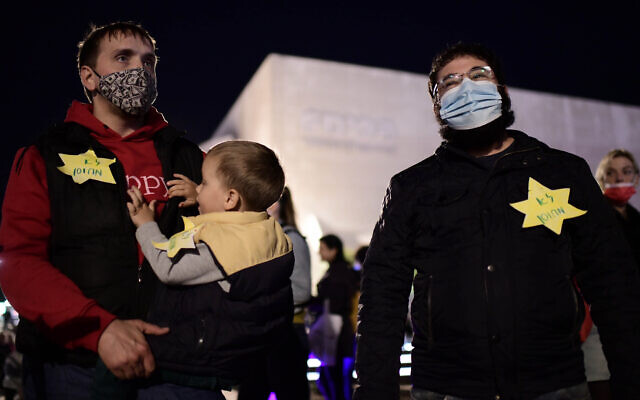
Israelis wearing yellow Stars of David saying ‘not vaccinated’ protest in Tel Aviv, on February 15, 2021

“I come from a family of Holocaust survivors and it is definitely very unpleasant when they tell me ‘you are worse than Mengele,'” he said. “I receive emails, WhatsApp messages and sometimes home phone calls with threats and curses. These are not just antivaxxers but groups with different agendas.”

Other doctors are falsely accused of having a financial interest in the pharmaceutical companies producing vaccines.

The threats were not the only time anti-vaccination activists have used Nazi imagery to attack Israel’s inoculation program.

At a demonstration earlier this month in Tel Aviv, several hundred people gathered to protest against the government program granting the vaccinated or recovered more access to public venues than those who refuse the shots.

Alongside banners deploring the green pass system as a form of apartheid, there was also a banner equating the pass to the yellow stars of the Holocaust and the numbers Nazis tattooed onto the arms of concentration camp inmates.

A previous Tel Aviv rally a week earlier featured a number of people not wearing masks, as well as comparisons between Israel’s vaccination campaign and Nazi laws, with some wearing yellow Stars of David saying “not vaccinated” meant to resemble the ones that Nazis forced Jews to wear during the Holocaust.

https://www.timesofisrael.com/worse-than-mengele-medics-reveal-antivaxxer-threats-as-union-calls-for-probe/?utm_source=The+Daily+Edition&utm_campaign=daily-edition-2021-03-10&utm_medium=email

Tuesday, March 09, 2021

The final report, which was released in 2017, stated that 15 males had been subjected to CSA by males (mostly of adult age) within the two organisations. The majority of the perpetrators were teachers, but others responsible included rabbis and support staff or volunteers.


Addressing child sexual abuse inside Australian Jewish organisations


The Malka Leifer case, which involves the alleged sexual abuse of multiple female students by the headmistress at the ultra-orthodox Adass Israel School in Melbourne, Australia, has provoked global attention. In late January 2021, she was finally returned to Australia to stand trial after the Israeli Minister for Justice approved an order for her extradition.

That extradition order, following enormous legal delays, including 74 court hearings over more than six years, can be attributed at least in part to the actions of the high-profile Bring Leifer Back campaign orchestrated by three of her alleged victims – Dassi Erlich and her two sisters, Nicole Meyer and Elly Sapper.

The campaign attracted almost universal support from the Australian Jewish community, which was incensed by the procrastination of the Israeli justice system, and ardently committed to achieving legal justice for the victims.

Much of the Australian Jewish discourse was vigorously critical of both the Israeli legal and political systems for failing to expedite the case. For example, an October 2019 editorial in the Australian Jewish News robustly censored the Israeli judiciary and the Israeli government.


The frustration of the grassroots community was also reflected in public protest petitions and alleged threats to withhold charitable donations to Israel.

This frustration was shared, and further expressed by national community leadership bodies such as the Zionist Federation of Australia, the Executive Council of Australian Jewry (ECAJ), the Australia/Israel and Jewish Affairs Council, and state-based bodies such as the Jewish Community Council of Victoria, and the New South Wales Jewish Board of Deputies.

The first three groups forwarded a joint letter to Israel President Reuven Rivlin in March 2020, expressing outrage at what they labelled "notorious" aspects of the case.

Reference was made to allegations that the Israeli Deputy Health Minister had illegally intervened to block Leifer’s extradition; claims that Leifer had been fabricating an alleged mental illness; the strange reversals of testimony by the appointed court psychiatrist; and the never-ending round of psychiatric evaluations.

The letter demanded that the President personally communicate with the Chief Justice of Israel to advance a prompt legal resolution of the case and ensure justice for Leifer’s alleged victims.

What is the impact of the Leifer case on child safety standards within Australian Jewry?

By Philip Mendes and Marcia Pinskier

The evocative nature of the campaign, and indeed the overwhelming support it enjoyed among Australian Jews, did not occur in a vacuum. Rather, there's no doubt it was directly informed by the findings of the preceding Royal Commission into Institutional Responses to Child Sexual abuse (RCIRCSA).

The commission’s deliberations were widely reported within Australian Jewry, and seem to have significantly advanced Jewish communal understanding of factors underpinning institutional child sexual abuse, and generated a concern to prevent similar instances in the future.

The commission was established in January 2013 by the then Australian Labor government to investigate how public and private institutions such as schools, sporting associations, children’s services, and religious and cultural groups had responded to manifestations of child sexual abuse (CSA).

The public hearings included an examination of the abuse of boys within two ultra-orthodox Jewish organisations associated with the Chabad communities in Melbourne and Sydney (not connected), known as Yeshivah Melbourne and Yeshiva Bondi.

The final report, which was released in 2017, stated that 15 males had been subjected to CSA by males (mostly of adult age) within the two organisations. The majority of the perpetrators were teachers, but others responsible included rabbis and support staff or volunteers.

The commission presented four major findings pertaining to CSA within these Jewish organisations:

  • The specific vulnerability of children in ultra-orthodox organisations due to an absence of sex education and associated patriarchal gender roles
  • A reluctance to report CSA to secular authorities due to cultural and religious beliefs connected to elements of Halacha
  • A failure to support survivors of CSA, and indeed a tendency to align with the abuser rather than the victim
  • A lack of operational child protection policies and procedures for responding to complaints.

The royal commission proposed a set of child safety standards for all faith-based communities examined. Those standards have since been incorporated into the 10 National Principles for Child Safe Organisations.

To date, there's been no research-based interrogation of whether and/or how the wide range of Jewish organisations – educational, religious, cultural and sporting – that actively engage with children have operationalised these standards within their core policies and practices.

One of the ironies of the community response to the Malka Leifer case is that the advocacy campaign focused almost solely on events concerning the extradition hearings in Israel. In contrast, there were very few references to the implications for child safety standards within Australian Jewry, even though the abuse was alleged to have occurred inside a Melbourne Jewish school.

One notable exception was a missive from the Modern Orthodox Rabbi Ralph Genende, who urged religious Jews within and beyond Australia to “learn the lessons of the royal commission”, and actively address “the reality of child sexual abuse in our midst”.

The Malka Leifer case highlights a need to facilitate grassroots child safety education across the Jewish community spectrum. The community education program should use the 10 National Principles to enable an upgrade of child safety standards, including particularly:

  • Ensuring that all Jewish organisations have effective measures for preventing and responding to CSA
  • That any instances of CSA are promptly reported to secular authorities such as child protection and/or the police
  • That survivors of CSA are supported rather than being ostracised
  • That governance and leadership structures are reformed to facilitate effective child protection protocols and processes

The impact of the Leifer case on child safety standards in Israel

By Amitai Marmor, Efrat Lusky-Weisrose and Dafna Tener

The Malka Leifer case shocked Israeli society and raised urgent issues related to CSA in the ultra-orthodox, with emphasis on CSA perpetrated by authority figures in the community.

In a study we conducted on public perceptions in Israel towards the Leifer case (accepted by the journal Sexual Abuse and to be published in the coming weeks), we describe the massive public criticism towards all those involved in the affair: the ultra-orthodox community and its leaders, law enforcement agencies, and Leifer herself.

In fact, most criticism has been directed towards the law enforcement authorities (the State Attorney's office, the court, and the police), perceived as bureaucratic systems, cumbersome and foot-dragging in regard to the extradition process – and even corrupt.

Beyond the public aspect of the affair, it's worth examining Israel's policy towards sexual violence in institutions in general.

This policy is enshrined in section 368(d) of the 1977 Penal Law (Amendment no.108, 2010), which regulates mandatory reporting of offences against minors under the maximum penalty of three months’ imprisonment. Mandatory reporting by professionals, including educators, is not limited in time, and the violator can be sentenced to six months in prison.

Ministry of Education procedures regarding mandatory reporting and the actions to be taken when it's suspected that a minor has been molested were promulgated in 2008. Beyond that, the ministry promotes an environment that facilitates treatment, early detection, and prevention programs.

Due to political compromises within the ultra-orthodox community, only 2.5% of its children study in official education institutions, 74.5% study in an unofficial institution, and 23% in semi-official institutions, according to an Israel Democracy Institute report.

The unofficial institutions are bound by the mandatory reporting law, but their supervision is more limited and doesn't include the reporting protocols that exist in the general education system. Therefore, it may be assumed that many professionals don't always know how to report, assuming they've overcome cultural difficulties in reporting to secular authorities.

However, during the past few years this situation has been changing, and the trend is reflected in the emergence of community organisations dedicated to the issue, and in growing collaboration with law enforcement agencies.

Our conclusions can be summarised as follows:

  • Professionals working with closed communities or with distinct cultural systems need to acquire sufficient knowledge and training, and to be aware of community members’ unique cultural and spiritual needs. This is in keeping with the call to move beyond cultural descriptions and stereotypes towards attending to the meanings clients assign to their lives and their experiences within their unique life contexts. Working together and creating culturally-appropriate materials is critical.
  • In the State of Israel, many changes to the intervention process have been made in recent years, from which it's possible to further learn and develop. For example, many welfare bureaus that operate in ultra-orthodox areas have a rabbi or a team of rabbis who work with the welfare professionals to mediate decisions and to help practitioners understand certain situations in order to provide culturally-adapted interventions. Another example is the exemption committee, which is authorised to respond to cases of sexual assault without contacting the police, but still under the supervision of the welfare system, and provide treatment tailored to the family’s needs.
  • The Leifer case highlights the urgent need for prevention programs to raise the awareness of leading authority figures in the ultra-orthodox community, and encourage supervision and protection of children from future harm. Raising awareness may be achieved by providing training that includes advanced theoretical knowledge and practical tools for dealing with this phenomenon among caregivers and educators within the ultra-orthodox community, as well as training for rabbis to raise awareness of CSA and the role of community involvement. In this context, programs written specifically for closed communities are delivered throughout the country. The Haruv Institute, for example, is a leader in disseminating culturally adapted knowledge to various communities.
  • The issue of sexual abuse by female perpetrators is significant and in need of greater public awareness. According to our findings, the fact that Leifer was a woman made it difficult for the public to believe the complainants. The case has contributed to raising awareness and promoting discourse on this type of abuse – momentum that needs to be maintained.

Dafna Tener, Amitai Marmor and Efrat Lusky-Weisrose work at the Hebrew University of Jerusalem.

Monday, March 08, 2021

A Chassidic man from Hackney has been jailed for 14 years for multiple child abuse offences, including sexual attacks on children under the age of 10 and sharing indecent images online.


‘Predatory’ paedophile jailed for abusing children under 10 years of age


Abraham Berger from Hackney jailed for 14 years over multiple child abuse offences, with around 1,600 images and 127 videos of child abuse on his phone

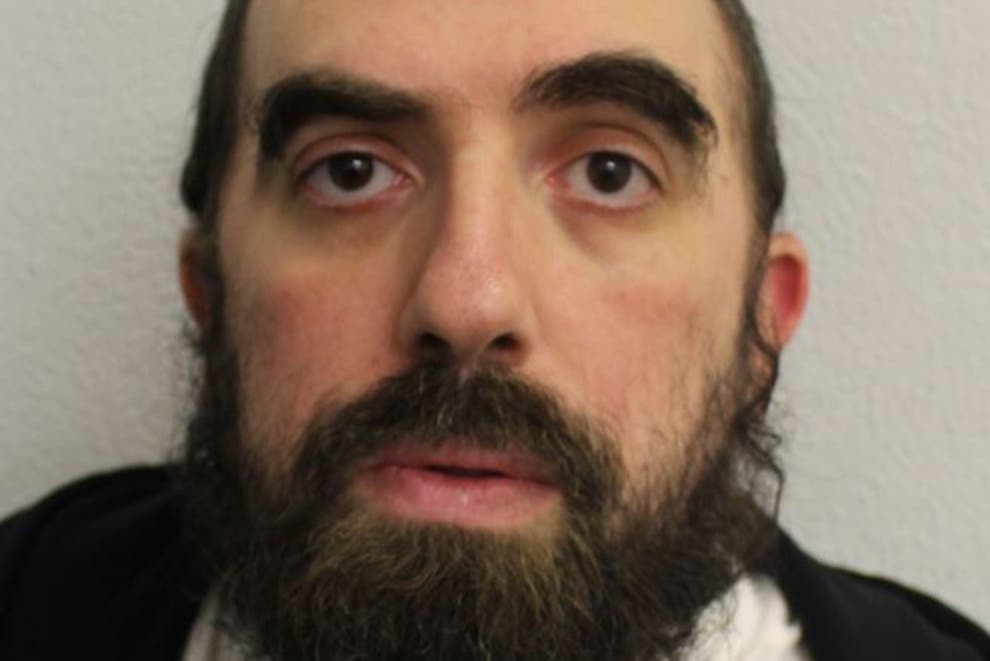
Abraham Berger
Abraham Berger

A Chassidic man from Hackney has been jailed for 14 years for multiple child abuse offences, including sexual attacks on children under the age of 10 and sharing indecent images online.

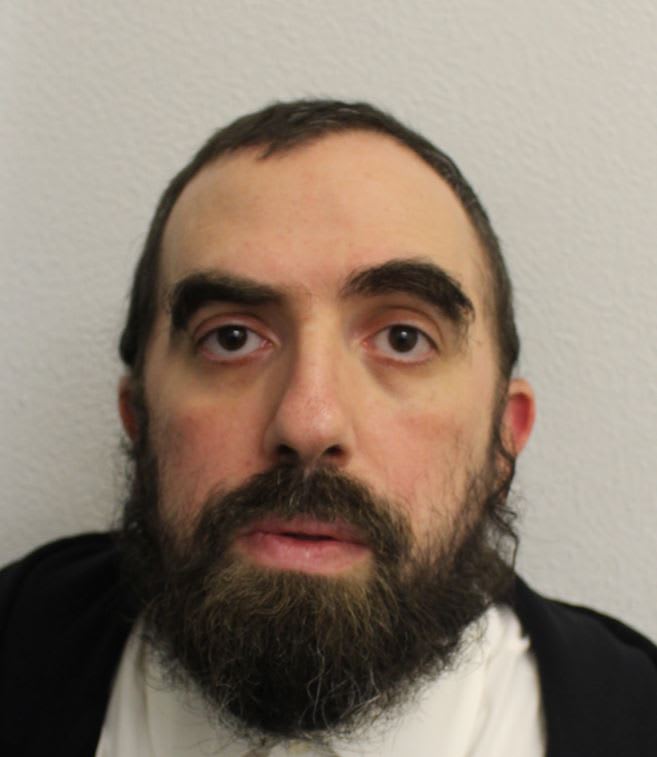
Abraham Berger, a member of the Skver Hasid community, was described by police as “a dangerous, predatory offender” with around 1,600 images and 127 videos of child abuse on his phone.

The 40-year-old, who describes himself on Twitter as a ‘proud dad and husband originally from New York’ was sentenced at Snaresbrook Crown Court, after pleading guilty to charges that also included sexually abusing a young boy and girl, both under the age of 10. After his release, he will spend a further four years on licence.

Berger was part of an instant messaging chat group that discussed child sexual abuse and shared such images between themselves. Police say he lead a “double life” and said many of the images he possessed were ‘first generation’, meaning that they show Berger committing the abuse.

Abraham Berger

Speaking to Jewish News Yehudis Fletcher, the founder of Nahamu, which has raised concerns about the systemic cover up of sexual abuse in the jewish community, said: “What’s interesting in this case is that he pleaded guilty, which is a shift and I hope and a sign of changing attitudes. Previously we have seen community- sponsored campaigns to pay for suspects’ defences so maybe this is one where nobody was been willing to pay up.” 

Detective Constable Chris Bailey, of the Met’s Central Specialist Crime vulnerability team, said: “The protection of children, and other vulnerable people, from harm is a priority for the Met, and we have a team of officers dedicated to identifying and arresting child abuse offenders who operate online.”

In a statement to Jewish News, Migdal Emunah, a Jewish organisation providing support to anyone who has experienced sexual violence, said

“This is a good outcome. The perpetrator has pleaded guilty without putting the victims and their families through a trial. Our hope and thoughts are with the families affected as they heal.

Anyone impacted by this can reach out to Migdal Emunah for help and support.”

Naomi Dickson, CEO of Jewish Women’s Aid said: “The perpetrator of these awful crimes is where he belongs – in prison, and I hope this case acts as a reminder that these things happen in the Jewish community and we must work together to stand up for  survivors and oppose attitudes which can provide cover for abusers. Jewish women and girls aged 16 and over can come to Jewish Women’s Aid for support on sexual violence through our specialist Dina service which is free and confidential.”

Anyone with concerns about Berger should call police on 101 or the NSPCC on 0808 800 5000. Find out more about Migdal Emunah HERE and visit Jewish Women’s Aid’s website here: www.jwa.org.uk


Thursday, March 04, 2021

Science is Imperfect and is Subject to Change with New and Better information - Not so with Fundamentalists' Beliefs as Crazy as they are!


THE WORSHIP OF SCIENCE GONE AWRY

. By Yonoson Rosenblum | MARCH 3, 2021

The current pandemic is likely the result of science gone mad

 WE LIVE in a science-driven society, and all educated people profess to "believe" in science. The most reassuring four words in English are, "Science says, 'Do this.' " But what happens when scientists are contradicting themselves or other scientists? Since the beginning of the pandemic, WHO first told us the fatality rate was 3.4 percent, which turned out to be 0.4 percent. It advised against shutting off air travel from Wuhan, even as China had done so internally. It proclaimed masks to be pointless, even as it was contradicting itself by saying that they must be saved for emergency medical personnel. It strongly advocated for lockdowns, until changing course, upon recognizing that they might well lead to a doubling of world poverty and child malnutrition.

It is no exaggeration to suggest that tens of thousands of lives in the US alone might have been lost because Dr. Fauci dismissed as worthless all early intervention treatments — hydroxychloroquine, Ivermectin, blood plasma extracted from healed patients — as not supported by RCTs. As a result, physicians were left with nothing to treat early stages of the disease, even when the proposed remedies were cheap, repurposed generic drugs, whose safety record had been studied for decades in millions of patients....

http://www.jewishmediaresources.com/2096/the-worship-of-science-gone-awry

Science: The Gold Standard of Truth

What is truth? You can speak of moral truths and aesthetic truths, but I’m not concerned with those here, important as they may be. By truth I shall mean the kind of truth that a commission of inquiry or a jury trial is designed to establish. I hold the view that scientific truth is of this commonsense kind, although the methods of science may depart from common sense, and its truths may even offend it.

Commissions of inquiry may fail, but we assume a truth is lurking there even if we don’t have enough evidence. Juries sometimes get it wrong, and falsehoods are often sincerely believed. Scientists, too, can make mistakes and publish erroneous conclusions. That’s all regrettable but not deeply sinister. What is profoundly troubling, however, is any wanton attack on truth itself: the value of truth, the very existence of truth. This is what concerns me here.

Some of what I have claimed here about scientific truth may come across as arrogant. So might my disparagement of certain schools of philosophy. Science really does know a lot about what is true, and we do have methods in place for finding out a lot more. We should not be reticent about that. But science is also humble. We may know what we know, but we also know what we don’t know. Scientists love not knowing because they can go to work on it. The history of science’s increasing knowledge, especially during the past four centuries, is a spectacular cascade of truths following one on the other. We may choose to call it a cumulative increase in the number of truths that we know. Or we can tip our hat to (a better class of) philosophers and talk of successive approximations toward yet-to-be-falsified provisional truths. Either way, science can properly claim to be the gold standard of truth....

https://skepticalinquirer.org/2021/03/science-the-gold-standard-of-truth/