(JTA)
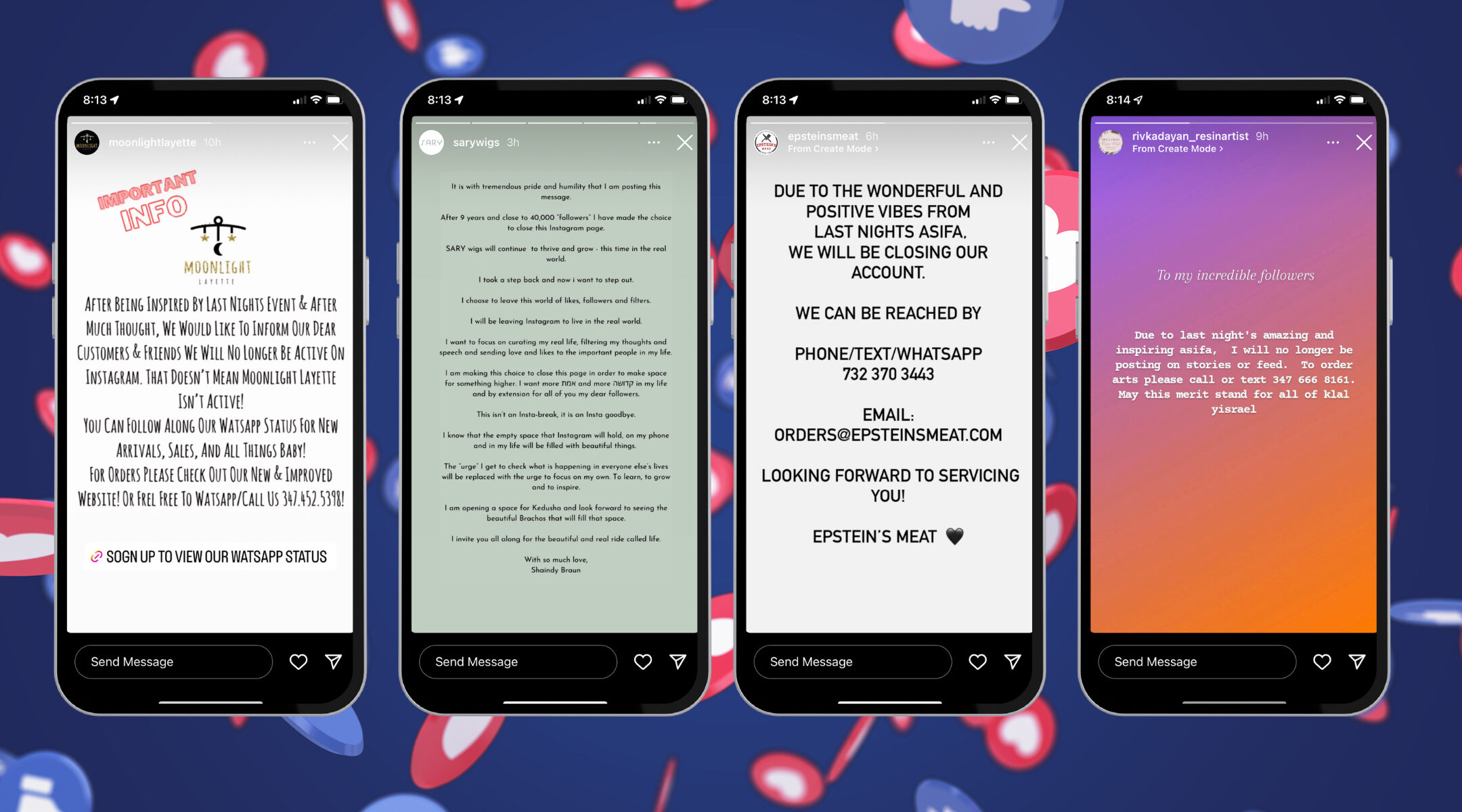
— Shaindy Braun and her wig business had nearly 40,000 followers on
Instagram, amassed over nine years, when she abruptly announced her
departure from the social media platform.
“I choose to leave this world of likes, followers and filters,” Braun
wrote last week. “I will be leaving Instagram to live in the real
world. I want to focus on curating my real life, filtering my thoughts
and speech and sending love and likes to the important people in my
life.”
Then she deleted her profile, cutting off a major line of
communication to clients — and potential buyers — of Sary Wigs, a
Lakewood-based company providing human-hair wigs to Orthodox Jewish
women in New Jersey and beyond.
She wasn’t the only one: Moonlight Layette, a baby clothing brand,
announced it would stop engaging actively on Instagram, directing
customers to a WhatsApp number instead. So did Rivka Dayan, a resin
artist who makes Judaica products, and others.
Their decisions might have come as a surprise to the brands’
followers — except that many of them had also tuned into two massive
gatherings in Newark last week exhorting Orthodox Jewish women to put
away their phones and disconnect from social networks.
Coming a decade after a landmark rally aimed at warning Orthodox men
about the dangers of the internet, the rallies were meant to inspire
women to spend more time away from their cell phones, according to its
organizers. But critics in the Hasidic Orthodox community, including
women who attended or listened in via a special phone line for remote
participation, said pressure to attend was intense — and that the
message was far from uplifting.
“They force themselves to sit through this, being told how evil they
are, how decadent they are today with their obsessions with ridiculous
things and how spiritually inferior they are,” one Hasidic woman told
the Jewish Telegraphic Agency on the condition of anonymity because she
still lives in a Hasidic community in Borough Park. “And they sit there
and they listen to it and they nod and they accept it all and they
internalize it.”
Known as an asifa or kinus (Hebrew words for gathering), the rallies
drew tens of thousands of Hasidic Orthodox women to the Prudential
Center in Newark last week, many transported on charter buses from
Orthodox areas such as Lakewood, New Jersey, and Williamsburg, Brooklyn.
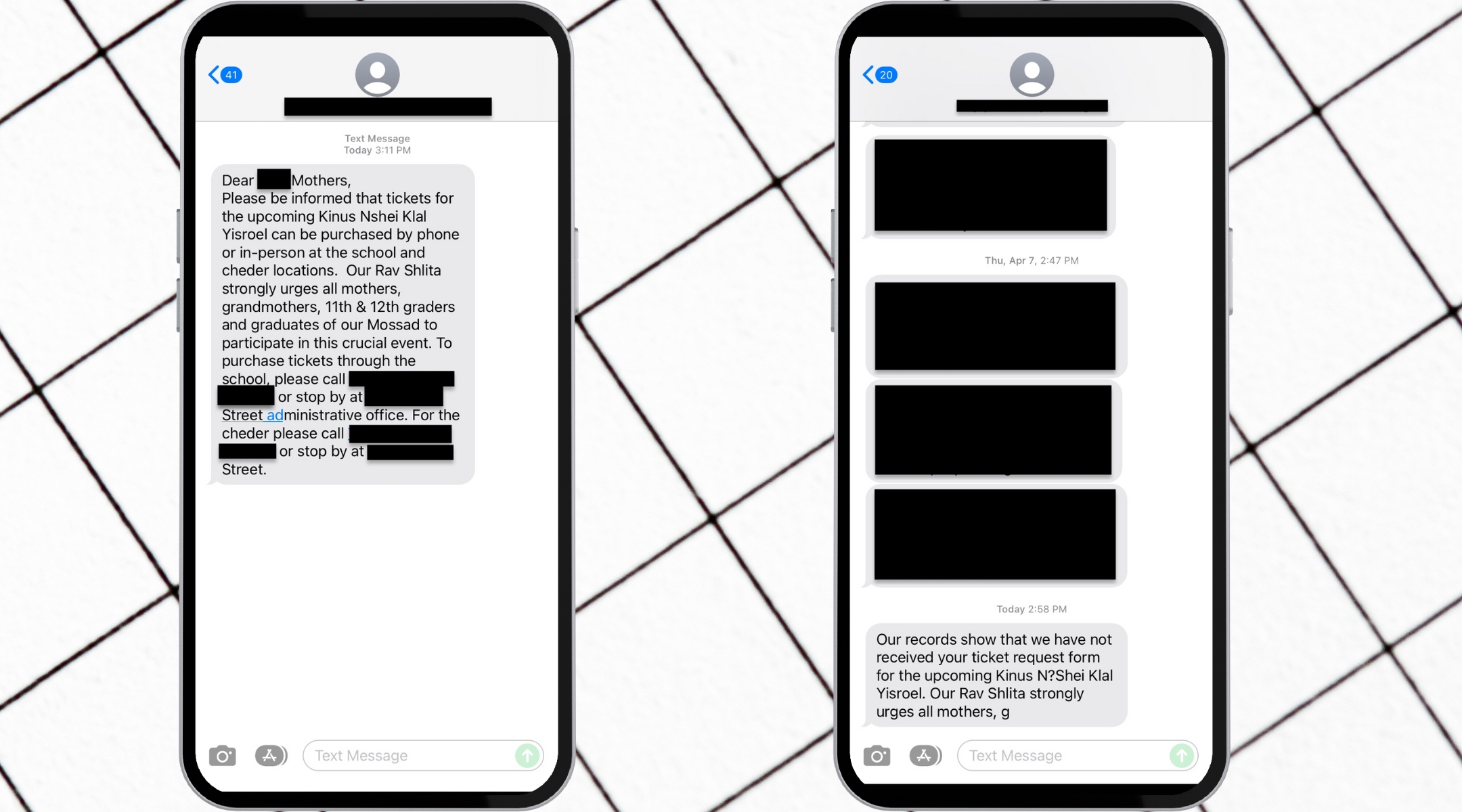
Women with children in the Bais Yaakov network of schools received text
messages and letters saying that the school rabbis urged them to
attend; one mother told JTA that she was told her children would be
expelled if she did not attend the rally, where tickets cost $54.
One rally was in English, while the other was in Yiddish, the
dominant language spoken in many of New York’s Hasidic communities. The
events, widely referred to as “nekadesh rallies” using the Hebrew word
meaning “make holy,” appealed to women’s maternal instincts — a winning
line in a community where fertility is prized and women typically have
many children and are responsible for their education.
“I miss the great times that we used to have before you got the cell
phone that your boss gave you,” a young boy said during a speech at the
Yiddish rally, according to a recording of the event. “I miss your sweet
smile. Do you remember our conversations, when we used to laugh at our
own stories, and not because we were listening to silly jokes on the
little black box?”
At the English-language rally, half of the speakers were women, and
at one point, the male rabbis who spoke left the arena so the women
could sing together. The speakers presented the issue of social media as
one where Orthodox women can choose more or less pious ways to engage
with the internet. Among the speakers was Rina Tarshish, a rebbetzin and
the director of a women’s seminary in Israel who is widely respected in
the Hasidic world.
The rally was intense at times, with attendees being told at one
point that technology is a manifestation of Satan’s efforts to spread
rot in the world, according to a Twitter thread by someone who transcribed much of the event.
But the Yiddish-language rally was more strident in tone and tackled
women’s participation in civic life offline as well, according to people
who were present. One rabbi who spoke even instructed women not to
speak on the street, except in cases of emergency.
The event came 10 years after
40,000 Orthodox men were similarly exhorted to give up their
smartphones at a major anti-internet asifa at Citi Field in New York
City. Then, the message was about insulating the community from outside influences.

Some
40,000 Haredi Orthodox men filled Citi Field in New York
Ayala Fader, an anthropology professor at Fordham University who
studies Hasidic communities, said what happened next helps explain the
latest rallies.
“Men were refusing to give up their smartphones,” she said. “So
leadership decided to focus on women and their responsibility for
rearing kids and keeping the home and really protecting the next
generation.”
Many Orthodox women who have found homes on social media built
connections within their own extended communities. Instagram in
particular has been both a tool for building businesses in a community
where working outside the home can be discouraged and logistically
challenging. Orthodox women have also used social media for activism,
such as to share experiences with infertility, combat racism and fight antisemitism. Some, seeking to comply with expectations around modesty, have even operated women-only accounts.
Hearing that they should set all of that aside struck some women who
were invited to the rally as offensive. Compounding their frustration
was the fact that attendees were prohibited from bringing cell phones,
taking pictures and sharing the event on social media, and Orthodox
media covered the rallies without printing pictures of the women who
attended.
“Women finally found an outlet where they can network and it lets you
build successful businesses via the internet,” said one Hasidic woman
who works in digital marketing and is the sole breadwinner for her
family. “And now the men realize, ‘hey, this is terrible! Women having
access to other women that are talented, successful, powerful
businesswomen. So let’s condense them even more, make them into mere
shadows.’”
The rallies were organized by the Technology Awareness Group, or TAG,
a nonprofit founded in 2011, shortly before the men’s rally, with a
mission of helping Jewish internet users avoid pornography and other
harmful influences online. Shmuli Rosenberg, a marketing executive who
promoted the event as well as many others targeting Orthodox Jews, said
the goal was not to ask women to eschew the Internet or having a public
profile.
“It’s far from cutting people off,” he said. “It’s helping people
find, in their own life, what will allow them to be more connected to
their families and their children and themselves and feel uplifted and
elevated and happy.”
Rosenberg said the rallies were limited to women only because the
organizers wanted to offer some programming, including women’s singing,
that would not be possible under communal norms in a mixed-gender
setting.
“This wasn’t specifically targeting women versus men,” he said. “This
was targeting everyone. And in our communities, it would be totally
unacceptable to say that men can access the internet or information more
than women.”
Some women who attended, like Braun, the wigmaker, found the events inspiring.
“I know, it’s kinda contradictory to talk about it here, online,” one
woman wrote on the Orthodox women’s forum ImaMother. “But those who
were there, in a positive mind, understood that it wasn’t about all or
nothing.”
But others said they saw in the events a dangerous tendency in
Orthodox communities to set rules far beyond what is required by Jewish
law. On their way out of the rallies, women were handed cards that they
could give to their taxi drivers and housekeepers to explain why they
cannot touch smartphones to type in their address and to ask that
smartphones not be used in their homes.
“Dear cleaning lady,” one of the cards read, “In accordance with our
religion, most of our community refrains from smartphone usage. I can
give you the details in writing. Please keep your smartphone out of
sight inside our home.”
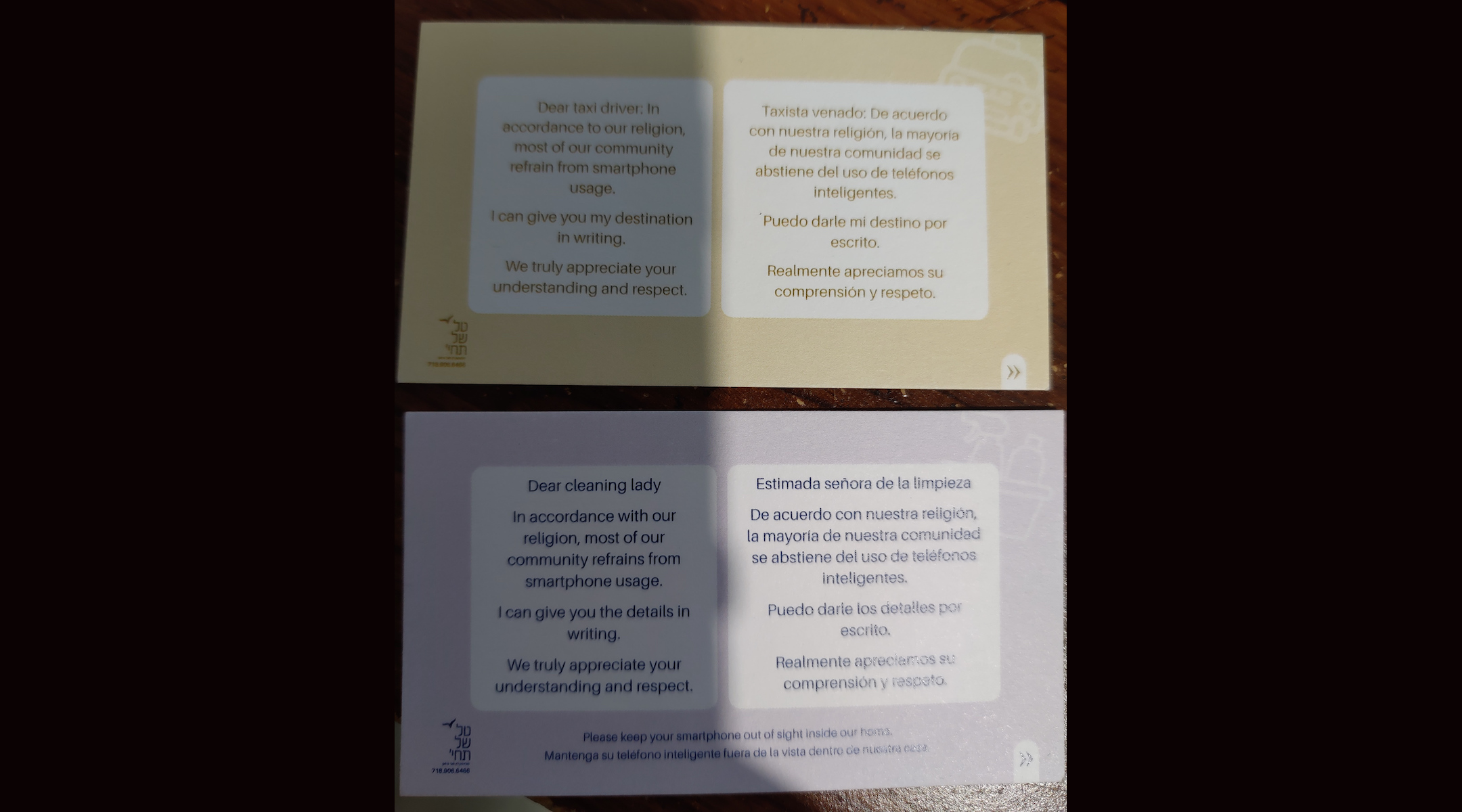
Women
were handed cards to be given to their taxi drivers and maids
Nothing in Jewish law, known as halacha, prohibits a woman from
typing in her address on a phone or creates any obligation for non-Jews.
But Rayne Lunger, a woman who grew up Hasidic and is now active on
social media, said she was familiar with the impulse to observe more
than the letter of the law.
She likened the call for women not to use smartphones to what has
happened with expectations around skirt length. In the past, women were
considered modest if their skirts covered their knees, she said, but
over time, 4 inches below the knee became the norm, and now women can
face criticism if their skirts do not reach at least 6 inches below the
knee.
“People want to be good and do the right thing,” Lunger said. “And
they’re sometimes building stringencies on top of stringencies on top of
stringencies that make no sense because they have no reference point.”
Not all Hasidic Jews are wrestling with the issue of internet use in
the same way. The Chabad-Lubavitch Hasidic movement, for example, has
embraced new technologies and uses social media in its outreach, and was
not involved in any of these events.
But for women who do choose to roll back their internet usage, groups
such as TAG stand ready to install “kosher” filters on their phones and
computers.
“The ultra-Orthodox mostly think that the medium is fine wherever you
use it in the clean way, or kosher way,” said Rivka Neriya-Ben Shahar, a
professor at Sapir Academic College in Israel who studies haredi
Orthodox approaches to media. “They feel very safe once they can control
the content.”
Like parental controls on an iPad or television, kosher filters
typically block access to websites or content that is considered
inappropriate in the community, such as pornography, gambling sites, or
anything related to violence or drugs. They also may block secular
content and, separately, can sometimes be glitchy and block content that
is not actually out of bounds in the Hasidic world, including health
and safety information that women need.
Exactly how many women will install filters, cede their cell phones
or cut communications with their customers as a result of the recent
gatherings remains to be seen. But what’s clear is that the press to get
New York-area Orthodox women to reconsider their internet use
continues, even as the latest events themselves fade into the past.
Women are still closing their accounts, according to participants on
Orthodox Instagram, and now another event has been scheduled: A replay
of the asifa is set for Monday at Tiferes Bais Yaakov School in
Lakewood. The school’s website says its ballroom can accommodate 4,600,
and tickets are $20.