EVERY SIGNATURE MATTERS - THIS BILL MUST PASS!

EVERY SIGNATURE MATTERS - THIS BILL MUST PASS!
CLICK - GOAL - 100,000 NEW SIGNATURES! 75,000 SIGNATURES HAVE ALREADY BEEN SUBMITTED TO GOVERNOR CUOMO!

EFF Urges Court to Block Dragnet Subpoenas Targeting Online Commenters

EFF Urges Court to Block Dragnet Subpoenas Targeting Online Commenters
CLICK! For the full motion to quash: http://www.eff.org/files/filenode/hersh_v_cohen/UOJ-motiontoquashmemo.pdf

Tuesday, July 18, 2023

But as Einstein walked back into his office he told his own assistant, nodding in the direction of Oppenheimer, “There goes a narr,” or fool.

J. Robert Oppenheimer


One day in the spring of 1954, J. Robert Oppenheimer ran into Albert Einstein outside their offices at the Institute for Advanced Study in Princeton, N.J. Oppenheimer had been the director of the institute since 1947 and Einstein a faculty member since he fled Germany in 1933. The two men might argue about quantum physics — Einstein grumbled that he just didn’t think that God played dice with the universe — but they were good friends.

Oppenheimer took the occasion to explain to Einstein that he was going to be absent from the institute for some weeks. He was being forced to defend himself in Washington, D.C., during a secret hearing against charges that he was a security risk, and perhaps even disloyal. Einstein argued that Oppenheimer “had no obligation to subject himself to the witch hunt, that he had served his country well, and that if this was the reward she [America] offered he should turn his back on her.” Oppenheimer demurred, saying he could not turn his back on America. “He loved America,” said Verna Hobson, his secretary who was a witness to the conversation, “and this love was as deep as his love of science.”

“Einstein doesn’t understand,” Oppenheimer told Ms. Hobson. But as Einstein walked back into his office he told his own assistant, nodding in the direction of Oppenheimer, “There goes a narr,” or fool.

Einstein was right. Oppenheimer was foolishly subjecting himself to a kangaroo court in which he was soon stripped of his security clearance and publicly humiliated. The charges were flimsy, but by a vote of 2 to 1 the security panel of the Atomic Energy Commission deemed Oppenheimer a loyal citizen who was nevertheless a security risk: “We find that Dr. Oppenheimer’s continuing conduct and association have reflected a serious disregard for the requirements of the security system.” The scientist would no longer be trusted with the nation’s secrets. Celebrated in 1945 as the “father of the atomic bomb,” nine years later he would become the chief celebrity victim of the McCarthyite maelstrom.

Oppenheimer may have been naïve, but he was right to fight the charges — and right to use his influence as one of the country’s pre-eminent scientists to speak out against a nuclear arms race. In the months and years leading up to the security hearing, Oppenheimer had criticized the decision to build a “super” hydrogen bomb. Astonishingly, he had gone so far as to say that the Hiroshima bomb was used “against an essentially defeated enemy.” The atomic bomb, he warned, “is a weapon for aggressors, and the elements of surprise and terror are as intrinsic to it as are the fissionable nuclei.” These forthright dissents against the prevailing view of Washington’s national security establishment earned him powerful political enemies. That was precisely why he was being charged with disloyalty.

It is my hope that Christopher Nolan’s stunning new film on Oppenheimer’s complicated legacy will initiate a national conversation not only about our existential relationship to weapons of mass destruction, but also the need in our society for scientists as public intellectuals. Mr. Nolan’s three-hour film is a riveting thriller and mystery story that delves deeply into what this country did to its most famous scientist.

Sadly, Oppenheimer’s life story is relevant to our current political predicaments. Oppenheimer was destroyed by a political movement characterized by rank know-nothing, anti-intellectual, xenophobic demagogues. The witch-hunters of that season are the direct ancestors of our current political actors of a certain paranoid style. I’m thinking of Roy Cohn, Senator Joseph McCarthy’s chief counsel, who tried to subpoena Oppenheimer in 1954, only to be warned that this could interfere with the impending security hearing against Oppenheimer. Yes, that Roy Cohn, who taught former President Donald Trump his brash, wholly deranged style of politics. Just recall the former president’s fact-challenged comments on the pandemic or climate change. This is a worldview proudly scornful of science.

After America’s most celebrated scientist was falsely accused and publicly humiliated, the Oppenheimer case sent a warning to all scientists not to stand up in the political arena as public intellectuals. This was the real tragedy of Oppenheimer. What happened to him also damaged our ability as a society to debate honestly about scientific theory — the very foundation of our modern world.

Quantum physics has utterly transformed our understanding of the universe. And this science has also given us a revolution in computing power and incredible biomedical innovations to prolong human life. Yet, too many of our citizens still distrust scientists and fail to understand the scientific quest, the trial and error inherent in testing any theory against facts by experimenting. Just look at what happened to our public health civil servants during the recent pandemic.

We stand on the cusp of another technological revolution in which artificial intelligence will transform how we live and work, and yet we are not yet having the kind of informed civil discourse with its innovators that could help us to make wise policy decisions on its regulation. Our politicians need to listen more to technology innovators like Sam Altman and quantum physicists like Kip Thorne and Michio Kaku.

Oppenheimer was trying desperately to have that kind of conversation about nuclear weapons. He was trying to warn our generals that these are not battlefield weapons, but weapons of pure terror. But our politicians chose to silence him; the result was that we spent the Cold War engaged in a costly and dangerous arms race.

Today, Vladimir Putin’s not-so-veiled threats to deploy tactical nuclear weapons in the war in Ukraine are a stark reminder that we can never be complacent about living with nuclear weapons. Oppenheimer did not regret what he did at Los Alamos; he understood that you cannot stop curious human beings from discovering the physical world around them. One cannot halt the scientific quest, nor can one un-invent the atomic bomb. But Oppenheimer always believed that human beings could learn to regulate these technologies and integrate them into a sustainable and humane civilization. We can only hope he was right.

https://www.nytimes.com/2023/07/17/opinion/kai-bird-oppenheimer-christopher-nolan.html

Monday, July 17, 2023

Jacob Daskal will be sentenced to between 14 and 17 years in prison and will register as a sex offender after pleading guilty to transporting a minor with the intent of engaging in criminal sexual activity, according to an announcement Friday from the U.S. Department of Justice.


Former head of Jewish security patrol in Brooklyn pleads guilty to sex crime involving a teenager


(New York Jewish Week) — The founder and longtime head of a private Jewish safety patrol group in Brooklyn has pleaded guilty to a crime related to sexual abuse of a 15-year-old girl.

Jacob Daskal will be sentenced to between 14 and 17 years in prison and will register as a sex offender after pleading guilty to transporting a minor with the intent of engaging in criminal sexual activity, according to an announcement Friday from the U.S. Department of Justice.

The guilty plea comes more than five years after Daskal, then the head of the Boro Park Shomrim security group, was first arrested and charged with sex crimes related to the alleged abuse of a girl who became his charge after she reached out for help because of trouble in her family. According to prosecutors, Daskal groomed the girl for sex and had sex with her multiple times, in Brooklyn, upstate New York and Chicago, all the while using his status as a community leader to pressure her to stay quiet.

“The defendant has admitted he abused his power, trust and position in the community by committing deplorable acts against a child in his care,” Breon Peace, the U.S. attorney for the Eastern District of New York, said in a statement Friday. “We want victims everywhere to hear this guilty plea as our Office’s continued declaration that no one is above the law and we will bring those who violate our children to justice.”

The plea allows Daskal to avoid a trial on additional charges that had been set to start this month. Elements of the prosecution’s case, including graphic text messages between Daskal and his victim, were revealed in court filings rebuffing Daskal’s efforts to delay a trial.

According to the New York Daily News, Daskal — who had close ties with local police and Brooklyn’s Orthodox politicians until his arrest — was tearful as he entered his plea in court in Brooklyn on Friday.

“I transported the 15-year-old victim from New York, Brooklyn to New Jersey,” he said in court. “I was 58 years old at that time.”


https://www.justice.gov/usao-edny/pr/former-head-boro-park-shomrim-society-pleads-guilty-transporting-15-year-old-girl

https://www.jta.org/2023/07/16/ny/former-head-of-jewish-security-patrol-in-brooklyn-pleads-guilty-to-sex-crime-involving-a-teenager

Wednesday, July 12, 2023

The realization is slowly sinking in that more and more ultra-Orthodox families want to send their sons to haredi Orthodox schools that teach core curriculum subjects and are under government supervision.


What’s happening right now around secular studies in Israeli yeshivas is remarkable

(JTA) — The irony of history is that we can understand and assess the full meaning of current events only in retrospect. Only looking back can we know for certain whether an incident that seems historic really is a turning point, or whether it was really the quiet and hard-to-detect processes bubbling under the surface that were shaping the future.

Either way, in recent weeks it seems that something notable is happening in the Israeli haredi, or ultra-Orthodox, community when it comes to teaching math, English and science in schools almost exclusively devoted to religious instruction.

The realization is slowly sinking in that more and more ultra-Orthodox families want to send their sons to haredi Orthodox schools that teach core curriculum subjects and are under government supervision.

 In order to avoid losing control over these schools, the rabbis are considering offering them a “kosher” alternative — schools that teach core curriculum subjects but are under haredi supervision. 

A few days ago, Israeli media reported on a meeting of prominent leaders of the pious “Lithuanian” haredi sector, known as “Yeshivish” in the United States. According to one account, the leaders, including two rabbis who are among the favorites in the race to be crowned the next “rabbinical giant of the generation,” met to discuss the “state ultra-Orthodox school system, with the objective of considering the challenges in education and the best way to proceed.” The teaching of secular subjects was clearly the context of their meeting. 

This comes on top of last month’s report that the Belzer Hasidic movement, one of Israel’s largest, wants to revert to a plan, devised in the previous Knesset by legislator Moshe TurPaz, whereby their schools would receive full state funding contingent on their incorporation of core curriculum subjects under government supervision. (The sect had dropped the plan under pressure from Rabbi Gershon Edelstein, the last rabbinical giant, who died in May at 100.) Whether these reports are true or just a gun placed on the table by haredi members of the Knesset as part of budget negotiations, the mere threat would seem to indicate that the core curriculum is gaining increased legitimacy in ultra-Orthodox society.

The truly shocking news, however, came on a different front: higher education. David Leibel, a well known rabbi who is also a businessman and social entrepreneur with a long record of success, announced the opening of an advanced yeshiva (for students ages 16 through marriage) that would also teach academic subjects. 

The announcement was preceded by a heavily promoted speech that garnered major coverage inside and outside the haredi sector. Currently, most haredi men continue to study Torah full-time and do not work for a living. The rabbi proclaimed, in short, that there is more than one way to be an ultra-Orthodox Jew. Devoting one’s life to Torah study is a stellar virtue, Leibel said, but acquiring a vocation and going out to earn a livelihood is equally legitimate. 

The attacks were swift and brutal. The Orthodox weekly Yated Ne’eman declared it totally out of the question to discuss the idea and condemned Leibel as the spiritual murderer of the greatest rabbi of the next generation, who instead of devoting himself entirely to Torah will choose to focus on secular studies. 

Despite the fierce public opposition to Leibel’s move, leaders associated with several ultra-Orthodox yeshiva high schools and others have just announced their intention to open a post-secondary institution that would allow its students to combine Torah studies with vocational programs and academic courses. 

According to the manifesto they wrote, which has circulated within the community but not been formally published, the yeshiva will offer “studies in a range of disciplines and occupations offered both by universities and other quality institutions that pave the student’s way to professionalism and excellence toward a dignified life and honorable livelihood, while sharing and accepting responsibility both in the economy, society, and community, and in the State of Israel as a whole.”

Can the ultra-Orthodox in Israel really incorporate a secular education or is the haredi DNA dedicated solely to religious studies for boys?

In the American context, the opposition by Hasidic leaders to calls that they improve their secular studies would suggest the latter. An investigation by the New York City Department of Education recently found that 18 Hasidic schools do not uphold the requirements to teach secular subjects. (It also concluded that some yeshivas do meet the state’s standards.) Hasidic yeshivas in New York, and their political supporters, have so far resisted heavy pressure from activists and the media to teach secular subjects in a way that is “substantially equivalent” with non-Orthodox schools. 

But the situation among the “Yeshivish,” non-Hasidic yeshivas in the United States is quite different. Their yeshivas, in places like the burgeoning Orthodox enclave of Lakewood, New Jersey, are teaching secular studies even in high schools, and most of their graduates are earning high school and often post-high school diplomas. This stems from parents’ desire to provide their children with the life skills required in modern society. In research we conducted on Haredi boys’ education in the United States, a principal of a Lithuanian institution told us that removing secular studies would lead 90% of parents to remove their sons from the yeshiva.

*****(Shraga Feivel Mendlowitz (1886 – 7 September 1948)[1][2] was a leader of American Orthodox Judaism and founder of institutions including Torah U'Mesorah, an outreach and educational organization. In 1921 he became principal of Yeshiva Torah Vodaas He subsequently added a high school and post graduate program to the yeshiva. His policies were often informed by the Orthodox philosophical movement Torah im Derech Eretz.[4]")*****

No wonder that more than 25% percent of the Yeshivish stream hold academic degrees, and the annual average earning of a Yeshivish household is 60% more than a Hasidic one. 

The haredi experience in the United States shows that it is possible to combine religious and secular studies for high-school aged boys. Can this latter model be replicated in Israel?

Only time will tell whether the current changes in Israel are viable or whether they prove premature and wither away. 

But if there is a lesson to be learned from all that’s happening, it is that change takes place only when alternatives are made available. If these and similar yeshivas gain momentum, the decision-makers will have no choice. Just as they are now considering the establishment of ultra-Orthodox schools that teach core curriculum subjects under rabbinic supervision, in the future we may see Israeli yeshivas that include secular studies as an integral part of the haredi world.

https://www.jta.org/2023/07/10/ideas/whats-happening-right-now-around-secular-studies-in-israeli-yeshivas-is-remarkable?utm_source=JTA_Maropost&utm_campaign=JTA_DB&utm_medium=email&mpweb=1161-59524-25499

Sunday, July 09, 2023

The Good Ol' Doctor's Note! The Joke Is On Every Thinking Jew Who Puts Their Fate In The Hands of Corrupt Batei Din!


Rabbinical court delays ruling on Berlin rabbi accused of sexual misconduct after he offers 11th-hour doctor’s note


BERLIN (JTA) – A Jewish religious court has convened to hear testimony against a Berlin rabbi who was fired following allegations that he preyed on young women, using religious arguments to lure them into sexual relationships.

The beit din, or religious court, of Germany’s Orthodox rabbinical association, the ORD, announced on Monday night that it had “heard several affected persons in the case of allegations of sexual assault by a rabbi.”

But the group, working together with the Chief Rabbinate of Israel and the Conference of European Rabbis, said it was not prepared to make a ruling because the rabbi had presented a letter from his doctor saying he could not testify, two hours before he was scheduled to do so. He will be given another chance, on July 13, according to the beit din’s statement.

The rabbi, Reuven Yaacobov, told the Jewish Telegraphic Agency on Tuesday that his doctors have told him to rest completely for a month because of the shock he had endured. “If we don’t end the situation, then the post-traumatic situation will follow,” he recounted via WhatsApp.

The ORD would not offer more specificity about the number of women who testified. But a source outside the ORD with knowledge of the proceedings said that at least 10 women took part, locally or remotely, in the hearings held before an international panel of rabbis convened specially to deal with this case.

The hearing came one month after the Jewish Community of Berlin fired Yaacobov and locked the doors of his synagogue, the Sephardi congregation Tiferet Israel, a day after several women testified about what they described as years of sexual and psychological abuse.

The swift actions by both the Jewish Community of Berlin and Germany’s Orthodox rabbinical association stands in contrast to past responses to allegations against Yaacobov. JTA reported last month that multiple entities had received complaints about him during the 17 years that he was employed by the official Berlin Jewish community.


Yaacobov has not commented publicly on the allegations. He told JTA that he had not been told officially why he was fired. He also said he plans to contest his termination in German court and had informed the ORD he was “ready to come to a neutral Beit Din at any time and in any place as soon as my health condition improves and the labor court has met.”

Yaacobov had been a popular spiritual leader in a subset of Berlin’s large community of Russian-speaking Jews. Born in Uzbekistan and ordained by the Midrash Sepharadi Yeshiva in Jerusalem, Yaacobov, 46 and a married father of four, also studied at the Moscow Yeshiva in Russia and the Shavei Gola Yeshiva in Jerusalem before being hired by the Jewish Community of Berlin 17 years ago, according to a biography that was removed from the organization’s website last month.

Some of Yaacobov’s former congregants have joined him in a private Berlin location for services since his firing, he told JTA. Speaking Tuesday, he also questioned why Tiferet Israel, which operates inside an apartment building owned by the Jewish Community of Berlin, remained closed, with personal belongings locked inside.

“If the community has a problem with me, then they can solve the problem with me, but why does the synagogue have to be closed because of that?” he asked, noting that the Nazis had destroyed a synagogue on that same street in 1938. “Why should the worshippers pray in another synagogue?”

A spokesperson for the Jewish Community of Berlin told JTA on Tuesday that the closure of the synagogue was essential for demonstrating to women that their concerns were being taken seriously. The spokesperson, Ilan Kiesling, said additional women had come forward with allegations against Yaacobov since the closure.

“Many of Rabbi Yaacobov’s victims did not dare to report their suffering to the community board … because they thought that Rabbi Yaacobov might be able to return to his old place of work,” Kiesling said by email Tuesday. “The closing of the synagogue on Passauer Strasse also sends a clear signal that he will never serve as rabbi there again.”

The synagogue will remain closed until both civil and religious court proceedings have been completed, he said, adding, “The ban on Rabbi Yaacobov in all institutions of the Jewish Community in Berlin remains in force.”

The ultimate ruling of a rabbinical court could deepen that estrangement. A beit din can issue pronouncements that affect a person’s role in the Jewish community locally and beyond.

Elena Eyngorn, a Berlin Jew who originally brought some of Yaacobov’s alleged victims to testify to the Jewish community’s board, told JTA on Tuesday that she had arranged for a psychologist to accompany the women at the hearings by the Jewish court this week, if they so wished. The psychologist donated her time, she said.

Eyngorn, who did not attend the hearings herself, said she understood that the ORD also had permitted each woman to bring a support person.

One of the women who testified to the beit din told JTA that she had been asked to sign a statement that she was telling the truth. With her permission, she said, the religious court recorded her testimony so the three rabbinical judges could listen to it again. She estimated that she spoke with them for about 20 minutes.

“I told them at the end of the meeting that I thought it was very important to decide something about him, because we are very responsible towards the girls who are growing up in this community,” she said in a telephone interview with JTA, speaking on condition of anonymity.


Thursday, July 06, 2023

" The Orthodox Jewish Community (OJC) in particular, most essentially reflected universal aspects of sexual abuse....


Sexual Abuse in the Orthodox JewishCommunity: A Literature Review


Sexual abuse is a cross-cultural phenomenon related to multiple cultural contexts including religious affiliation. The Haredi, or Orthodox Jewish community (OJC), constitutes a significant minority group of the worldwide Jewish population, characterized by cultural conservatism, steadfast loyalty to the community, and strict religious behavioral codes. To date, only few empirical studies (as opposed to multiple media reports) have dealt with the issue of sexual abuse within the OJC.

Using  Preferred Reporting Items for Systematic Reviews and Meta-Analyses guidelines, we conducted a systematic review of the literature on sexual abuse within the OJC and its subgroups that addresses experiences and reports of victims, perpetrators, the Jewish and general community, and professionals in the North America, Israel, and Australia. Articles were collected from peer-reviewed databases and bib-liographies; 13 quantitative and qualitative articles were included in the final sample.

Three themes emerged: disclosure of sexual abuse, perceptions and attitudes toward the abuse, and its implications. Results indicated that alongside several findings that were specifically grounded in the context of closed collective or religious societies and the OJC in particular, most essentially reflected universal aspects of sexual abuse. The results suggest promoting context-informed interventions based on community knowledge and resilience, together with appropriate training in order to better understand the needs of the OJC and of closed communities in general.


 READ THE ENTIRE RESEARCH PAPER:

https://www.researchgate.net/publication/339264609_Sexual_Abuse_in_the_Orthodox_Jewish_Community_A_Literature_Review

Wednesday, July 05, 2023

Israel's Second-largest Haredi Sect Starts Teaching Boys About Sexual Abuse Awareness


Israel's Second-largest Haredi Sect Starts Teaching Boys About Sexual Abuse Awareness

The Belz Hasidic sect, the second largest Haredi community in Israel, established a school program last month to protect students at its elementary schools …

The Belz Hasidic sect, the second largest Haredi community in Israel, established a school program last month to protect students at its elementary schools for boys from sexual abuse. Parents of students from grades 1 through 6 in the community’s boys’ schools were recently sent a letter regarding the “Sviva Betucha” (safe environment) program.

The letter explained that the program “will give the students tools and practices relating to cautiousness and protecting the body and the soul,” and that the educational staff has been given professional instruction “in keeping with the Belz outlook.”

Prior to this, similar programs were only instituted in schools that are considered more marginal in the Haredi community, including girls’ schools, private elementary schools for boys and in some of the Bnei Yosef schools affiliated with the Shas party. By contrast, the Belz school system has roughly 7,000 students, and the expectation now is that other Hasidic schools could follow suit.

The program is sponsored by Yedidut Toronto, a Jerusalem-based nonprofit, for ultra-Orthodox schools. According to the organization’s website, the program has been introduced into 185 schools in about 1,100 classrooms, having trained 3,000 teachers and involving 58,000 students (about 16 percent of all of the country’s Haredi students)

Among the skills that the program is designed to teach students is “observance of rules that will help them avoid getting into situations of risk and of overstepping boundaries.” The students are also to be taught “to spot from the beginning when a boundary has been overstepped that might lead them to a risk of being harmed and how to prevent that in time.” Finally, students are taught how to respond by sharing any inappropriate conduct with people in authority.

The issue of protecting students from sexual abuse is highly sensitive in Haredi schools and in the ultra-Orthodox community in general. Rabbis and educators in the community have therefore faced a dilemma, wanting to address the issue but not knowing how. In recent years, however, there has been a dramatic change and greater openness. One source told Haaretz that this is also just one aspect of greater openness on the issue of mental health in the Haredi community in general.

The rabbis involved in the project obtained the approval in advance of the community’s spiritual leader and worked with Yedidut Toronto to adapt the program to the Belz schools’ needs. “We didn’t wait for the coming school year due to the immediate need to act on the issue before summer vacation,” a source from the community said, noting that summer vacation is a period during which such abuse is more likely to occur.

“Students have proven that when adults in a child’s environment … set clear boundaries maintaining and respecting the sensitivities and needs of the child through healthy communications, the child is less likely to be in situation of risk,” the letter to Belz school parents explained. Unlike limited instruction in the past in the country’s Haredi schools that emphasized the need to be cautious of people from outside the community, this program actually focuses on the students’ immediate environment, where the risk of harm is greater.

“Statistics in Israel show that there is a higher percentage of harm to children, boys and girls, under the age of 12,” the Yedidut Toronto website notes. “In a large proportion of the cases, it involves an offender from the immediate environment with which the child is familiar. It’s important to prepare the children for situations in which they would exercise awareness, spot behavior that is not appropriate and report it to a person of responsibility.”

Yedidut Toronto, which works extensively with mainstream ultra-Orthodox institutions, refused to comment for this article or to explain the program, but the program content becomes clearer from the information on its website. “Preventing sexual harm is based first and foremost on teaching children basic cautionary rules, developing and normalizing protective discourse with the child, imparting the child’s self-confidence in his body and familiarization with the rules of ‘do’ and ‘don’t’ in personal and public space,” it states.

As the parents of the children gain greater awareness of the issue, they may also discover that their children have been abused. The parents also receive training and have access to counseling resources in the event that they have a child who has been abused.


Read more on haaretz.com

Monday, July 03, 2023

Izzy Posen grew up in London's Ultra-Orthodox Hasidic Jewish community, receiving the bare minimum of secular education in an illegal school that still practiced corporal punishment. Ash talks to Izzy about Zionism, how much the state should interfere with child rearing and the correct way to cut your nails in the eyes of the lord.

 This post is for informational purposes only! I do not advocate or condone the path Izzy has taken whatsoever. My posting is simply to demonstrate the various factors that contribute to Orthodox children  leaving the path of their forefathers. PM


 Izzy Posen grew up in London's Ultra-Orthodox Hasidic Jewish community, receiving the bare minimum of secular education in an illegal school that still practiced corporal punishment. Even with the strictures of this ultra insular community, he still managed to develop an acute curiosity about the world, something that resulted in him teaching himself english and eventually leaving the community to study physics and philosophy. Ash talks to Izzy about Zionism, how much the state should interfere with child rearing and the correct way to cut your nails in the eyes of the lord.

Tuesday, June 27, 2023

Why Not Scar A Child For Life Over Some BOZO "CODE"?


Against school code: Girl suspended from haredi school after celebrating Bat Mitzvah


The school claims the party went late, the songs at the event were not from the approved list, and several male relatives were present.

Hadar, a 12-year-old student at a haredi school in Ashkelon, was suspended after, according to the school, her Bat Mitzvah celebration violated school policy. According to Kan News, since then nearly two weeks, the school administration has not allowed her to return to class.

According to the girl's mother, the event was organized per the school's strict code, with strict kosher supervision and a female photographer, DJ, and waitresses. She says the trouble began in the middle of the event when the Hadar's friends began to leave early. "During the party, there was a commotion because the party was supposed to end at 9:30 PM. I explained the problem to the assistant principal that I already had invited people for a specific time, and I couldn't change it. The whole point of having a party for only girls is so her classmates could come."

Hadar recounted, "I was sad, I cried, I told my friends the principal wouldn't do anything, don't worry, stay. Some said, 'You're right,' they stayed, and some left."

Two days later, Hadar, a sixth grader at the Netzach Israel school in Ashkelon, received a letter notifying her that she would not return to class until her mother signed the letter admitting that she was wrong. According to the school, the party continued past the accepted time, the songs played at the event were not from the approved list, and several male relatives, including Hadar's father and grandfather, were present.

The school's principal claims that "the girl's mother keeps refusing to sign the letter she received after she violated several articles of the school's code."

The Ashkelon Municipality stated: "It was made clear to the student's mother that she can return to school, but she chose not to." (LIE)


http://www.israelnationalnews.com/news/373284?utm_source=activetrail&utm_medium=email&utm_campaign=nl

Monday, June 26, 2023

Child sexual abuse at religious Jewish camps, schools no longer secret


Child sexual abuse at religious Jewish camps, schools no longer secret 


If a young child today suffers abuse, chances are, it will have been recorded in some way. A reconstruction of that moment with the use of modern technology, enables them to speak up.

 ‘I CANNOT keep quiet.’  (photo credit: Kristina Flour/Unsplash)
‘I CANNOT keep quiet.’

I am ready to raise a storm. I don’t think I have a choice anymore – I cannot keep quiet and I will use the powers I have to raise awareness.

I feel a little like the character Carrie Bradshaw in Sex and the City, when she would sit down and write her funky articles on single life in one’s forties, from her cute little apartment. There, she’d sit at her desk in front of open windows overlooking a charming street in Manhattan, while wearing a super-cool outfit and her hair up in a trendy bun.

I am also by a window overlooking a stunning view of the Knesset, but that is where the similarities end. I am wearing a headscarf, hoping my kids are sleeping in their beds and knowing, in the back of my mind, that I still have to finish the dishes, load a washing machine and make sure uniforms are ready for school the next day. Oh, and I almost forgot – I am not writing about the single lives of wealthy girls in their forties, but about a subject that frightens me: sexual abuse of young boys.

My seven-year-old boy is finally sleeping calmly in his bed. I stare at him, with his blond hair and blue eyes. He looks like a mini Leonardo DiCaprio.

Yesterday, I got a call from a friend in Milan asking me if I was interested in sending him to camp there. For years, I went to that same camp as a child, and then as a teenager. I was in the girls’ division and I loved it.

I have such good memories of the place: A large Tuscan villa nestled between the Tuscan mountains, with gorgeous views and only 30 minutes from the Mediterranean Sea and the gorgeous town of Viareggio, known for its beaches, markets and stores.


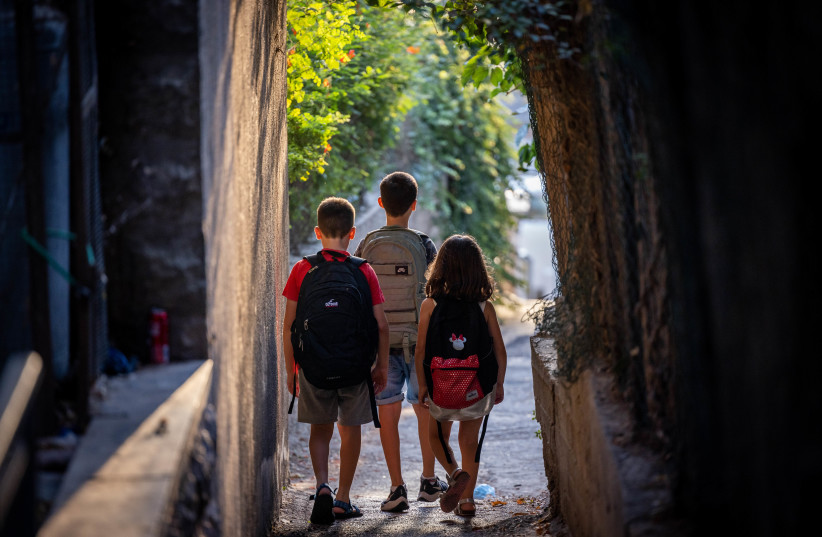
 Israeli kids wearing school bags. (credit: YONATAN SINDEL/FLASH90)


“Of course I would love to send him,” I heard myself saying out loud, that’s “my camp.” My oldest girls went there in the past, and this year, it’s my seven-year-old boy and nine-year-old girl’s turn.

A few nights after that conversation about camp, however, I found myself sitting up in bed, unable to sleep.

“What if it happens to him?” I thought to myself.

I have been hearing rumors for quite some time: Stories from all over the world about what happens in boys’ camps, boys’ schools and yeshivot. I heard stories of friends falling apart 30 years later because of a secret they were hiding since childhood, and then it came out.

Suddenly, I understood their occasional weird behavior or lifestyle, as if something was not quite right. Then I realized that this person must have gone through something traumatic at a younger age and never spoke about it.

When I went to camp 30 years ago, these thoughts would never have entered my parents’ minds – no one spoke about it as it wasn’t something that was taken into consideration.

Yet, here I am, more or less the same age as my mum at that time, wondering whether my child might be sexually abused if I send him to a religious camp.

What has happened to our world? Was it always like this?

Fears of sexual abuse at religious Jewish institutions

The only difference between then and now, is that 40 years ago, you wouldn’t say a word if something happened to you, because no one would believe you. If you dared to speak out, you would be ridiculed and sidelined.

Now we live in another era entirely, where we speak to our wrist to make a phone call and take videos with our phones. Secrets are hard to keep, and everything is recorded.

If a young child today suffers abuse, chances are, it will have been recorded in some way. A reconstruction of that moment with the use of modern technology, enables them to speak up. This, in turn, has empowered those who have kept their own dark secrets hidden deep in their souls for decades, fearful that no one would believe them. Now, they too feel they can come forward and tell their stories – the secret is out.

SOMEHOW, THESE dark stories of abuse all seem to have started in a kids’ camp at a very young age, often at the hands of a counselor or teacher. From that day on, their lives changed.

Boys, who are now fathers themselves, often wonder if they might have turned out differently, were it not for that little secret they kept inside for so long? Would their life choices have been different had they come forward and spoken openly about their experiences, without fear of being humiliated – or even turned away? 

This is a big problem in our society where camps operate strict rules of gender segregation: boys sleep with boys and are supervised exclusively by male counselors.

I want to be clear, that sexual abuse happens across all sectors of society, and not just in religious Jewish circles. Lately, however, an increasing number of disturbing stories have come to light concerning all-boys religious camps, schools or yeshivot where the abuse is alleged to have taken place at the hands of those in positions of power.

I never thought this appalling situation could, one day, hit so close to home – where I would be scared for my own son.

Until seven years ago, we were a “girls only” house – then my little boy was born. Friends had warned me, about how different it would be with a boy. I thought for sure, no more bows and frills, but boring boys’ clothes and short hair.

And then it slowly dawned on me while eavesdropping on a parents’ meeting, and listening to friends reminiscing. As I gathered more information, I became aware of a big problem which is no longer hidden from view. Sexual abuse – a subject which is now openly discussed, just as we would discuss any other subject surrounding boys’ activities in class, school or camp.

Sexual abuse, can range from an improper comment directed to a boy, to full blown physical abuse – and all that lies in between.

When they are young, our greatest worry concerning our boys, is why they don’t sleep at night, or that they might destroy our house. Once they start going away to overnight camps, school and yeshivot, suddenly the nights seem so long and silent as we wonder if everything is okay with them, wherever they are.

When they come back home, it’s important to stay up late into the evening, talking to them and encouraging them to be open with us. We must encourage them to share any dark secrets they might have and be ready to help if necessary.

I don’t think I will send him to camp this year – not yet. I am not ready to face this dark side of reality.

When your child goes away, be aware – watch out for clues of anything unusual and be prepared to help him, should the worst happen. 

https://www.jpost.com/opinion/article-747292

Tuesday, June 20, 2023

Over time, Yaacobov’s private lessons escalated to phone calls and text messages and, ultimately, an invitation to a Shabbat dinner at his apartment, located so far from her home that she would need to stay over to avoid the prohibition on traveling on Shabbat.


A Berlin rabbi has been fired amid mounting allegations that he preyed on young women


BERLIN (JTA) — As a teenager in Berlin, Adelle was honored when a rabbi began showing interest in her spiritual development. Rabbi Reuven Yaacobov’s offer of personal instruction was an appealing prospect to the Russian-speaking immigrant with no documentation of her Jewish heritage.

Over time, Yaacobov’s private lessons escalated to phone calls and text messages and, ultimately, an invitation to a Shabbat dinner at his apartment, located so far from her home that she would need to stay over to avoid the prohibition on traveling on Shabbat.

There, Adelle was surprised to discover that Yaacobov’s wife was away and she was the only guest. After setting up the couch for Adelle, Yaacobov told her she needed a massage. There were points in her body, he said, where her energy was blocked.

He began with her back but ultimately told her that the points that needed attention — he called them chakras, a Hindu term, and sefirot, a term from Jewish mysticism — included her uterus.

“He said, ‘If I am not pressing it now, basically all that hard work I did’ – half an hour of hard work pressing on my back – ‘all that hard work is going to go to waste. If you don’t activate it all the way, it’s not going to work,’” Adelle recalled.

“I was very fresh to Jewish life. I didn’t know much,” she said. “I was not sure, but if it is a rabbi telling you that something is wrong [with you], you know, I kind of accepted it.”

After her formal conversion to Judaism, the touching escalated to pressure to have sexual intercourse, which Yaacobov said was permitted under Jewish law if he took her as a secret second wife.

He told Adelle that through her conversion she had absorbed the spirit of Batsheva, the Biblical woman whom King David famously spotted from afar and took as his wife — even though he had to have her husband killed to make it happen. Yaacobov said that only he, as a self-described descendant of David, had special powers to heal her.

When she balked, he told her that she would “stay a zero, just like you are now” and that her spiritual development would remain stunted.

“He made it very clear that I am a nobody at that point,” she recalled. “And, so, 19-year-old me, from not a very good family background — that was a statement that sounded true.”

Rabbi Reuven Yaacobov on stage during the ceremonial handover of a new Torah 


Yaacobov’s hold over her was so complete, Adelle said, that when her Orthodox girls school announced that students could no longer associate with the rabbi, she rejected the warning.

“They summoned me to speak about that, and told me some horrifying things about him, and I was in complete denial,” she said. “I said, ‘No, no, it cannot be, he is a holy person. It cannot be, it’s wrong, you guys are wrong!’ I was fighting against them.”

That was in 2010. For years, Adelle told her story to no one. But eventually, she learned that “there was a whole team of Batshevas” — women like her whom Yaacobov had identified as vulnerable and groomed for sex, leveraging their naivete about Judaism to his advantage.

Now, Yaacobov has been fired from his position as the rabbi of Tiferet Israel, Berlin’s Sephardic synagogue, because of the alleged misconduct. His termination came just one day after Adelle and other women — organized by a onetime champion of Yaacobov named Elena Eyngorn — brought their stories to the Jewish Community of Berlin, the group that oversees most Jewish institutions in the city and employs some of its clergy.

“In view of the seriousness of the allegations, the Executive Board was shocked and outraged and immediately released Rabbi Yaacobov and finally fired him without notice effective May 31,” Ilan Kiesling, the organization’s spokesperson, said in a statement to the Jewish Telegraphic Agency.

He said Tiferet Israel would be “closed until the facts have been fully clarified” and that worshipers could pray at a nearby synagogue instead. He also said steps would be taken to prevent “such incidents in the future” and noted that a religious court, known as a beit din, might try Yaacobov according to Jewish law.

“The community has promised the victims unlimited support,” Kiesling said.

Yaacobov did not respond to JTA’s queries sent via Facebook messenger and WhatsApp.

Although the women and their advocates are relieved to see Yaacobov lose his pulpit, Yaacobov’s firing — which has not been publicly announced — is raising broader questions about the community and its guardrails. How could his alleged misconduct have gone unaddressed for years? Could someone have taken action earlier?

In fact, the Jewish Community of Berlin, the local police and an Orthodox rabbinical court in Moscow all received complaints about Yaacobov’s behavior with women in the past. The complaints predated the sweeping cultural shift around responses to sexual misconduct, known as #MeToo, that began in 2017 when the Hollywood producer Harvey Weinstein was accused of being a serial sex abuser.

“If Elena was able to do this in two weeks, to pressure the head of the community and get it done and get him to lose his job, how come all the powerful people that knew about it for years couldn’t take him down?” Adelle asked. “How come?”

Yaacobov has long been a popular spiritual leader in a subset of Berlin’s large community of Russian-speaking Jews. Born in Uzbekistan and ordained by the Midrash Sepharadi Yeshiva in Jerusalem, Yaacobov, 46 and a married father of three, also studied at the Moscow Yeshiva in Russia and the Shavei Gola Yeshiva in Jerusalem before being hired by the Jewish Community of Berlin 17 years ago, according to a biography that was removed from the organization’s website this month.

In addition to leading Tiferet Israel, Yaacobov has worked as a sofer, or ritual scribe, as a shochet or ritual slaughterer, and also as a mohel, performing brit milah, or traditional circumcision, on male infants. Sources in the community say he has performed circumcisions since being fired from his synagogue position. On his social media accounts, he posts inspirational videos and notes in Russian.

“Never, ever let others convince you that something is difficult or impossible,” he wrote in a post last week. “When you know what you want, and you want it bad enough, you’ll find a way to get it.”

The full scope of the allegations against Yaacobov is still unfolding. JTA has met with two women who say Yaacobov lured them into sexual relations, using pseudo-religious justifications, and spoken with a third who said she got away before he touched her. The women are being identified by pseudonyms because they asked that their names not be published.

Others told JTA they are aware of additional survivors. Eyngorn said she has spoken directly with nine, including the three with whom JTA spoke; new accounts continue to emerge, she said, as word spreads about her inquiries.

What is clear is that the testimony given to the Jewish Community of Berlin instigated immediate action — offering a sharp contrast to what happened at multiple other junctures when people raised concerns about Yaacobov’s behavior.

At least twice, women went to law enforcement but no charges resulted. In one case, Berlin’s top prosecutor declined to investigate the report it received, telling an attorney that because their client was a legal adult at the time of the incident and appeared to have been able to leave the scene if she wanted, there was no grounds for a criminal investigation.

Meanwhile, a woman who left Germany for Moscow gave a statement to the rabbinical court there over a decade ago, according to Rabbi Pinchas Goldschmidt, then the chief rabbi of Moscow. Goldschmidt, the longtime head of the Conference of European Rabbis, said he passed the complaint along to Lala Suesskind, then president of the Jewish Community of Berlin. He was not aware of any action taken in response.

Suesskind told JTA that she did not recall hearing from Goldschmidt but said she had received a different tip about Yaacobov’s behavior — which she dismissed as a rumor.

She said a Berlin rabbi whom she would not name had come to her with reports of sexual impropriety by Yaacobov during her tenure, which lasted from 2008 to 2012.

“I said, ‘Then bring the women to me.’ No one came. No one did anything,” Suesskind said. “I am someone who does not react to rumors and doesn’t spread them. I had no facts.”

The turning point against Yaacobov came this spring after Liza Khurgin, a volunteer at a Berlin conference for Russian-speaking Jews held in March, raised concerns about his behavior following a lecture he delivered on the topic of “Kosher Sex.” She told JTA she had objected to Yaacobov’s “sexist” comments and left early — then began to get repeated messages from the rabbi.

“I don’t know how he got my Telegram contact,” she said, referring to a secure text platform. “He started to message me that I looked sad and someone broke my heart and he can help. He started to call on Telegram and tried to contact me again on Facebook, and I did not reply.”

She added, “It was not appropriate. It was very weird. You don’t expect a rabbi to act this way.”

Khurgin urged the conference organizers never to invite Yaacobov again. The organizers in turn informed Eyngorn, a former president of Germany’s Federation of Jewish Students who had nominated him to speak. Having known Yaacobov for years — he even performed her son’s bris — she was shocked.

“Before accusing someone you have to check,” Eyngorn told JTA. “I started to investigate and … realized this story had a much longer history and was more terrible than I imagined.”

Stories started spilling out, spanning years and all following a similar trajectory. Eyngorn said several women told her about how Yaacobov “groomed” them over weeks and months — after checking their age, gradually winning their trust and fealty, and ultimately swaying them to accept intimate touching and submit to sexual acts by claiming that a secretive Jewish court had prescribed this treatment for them or — in another variant — claiming that only he, supposedly a descendant of King David, could rescue their souls.

Twisted invocations of scriptures and religious law are common among sexual predators who happen to be rabbis, said Rabbi Yosef Blau, spiritual guidance counselor and rosh yeshiva at the Rabbi Isaac Elchanan Theological Seminary at Yeshiva University in New York, and a longtime advocate for survivors of sexual misconduct in the Orthodox world.

Blau recalled being consulted about a different rabbi who had been accused of abusing teens.

“They were people who at this point knew very little about Jewish law, and therefore it was possible for him to manipulate them to think what he tells them is permissible is permissible,” Blau said. “He is the rabbi who is bringing them into Judaism, defining Judaism in his terms, and that gives him a certain measure of control over them.”

While the two women who met with JTA were not legally minors at the time of the alleged misconduct, they described themselves in hindsight as impressionable and vulnerable.

Sara, who first came under his sway when she was 18, recalled Yaacobov progressing from lessons in Kabbalah and Jewish law to telling her how to walk, do her hair and nails in order to be attractive to men. The next step seemed to follow logically: photographing her in her underwear, supposedly in order to check her “chakras.” He also told her he was a physiotherapist, which further undermined her skepticism, she recalled.

Afterward, “I just left in a kind of shock,” Sara told JTA. “I thought something is obviously seriously wrong with me; that is why all of the things are happening to me that I find so difficult. So he will fix them, right? And this is the discomfort I will have to go through.”

In their final meeting, she said, he told her that a secret Jewish court required her to perform oral sex on him. He insisted he was only acting in accordance with her spiritual needs — while making her swear not to tell anyone because of the risk of consequences in the “spiritual realm.”

Estie was a bit older than the other women who talked to JTA, no longer a teenager, when Yaacobov started chatting with her after she attended a lecture he gave on family values.

She had been going through a difficult phase, having just ended a relationship. “He said, ‘I will help you,’ and he immediately started to give me advice on how to get a good guy,” she said. After they met once in public, he invited her for “training.”

From there, her story mirrored those of Adelle and Sara.

“He said, ‘Your chakras are closed, you need to open up,’” Estie recalled. Then, he invited her to his home. She was looking forward to meeting the wife and children he spoke of so warmly, and bought some kosher candy as a gift. But when she arrived at his apartment, she discovered she was alone with him.

“He said he wanted to give me a massage,” she said. “It was a weird, uncomfortable situation. I am alone with a rabbi in his apartment and he wants to give me a massage – a full-body massage. He said, ‘You should be more open, you should open your buttons.’”

Estie said she made up an excuse and left. “I did not let him do it. I got out with very little damage.” Afterward, she said, he called her incessantly.

“He said he can help me and I am denying his help, and he made me feel really bad about myself,” she said.

Estie said she had been able to cope with her trauma, in part by jokingly referring to Yaacobov as “Reuven the Masseur.” But she said she was “shocked” when she found out, through Eyngorn, that other young women had been in a similar situation to hers.

“I didn’t know that it was his hobby. I didn’t know he was so bad, that he did much worse things,” she said.

“I really trusted him,” she added. “I told him my story about my breakup and I cried. He looks for people who are weak or vulnerable at the moment. He told me, ‘I will help you.'”

Adelle, Sara and Estie were all immigrants to Germany from the former Soviet Union; about 90% of German Jews today have roots there. While Estie was exploring her Jewish roots on her own, Adelle and Sara were attending an Orthodox school created to serve young Russian-speaking women amid a broad push to connect immigrants with the Judaism they had been prohibited from accessing under communism.

Their profile — young, Russian-speaking Jews on the search for spiritual fulfillment — may have made them targets. “According to my humble understanding it is a matter of finding vulnerable people,” said Rabbi Zsolt Balla of Leipzig, who has counseled Eyngorn and some of the women as they prepare to seek redress in a religious court.
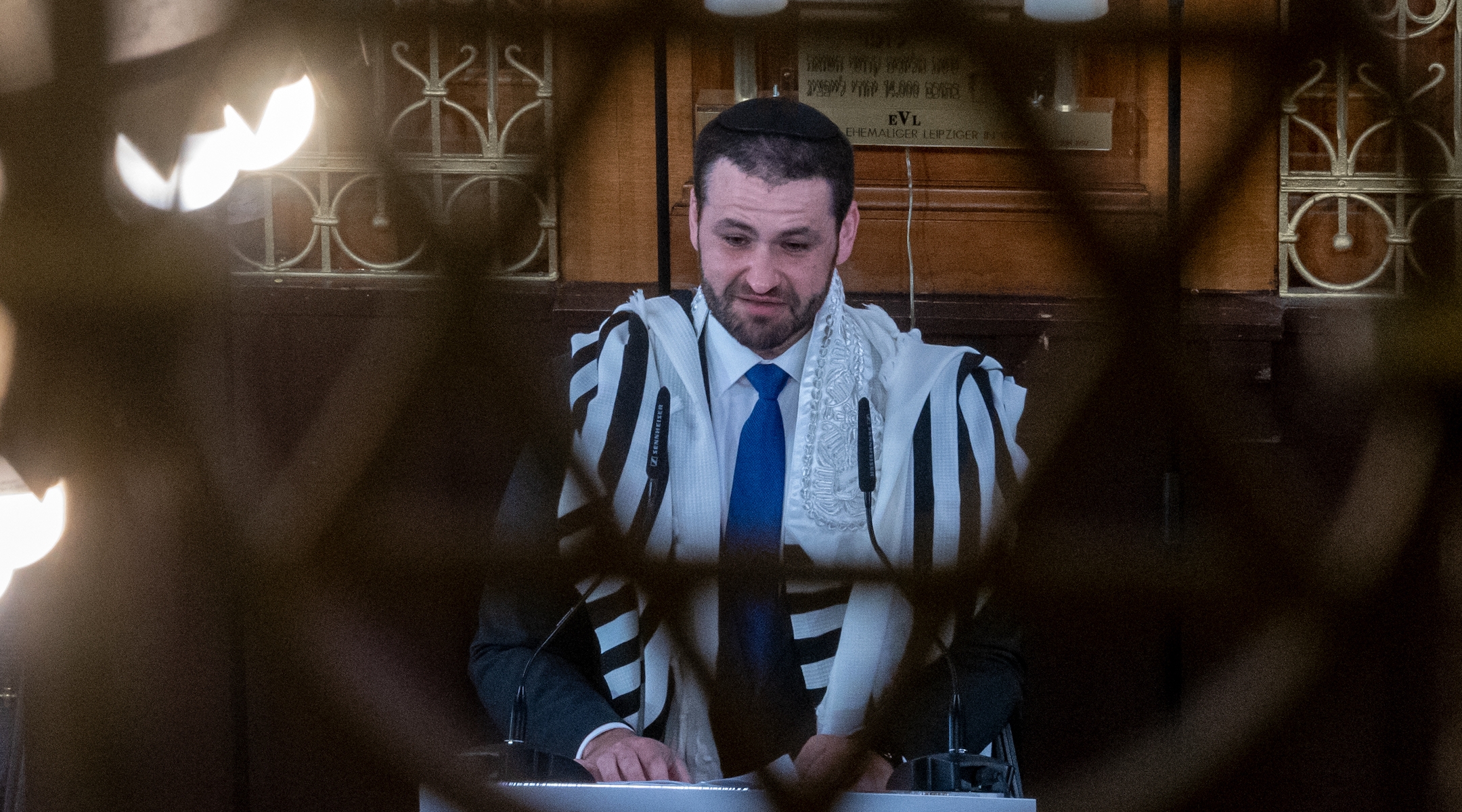
Rabbi Zsolt Balla

Rabbi Zsolt Balla speaks in a synagogue in Saxony, Germany

“Someone who wants to groom people has to find the common denominator,” and in this situation, Balla said, “it was language.”

Shana Aaronson, the executive director of Magen-Israel, an advocacy group for survivors of sexual misconduct in religious communities in Israel, said it was significant that the rabbi’s alleged misconduct came as the women were being steeped in Orthodox Judaism, where rabbinic leadership confers power.

In Orthodox communities, “we are trained from an early age to do what the rabbi says,” Aaronson said. A predator’s “first step is an overstepping of boundaries, involving themselves in aspects of the person’s life that do not fall into the rabbi’s role: ‘Let me guide you and advise you on this, that and the other thing not related to their spiritual observance.”

Then, she said, they break down emotional boundaries, and ultimately give Jewish legal or “halachic reasoning for why what I am now telling you to do is OK or necessary.” Some will even bring texts to justify their actions, she said.

“Yes, we are taught that this behavior is forbidden, but it always comes back to the fact that the rabbi knows best,” Aaronson said. “It sounds absurd, but even a young woman who is educated is certainly not as knowledgeable as a rabbi. If he says in this case it is allowed, who is she to question that?”

When Adelle realized that she had been victimized, she apologized to her school’s administration for not heeding its warning about Yaacobov. She also began realizing that she needed to unlearn the twisted version of Judaism that he had taught her.

“I started to wake up and reevaluate everything he taught me, everything he said, ever,” Adelle recalled. “Three years of telling me things, three years of nonsense, along with Torah, along with wrong information, wrong halacha, wrong everything. It was like being reborn.”

The girls school was not the only Jewish institution to keep Yaacobov at a distance. ORD, Germany’s Orthodox rabbinical organization, spurned his bid for membership more than once at least a decade ago after a majority of members voted against his application. Their reasons are not public.

Now, ORD is hoping to take action to prevent harm to other women. Rabbi Avichai Apel, a board member, said the group wants to convene a religious court or beit din quickly to adjudicate the claims of Yaacobov’s alleged victims under Jewish law.

A beit din cannot put someone in jail, but it can issue pronouncements that affect a person’s role in the community. It could “issue a public statement saying that [the accused] is not allowed to interact with women or declaring him unfit to serve as a rabbi,” said Blau, who has begun advising ORD about its handling of Yaacobov. “In effect he will have been found guilty.”
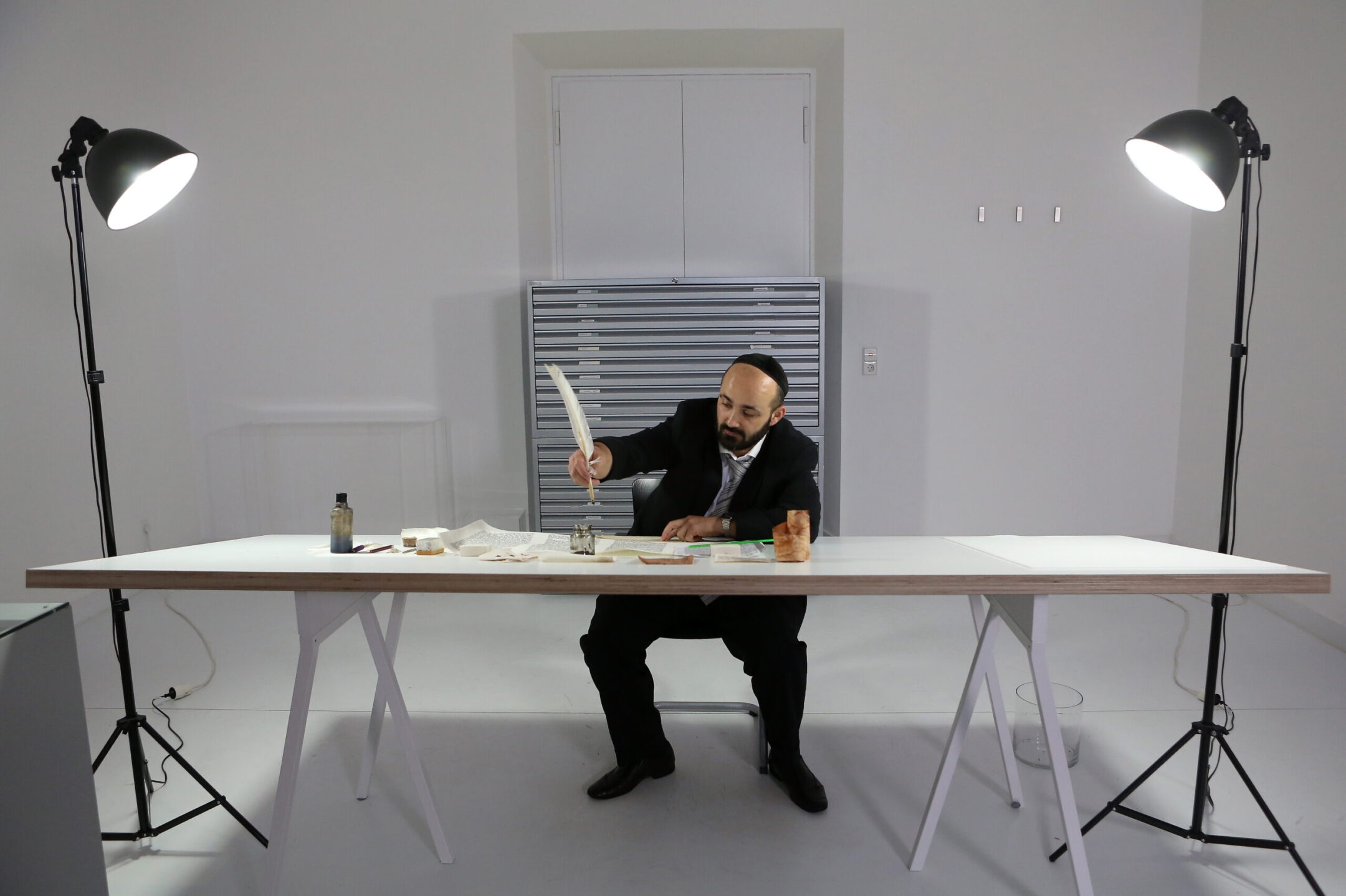
Rabbi and Torah scribe Reuven Yaacobov writes sections of a Torah

In Jewish settings, Blau said, “an accused perpetrator is responsible whenever he takes advantage of a power imbalance, irrespective of the age of the victims.”

Apel declined to comment on Yaacobov’s case specifically but said he said he knew that sharing testimonies with rabbis could be hard for the women.

“It is a situation that nobody wants to imagine for himself, it is so terrible, really terrible,” he said. “But unfortunately they have to speak about it.”

He also said he planned to talk with his own congregation about the subject of sexual abuse, to help them recognize and prevent it, and to support survivors.

Goldschmidt said the more witnesses who appear before a beit din, the more likely the rabbinical court is to find in their favor.

“When it is a story of one man against a woman, it is her word against his,” said Goldschmidt,. “But if you are talking about a whole line of people who alleged that a person has been sexually improper with them, in 99% of the cases [it turns out] that where there is smoke, there is fire.”

Eyngorn said that, in her view, the situation is not just a fire but a conflagration. In the days after Yaacobov was terminated, she said her phone rang “every second moment” with people angry that she had worked against him.

“Women from his synagogue were accusing me: ‘You fired such a great rabbi! We are women and it never happened to us!’” she recalled. “I said, ‘It also did not happen to me; that is not an argument at all.’”

Since then, she said, some of them have called back or written to apologize, saying that they, too, have stories about Yaacobov.

Monday, June 19, 2023

Israel's National Security Ministry announced a new initiative on Sunday designed to keep children safe online by creating an online service in which parents and children can report dangerous activity online.


Israelis can now report internet child abuse to police online


The initiative falls under the auspices of the Israel Police's Unit 105, a section of the Lahav 433 unit that specifically handles children's safety on the Internet. 

 Young child uses the computer. (photo credit: Wikimedia Commons)

Israel's National Security Ministry announced a new initiative on Sunday designed to keep children safe online by creating an online service in which parents and children can report dangerous activity online. 

The initiative falls under the auspices of the Israel Police's Unit 105, a section of the Lahav 433 unit that specifically handles children's safety on the Internet. 

Known as the “Israeli FBI,” Lahav 433 is the police unit tasked with investigating national crimes and corruption. 

The form, currently available in Hebrew and Arabic, allows users to report anyone harming minors online directly to Unit 105. Users can type up their reports and attach screenshots, documents, photos, and videos as needed.

"Protecting children online is a very important goal," said National Security Minister Itamar Ben-Gvir in a statement on the new initiative. "In order to reduce violence and harm to children online, the National Security Ministry is working with TikTok Israel, Google Israel, Meta and others. [This new] option [people have] of sending in a report online will encourage more populations to report [wrongdoing]. It is also useful for more diverse populations, children and parents with special needs."

 A router providing internet access. (credit: Walla)

Israel's 105 child internet safety hotline

Unit 105 already operates a telephone hotline (reachable by dialing 105 from within Israel) specifically designed for people to report those who are harming children via the Internet.

The hotline is a joint operation run by the National Securty Ministry, the Education Ministry, the Health Ministry and the Knesset Labor and Welfare Committee. According to the Israel Police, the 105 hotline has handled approximately 45,000 cases of abuse of minors since it was established in 2018. 

https://www.jpost.com/israel-news/crime-in-israel/article-746708


Sunday, June 18, 2023

In the religious communities in Israel we have also witnessed a sea-change. High profile cases like Chaim Walder in the haredi community and Mordechai Elon in the national religious community have raised awareness. Where there were few activists and organizations before, there are now a growing body, some of whom are themselves the victims of abuse.


Breaking the taboo on sexual abuse in all communities 


Shame is a weapon used by abusers and predators across the social and religious spectrum, and we have got to take it away from them.

 YAEL SHERER, a survivor of domestic sexual abuse and founder of the Lobby for the Fight Against Sexual Violence, was one of the torchlighters at the Independence Day ceremony on Mount Herzl last year. (photo credit: YONATAN SINDEL/FLASH90)
YAEL SHERER, a survivor of domestic sexual abuse and founder of the Lobby for the Fight Against Sexual Violence, was one of the torchlighters at the Independence Day ceremony on Mount Herzl last year.

Survivors of sexual abuse carry shame and guilt, often for decades. It is society’s responsibility to say loudly that they carry no guilt for the crimes committed against them, and they should not feel shame, just because they are victims. Shame is a weapon used by abusers and predators across the social and religious spectrum, and we have got to take it away from them.

Yael Sherer is a survivor of domestic sexual abuse and the founder of the Lobby for the Fight Against Sexual Violence. I first came across her while reading a story in Israel Hayom last week about the lack of resources for facilities used in the acute treatment of children who have been sexually abused. The Lobby is one of myriad organizations that is trying to reduce the amount of abuse and support the survivors.

The prevalence of sexual predators, within so many communities, makes the hope of eradication of sexual abuse and rape of children almost utopian. However, there is much that can be done to reduce the dreadful impact. Closed communities, including the religious and haredi, are absolutely not alone in suffering this scourge but, because of the nature of the communities, the impact is often amplified.

According to Sherer, there remains a serious taboo around the subject across all sections of society. This translates into a lack of motivation by the myriad of government offices that should be tasked with protecting victims. “The complex issue of sexual abuse demands a complex and integrated response. That means coordination between government ministries, including education, justice, welfare, treasury and others. In reality, the only body able to lead this is the Prime Minister’s Office.”

Research shows that hundreds of thousands of Israelis are affected by sexual abuse meaning that this is not a marginal issue, but a national one and where victims still struggle to be heard.

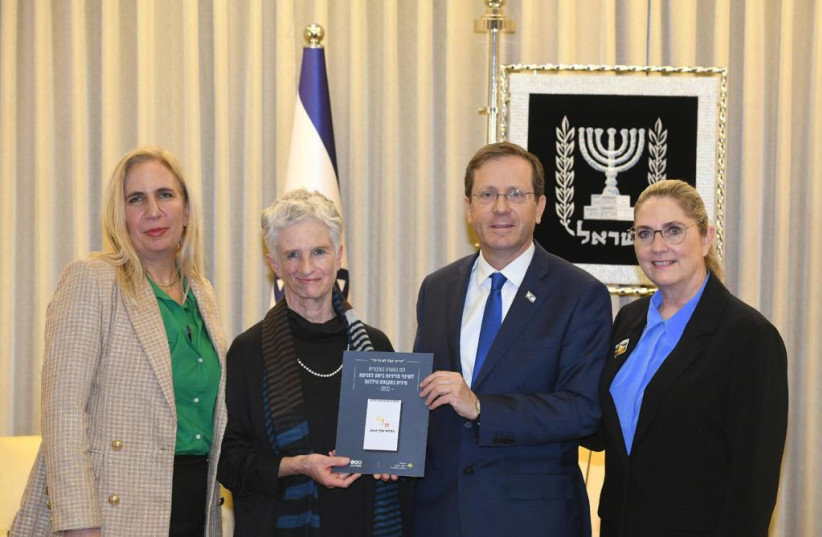
 President Isaac Herzog at the reception of the report of the Israeli Independent Public Inquiry into Child Sexual Abuse, December 13, 2021. (credit: AMOS BEN GERSHOM/GPO) President Isaac Herzog at the reception of the report of the Israeli Independent Public Inquiry into Child Sexual Abuse
 

Almost no senior Israeli politician has addressed the topic with only former prime minister Yair Lapid commenting on the subject. Even then, Lapid spoke only because of the nationalistic nature of a story that involved female prison warders being sexually attacked by Palestinian terrorist inmates.

Stigma is not unique to a single community or a single country.

Neil Henderson, CEO of UK charity Safeline was interviewed last month on the importance of breaking the taboo that still surrounds sexual abuse. Safeline is a specialist charity that works to prevent sexual violence and abuse and support those affected to cope and recover.

The organization published research showing that only a tiny percentage of victims actually report the abuse. And why is that? “This has a lot to do with ‘not being believed’ and the stigma of the subject.” In their research they have learned that female survivors, on average, keep their abuse to themselves for 25 years and men, who have been abused, for 40 years, before speaking out.

Two recent high-profile events stand out in the UK that have led to a change in attitudes. The first involves Broadchurch, a drama series which highlighted sexual abuse within the story line, and the footballers #metoo moment in 2016 when many high-profile professional footballers went public about abuse that they had suffered in in the 1970s, 1980s and 1990s.

The writers of Broadchurch were widely praised by campaigners for raising awareness and, commenting on the effects of the footballers speaking out, Henderson said “Calls to our helpline services have more than doubled following the disclosures of sexual abuse in football,” and this in the space of a number of months. “The footballers having the courage to disclose their abuse has helped thousands of other survivors to come forward and seek support for their abuse. If footballers can be believed, so can we.”

Walder, Meshi-Zahav, Elon

In the religious communities in Israel we have also witnessed a sea-change. High profile cases like Chaim Walder in the haredi community and Mordechai Elon in the national religious community have raised awareness. Where there were few activists and organizations before, there are now a growing body, some of whom are themselves the victims of abuse.

There are also dedicated professionals who see this field as their calling. What started as a Facebook group for haredim to share their stories turned into an organization driving more awareness and action. Started by a small number of dedicated volunteers, Lo Tishtok (literally, Don’t be Silent) became a lightning rod of grass roots action.

Young haredi journalists and activists have also made a real impact. Terrible stories of abuse have been highlighted by haredi journalists integrated within mainstream media, including on television and in print. No doubt this is changing awareness.

Magen is dedicated to creating safer Jewish communities in Israel and around the world, and is a rare instance of organizations joining together to create greater impact. According to CEO Shana Aaronson, there is a huge lack of education and awareness of what the schools should actually do to prevent abuse, or how to act and respond if abuse has happened. “This is even in schools that are interested and care and want to do the right thing. It’s obviously much worse in schools that are not.” However, since these high-profile cases “there has been a major increase in the number of victims seeking our help.”

Aaronson also added that the threat of legal action is also stirring change with schools. While there have only been a small number of successful suits, the threat of more has had its effect.

Allies across the spectrum

Sherer has spent the last decade walking the corridors of power building political allies for the policy changes she believes will make an impact. She has had successes and failures, and not necessarily based on the politics of her various political interlocutors. She has even made the economic case for government action and in talking to Globes recently stated: “It may be cynical to consider the cost of tears, fear, attempted suicides etc., but sometimes what can’t be measured doesn’t get counted.” 

Research carried out in other countries has shown the enormous lifetime cost in welfare, health and other expenses but Sherer claims that “the economic expense resulting from sex abuse is considered taboo.”

The current and immediate past chairmen of the Constitution, Law and Justice Committee of the Knesset, MKs Gilad Kariv and Simcha Rotman could not be further apart politically. Sherer considers both to be allies, and both have given hours of committee time to create and approve critical changes in legislation that assists victims.

It is fashionable to attack current chair, MK Rothman, especially by those in the Center and Left of politics, due to his handling of the legal reform proposals, but Sherer was clear that he deserves significant praise for the way that he made sure to push forward practical measures to help victims of abuse. And yet, she feels that at the strategic level she is continually getting the run around with no one part of the government taking overall responsibility for this complex issue.

Civil society, community leadership and the power of the state need to combine in order to get to grips with the defense of children against sexual predators. Apart from the basic morality of society to take care of the most vulnerable of its members, the vast array of mental and other health and welfare problems are a huge and avoidable burden that the country bears as a cost of not doing so.

The writer is a founding partner of Goldrock Capital and the founder of The Institute for Jewish and Zionist Research. He is a former chair of Gesher, World Bnei Akiva, and the Coalition for Haredi Employment.


https://www.jpost.com/opinion/article-746649