Iranian Jews forced to cut ties with relatives in Israel
During
the demonstrations, the demonstrators & the chief rabbi of Iran even waved banners in Hebrew
condemning "Israel's crimes against the Palestinian people."
Iranian Israelis say their relatives in Iran have left family Whatsapp groups and are even blocking their Israeli contacts.
The UK-based Persian language television channel Iran International
reported on Wednesday that after the war began between Israel and
Hamas, the Iranian regime threatened the Jewish communities in the
country.
Jews of Iranian origin in Israel are reporting that their
relatives in Iran have left family Whatsapp groups and are even
blocking the numbers of all their Israeli contacts.
Since the
start of the war, concern in the Jewish community of Iran, which numbers
several tens of thousands of members, has spiked.
The report adds that the local Jewish community organized pro-Gaza demonstrations in Teheran, the capital, and in the city of Esfahan. The demonstrations were held under the headline: "Judaism has no connection with Zionism."
During
the demonstrations, the demonstrators even waved banners in Hebrew
condemning "Israel's crimes against the Palestinian people."
Kahane was buried on Har HaMenuchot, in Jerusalem.
He was eulogized by supporters in both the U.S. and in Israel,
including Rabbi Moshe Tendler and the Sephardic Chief Rabbi of Israel,
Mordechai Eliyahu, who spoke of how little the people understood of
Kahane's true value.
The
disturbing fact of the past month is that Jews are under attack not only
in Israel and not only by Hamas. The weeks since the barbaric Oct. 7
Hamas invasion of Israel have witnessed physical assaults on Jews the
world over, including in the U.S. and Europe. This most modern of
pogroms—global, televised, politicized—demonstrates exactly what is at
stake as Israel ramps up its defensive war against Hamas in Gaza.
The
Islamist group and its Western enablers are pursuing or justifying a
genocidal war against Jews, not merely a territorial dispute with
Israel. And since Western governments too often seem unable to protect
the Jewish minorities in their midst, Israel must defend itself as the
only safe home for the Jewish people.
This weekend hundreds of rioters in Dagestan, Russia, stormed an airport in search of Jewish travelers. Mobs raided hotels
in other parts of the North Caucasus looking for Jews, and a Jewish
community center under construction in the city of Nalchik was the
target of an apparent attack.
Germany has witnessed a spate of anti-Semitic incidents, including an attack with Molotov cocktails
against a synagogue in Berlin on Oct. 18. Some Jews found Stars of
David painted on their homes, an echo of the Nazi persecution. German
politicians have been forceful in their denunciations, but apparently
not forceful enough in their policing.
Two Jewish schools in London closed for a period over safety concerns, and some British Jews no longer feel safe
wearing visible symbols of their faith. They’re probably right to worry
the state can’t protect them. Tens of thousands of protesters in London
over three successive weekends called for “jihad” and chanted “from the
river to the sea,” a demand for the erasure of Israel and by extension
its citizens. A crowd in Sydney, Australia, chanted “gas the Jews” after
the Hamas attack.
Americans like to believe such things couldn’t happen in the U.S. They have. The Anti-Defamation League last week reported
a 388% increase in anti-Semitic incidents from Oct. 7-23 compared with
the same period a year ago. The 312 incidents the ADL recorded include a
car carrying individuals with Palestinian flags allegedly swerving
toward a Jewish family and several alleged assaults by pro-Palestinian
protesters. The ADL tally counts 109 anti-Israel rallies that featured
support for Hamas or violence against Jews in Israel.
These
and too many other incidents to count put paid to the notion that one
can distinguish anti-Zionism from anti-Semitism since Oct. 7. If
protesters wanted to burn Israeli flags in a fit of wrong-headed pique
about a two-state solution, that is one thing. Only anti-Jewish hate can
explain how synagogues, children and airports are targets of this
outrage.
Yet
many Western intellectuals—and a growing number of politicians—insist
on maintaining this false distinction. They’ve seen what Hamas has done
to innocent Israeli civilians, and what pro-Hamas protesters have said
and done in Western streets. They’d nonetheless forgive any violence by
Hamas or Hezbollah against Jews as anticolonial defiance.
This
is why Israel is fighting, and must fight, as hard as it is for its
survival as a state. And why it’s inexcusable for any Western politician
now to demand a cease-fire in Gaza. No leader who is demonstrably
incapable of protecting Jews in his or her own country should try to
prevent Israel from defending itself. This is how the West slips from
“never again” into “nowhere is safe.”
This
global war on Jews also clarifies what is at stake for Western
societies in this fight. The West spent the decades after the
civilizational catastrophe of the Holocaust vowing never again to allow
itself to slide into such barbarism. What we see now in the attacks on
Jews is how that slide began.
Before
there was a Chancellor Hitler in 1933, there were roving bands of
Brownshirts inflicting political and anti-Semitic violence on the
streets of Germany. They too often went unchecked by police, prosecutors
and politicians who didn’t understand the menace, sympathized with the
offenders, or merely felt overwhelmed by the scale of the danger. Hitler
gained power in part because the German state no longer could maintain
its monopoly on violence in defense of democratic values.
Today’s
threats to democracy are different, but one lesson is the same and is
crystal-clear: A Western society that can’t or won’t muster the will to
defend its Jewish neighbors and fellow citizens won’t be able to defend
itself.
Warning sirens sounded in Jerusalem for the first time in several days,
alerting Israelis to possible Palestinian rocket fire and sending
residents scrambling for cover. Booms — likely from Iron Dome
interceptors — resounded overhead.
Yuval Semmo, playing a BBC reporter,
says he is reporting from the “illegal colony of Tel Aviv" and praises
Hamas as “the most credible not terrorist organization in the world.”
UN DEMANDS HUMANITARIAN CEASEFIRE - UBER EATS & RED CROSS TO DELIVER SOUP, PIZZA & SANDWICHES TO AREAS HE MAY BE IN!
UN CONDEMNS POLICE FOR POTENTIAL BRUTALITY!
COLLEGE CAMPUS STAGE PROTESTS AGAINST POLICE FOR BEING PRO-ISRAEL!
WORLD OPINION --- "HE DOES NOT EXIST IN A VACUUM"
BIDEN - "POLICE MUST CONSIDER INTERNATIONAL LAW!"
SAUDIS DEMAND 2 STATE SOLUTION
At least 22 killed and SIXTY injured in Lewiston, Maine, mass
shooting after gunman armed with AR-15 opens fire at bowling alley and
then at a bar: Firearms expert and Army reservist Robert Card named
person of interest
At
least 22 people have been shot dead in Lewiston, Maine and 50-60 people
injured at two different locations: a bowling alley and a bar
Mir Yerushalayim Closing Temporary US Locations, Will Return All Bochurim To Eretz Yisroel - While Israeli forces battled on four fronts
Wednesday, hitting targets in Lebanon, Syria, the West Bank and Gaza
and fighting off a sea incursion, in a new sign the war with Hamas was
slowly expanding to Iran-backed forces around the region.
EXPLAIN THE MAPS TO THE FINKEL BROTHERS
The Mir Yeshiva of Yerushalayim has provided an update to the
parents of their bochurim, saying in a new message that they will be
closing its satellite locations in the US and return all of its
operations to Eretz Yisroel – noting that “given the current conditions,
it is now clear that it is possible to comfortably and confidently
return to Eretz Yisroel.”
The yeshiva sent out the following letter to parents:
With חסדי שמים , we have witnessed a distinct סייעתא דשמיא at
work in the learning established for the בחורים of the Yeshiva here in
the USA. As you surely know, the Yeshiva has gone to great lengths and
invested substantial efforts so that the בחורים of Yeshiva can immerse
themselves in learning. Indeed, our dear בחורים are sitting and toiling
in their learning with great diligence and התמדה , achieving remarkable
הצלחה .
Yet, at this time, we must firmly heed the unequivocal call and הוראה
of the ראש הישיבה שליט”א , in conjunction with other גדולי ישראל .
Given the current conditions, it is now clear that it is possible to
comfortably and confidently return to Eretz Yisrael, to learn within the
ישיבה הקדושה , where the true עיקר of הצלחה in Torah learning and עליה
רוחנית is achieved.
And the Rosh Hayeshiva said that the special סייעתא דשמיא that תורה
מגנא ומצלא these days to the Talmidei Hayeshiva is to those who Shteig
in all sedorim and Tfilos of the Yeshiva including Friday and Shabbos.
Therefore, it is expected that each and every one return as soon as
feasible to the Yeshiva in Eretz Yisrael, to rejoin their חב ו רה and רב
נ ים within the ישיבה הקדושה .
Consequently, this temporary learning arrangement in Woodbourne will
remain open only until Thursday after morning Seder, the 11th of
Cheshvan.
May the Ribbono shel Olam help us in witnessing ישועות and נחמות , and see many nachas from our children.
Weapons Flood West Bank, Fueling Fears of New War Front With Israel
Iran
and its allies operate a smuggling network that crosses hundreds of
miles and at least four borders as part of an effort to broaden
Palestinian military capabilities beyond Hamas
AMMAN—Long before Hamas militants burst out of their Gaza stronghold to massacre scores of civilians
with handguns and assault rifles, Iran and its allies had accelerated
efforts to smuggle weapons into a different part of the Palestinian
territories, the West Bank.
Using
drones, secret airline flights and a land bridge that traverses
hundreds of miles and at least four national borders, the smuggling
operation is raising the specter of a new conflagration in the war between Israel and Palestinians.
It also poses a growing threat to Jordan, a staunch U.S. ally which
borders Israel and the West Bank and has been struggling to contain a
growing flow of drugs and arms.
“Iran wants to turn Jordan into a transit area for weapons going into
Israel,” said Amer Al-Sabaileh, founder of Security Languages, a
counterterrorism think tank in Amman. “But my fear is that the weapons
might be used in Jordan as well. Where is the easiest place in the
Middle East to punish the U.S. and the West? Jordan,” he said.
Iran
is a patron of Hamas, which it over the years has supplied with money,
weapons and training. But as Egypt has cracked down on smuggling routes
through the Sinai Peninsula, which borders on the Gaza Strip, Hamas has
become increasingly self-reliant on indigenously built weapons,
especially rockets.
The
bulk of Iranian weapons to Palestinians go into the West Bank,
particularly to the Palestinian Islamic Jihad, a militant group allied
with Hamas, according to a senior Jordanian security official. Both have
been designated terrorist organizations by the U.S., Europe and Israel.
The official said networks of smugglers, assisted by the Syrian
government and Iranian-backed militias like Hezbollah, were growing.
“The
weapons flow has really increased, specifically over the past year.
This is because Iran has been much more focused on the West Bank
recently, and trying to arm some of the groups there, especially the
Palestinian Islamic Jihad, which is Iran’s more direct partner,” said
Michael Horowitz, Israel-based head of intelligence at Le Beck
International, a risk consulting firm.
By Rabbi Meir Kahane, Z"L - Tue, September 19, 2006, 4:51 pm
Rabbi
Meir Kahane, OBM, was a strong Jew who believed in a Jewish State that
apologized neither for its Jewishness nor its willingness to fight to
survive. He was vilified by the Left, especially the Israeli government
as he gained popularity dramatically among the Likud voters, threatening
the status quo. The Israeli Supreme Court outlawed his party as racist
when it used quotes from the Five Books of Moses. He was assassinated by
an Arab named Nosair on the streets of New York -- the same Arab who
later stood trial as a co-conspirator of Shaikh Omar Abdel Rahman and
received a life sentence plus fifteen years imprisonment for the 1993
World Trade Center bombing, conspiracy to use explosives against New
York landmarks, and a plot to assassinate U.S. politicians.
The
following is a letter Rabbi Kahane, OBM, wrote to the world. It is a
strong letter based on an unpleasant history, but a true one
nonetheless. What rings out, however, is the clarifying distinction
between the call by Muslims and Arabs around the world claiming
victimhood and hatred and calling for murder and indeed terrorizing the
world with actual murder, and this one Jew's proclamation that his
desire is not to conquer or convert but to be left alone. With all of
the Left-wing and Arab-based conspiracy theories of Jews manipulating
the US government into war expeditions in Iraq and elsewhere, the simple
truth is that Jews around the world would be happy to be just left
alone in one little piece of real estate surrounded by more than 21
Islamic states with a collective land mass 649 fold greater than
Israel's and a total population 49 fold greater. When Muslims can blame
the Jew, the American, the European, and even the Pope for their misery
and wretchedness, one might conclude that the condition they find
themselves in is a product of their own making and constitution.
The text of the letter follows:
AN OPEN LETTER TO THE WORLD
Dear World,
I understand that you are upset by us, here in Israel.
Indeed, it appears that you are quite upset, even angry.
Indeed,
every few years you seem to become upset by us. Today, it is the
"brutal repression of the Palestinians"; yesterday it was Lebanon;
before that it was the bombing of the nuclear reactor in Baghdad and the
Yom Kippur War and the Sinai campaign. It appears that Jews who triumph
and who, therefore, live, upset you most extraordinarily.
Of course, dear world, long before there was an Israel, we - the Jewish people - upset you.
We
upset a German people who elected Hitler and upset an Austrian people
who cheered his entry into Vienna and we upset a whole slew of Slavic
nations - Poles, Slovaks, Lithuanians, Ukrainians, Russians, Hungarians
and Romanians. And we go back a long, long way in the history of world
upset.
We upset the Cossacks of Chmielnicki who massacred tens of
thousands of us in 1648-49; we upset the Crusaders who, on their way to
liberate the Holy Land, were so upset at Jews that they slaughtered
untold numbers of us.
For centuries, we upset a Roman Catholic
Church that did its best to define our relationship through
inquisitions, and we upset the arch-enemy of the church, Martin Luther,
who, in his call to burn the synagogues and the Jews within them, showed
an admirable Christian ecumenical spirit.
And it is because we
became so upset over upsetting you, dear world, that we decided to leave
you - in a manner of speaking - and establish a Jewish state. The
reasoning was that living in close contact with you, as
resident-strangers in the various countries that comprise you, we upset
you, irritate you and disturb you. What better notion, then, than to
leave you (and thus love you)- and have you love us and so, we decided
to come home - home to the same land we were driven out 1,900 years
earlier by a Roman world that, apparently, we also upset.
Alas, dear world, it appears that you are hard to please.
Having
left you and your pogroms and inquisitions and crusades and holocausts,
having taken our leave of the general world to live alone in our own
little state, we continue to upset you. You are upset that we repress
the poor Palestinians. You are deeply angered over the fact that we do
not give up the lands of 1967, which are clearly the obstacle to peace
in the Middle East.
Moscow is upset and Washington is upset. The "radical" Arabs are upset and the gentle Egyptian moderates are upset.
Well, dear world, consider the reaction of a normal Jew from Israel.
In
1920 and 1921 and 1929, there were no territories of 1967 to impede
peace between Jews and Arabs. Indeed, there was no Jewish State to upset
anybody. Nevertheless, the same oppressed and repressed Palestinians
slaughtered tens of Jews in Jerusalem, Jaffa, Safed and Hebron. Indeed,
67 Jews were slaughtered one day in Hebron in 1929.
Dear world,
why did the Arabs - the Palestinians - massacre 67 Jews in one day in
1929? Could it have been their anger over Israeli aggression in 1967?
And why were 510 Jewish men, women and children slaughtered in Arab
riots between 1936-39? Was it because Arabs were upset over 1967?
And
when you, dear world, proposed a UN Partition Plan in 1947 that would
have created a "Palestinian State" alongside a tiny Israel and the Arabs
cried "no" and went to war and killed 6,000 Jews - was that "upset"
caused by the aggression of 1967? And, by the way, dear world, why did
we not hear your cry of "upset" then?
The poor Palestinians who
today kill Jews with explosives and firebombs and stones are part of the
same people who when they had all the territories they now demand be
given to them for their state -attempted to drive the Jewish state into
the sea. The same twisted faces, the same hate, the same cry of
"itbach-al-yahud" (Massacre the Jew!) that we hear and see today, were
seen and heard then. The same people, the same dream - destroy Israel.
What they failed to do yesterday, they dream of today, but we should not
"repress" them.
Dear world, you stood by during the holocaust
and you stood by in 1948 as seven states launched a war that the Arab
League proudly compared to the Mongol massacres.
You stood by in
1967 as Nasser, wildly cheered by wild mobs in every Arab capital in the
world, vowed to drive the Jews into the sea. And you would stand by
tomorrow if Israel were facing extinction. And since we know that the
Arabs-Palestinians dream daily of that extinction, we will do everything
possible to remain alive in our own land. If that bothers you, dear
world, well think of how many times in the past you bothered us.
In any event, dear world, if you are bothered by us, here is one Jew in Israel who could not care less.
What is delaying Israel's ground invasion into Gaza? Hamas is Using The Hostage Drip To Play The World & Israel! PM
Aerial bombing absolutely can pave the way for an earlier invasion, but it does not eliminate risk or ground troop losses.
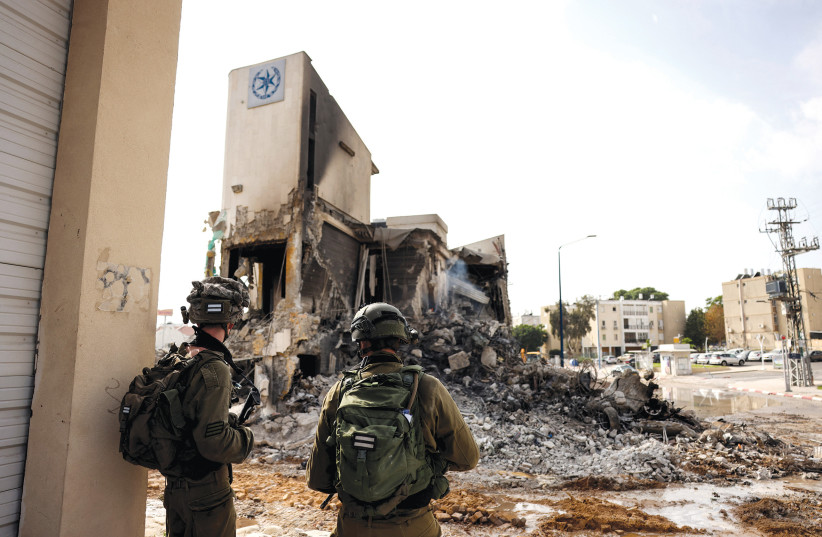
IDF soldiers inspect the remains of a police station in
Sderot, which was the site of a battle following a mass infiltration by
Hamas gunmen from the Gaza Strip, on October 8.
When Hamas invaded southern Israel and massacred 1,400 people on
October 7, the proposition among the IDF to enter Gaza arose almost
immediately, and a ground incursion was expected to be launched within a few days.
The
reasons to invade at the time, however, are quickly becoming obsolete.
And as the invasion delays further, a variety of reasons are being
brought forth as to why this is so – more than two weeks into this war.
The
first reason, and the most obvious, is that in the first week of the
war, not all of the 360,000 IDF reservists were in the right places with
the right gear, and they were not all fully updated and trained for
their disparate missions. So, they were not prepared to enter.
This
is no longer true. Troops can always improve their readiness, but
waiting and training for too long without acting creates skittishness
and uneasiness, and it negatively impacts morale.
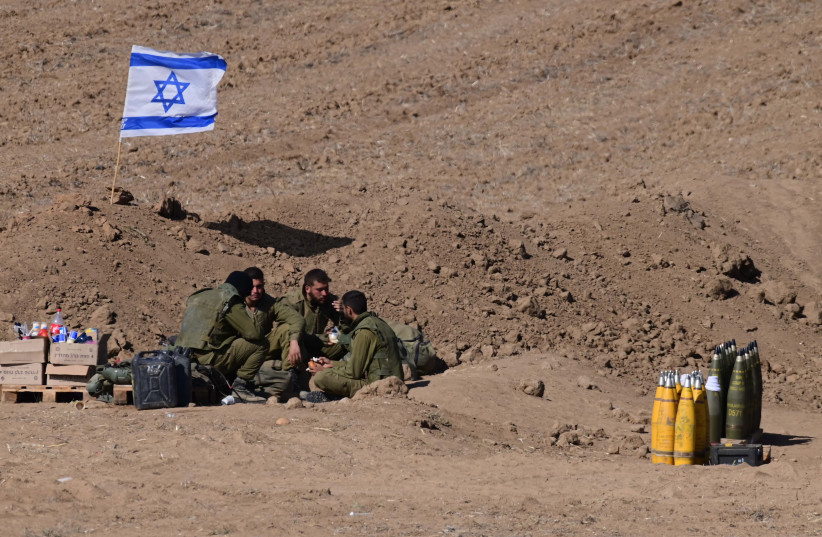
IDF Artillery Corps seen at a staging area near the southern Israeli
border with Gaza, October 15, 2023.
The
second reason, cited last week – at which time it arguably made sense,
and which the IDF is still citing – is to allow more time for Gazans to
evacuate. By the end of the first week of fighting, around 500,000
Palestinians – roughly 50% – fled from northern Gaza southward. By the
start of this third week, the number was up to above 700,000, close to
70%-75%. The argument is strong here to wait a little longer to enter so
as to give more time for more civilians to evacuate. But it stands to
reason that those who have not yet fled the targeted sites in the Strip
will not do so.
This
means that the IDF is going to be stuck fighting an urban battle
against Hamas with many civilians. It was always going to be this way,
somewhat due to Hamas’s entrenchment in Gaza; delaying the incursion is not going to change that.
The
third – and probably the most decisive – reason is the following: The
more IAF attacks there are, the fewer IDF losses there will be once they
enter on the ground, because the remaining Hamas forces will be
significantly weakened.
This was true for delaying from week one to week two, but it has been
almost impossible to decode any new progress by the IAF in the last
several days other than simply hitting a higher quantity of targets.
After
each additional day of hundreds of strikes, the fact is that Hamas has
thousands and thousands more rockets to keep firing and some tens of
thousands of fighters, a majority of whom will not be killed or captured
without Israeli troops on the ground. Hamas’s ability to maintain some
level of fighting will not stop without a long ground invasion.
Once the invasion begins, many soldiers will die
Once
the ground invasion starts, a large number of soldiers will die, more
than in any of the rounds of conflict we have seen in recent decades.
There simply is no other way to subdue Hamas.
Aerial bombing absolutely can pave the way for an earlier invasion, but it does not eliminate risk or ground troop losses.
So,
whether the driving force here is political fear or authentic guilt
about ordering a significant number of young troops to their deaths,
that concern cannot justify a further delay of the invasion.
It
merely delays the inevitable, lowers morale, and reduces the small
window of time the world has allotted Israel to spend in Gaza toppling
Hamas.
As
Thomas Jefferson said, “The tree of liberty must be refreshed from time
to time with the blood of patriots and tyrants.” No one should rush into
such a scenario, but Israel and the IDF are long past the point of
rushing and have reached the stage of dwindling returns.
There
is a reason so many Jews cannot stop shaking right now. The concept of
intergenerational trauma doesn’t begin to describe the dark place into
which this month’s attack plunged Jewish communities around the world.
On
Oct. 7, a Jewish holiday, Hamas terrorists went house to house in
southern Israel murdering and abducting children and grandparents,
pulling them from their beds, displaying victims’ dead bodies online, in
a massacre of at least 1,400 people. In at least one instance,
terrorists were reported to have uploaded a video of the murder of one victim to her own social media account for her family to discover.
The
feeling of deep dread that these atrocities stirred in Jews was
horribly familiar. This is what Jewish history has all too often looked
like: not civilians tragically killed in war but civilians publicly
targeted, tortured and murdered, with the crimes put on public display.
Accounts of past crowd-pleasing killings are folded into Jewish
tradition; every Yom Kippur, we recount the public torture and execution
of rabbis by their Roman oppressors in a packed second-century stadium.
Those ancient stories are consistent with the experiences of the more
immediate ancestors of nearly every Jew alive today.
I’m
not even talking about the Holocaust, which several of last week’s
oldest escapees and victims also endured. (Far more Jews were killed on
Oct. 7 than on Kristallnacht.) No, I’m thinking of the Farhud pogrom in 1941
Baghdad, a two-day rampage in which hundreds of Jews were raped,
tortured and murdered. I’m thinking of the pogroms of 1918-21 in
Ukraine, in which an estimated 100,000 Jews were slaughtered in
organized massacres, reminiscent of this month’s attack.
I’m thinking of the lynching of Leo Frank
in Georgia in 1915, after which the delighted crowd’s snapshots of
Frank’s body were made into postcards mailed around the country and
pieces of his clothing were sold as souvenirs. I’m thinking of how many of the earliest books off Europe’s first printing presses were about the executions of Jews accused of the blood libel and of a 10th-century massacre of thousands of Jews in the Spanish caliphate encouraged by a poem calling for Jewish blood and of the paintings and illuminated manuscripts
showing Jews who were burned alive by the Spanish Inquisition and
during the Black Death — all crowd-pleasing events celebrated in popular
media and art.
Even
ancient Romans celebrated their destruction of Judea by issuing
commemorative coins featuring a bound Jewish woman and inscribed with
the words “Judaea capta.” The humiliation and murder of Jews have always made a great meme.
Many
American Jews, like Jews around the world, are descendants of those who
survived. Our ancestors, in one way or another, were the ones who
either made lucky decisions or barely made it out alive from Lodz and
Kyiv and Aleppo and Tehran.
For
diaspora Jews, the recent attacks were not distant overseas events. As
was true in ancient times, the ties between global Jewish communities
and Israel are concrete, specific, intimate and personal. My New Jersey
Jewish federation has institutional ties with the southern Israeli town
of Ofakim and its surrounding communities, sharing annual home stays
with a place whose death toll from the attacks already exceeds that of the notorious Kishinev pogrom of 1903,
in which 49 Jews were murdered. Millions of American Jews, not to
mention Jews in Britain, France, Australia and elsewhere, have friends
and relatives in Israel. Even if Hamas hadn’t made it clear that they
see all Jews as targets, our connection is personal and all too real.
We
spent days desperately scrolling to learn who among our acquaintances
was dead, maimed or captive, connecting American hostages’ families with
State Department contacts, attending panic-stricken online briefings
and pooling resources and supplies for victims — all while fighting
obtuse official statements from our own towns, schools, companies and
universities that refused to mention the words “Israel” or “Jews” in
referring to the largest single-day massacre of Jews since the
Holocaust, lest some antisemite take offense at the existence of either.
We
have tried to get our children off social media, shielding them from
images of the violence. We’ve held mass fasts, recited psalms and sung
ancient prayers for the rescue of captives. And as we gather by the
thousands despite our many contradictory opinions and despite the extra
security required for our gatherings even here, we have returned to the
words of our ancestors that have carried us through thousands of years:
Be strong and courageous. Choose life.
Many
of us were physically carrying those words during the weekend of the
attack, celebrating Simchat Torah, a joyous holiday when congregations
dance with Torah scrolls, read the Torah’s final words and then scroll
back to the beginning to start the book again.
As
a child, I found this baffling. Why read the same story over and over,
when we already know what happens? As an adult, I know that while the
story doesn’t change, we do. What defines Jewish life is not history’s
litany of horror but the Jewish people’s creative resilience in the face
of it. In the wake of many catastrophes over millenniums, we have
wrestled with God and one another, reinvented our traditions, revived
our language, rebuilt our communities and found new meanings in our old
stories of freedom and responsibility, each story animated by the
improbable and unwavering belief that people can change.
Right
now many of us feel trapped in this old, old story, doom-scrolling
through images with terrible outcomes. But in our grief, I remind myself
that each year as we finish the reading of the Torah, we immediately,
at that very moment — and at the moment of this newest, oldest horror —
scroll back to the story of creation and the invention of universal
human dignity. We recall, once again, that every human is made in the
divine image.
Since the establishment of
the State of Israel, religious Zionists like yourself have been saying
that this is the promised Redemption. Now, after two decades of
Intifadas and thousands of missile attacks and hundreds of terrorist
killings, Israel is facing the threat, G-d forbid, of Iranian missiles
armed with powerful warheads raining down on Tel Aviv. Not only that,
but Israel’s economy is taking a beating from this expanding war and the
country’s leaders don’t seem to have solid answers. I ask you, where is
the Redemption in this?
Answer:
Your
concern over the situation in Israel is understandable, but the fact
that there are problems in Eretz Yisrael does not in any way negate the
great Redemption which we are witnessing in our time. In fact, the
opposite is true. The tribulations and wars which we are experiencing
are signs that Mashiach is on the way.
The Sages of the Talmud, in
tractate Sanhedrin, describe the terrible suffering which will
accompany the advent of Mashiach (Sanhedrin 97A-98B).
The national
anguish, economic chaos, and spiritual decline surrounding the
messianic era lead the Sages to say that they would rather not be around
when it comes. Foreseeing the economic hardships, Rabbi Chanina says:
“The son of David (Mashiach) will not come until a sick person will ask
for a fish to eat and there will be none to give him” (Ibid. 98A).
Rabbi
Simlai says in the name of Rabbi Elazar, son of Rabbi Shimon, “The son
of David will not come until judges and public officers are no more.”
“Rabbi Yochanan says: If you witness a generation where the influence of
Torah lessens and lessens, expect the Mashiach to come” (Ibid). And he
adds: “If you see a generation where great tribulations sweep over it
like a river, expect the Mashiach to come.”
While no one likes
war, military engagement is an integral part of the process of Israel’s
salvation and triumph over its enemies. The Talmud states that, “War is
also the beginning of Redemption (Megilla 17B). There, the Talmud
explains that Mashiach comes after a period of struggle and war.
The
Midrash teaches that if you see the nations of the world waging war
against each other, you can expect the “footsteps of Mashiach” (Bereshit
Rabbah 42:4). In our daily prayers, G-d’s hand in the blueprint of
Israel’s Redemption is clearly laid out as a gradually developing
process: “The Master of Wars, the sower of righteousness, Who causes
Salvation to sprout….” (Morning blessing, “Yotzer Ohr” recited before
the Shema).
An interesting Midrash, fitting for our times,
describes a future when all the world is at war: “Rabbi Yitzhak stated,
the year in which the King Mashiach comes, all of the kingdoms of the
world are at war with each other. The King of Persia attacks the King of
Arabia… and all of the nations are confounded in fear… and Israel is in
panic and trembling and says, ‘Where shall we flee to and where shall
we go?' And Hashem says to them, ‘My children, fear not. All which I
have done, I have done for your sake alone. Why are you frightened? Fear
not. The time of Redemption has come'” (Yalkut Shimoni, Isaiah, Remez,
499).
Rabbi Kook, in his classic work, “Orot,” writes that “When
there is a great war in the world, the power of Mashiach awakens” (Orot,
2:1). In retrospect, we can see that World War One and World War Two
were the instruments G-d employed to reestablish the Jewish People in
Israel. In the aftermath of WWI, the Balfour Declaration recognized the
right of the Jewish People to establish a homeland in Israel. The result
of WWII brought another step forward in the Redemption of Israel – the
establishment of Jewish State. In the aftermath of the Six Day War,
Jerusalem returned to our hands along with the heartland of Biblical
Israel.
G-d directs the world in a natural, historical fashion,
achieving His aims through the vehicle of nations and kings. “He
dethrones kings and raises kings up” (Daniel 2:21). To return the
scattered Jewish People to Israel, G-d had to rearrange the world map.
Since nations are reluctant to surrender their territory, this can cause
war.
Rabbi Kook refers to the uprooting of tyrants as “the time
of the songbird.” In writing about this aspect of Israel’s Redemption,
he uses the allegory of the songbird from Shir HaShirim where springtime
and rebirth are connected to the songbird of Eretz Yisrael (Shir
HaShirim 2:11-12).
“The time of the songbird has come, the weeding
of tyrants. The evil ones are obliterated from the world, the world
becomes perfected, and the voice of the turtledove is heard in our
Land.”
The uprooting of the world’s Saddam Husseins, Arafats, Bin
Ladens, and Hamas terrorists brings cleansing to the world. Little by
little, like the shining of dawn (Jerusalem Talmud, Berachot 1:1) the
light and righteousness of Israel shines forth from out of the darkness –
precisely through the Hand of G-d which works wondrously in these very
wars. Just as increasing pain and screaming are heard during labor just
before birth, so too the anguish of war leads to a further stage of
Redemption.
Therefore, don’t let current events overwhelm you. The
Jewish People are still on course. G-d is directing the ship. If we do
our share by fervently increasing our commitment to Torah, prayer, and
the settlement of the Land, then G-d will do His part.
“The Master
of wars, the sower of righteousness, Who causes salvation to sprout,
the creator of cures, awesome in praise, Master of Wonders…cause a new
light on Zion to shine, and may we all speedily be privileged to enjoy
its light.”
May the missiles of our enemies all backfire and explode on their heads. Amen.
[When] someone becomes attracted to a woman and is [love-]sick [to the extent that] he is in danger of dying, [although] the physicians say he has no remedy except engaging in sexual relations with her, he should be allowed to die rather than engage in sexual relations with her. [This applies] even if she is unmarried.
I
want to say a few things about recent events in Israel. I’m sure I will
do future podcasts about this and speak with a wide range of relevant
experts. But, for the moment, I would like to say something brief that
stands a chance of being useful, as we watch the initial expressions of
support for Israel begin to decay, as it wages war in Gaza and perhaps
beyond.
As
many of you know, I spent years talking about the clash, as I see it,
between Western civilization and Islam. Specifically, I’ve spoken and
written about the connection between the actual doctrines of Islam and
jihadist violence. Of course, this violence has fallen out of the news
in recent years, especially since the collapse of the Islamic State.
Even I have stopped thinking much about it, but I’ve been under no
illusion that the problem has gone away. Those of you who have been
following my work for 20 years know that I’ve said everything I have to
say on this topic, ad nauseum. And I’m sure I’ll periodically just
repeat myself for the rest of my life—because eruptions of jihadist
violence, and the attendant secular moral confusion about it, will be
with us for generations.
However,
I don’t want to rehash any of my criticism of Islam here. I’ll just
briefly remind you of what I believe, which is that there is no
possibility of living in peace with jihadists. So, whether we want to
admit it or not, we are perpetually at war with them. And we must win a
war of ideas with everyone, both within the Muslim world and outside it,
who is confused about that—and there are legions of the confused. And
there is no place on Earth where the truth about jihadism is more
obvious or excruciating, and moral confusion about it more
reprehensible, than Israel today.
But
leaving all of that to one side, for the moment I’d like to make a very
simple point, that really shouldn’t be at all controversial—because it
doesn’t prejudge any of the questions that people might disagree about.
You don’t have to agree with me about Islam, or about the role it plays
in inspiring conflict. The point I’m making now says nothing about the
causes of the recent violence in Israel—and yet it cuts through all the
arguments and pseudo-arguments that attempt to paint some moral
equivalence between Israel and its enemies, or to justify the actions of
Hamas as though they were a response to Israeli provocations—to the
growth of settlements, or the daily humiliation of living under
occupation. Incidentally, there has been no occupation of Gaza since
2005, when Israel withdrew from the territory unilaterally, forcibly
removing 9000 of its own citizens, and literally digging up Jewish
graves. The Israelis have been out of Gaza for nearly 20 years. And yet
they have been attacked from Gaza ever since.
But
even a statement like that wades too far in controversy. I want you
step back… Whatever you think about the origins of this conflict,
whatever you believe about the role that religion plays here (or doesn’t
play), whatever you think about colonialism, or globalism, or any other
‘ism, whether you’re a fan of Noam Chomsky or Samuel Huntington, you
should be able to acknowledge the following claims to be both
descriptively true and ethically important.
At
this moment in history, there are people and cultures that harbor very
different attitudes about violence and value of human life. There are
people and cultures that rejoice, positively rejoice—dancing in the
streets rejoicing—over the massacre of innocent civilians; conversely
there are people and cultures that seek to avoid killing innocent
civilians, and deeply regret it when they do—and they occasionally
prosecute and imprison their own soldiers when they violate this modern
norm of combat.
There
are people and cultures who revel in the anguish of hostages and
prisoners of war—who will parade them before cheering mobs, and often
allow them to be assaulted, or raped, or even murdered. They will
desecrate their bodies in public, and all of this carnage is a cause for
jubilation. Conversely, there are people and cultures who find such
barbarism revolting—and, again, would be inclined to prosecute anyone on
their own side who took part in it.
In
short, there are people and cultures who revel in war crimes—and who do
not hide these crimes or their celebration of them but, rather, proudly
broadcast their savagery for all the world to see. Conversely, there
are people and cultures who have given us the concept of a war crime as a
sacred prohibition—and as a safeguard in the ongoing project of
maintaining the moral progress of civilization.
One point to concede, and this will absorb all the
nuance and nonsense that is now percolating in the brains of many
listeners: It is, of course, true that we in the West have been on the
wrong side of these dichotomies in the past. Most Western armies,
including Israel’s, have at one time or another been guilty of war
crimes. And if you go back far enough, all of human conflict was just a
litany of war crimes. And you don’t have to go back all that far, in
fact, to find large pockets of Western culture that were morally
indistinguishable from what we now see in much of the Muslim world. If
you have any doubt about this, study the photos of white mobs
celebrating the lynchings that occurred in the American South in the
first half of the 20th century: where seemingly whole towns—thousands of
men, women and children—turned out as though for a carnival to watch
some young man or woman be tortured to death and then strung up on a
tree or lamppost for all to see.
Seeing the pictures of these people in their Sunday
best, having arranged themselves for a postcard photo under a dangling,
and lacerated, and often partially cremated person, is one thing, but
realize that these genteel people—who considered themselves good
Christians—often took souvenirs of the body home to show their
friends—teeth, ears, fingers, knee caps, internal organs—and sometimes
displayed them in their places of business.
So I’m not claiming that there are permanent
differences between groups of people. I’m talking about the power of
ideas that happen to be ascendant at any given time and place. I’m
talking about beliefs and whole worldviews that come into being in one
culture and have yet to come into being in others. The point, of course,
is that if we recognize the monstrosities of the past, we should
recognize the monstrosities of the present, and acknowledge that at this
moment in human history not every group has the same ethical norms
governing its use of violence. For whatever reason. Perhaps religion has
nothing to do with it.
Consider
just one of these norms: Whenever an armed conflict breaks out, some
groups will use human shields, and others will be deterred, to one
degree or another, by their use. To be clear, I’m not talking about the
taking of hostages from the opposing side for the purpose of using them
as human shields. That is appalling, and it is now happening in Gaza,
but it is separate crime. I’m talking about something far more
inscrutable—it’s astounding, really, that it happens at all—I’m talking
about people who will strategically put their own noncombatants, their
own women and children, into the line of fire so that they can inflict
further violence upon their enemies, knowing that their enemies have a
more civilized moral code that will render them reluctant to shoot back,
for fear of killing or maiming innocent noncombatants. If anywhere in
this universe cynicism and nihilism can be found together in their most
perfect forms, it is here.
Jihadists
use their own people as human shields routinely. Hamas fires rockets
from hospitals and mosques and schools and other sites calculated to
create carnage if the Israelis return fire. There were cases in the war
in Iraq where jihadists literally rested the barrels of their guns on
the shoulders of children. They blew up crowds of their own children in
order to kill US soldiers who were passing out candy to them.
Conversely, the Israeli army routinely warns people to evacuate
buildings before it bombs them.
Of
course, during times of war, it common to dehumanize one’s enemy, to
describe them as barbarous and evil. And it is natural for ethical and
educated people to distrust such politically-charged language. But pay
attention: I’m describing concrete behaviors—behaviors that occur on
only one side of this conflict.
Just
consider how absurd it would be to reverse the logic of human shields
in this case: Imagine the Israelis using their own women and children as
human shields against Hamas. Recognize how unthinkable this would be,
not just for the Israelis to treat their own civilians in this way, but
for them to expect that their enemies could be deterred by such a
tactic, given who their enemies actually are.
Again,
it is easy to lose sight of the moral distance here—which is strange.
It’s like losing sight of the Grand Canyon when you are standing right
on the edge of it. Take a moment to actually do the cognitive work:
Imagine the Jews of Israel using their own women and children as human
shields. And then imagine how Hamas, or Hezbollah, or al-Qaeda, or ISIS,
or any other jihadist group would respond. The image you should now
have in your mind is a masterpiece of moral surrealism. It is
preposterous. It is a Monty Python sketch where all the Jews die.
Do
you see what this asymmetry means? Can you see how deep it runs? Do you
see what it tells you about the ethical difference between these two
cultures?
There are not many bright lines that divide good and evil in our world, but this is one of them.
Of
course, there is much more talk about when considering the ethics of
war and violence. And there’s much more to be confused about. For
instance, as this war proceeds, many people will consider the deaths of
noncombatants on the Palestinian side to be morally equivalent to the
kids who were tortured and murdered at the peace concert by Hamas, or to
the hostages who may yet be murdered and their murders broadcast on
social media. But they’re not. There is a difference between collateral
damage—which is, of course, a euphemism for innocent people killed in
war—and the intentional massacre of civilians for the purpose of
maximizing horror.
Simply
the counting the number of dead bodies is not a way of judging the
moral balance here. Intentions matter. It matters what kind of world
people are attempting to build. If Israel wanted to perpetrate a
genocide of the Palestinians, it could do that easily, tomorrow. But
that isn’t what it wants. And the truth is the Jews of Israel would live
in peace with their neighbors if their neighbors weren’t in thrall to
genocidal fanatics.
In
the West, we have advanced to a point where the killing of
noncombatants, however unavoidable it becomes once wars start, is
inadvertent and unwanted and regrettable and even scandalous. Yes, there
are still war crimes. And I won’t be surprised if some Israelis commit
war crimes in Gaza now. But, if they do, these will be exceptions that
prove the rule—which is that Israel remains a lonely outpost of
civilized ethics in the absolute moral wasteland that is the Middle
East.
To
deny that the government of Israel (with all of its flaws) is better
than Hamas, to deny that Israeli culture (with all of its flaws) is
better than Palestinian culture in its attitude toward violence, is to
deny that moral progress itself is possible. If most Americans are
better than their slaveholding ancestors, if most Germans today are
better than the people who herded Jews into gas chambers, if the
students protesting this war on your college campus—who are so
conscientious that they lose sleep over crimes like “cultural
appropriation” or using the wrong pronouns—if they are better than the
racists and religious lunatics that inevitably lurk somewhere in their
family trees—then we have to recognize that there is no moral
equivalence now, between Israel and her enemies.
As an IDF
soldier stationed near Gaza in 2011, Ilan Benjamin believed he could
promote “goodwill with our Palestinian neighbors.”
Once, I Was a Peace Advocate. Now, I Have No Idealism Left.
The
story I’m about to tell is one that many progressive Jews can relate
to. In some ways, it’s a prototypical arc of a diaspora Jew who has
always advocated for nuance. This week, something broke in us. We
watched history repeat itself. Not just on the global scale, with the
wanton massacre of our people, the savage mass murders and
dismemberments of entire families and communities. But for many, my
family included, history is repeating itself on a personal level as
well.
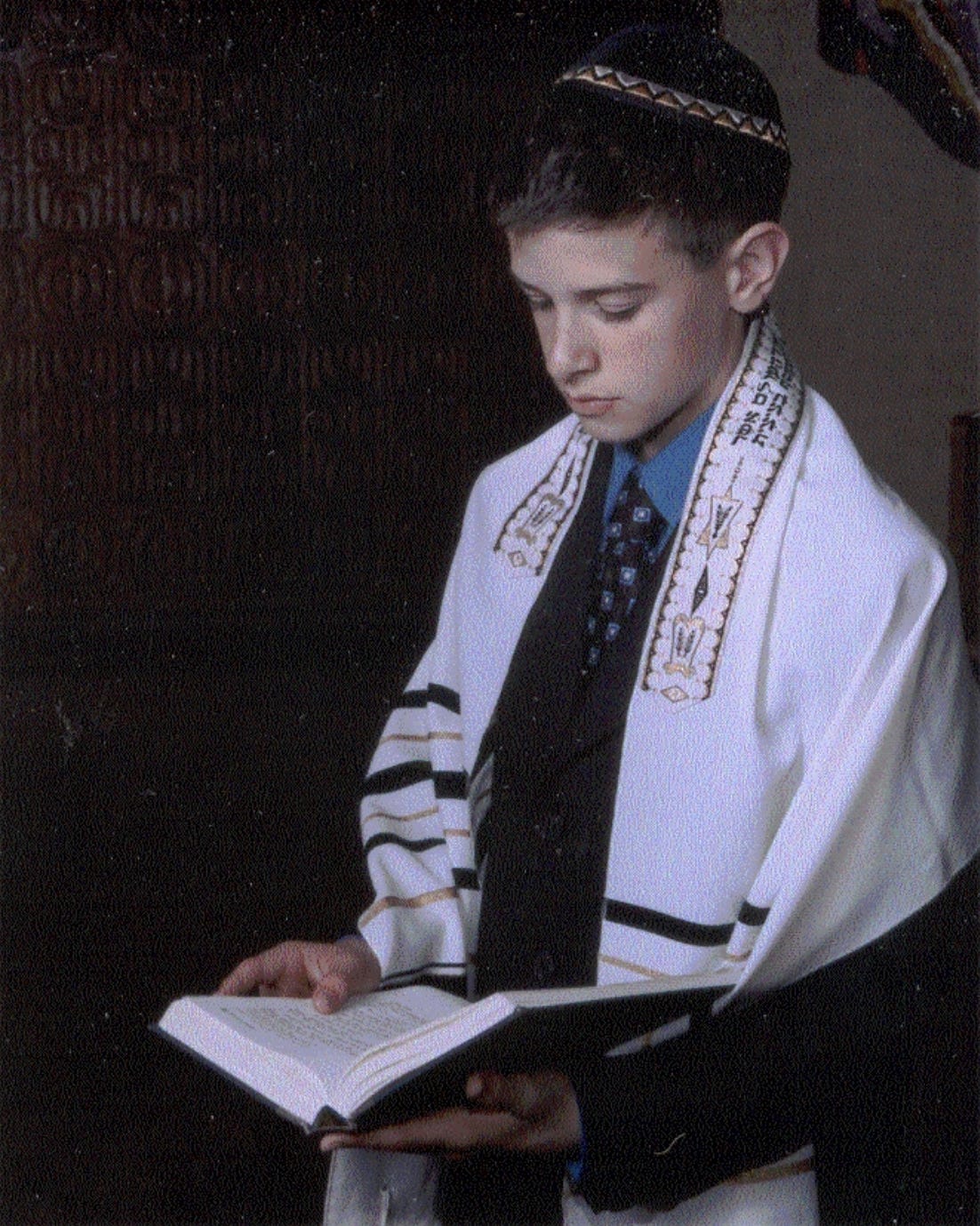
In March 2003, I turned 13 and
celebrated my bar mitzvah in Walnut Creek, California. By Jewish
tradition, I became a man. But the ceremony felt redundant; I had
already grown up. Only one year earlier, my older cousin, Daniel Pearl,
an investigative journalist for TheWall Street Journal,was kidnapped and beheaded by Islamist jihadis while on assignment in Pakistan.
His
killers, like the Hamas killers of last weekend, proudly released a
video documenting Danny’s murder. Among Danny’s last words were, “My
father is Jewish. My mother is Jewish. I am Jewish.” At first, I was in
shock—how had my own cousin become a player in such a large
international nightmare? Why did people get murdered simply for being
who they are? In this case, for being Jewish?
Danny’s parents did not call for revenge. Instead they set up The Daniel Pearl Foundation
that offers fellowships, sponsors cross-cultural music events (Danny
was a gifted musician), and brings people together to improve the world.
Even after what my family had been through, their work encouraged me to
be idealistic and believe that the Jewish people could make peace with
our neighbors. I became a fierce advocate for peace.
When
I immigrated to Israel at the age of 18 and enlisted in the Israel
Defense Forces, I was still driven by ideals. I thought I could promote
more goodwill with our Palestinian neighbors. Serving in a combat unit
based on the Gaza border, I witnessed the release of the kidnapped
Israeli soldier Gilad Shalit,
held for five years by Hamas, when his freedom was exchanged for more
than 1,000 Palestinian prisoners. One for 1,000. Despite my many
criticisms of the Israeli government, I recognized then how much Israel
valued the life of every soldier.
The late journalist Daniel Pearl
On
my rare free weekend, I spent my time at Kibbutz Be’eri. Because I was a
“lone soldier”—that is, an immigrant without much close family in
Israel—I was given a host family. They treated me like a son, including
teasing me relentlessly for choosing to come to Israel and serve,
whereas most Israelis have no choice. They were politically left, just
like me. Despite rockets often raining down on them, they believed in
peace, just like me. This week, when the terrorists came, ideals didn’t
make a difference.
I watched the news in horror as terrorists massacred over 100 people
at Kibbutz Be’eri. Women. Children. I frantically messaged my host
family and heard nothing back. Like my cousin Danny years ago, my family
was being held hostage. The good news: unlike Danny, my host family at
Kibbutz Be’eri was saved. They are physically okay. But how can they
really be okay, after watching their friends and neighbors being
slaughtered?
There was a time when these
types of events couldn’t shake my ideals. I used to argue relentlessly
for a two-state solution. I fought bitterly with Israeli friends about
the decency of the Palestinian people. Even though radical Islamists had
murdered my cousin, even though civilians had been blown up in buses
daily during the Second Intifada, I refused to give in to nihilism.
In
2012, I returned to the States to study film at University of Southern
California, and published a book about my military service that
criticized the Israeli government. This didn’t win me many friends, but I
continued to advocate for nuance regardless. I proudly supported Black
Lives Matter, LGBTQIA+, and feminist causes. I called myself a
progressive Jew.
But over the years, I
noticed a disturbing trend: With all the atrocities in the world, why
did my social justice warrior friends hate Israel so disproportionately?
Why did it feel like intersectionality excluded Jews? Why did the
left—who supposedly stood up for human rights—put child-murdering Hamas
terrorists on a pedestal?
At first, I thought it must be miseducation.
“Ah,
they think Palestinians are the indigenous people. I’ll show that
Jewish history, and the archaeology to prove it, dates back millennia.”
“Ah, they think we’re white colonizers. I’ll show how many Jews are people of color, including those who are Mizrahi, Sephardi, and Ethiopian.”
“Ah, they’ll get it once I show them that there are fifty Muslim countries, and only one Jewish state.”
But my friends weren’t interested in correcting their misunderstandings.
Ilan Benjamin at his bar mitzvah.
I
agreed that the settlements were unlawful, that Gaza was a humanitarian
crisis, that Israeli Prime Minister Benjamin Netanyuahu was a dictator.
I assumed—if I cared enough, if I mourned for the Palestinian dead, if I
put nuance above all else—our neighbors and their allies would give us
the same decency.
How wrong I was. This past week, as over 1,300 Jews
were slaughtered, the most murderous attack on Jews since the
Holocaust, I saw the true face of Palestinians and their allies. All
around the world, they celebrate. They gloat. They mock our tears. They do not protest against Hamas. They embrace pure evil.
And so, to the terrorists I now say:
When
you killed my family, I forgave you. When you killed my people, I
forgave you. But when you killed my idealism, I had no forgiveness
left.
To non-Jewish friends who
have reached out, thank you. It is simply the human thing to do. To
friends who dare justify what has happened, you are not friends. You are
nothing but Nazi supporters dressed up in leftist intellectual
language. To the Palestinians: you have lost all moral authority to
claim victimhood. I will never advocate for you again. To my family,
friends in Israel, and Jews around the world hurting right now, I love
you. Stay safe.
In Berlin, where I live today with my German-Ukrainian Jewish wife, Germans love to say “Never Again.” Right now, Never Again
is happening again in real time, livestreamed for the whole world to
see. I find myself looking up my military number in case the IDF
reserves call for me. Unlike our enemy, I feel no joy at the prospect of
going to war. But if our people’s existence is at stake, I will do what
I must. I will be the world’s favorite villain: the Jew who has the
audacity to defend his people.