At
the same time as Klal Yisrael davens, each in their part of the world,
there will be a minyan of Talmidei Chachamim in Amuka, davening for all
who submit their names for tefillah (it’s free) through Yad L’Achim.
Tu
B’Av Together is a Yad L’Achim initiative founded in 2015. Shidduchim
is a topic that truly brings the entire spectrum of Klal Yisroel
together. Tu B’Av Together, a day for tefillah—for shidduchim—is
recognizing the need to daven for this important aspect of the Jewish
people. We have been zoche to have millions of Yidden involved in
tefillah, and with every year, one Jewish tefillah at a time, we’ll
bring shidduchim closer to those yearning.
“The stance of the Jewish public in Israel is clear: a large majority
rejects the policies of Israeli governments that have succumbed to the
blackmail of the ultra-Orthodox parties since the founding of the state,
and imposed the authority of the Orthodox Rabbinate on the entire
Jewish public”
Half of Israeli Jews would prefer to marry in non-Orthodox wedding ceremonies
Two-thirds of public backs lifting Chief
Rabbinate’s monopoly on Jewish weddings to include Reform, Conservative,
civil ceremonies; only ultra-Orthodox, far-right voters oppose
Illustrative - An Orthodox Jewish wedding
A poll released on Sunday ahead of Tu B’Av, the “Jewish holiday of
love,” found that half of Israeli Jews would choose not to marry in an
Orthodox ceremony if they could, with 22 percent opting for civil
marriage and 13% preferring a Conservative or Reform marriage.
The Smith Research Institute for Hiddush, an organization that
promotes freedom of religion, found that the vast majority of those who
said they would choose an Orthodox ceremony identified as ultra-Orthodox
or Modern Orthodox. Among secular respondents, only 15% said they would
choose an Orthodox ceremony.
The poll found that women were less likely (44%) to choose an
Orthodox ceremony than men (55%) and expressed more support for other
marriage options including through an online marriage service provided
by Utah County, in Utah.
Among the requirements to legally marry in Israel, women must attend at least one “kallah
(bride) class” where they are taught about Jewish law surrounding
menstrual cycles and they must immerse themselves in a mikveh (ritual
pool) before the wedding. There are no such requirements for men.
Regardless of which ceremony they would personally choose, 67% of
Israeli Jews responded that they would support the legalization of more
types of marriage, including civil, Conservative, and Reform Jewish
weddings.
Ninety-two percent of the secular public and 31% of the religious
public supported broadening the types of marriage allowed in the
country.
Illustrative: A luxury mikveh (ritual bath)
for women
The survey noted that these figures include 68% of people who vote
for the ruling Likud party and 41% of far-right Religious Zionism and
Otzma Yehudit party voters. Only 9% of ultra-Orthodox party voters
voiced support for other types of marriage.
Religious parties have long fought efforts to institute civil
marriage in Israel, citing their religious objections to the state
sanctioning interfaith marriages and other unions prohibited by Jewish
law.
Israeli law only allows for marriage through established religious
institutions like the Orthodox rabbinate for Jews and sharia courts for
Muslims, meaning that hundreds of thousands of Israeli citizens cannot
get married in Israel due to various religious barriers.
Although couples have been able to get married in civil ceremonies
abroad and have their marriages registered by the Population Authority
for nearly six decades, this process involves considerable expense and
inconvenience.
Since December 2020, at the height of the COVID-19 pandemic, several
Israeli couples have been married through the online marriage service in
Utah.
Israel also offers a common-law marriage option for couples who
cannot legally marry in Israel such as same-sex and interfaith couples
or people who don’t legally qualify as Jewish by Rabbinate standards.
While common-law marriage is not fully cemented into Israeli law,
couples who choose this option have almost all the rights that legally
married couples do with a few exceptions.
A chuppah at a Jewish wedding.
“The stance of the Jewish public in Israel is clear: a large majority
rejects the policies of Israeli governments that have succumbed to the
blackmail of the ultra-Orthodox parties since the founding of the state,
and imposed the authority of the Orthodox Rabbinate on the entire
Jewish public,” said Hiddush CEO Rabbi Uri Regev about the poll.
“The irony is that the Rabbinate has managed to alienate tens of
thousands of couples from the institution of marriage, leading them to
prefer cohabitation without formal marriage. Thus, the Rabbinate has
become the greatest threat to the institution of marriage in Israel.”
There has been an onslaught of hucksters online with YouTube videos, public gatherings, and "divrei chizuk" with contrived lies, stories that never happened, suggesting nonsensical cures for every physical, personal and emotional ailment. DO NOT BUY INTO THIS INSANITY! You never hear about the 99.9999% failure rate!
THE MAGGID WILL TELL YOU HOW - VIA PAYPAL
MAKE BELIEVE DOCTORS WITHOUT KNOWLEDGE OR BORDERS
THE JACK OF ALL TRADES - FROM GENITALS TO GEHINOM
WOULD YOU BUY A USED CAR FROM THIS GUY?
I LEFT THE FIVE TOWNS WITH $20,000 IN ONE DAY!
False hopes, particularly in the context of religious or spiritual leadership, can have profound and sometimes damaging effects on individuals and communities. In the Jewish tradition, rabbis hold a position of immense respect and authority, often serving as spiritual guides and counselors. However, when rabbis promise blessings such as babies, marriage, or financial success without a basis in reality or achievable means, it can lead to significant psychological and emotional harm.
False hope is the belief in an outcome that is unlikely or impossible to achieve. It often stems from a desire to offer comfort or encouragement but can result in deep disappointment when expectations are not met. In the context of religious promises, this can be particularly harmful because the trust placed in religious leaders is often profound and deeply rooted in faith.
Rabbis are traditionally seen as spiritual authorities in the Jewish community. Their role is to provide guidance based on Jewish law (Halacha), ethics, and religious traditions. They also often serve as counselors, offering advice and support in times of personal difficulty. However, when rabbis overstep their bounds by guaranteeing specific outcomes such as having children, finding a spouse, or achieving financial success, they risk fostering a reliance on divine intervention over practical action.
One area where false hope can be particularly damaging is in the realm of fertility. For couples struggling to conceive, the promise of a child can be both a source of hope and potential despair. When a rabbi assures a couple that they will have a baby, especially when no medical or practical intervention is suggested, it can lead to prolonged emotional distress. The couple may continue to wait and hope, delaying medical treatment or other avenues of support that could help them address their fertility issues in more practical ways.
Similarly, the promise of marriage can be problematic. Marriage is often viewed as a critical milestone in life, especially within the Jewish community, where family and continuity of tradition are highly valued. When a rabbi assures someone that they will find a spouse, it can create unrealistic expectations. This can lead individuals to overlook practical steps they could take to find a partner, such as social engagement, self-improvement, or even seeking professional matchmaking services. Moreover, when these promises fail to materialize, it can lead to a loss of faith, not only in the rabbi but also in the religious tradition itself.
Financial success is another area where false promises can have devastating effects. In difficult economic times, people often turn to religious leaders for hope and guidance. While faith and positive thinking can be powerful motivators, they are not substitutes for sound financial planning, education, or hard work.
When rabbis promise financial success without encouraging practical steps, individuals may make poor financial decisions, believing that divine intervention will solve their problems. This can lead to financial ruin and a deep sense of betrayal when the promised success does not materialize.
The ethical implications of providing false hope are significant. While the intention may be to provide comfort or encouragement, the result can be the opposite. Individuals may delay taking necessary actions, avoid confronting difficult realities, or even lose faith in their religion when promised outcomes do not occur. This can lead to a sense of betrayal, disillusionment, and a deepening of the very problems the rabbi sought to alleviate.
While faith and hope are important aspects of religious life, it is crucial that they are balanced with practical guidance. Rabbis should provide spiritual support while also encouraging their followers to take realistic and actionable steps towards their goals. For example, in the case of infertility, a rabbi might offer prayers and blessings while also encouraging the couple to seek medical advice. Similarly, when discussing marriage or financial success, rabbis should offer both spiritual support and practical advice that aligns with the individual's situation.
1. Promises of Children
Example: A rabbi might tell a couple struggling with infertility that they will conceive a child within a certain time frame, perhaps after performing a specific religious ritual or giving charity to a particular cause.
Impact: The couple may cling to this promise, postponing medical treatment or other avenues of support, only to experience deep disappointment and emotional distress if the promise doesn't come true.
2. Promises of Marriage
Example: A rabbi might assure a single individual that they will meet their future spouse within a year,possibly after following certain religious practices, such as reciting specific prayers or attending certain religious events.
Impact: The individual might focus solely on these spiritual practices, neglecting other important aspects of social interaction and self-development that could help them find a partner. If no marriage occurs, they could feel disillusioned or even blame themselves for not being devout enough.
3. Promises of Financial Success
Example: A rabbi might promise someone struggling financially that they will soon experience great wealth,perhaps after donating to the synagogue or performing a specific mitzvah (good deed).
Impact: The individual might make risky financial decisions or ignore practical steps like budgeting, saving, or seeking employment, believing that a miraculous financial turnaround is imminent. When the wealth doesn't materialize, they could face even greater financial hardship and a loss of faith.
4. Promises of Healing
Example: A rabbi might tell a person with a serious illness that they will be cured if they engage in particular religious acts, such as reciting certain prayers daily or participating in a pilgrimage.
Impact: The person might forego or delay necessary medical treatment in favor of these religious practices, potentially worsening their condition. If the healing doesn't happen, they may experience not only physical deterioration but also a crisis of faith.
False hopes, particularly in areas as significant as family, marriage, and finances, can lead to profound disappointment and harm. Don't buy it.
ON THE LAST TISHA B'AV OF HIS LIFE (1948) - BY MINCHA SHEMONA ESREI - AT V'YERUSHALYIM IRCHA B'RACHAMIM TASHUV - HE BROKE DOWN WEEPING AND NEVER RECOVERED. (PM)
The ‘Anti-Zionism’ of R’ Shraga Feivel Mendlowitz and Others
Zionist Zealots
On
Friday, November 29, 1947, the United Nations debated the issue of
partitioning the British mandate for Palestine into two countries—one
Arab and one Jewish. R’ Shraga Feivel Mendlowitz (1886–1948) prayed fervently for
partition. He had no radio in his house but that Friday, he borrowed
one and set it to the news, leaving it on for Shabbos. He waited with
such intense anticipation to hear the outcome of the UN vote that he
didn’t come to shalosh seudos (“the third Shabbos meal”).
When he heard the UN’s decision to establish a Jewish state, he recited the bracha of hatov v’hameitiv.[1] Without
losing sight of the anti-religious nature of the leaders of the state,
he still saw the creation of the Jewish state as an act of providence
and as a cause for rejoicing. At the very least, there would now be one
country in the world whose gates would be open to the thousands of
Holocaust survivors still languishing in displaced persons camps in
Germany and Austria.R’ Shraga Feivel once said that even though Eretz
Yisrael is controlled by non-religious and anti-religious Jews, one must
still admit the good that Hashem had done in causing the gates to the
Land to be open once again to Jewish immigration.
R’ Shraga Feivel
compared the new State of Israel to a breech birth. When a baby is born
normally, head-first, the delivery is easiest and safest for the mother
and promises the best for the future development of the infant. In the
context of the establishment of Jewish political sovereignty in Eretz
Yisrael, a “head-first” birth would have been one in which the great
Torah leaders—the real heads of the nation—led the way. But even in a
breech birth, despite the danger to the infant, one can still hope that
it will live and be healthy.[2]
A
response written in 1948 to a Jew in Iraq posits that it definitely is a
mitzvah to move to Israel nowadays, as it is full of yeshivos and
Torah.[6] Yet
he advised that if someone was unsure of which path he would take once
arriving in Israel, it’s better to remain a religious Jew in the
Diaspora.[7]
Hearing R’
Shraga Feivel Mendlowitz’s criticisms of Zionism, someone once said, “I
too hate the Zionists. They should be cursed.” R’ Shraga
Feivel retorted, “G-d forbid. To the contrary, they should be blessed,
along with all those who are building up our Holy Land. I only pray that
they observe mitzvos but G-d forbid to curse or hate them. They are tinokos she’nishbu[8] (people who never received a Jewish education and were led astray).”[9]
[1]In
1948, after the Arabs attacked the new Jewish state and soldiers were
dying on the battlefield, some Roshei Yeshiva criticized R’ Shraga
Feivel for having recited the bracha. R’ Shraga Feivel turned to R’
Aharon Kotler who agreed with him that the favorable UN resolution was
indeed worthy of a bracha.
[2] In
the 1930s and 40s, there was virtually no event or simcha in the
religious Jewish world that didn’t begin with the playing of the Zionist
national anthem, Hatikvah. During its playing, R’ Shraga Feivel would
sit fixed in his place. He explained, “their hope (tikva) is not ours because it doesn’t include the Beis Hamikdash or the coming of Moshiach.”
Haredi
parties criticized the decision to stop subsidizing daycares for
yeshiva students eligible for enlistment. "A direct blow to Haredi women
who go out to work for their livings."
Haredi
parties have denounced the decision by Attorney General Gali
Baharav-Miara that families with a member eligible for enlistment who
has not reported for duty are no longer eligible for daycare subsidies.
Shas
stated, "The decision to deny working haredi mothers the subsidization
of daycares, three weeks before the start of the school year, just
because the husband studies Torah, is cruel legal bullying and abuse of
helpless children. This is a disgraceful mark on a legal system that is
supposed to be the protector and supporter of women who decided to enter
the labor force and contribute to the Israeli economy."
"The
purpose of the subsidy is to encourage the employment of women. Haredi
women have the highest rate of female employment in the state. This
unfortunate decision will set them back. The status of yeshiva students
is currently being discussed in the Knesset, and efforts are being made
to reach a legal arrangement in cooperation with the security system.
The abuse of working haredi women as a means of pressure is complete
foolishness that will not remove even one yeshiva student from the Beit
Midrash and will drive away any solution to the issue. Shas, led by
Chairman Rabbi Aryeh Deri, will examine the legal tools at its disposal
to overturn this scandalous decision, which is obviously illegal," Shas
stated.
Minister Yoav Ben-Tzur announced that he has begun holding
emergency consultations with professional and legal advice bodies in
the Ministry of Labor to examine the issue of canceling the
subsidization of daycares.
The Ministry of Labor stated,
"Unfortunately, the significant legal arguments that the Minister
presented to the Attorney General to the government did not receive
professional and substantive attention in the letter as published in the
media. The minister views the severe and direct harm to helpless
infants who will be left without supervised educational frameworks as
severe. He sees the decree as a severe blow to the economy of families
since thousands of mothers will leave the labor pool and turn from
normative families to supported families. He will continue the just and
moral struggle for these infants with all legal tools and will not stop
the fight until justice for them comes to light."
United
Torah Judaism Chairman Minister Yitzhak Goldknopf, said, 'The decision
of the Attorney General to exclude the children of yeshiva students is
scandalous and discriminatory. This is a direct blow to haredi women who
go out to work for a living and seek to maintain a Torah-based way of
life."
'It goes without saying that the Attorney General would not
have published a similar decision against the Arab population that does
not serve or towards the children of foreign workers and infiltrators
who enjoy services and allowances as if they served in the IDF. This is
another attempt to harm the haredi public in various cruel ways. An
attempt doomed to failure. United Torah Judaism will use all means at
its disposal to cancel this oppressive decree and ensure that yeshiva
student families do not get harmed. We will demand an urgent discussion
in the government and the Knesset on the issue and act to rectify the
situation as soon as possible," added Goldknopf.
Jerusalem
Minister Meir Porush responded, "The Attorney General reveals the truth -
they are not interested in the needs of the army, but only in obsessive
pursuit against the Torah world and the haredi family. The legal system
is dragging small children into a political battle and acting to starve
them; they have no boundaries."
The Attorney General wrote
earlier in her letter to the Minister of Labor that "under the current
legal situation, the state is no longer authorized to encourage through
government funding the religious studies of draft-age students. That is,
the lack of authority no longer allows funding based on the fact that
one of the family members is studying in a religious institution while
he is eligible for military service."
of experts last year
recommended better access to swimming lessons for pe
The
rate of drownings in the U.S. increased in nearly all adult age groups
between 2020 and 2022, the latest year for which data exist, and nearly
three-quarters of the people who drowned in that time period were
adults, reports journalist Erica Westly.
It is unclear what is causing this shift, a reversal of trends in the
past two decades, but it could be related to people spending more time
outdoors during the peak COVID pandemic years. Alcohol is often involved
in adult drownings and boating fatalities (most of which are due to
drowning). Drinking alcohol impairs breathing and muscle coordination.
What the experts say:
"Drowning prevention has been entirely too focused on the child, and
that's a weird thing coming from a pediatrician. It's terrible to lose a
child, but it can also be devastating for a child to lose a parent. It
affects the whole family," says Lina Quan, a pediatric drawing expert.
What to do:
Many people, and especially men, overestimate their strength and skills
as swimmers. So experts urge people engaging in aquatic fun to wear
life jackets.An interdisciplinary coalitionople of all age
groups and particularly for groups with disproportionately high fatal
drowning rates, such as Native American, Alaska Native and Black
people.
Amanda Montañez; Source: Centers for Disease Control and Prevention
As Political Deadlock Leaves Israel Without Chief Rabbis, High Court Sets September Deadline
Israel's
Chief Sephardi Rabbi Yitzchak Yosef (left) and Chief Ashkenazi Rabbi
David Lau at a Western Wall
Israel’s High Court of Justice on Thursday ordered a committee
responsible for choosing the country’s Chief Rabbis to convene and fill
positions left open by a political stalemate.
For the first time in the country’s history, Israel is without Chief
Rabbis after Ashkenazi Chief Rabbi David Lau and Sephardic Chief Rabbi
Yitzhak Yosef’s 10-year terms expired on July 1.
The Chief Rabbinate has jurisdiction over issues of personal status,
such as marriage, divorce and conversions, as well as burials, kosher
certification, holy sites, rabbinical courts and religious seminaries
known as yeshivas. The Chief Rabbis often represent Israel abroad as
well.
Chief rabbis, including for local municipalities, are elected by an
election assembly consisting of 80 rabbis representing local religious
councils and 70 public officials representing the Knesset and local
authorities. By law, replacements are supposed to be elected at least 21
days before the end of their term.
The assembly also appoints local rabbinic authorities as well as
members of Chief Rabbinate Council, which oversees the rabbinate’s
day-to-day affairs.
The High Court instructed the assembly to meet by September 30.
The chief rabbis, local rabbis and public officials on the national
and local levels each select a certain number of members to the
assembly. But disagreements over the assembly’s makeup persisted and the
Ministry of Religious Affairs never convened the assembly.
A vote was originally supposed to be held in August 2023. But the
Knesset postponed the vote, at the behest of Religious Affairs Minister
Michael Malkieli who argued that the timing would interfere with
municipal elections scheduled for October 31. Critics accused Malkieli
of trying to get individuals onto the assembly with more favorable views
of certain candidates. The municipal elections were postponed to
February when war with Hamas broke out.
Matters became more complicated when the Attorney General said both
Rabbis Lau and Yosef could not be involved in selecting members of the
statutory body over conflicts of interest.
Both come from rabbinic
families and have brothers seeking positions in the rabbinate, raising
accusations of nepotism. Rabbi David Lau’s father, Rabbi Israel Meir
Lau, was Chief Ashkenazi Rabbi from 1993-2003. Rabbi Yitzhak Yosef’s
father, Rabbi Ovadia Yosef, was Chief Sephardi Rabbi from 1973-1983.
In another twist, the High Court of Justice in January ruled that
women were under-represented in the election assembly and ordered the
Chief Rabbis to include women among their selections.
No clear front runners to replace Rabbis Lau and Yosef have emerged.
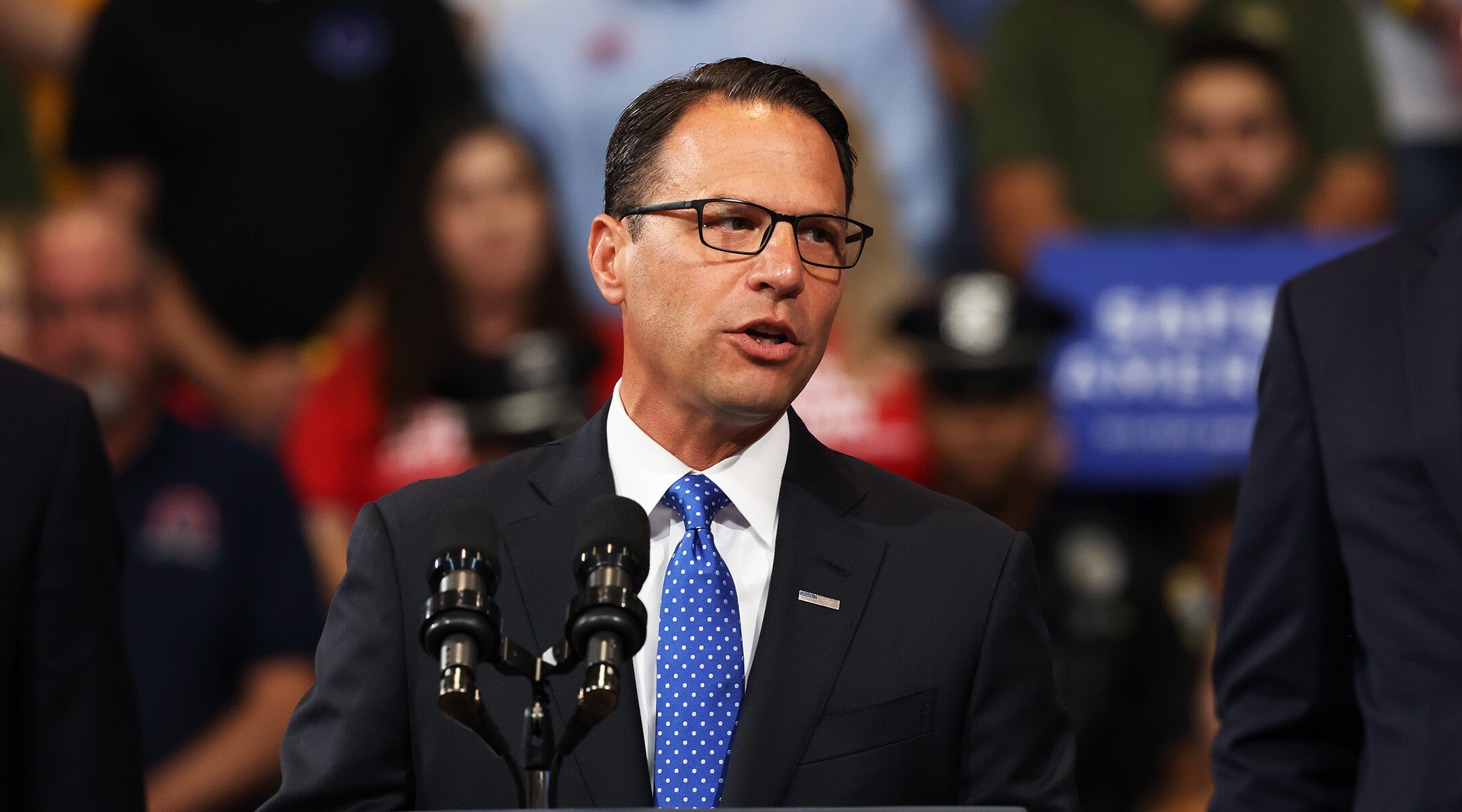
Josh Shapiro quotes Rabbi Tarfon in statement about not being Kamala Harris’ VP pick - My faith teaches me that no one, no one is required to complete the
task, but neither are we free to refrain from it. That means that each
of us has a responsibility to get off the sidelines, to get in the game
and to do our part.”
Now, after losing the battle to be Kamala Harris’ running mate,
Shapiro has turned to the same adage, attributed to Rabbi Tarfon, a sage
who lived nearly 2,000 years ago.
“Since I first ran for State Representative 20 years ago, I’ve been
called to serve because I want to leave our community, our Commonwealth,
and our country better off for our children – and because my faith
teaches me that no one is required to complete the task, but neither are
we free to refrain from it,” Shapiro, who is Jewish, said in a statement Tuesday morning, following reports that Harris had chosen Minnesota Gov. Tim Walz as her vice presidential nominee.
The quotation
— “It is not your duty to finish the work, but neither are you at
liberty to neglect it” — is generally taken as a reassurance to those
facing monumental or seemingly unreachable goals. It has become a
mainstay of Jewish activist circles across the political spectrum.
Shapiro’s statement came after a two-week period when he was thought to be one of the frontrunners in Harris’ veepstakes.
By Monday, he and Walz were reportedly the final two contenders. The
distinction between them had been framed as a choice between one
swing-state governor — Shapiro — with a reputation for centrism and
bipartisanship, and another — Walz — with a folksy demeanor and cachet
with the party’s progressive wing.
Rumors that Shapiro was the leading candidate ignited a campaign by progressives to sink his bid,
focused on his support for Israel, his criticism of pro-Palestinian
college student protesters, and his positions that buck Democratic
norms. Several of Shapiro’s Jewish allies, noting that Walz also has a
pro-Israel record, suggested that the anti-Shapiro effort was
antisemitic. No parallel anti-Walz campaign emerged in the public eye.
He added, “As I’ve said repeatedly over the past several weeks, the
running mate decision was a deeply personal decision for the Vice
President and it was also a deeply personal decision for me.”
He congratulated Walz and his wife, whom he referred to as “Tim and
Gwen,” and whom he called “good friends of ours.” He wrote that Harris
“has my enthusiastic support,” and he pledged to campaign for her in
Pennsylvania, seen by many analysts as a must-win state. He said he
would appear at a rally with Harris later on Tuesday in Philadelphia,
where she will publicly appear with Walz as her running mate.
Shapiro took office at the beginning of last year, and recommitted in
his statement to serving as Pennsylvania’s governor, referring back to
the Rabbi Tarfon passage.
“Pennsylvanians elected me to a four-year term as their Governor, and
my work here is far from finished there is a lot more stuff I want to
get done for the good people of this Commonwealth,” he wrote. “In just
19 months, we’ve made a meaningful, positive impact in peoples’ lives,
and I’m proud of how Americans all across the country have taken notice
of what we’re accomplishing here.
Rejoining IDF, Ex-Envoy Michael Oren Warns: ‘We’re Fighting the Wrong War’
Former Israeli Ambassador to the US Michael Oren in IDF uniform.
Israel’s former Ambassador to the United States Michael Oren has
traded his diplomatic credentials and suits for a dog tag and combat
uniform by joining an Israel Defense Forces (IDF)
rapid response counter-terrorism unit in a northern kibbutz, warning
that the fall of the embattled north would pose the most significant
threat to Israel’s central heartland.
Oren recently returned from Washington, DC, where he accompanied a
delegation of displaced Israelis from the north for a series of talks
and high-level meetings in the US capital. The former envoy criticized
Biden administration officials for lacking adequate answers for the
evacuees they met with, implying they expected the evacuees to simply
accept living in close proximity to a terror threat.
“No one is going to go back to living, say, in Metulla, which is
literally a war zone with 150 houses destroyed and with Hezbollah on the
other side of the fence,” he said, referring to the powerful
Iran-backed terrorist organization in Lebanon. Oren cited army estimates
that as much as 40 percent of Israel’s evacuated north, numbering some 80,000 people, would not return home in the event of a ceasefire with Hamas in Gaza.
“We now know what terrorists on the other side can do to Israelis,” he added.
Oren asserted that Israel was misdirecting its focus with the
fighting in Hamas-ruled Gaza to the south, investing its manpower and
resources against the wrong enemy. “We’re fighting the wrong war. We
should focus our main energy on the north, which is a strategic threat.
Hamas was and is a tactical threat. It’s not going anywhere.”
Hezbollah, which wields significant military and political influence across Lebanon, has been firing drones, missiles, and rockets at northern Israel daily
since October, when the Israel-Hamas war in Gaza began. The onslaught
has forced Israelis living near the Lebanon border to flee to other
parts of the country for safety.
Oren assailed the response by world leaders and global press to last
week’s targeted assassinations of Hezbollah commander Fuad Shukr in
Beirut and Hamas terror chief Ismail Haniyeh
in Tehran, and rejected claims that the killings would make hostage
negotiations tougher and foil the chances for regional quiet.
“The reaction of the world was extraordinary. By eliminating two mass
murderers, they’re saying Israel has jeopardized peace. You can’t make
this stuff up,” Oren said. “What foils the chances for a hostage
agreement [with Hamas] and for regional stability is not standing up to
terror and not fighting.”
“Leaders of the United States and the world should thank Israel for
eliminating the murderer of not just Israelis, and of Palestinians, but
the murder of Americans,” he added.
Oren rejected claims that Israel was not operationally or logistically prepared for a full-scale war with Hezbollah,
asserting that Israel had untapped resources ready for deployment. “We
have conventional means that we’ve never used before, and we could use
them now, like our submarine force,” he said, declining to elaborate
further.
Kobi Levy, a resident of Kfar Blum who is part of the rapid response
team alongside Oren, hailed the former envoy’s decision to dust off his
uniform for the first time in over a decade. Oren fought in the First
Lebanon War in 1982 in the Paratroopers Brigade.
According to Levy, many lawmakers and politically-affiliated groups,
including the Brothers in Arms anti-government protest group, have
briefly visited the kibbutz for what he termed “photo ops and empty
promises.”
Oren, he said, “came with all his heart to listen. To us, the people
of the north. He’s the only politician who understands exactly what the
residents want.”
Levy also said that Oren wasn’t above doing whatever was needed for
the team, from early morning drills to overnight guard shifts. He
predicted that Oren, who also served as a deputy minister in Israel’s
19th Knesset, had a “bright future” ahead of him should he make a return to Israeli politics.
Asked if such a scenario was on the cards, Oren was coy. “Whether in a
suit or a uniform, I’ve always been about service to our country and
our people, and I’ll continue serving in any way I can.”
Former Israeli Ambassador to the US Michael Oren in IDF uniform.
For the meantime, Oren was happy to be the “oldest guy by far” in the
rapid response squad. “I knew that if I wanted to advocate for the
north, I needed to see it firsthand,” he said.
That experience has led him to discover things he would never
otherwise have known. One example he gave is the lack of financial
support for Kfar Blum, which was not evacuated by the IDF and therefore
receives no compensation. More than 60 percent of the kibbutz’s
residents have self-evacuated, including Levy’s own family which
evacuated only last week over fears of a reprisal after last week’s
double assassination. The kibbutz, once known for being the cultural
center of the north with several music festivals, has hosted thousands
of soldiers passing through in the past ten months of war, and
authorities have yet to pick up the tab, Oren said. “They do it with
love of course, but even just the water bill is a tremendous burden on
this community.”
“I’m deeply impressed by the people here and their commitment to the north and to Israel,” he said.
“I’m not being sentimental; they are the embodiment of the Zionist
ideal,” Oren added. “But the sense is that they’ve been forgotten.”
He Took His 68-Year-Old Secret to Court and Finally Confronted His Ghost
By the time Robin Davis testified at trial, nearly everyone involved in the events that led to his lawsuit was dead.
AN ABBREVIATED VERSION OF THE NYT ARTICLE:
The
79-year-old man sat silently in the back of the courtroom on Long
Island, 20 miles from his home in Queens. He wore a dark suit over his
slim frame, as if back at his old offices in Manhattan’s financial
corridors, at Merrill Lynch and Bank of America and other blue-chip
firms.
Here the man, Robin Davis,
settled in for what promised to be a strange trial in this mostly empty
room. His lawsuit centered on the actions of a person long dead. His
adversaries were Long Island bureaucrats who had never heard of that
person or his reported misdeeds.
Generations
had passed since the terrible acts that Mr. Davis described in his
lawsuit, a dark stretch of weeks 68 winters ago, during the first
Eisenhower administration. In this courtroom in 2024, he faced lawyers, a
judge, a jury of strangers and a ghost who had haunted him for the
better part of seven decades.
A ghost who had made him — for good and for bad — what he is today.
Mr.
Davis had long been widely known for his philanthropy on behalf of one
cause: fighting child abuse. Twenty-five years ago, he created a charity
to raise money in the business community to fund boots-on-the-ground
agencies in New York City and beyond that sought to treat and prevent
the abuse of children.
Now, the trial would reveal the answer to a question about the charity that he’d been asked many times: Why? Why child abuse?
But the real reason he’d devoted himself
to this singular cause would be made public in this courtroom in
Mineola, when he could speak about what had happened when he was 10
years old and a new coach arrived at his school’s gymnasium.
He
knew the poster boy for child abuse, all right. That boy had stared
back at him in the mirror, ashamed, every day for going on 70 years.
‘I never got the words out’
Rob
Davis was a student at the public Caroline G. Atkinson School in the
Village of Freeport when, in the fifth grade, he brought home a
permission slip to join an evening basketball clinic at the school. His
mother signed it, and the boy showed up on the first night, short and
scrawny and hardly able to throw a basketball with enough force to reach
the basket.
But
a coach he’d never seen before, Vernon Alleyne, was encouraging, and
praised him when Rob finally made a basket. The coach offered him a ride
home later and pulled over around the corner of the school to give him
candy, Mr. Davis recalled in sworn testimony and in an interview.
“‘Have
you ever seen a big man’s penis?’” Mr. Davis recalled that the coach
asked. “I said, ‘My father.’ He said, ‘Well, we’re going to be friends.
I’d like you to see mine.’”
The coach
went on to touch the boy’s privates and, later, during a series of
escalating encounters in the same car, parked in the same spot, forced
him to perform oral sex, Mr. Davis said.
During
the weeks of abuse, the coach gave the boy money to buy himself candy,
and Mr. Davis said he ate so much that he developed a mouthful of
cavities that made his father, a spendthrift facing new dental bills,
angry.
No one realized that his mouthful of decay was a clue that something was wrong. It was the only clue. Because he said nothing.
“I never told my mother and father,” he said in an interview. “I never got the words out of my mouth.”
And for the rest of his life, he has lived with guilt and shame over that silence.
“He
never got caught,” he said of the coach. “Because of me, how many
people did that guy nail? Because I didn’t tell my mother? That’s
crushing to me.”
But all along, he carried a thinly hidden
obsession. It was understandable, even noble. But it was
self-destructive. He could not tolerate any situation in which he
believed someone — especially a child, but anyone, really — was being
mistreated or treated unfairly. Or, of course, abused.
His
revulsion to it was physical, as if he was trying to compensate for his
inaction that winter when he was a 10-year-old boy who did not speak up
when it mattered. As an adult, he spoke up all the time.
During
his brief career teaching, he became convinced that three of his
fourth-grade students were probably being abused at home. He reported
his suspicions to the school nurse and the principal. We’ll handle it,
he was told. But he didn’t stop there.
Taking the stand
In
2019, the New York State Legislature passed the Child Victims Act,
which allowed a window during which victims of childhood abuse could sue
those they felt were responsible, regardless of whether the statute of
limitations had passed. Thousands of lawsuits were filed, many involving
abuse dating back to the 1990s, the 1980s and earlier.
Mr. Davis decided it was time to go public: “It’s just a way of trying to get even with life a little bit.”
His
lawsuit in 2021 would become among the oldest on file, with the abuse
having happened in 1956. As a result, the case brought unique
challenges.
“Do you have any
documentation or paperwork regarding this basketball program?” Mr. Davis
was asked during the deposition in 2022.
“I don’t.”
The
trial began on July 17. Freeport officials said they had found no trace
of a Vernon Alleyne coaching basketball or anything else in the 1950s,
and only a few mentions of him in old payroll ledgers in the early
1960s.
Vernon Alleyne is not a
defendant in the case, and no one was called to testify on his behalf.
Little was revealed about the man besides a home address on an old
payroll entry, on Colonial Avenue in Freeport. Public records indicate
that a man with that name who once lived at that address died in 2008.
Mr.
Davis took the witness stand and faced the jury to tell his story. He
explained how the details of the abuse returned to him in his dreams,
and said that only exhausting himself by running and bicycling long
distances eased his anxiety. He said he is haunted by the fact that he
didn’t speak up.
“I could not get the
words out,” he testified. “It’s horrifying, the fact I didn’t tell my
mother — it would have stopped him in his tracks. She knew the police,
she knew everybody in town.”
A
psychologist hired by Mr. Davis’s lawyers testified about the effects of
trauma on a person. The judge paused testimony when he noticed a juror
sleeping and called for a coffee break. But Mr. Davis, listening in
court, was riveted.
But he kept his own story a secret. He told The New York Times
in 2007 that his interest in the area emerged from his brief time as a
teacher. “There are so few big organizations that do child abuse work,”
he said in that interview. “There’s no poster child for the movement,
because it’s such a painful subject.”
He later renamed the charity Help For Children. Now 25 years old, it has given away some $61 million and has chapters in five countries.
A verdict, and an absolution
After
a weeklong trial, the jury reached a verdict. It found that Mr. Davis
had been molested by Mr. Alleyne. But it also found that the Village of
Freeport was not responsible for or liable for what had happened.
Mr. Davis had wanted to hit the village in its wallet to send a message. Instead, he left court crestfallen.
“That
seems to be the height of irresponsibility,” he said while driving home
to Queens. His lawyers, Jared Scotto and Nicholas Wise, had asked for
whatever financial damages the jurors found appropriate, and their
answer was zero.
Mr. Davis said he’d hoped to pump whatever money he was awarded into the charity.
But
something else had happened during that trial, something that felt to
him like a different kind of verdict. It was during the dry testimony of
the psychologist, Valentina Stoycheva, which had put a juror to sleep.
She
had been explaining that besides the familiar “fight or flight”
responses to trauma, there is another — “The three F’s,” she called
them.
“The ‘freeze’ response,” Dr.
Stoycheva said. “Which is, basically, your nervous system tells you stop
whatever else you are doing, just endure, just survive, just make sure
you get through this.”
Mr. Davis, listening, silently wept into his hand.
That
single word, “freeze,” was like a pardon, handed down upon a
10-year-old boy who had lived with the weight of having said nothing. To
the 79-year-old man he became, that word swept in feelings altogether
new to him. Absolved. Not guilty.
“That
was something of — relief is the wrong word. But explanation,” he said
later. “I’ve never been able to explain that, even to myself.”
He drove toward home, the city skyline before him, the village and the parked car and the ghost at his back.
Is Israel too passive in waiting for the Iranian response?
Israel faces a tense period
of anxiety and preparation, reminiscent of 1967, as it braces for
potential retaliation from Iran and Hezbollah after recent high-profile
assassinations.
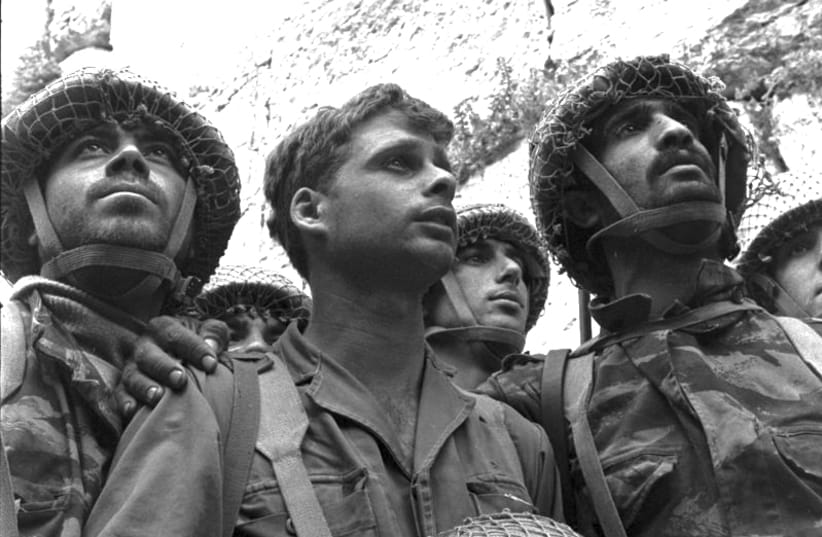
DAVID RUBINGER’S iconic photo of the IDF paratroopers at the Kotel during the Six Day War in 1967.
One of the most tense periods in Israeli history was the three weeks preceding the Six Day War in 1967, a period known as the “waiting period” or tekufat hahamtana.
This
was a period of anxiety, uncertainty, and preparation within Israel as
the country faced the imminent threat of an all-out regional war. Egypt had closed the Straits of Tiran, an act of war, and the rhetoric from the Arab lands was chilling.
Only
19 years old and isolated internationally, there was genuine concern
that the country might not survive. Anxiety was palpable, with mass
graves being dug in parks as a grim precaution.
This
anxiety-filled period ended on June 5, 1967, when Israel preempted its
enemies, destroying the Egyptian Air Force on the ground in a matter of
hours and changing the course of history.
That
period comes to mind today as the country is again gripped by
apprehension, waiting for a response from Iran and Hezbollah – either
together, separately, or with other non-state actors in the “axis of
resistance” – to the twin high-profile assassinations last week of
Hezbollah’s Chief of Staff, Fuad Shukr in Beirut, and Hamas’s leader,
Ismail Haniyeh, in Tehran.
An anti-Israel billboard is seen next to the Iranian flag
It
would be wrong to say that the country is panicking – it most
definitely is not. Brisk sales on home generators, bottled water, canned
tuna, and salami are signs of preparedness, not panic.
Panic
comes in the form of people clamoring to leave the country, refusing to
leave their homes, or seeing daily life come to a standstill. That is
not what Israel is experiencing.
It is, however, experiencing anxiety. And who can blame it? With Hezbollah
and Iranian leaders threatening retaliation and with the media full of
endless speculation about what kind of retaliation to expect and when,
the nervousness is understandable.
The
question, however, is whether similar anxiety is being felt in Beirut
and Tehran. Are they, too, stocking up on tuna, bottled water, and
salami? Are they wondering when Israel will hit, how, and from what
direction?
If not, why not?
Something
about the current situation feels off. Two arch-terrorists are
eliminated – one in Beirut with a US-issued bounty on his head, the
other in Tehran without Israel even claiming responsibility – yet Israel
is the one adopting a defensive posture, what is called in Hebrew,
konnenut sfiga, bracing for an attack.
Instead
of Israel being in a defensive posture for eliminating the terrorists,
Beirut and Tehran should be the ones worried – since they harbored them.
Even
more than this period being reminiscent of the tekufat hahamtana, it is
reminiscent of early April after Israel killed Islamic Revolutionary
Guard Corps commander Mohammad Reza Zahedi in Damascus when Israel
braced for an Iranian response that came in the form of over 300 drone,
cruise, and ballistic missiles fired at the country.
Watching
television broadcasters announce on a Saturday night in mid-April when
the drones, missiles, and rockets were scheduled to arrive was like
monitoring the arrival screen at Ben-Gurion Airport. It was a bizarre
feeling: you saw a bullet headed in your direction and just prayed that
the country’s defenses would work and the bullet would either be
intercepted or miss its mark. In other words, someone was trying to kill
you, and you just prayed they would not succeed.
One
problem with the current situation is that it engenders a feeling of
powerlessness among the population: waiting for the second shoe to drop,
waiting for the inevitable.
But
Israel is far from powerless. Rather than just waiting to see what
happens – or how many people are killed – before responding, it should
already be projecting its power. If it does not want to exacerbate the
situation or is being held back by the US from taking further action,
the country should at least make it clear that any type of attack will
be met with immediate and overwhelming force. Planning for such a
response should, as it certainly is, already be well underway.
This
time the threats need to be backed up with immediate action, not, as
has been the case up until now, with empty rhetoric from Prime Minister
Benjamin Netanyahu, Defense Minister Yoav Gallant, or Chief of Staff
Herzi Halevi about “sending Lebanon back to the Stone Age” – threats
issued so often it is doubtful anyone takes them seriously. This time,
the response needs to be immediate and devastating.
PROJECTING
POWER is also crucial for the country’s morale. Israel is not helpless.
It has one of the strongest militaries in the world. The population
needs to be reminded of this and see it to maintain psychological
well-being. Feeling powerless is detrimental, and this defensive crouch
in the face of Iranian and Hezbollah threats saps morale.
The
hit on Shukr came only after 12 children and youth were killed by
Hezbollah rocket fire at Majdal Shams. Only after this atrocity was
Shukr assassinated, and that reinforces a bad pattern: if an attack is
“successful” and causes casualties, Israel responds; if not, it will let
it slide.
This
approach is flawed. Had Israel acted to destroy Hamas’s capabilities
after the terrorist organization fired countless rocket attacks since
2001, rather than waiting for a mass casualty event before responding,
the current situation might have been quite different.
Why are we on the defensive?
It
is a mistake for the country to be in this defensive crouch. It sends
the wrong message to Israel’s enemies and to its own people.
That said, there are similarities and differences between the current waiting period and the one that preceded the Six Day War.
First,
in 1967, there were doubts about whether the Israeli army could
withstand a coordinated attack by neighboring Arab states. Today, while
there is concern about potential damage, there is greater confidence in
the army’s ability to manage the threat.
Israel’s
military capabilities were more limited in 1967; today, it has a much
mightier force and the most formidable missile defense system in the
world.
Second,
in 1967, Israel felt completely isolated in the world, especially after
Egypt demanded the removal of UN peacekeeping forces from Sinai, to
which the UN acquiesced. There was also skepticism about the level of
support Israel could expect from the world.
Today,
the US has sent warships to the region to assist Israel in batting
drones, rockets, and missiles out of the sky, as it did in April.
Additionally, there is coordination with a regional defense alliance
established after the Abraham Accords under the leadership of the US
Army Central Command (CENTCOM). This represents a significant regional
alliance.
Finally, there’s a significant difference in the nature of the existential threat facing Israel now compared to 1967.
Back
then, there was a genuine fear that a war could lead to Israel’s
destruction – that enemy armies would invade, conquer, and eradicate the
Jewish state. Today, while Israel still views itself as engaged in an
existential battle, the immediacy and nature of the threat have changed.
The
current concern is not that an immediate attack by Iran, Hezbollah, and
their allies would destroy the state outright, at least not until Iran
gets nuclear capabilities. Instead, the fear centers on the potential
for a prolonged war of attrition if Israel fails to decisively defeat or
deter its enemies now. Such a war could gradually grind down the
country, making life increasingly difficult for its citizens, destroying
the economy, and threatening Israel’s long-term viability.
This
persistent threat – also an existential one – demands proactive
measures. Israel cannot afford to wait passively for attacks. The
country must take preemptive action or respond swiftly and decisively to
secure its future and survival.
HaRav Zilberstein: “Attack Was Near An Area Of Chillul Shabbos B’Farhesiah”
FROM YWN:
HaGaon HaRav Yitzchak Zilberstein, a member of the Moetzes Gedolei
HaTorah and the Rosh Kollel of Beis Dovid in Holon, published a special
letter of chizzuk after the murderous terror attack in Holon at the request of the city’s residents who wanted his Daas Torah on the tragedy.
“To my dear and beloved brothers and friends,” HaRav Zilberstein
wrote. “We are shocked and pained by the tragedy that befell our city of
Holon, the murderous attack by a heinous terrorist today, Sunday
morning, erev Rosh Chodesh.”
“And each one of us should examine our deeds, why this happened in
our city, why Hashem is showing His anger. Chalilah that we should point
fingers at who we think is responsible for the tragedy. Instead, each
person should think that it is because of him and his sins that this
terrible tragedy happened. Like Yona HaNavi said: כי יודע אני כי בשלי
הסער הגדול הזה עליכם” (יונה א-יב) – despite the fact that Yonah could
have blamed all those who worshipped avodah zara who were on the boat
with him, he blamed only himself!”
“And seemingly, since it was right after Motzei Shabbos Kodesh, and
right near a place where public Chillul Shabbos takes place, in our many
sins – the Shabbos HaKedoshah is pained by the Chillul Shabbos and we
must appease it and be mechazeik in shemiras Shabbos.”
“And therefore every one of us should be mechazeik in Shemiras
Shabbos, at home and on the street, and influence those around him in
Shemiras Shabbos. And each person should learn at least two halachos of
hilchos Shabbos every day.”
“ובזכות החיזוק בשמירת השבת, נזכה לברכת השבת, וכדברי רבינו אברהם אבן עזרא “כי אשמרה שבת א-ל ישמרני”, ונזכה לגאולה בקרוב. אמן”.