


Out of a total of 3,000 draft orders sent over the previous three months, 273 men showed up at the IDF induction center and 48 actually enlisted.

Still, with IDF casualties continuing to rise on the battlefields and Israeli public sentiment bitterly against the sweeping draft exemptions provided to able-bodied Haredi young men, Israel’s Haredi rabbinic leadership is facing the biggest threat to Haredi yeshiva culture since the founding of the State of Israel.
“Never before has the yeshiva world been more besieged and in danger than right now,” Yitzhak Sudri, a Haredi public relations consultant, told the Haredi Kikar Hashabbat internet news site on Thursday.
Public outcry against blanket exemptions for Haredi soldiers has grown since war erupted after Hamas’s October 7, 2023, massacre, which saw some 3,000 terrorists burst across the border into Israel by land, air and sea, killing some 1,200 people and seizing 251 hostages amid acts of brutality and sexual assault.
About 800 IDF soldiers have been killed, over 5,400 injured, and 300,000 called up for reserve duty since the Hamas onslaught. With no end in sight for the war being conducted in Gaza and Lebanon, most Jewish Israelis — Arab Israelis are exempt from military service — are no longer willing to tolerate a situation in which tens of thousands of able-bodied Jewish men avoid taking part in defending the Jewish state.
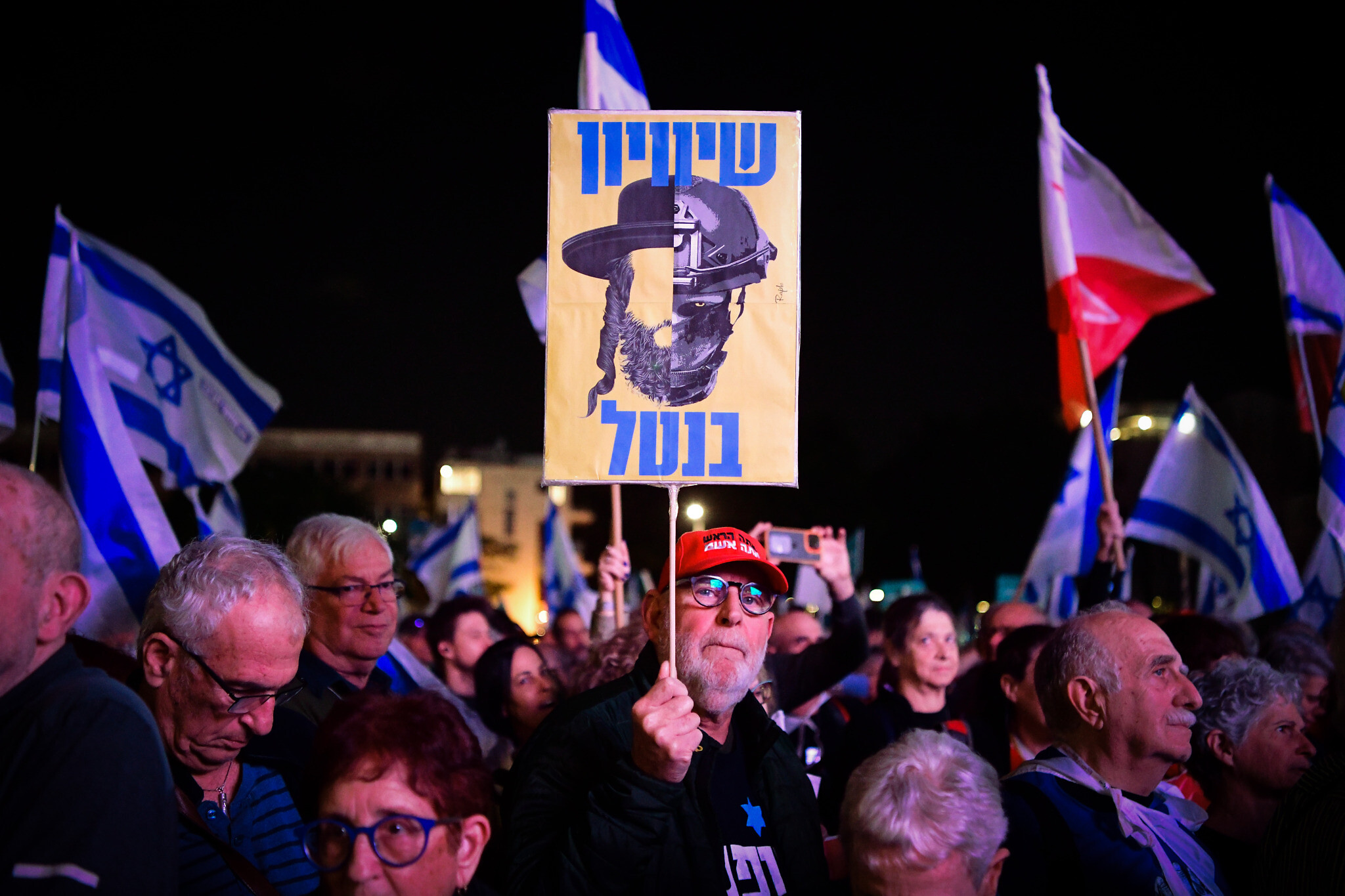
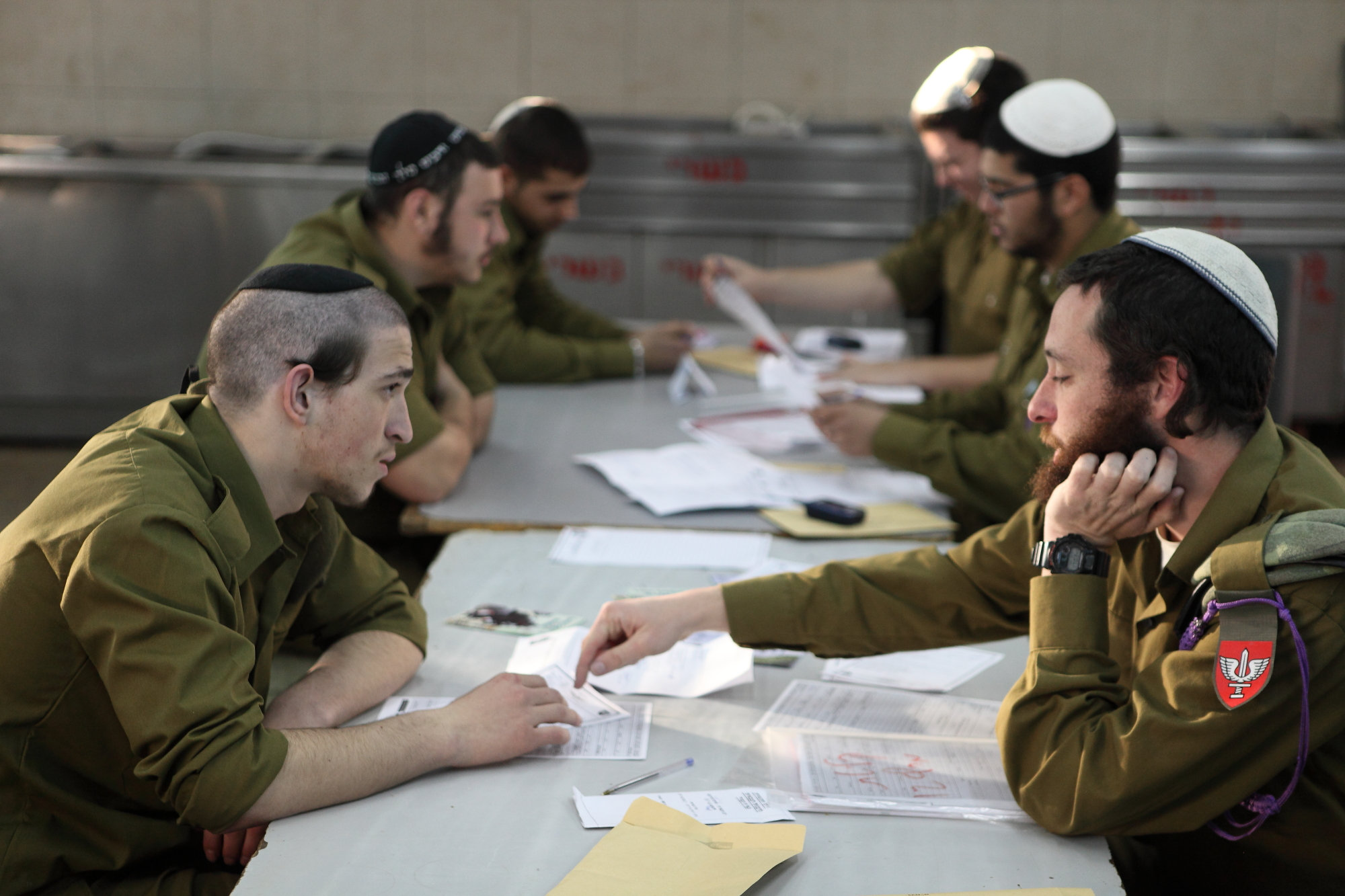
About 66,000 Haredi men aged 18 to 24 have secured exemptions from military service, claiming they devote most of their waking hours to Torah study.
However, according to Yossi Levi, CEO of the Netzah Yehuda Association, which has worked for the past 25 years to encourage Haredi men who aren’t studying Torah to enlist in the IDF, many of these men are only nominally registered in yeshivas and actually work illegally or are idlers.
“According to the most lenient estimates, at least a third of the 66,000 are not in yeshivas,” said Levi.
Asked about the efficacy of sending thousands of draft orders to Haredi men, Levi said there were “two sides” to the argument.
“On one hand, the orders will force guys who aren’t in yeshiva to face the fact that they are criminals. They are cheating and taking advantage of us,” he said. “But on the other hand, sending orders to guys who are serious Torah scholars will only cause damage.”

Levi said that publicly punishing serious yeshiva students would only galvanize Haredi opposition to the draft.
At the same time, Levi said that today there is no excuse for a Haredi young man who is not learning in yeshiva to avoid the draft.
“More than ever before, there is a clear need for more soldiers. And there are plenty of frameworks in the IDF fit for Haredi soldiers, including the Netzah Yehuda Battalion and the new Hasmonean Brigade,” Levi said.
Rabbi David Leybel, one of the Haredi figures behind the creation of the Hasmonean Brigade, said the brigade provides a solution for Haredi parents worried about the spiritual dangers of IDF service.
“What worries most Haredi parents more than anything else about the IDF is that their son will begin military service as a Haredi, but won’t finish that way,” Leybel said. “If there would be a place in the IDF where the Haredi public feels safe both spiritually and culturally, many of the obstacles to Haredi draft will be removed. I believe the Hasmonean Brigade provides precisely that sort of place.”
Creating an entire Haredi brigade with about 2,000 soldiers means more autonomy and control of the environment.
From the beginning of service until the end, Haredi soldiers can be provided with an insular surrounding in which gender segregation is meticulously maintained, glatt kosher food is provided, and soldiers can attend regular Torah classes.
Leybel is now working with the IDF to allow rabbinic supervision of how the new brigade is run and ensuring that a list of conditions is anchored in chief-of-staff directives.

Until now, the largest IDF formation compatible with the Haredi lifestyle has been the Netzah Yehuda battalion, which has about 500 soldiers — not all of whom actually come from the Haredi community. Haredi men who underwent officer training or were required to take various courses were forced to leave the battalion and serve in the vicinity of female soldiers and live in predominantly secular surroundings.
But Leybel said that the main obstacle to drafting a large number of young Haredi men is the non-Zionist, separatist narrative prevalent on the Haredi street.
“There is a narrative within the educational system that we are not part of the general public and if we are not part of the general public then why should we join the IDF?” said Leybel. “We need to change the narrative.”
Leybel said perspectives have changed since October 7.

“There is a sense of guilt and shame among a lot of Haredim because they are not really sharing in the war effort,” he said. “But it’s not enough to really get guys to go out and join the IDF. And there remains a very heavy social stigma on a Haredi guy who joins the IDF.”
Many Haredi men who do enlist face harassment, intimidation and ostracization by their own communities; some are afraid to return home from service while in uniform. One indicator that Haredi opposition to mass induction is still strong is the way the issue is being presented on Haredi news media.
Panels of Haredi commentators that discussed the draft on Haredi news outlets such as Kikar Hashabbat and Radio Kol Chai focused more on the injustice being perpetrated against the Haredi community and yeshiva world than on any sense of self-reckoning or a need to fundamentally change Haredi positions on IDF service.
Many of the commentators, such as Sudri, a former spokesman for the Shas party, recommended shifting the blame for the failure of a Haredi draft to the IDF by claiming it is not prepared to provide the proper spiritual atmosphere for Haredi soldiers.
These Haredi commentators also voiced hope that leftwing organizations would fight their battle for them by petitioning the High Court against the creation of the Hasmonean Brigade because the strict gender separation discriminates against women.
Levi said that consecutive governments have done little over the years to encourage Haredi men to integrate into the IDF.
“Our entire budget at Netzah Yehuda, the oldest and most experienced organization dealing with Haredi enlistment, is NIS 22 million [about $5.9 million] annually, and over 90% of that comes from private donations,” Levi said.
He emphasized that the State of Israel must make the conscription of Haredi men into the IDF “an important national goal.”
“It must build multi-year programs, support existing institutions, encourage outreach to Haredi youth, encourage awareness and provide incentives,” he said.
“These are long-term processes, though,” he added. “You can’t expect a huge change overnight.”
 |
| "IT IS A MITZVAH TO EVADE THE DRAFT" |


 | ||
| NO DRAFT IN BROOKLYN --- LIVE FOR FREE UNDER THE BRIDGE - UNTIL AGUDATH ISRAEL SELLS IT |

Yesterday, I attended the funeral of 23-year-old Sgt. First Class Yona Bezalel Brief. His family had called on the public to accompany the burial and many thousands did. We gathered on Jerusalem’s Mount Herzl for a ceremony that has become agonizingly familiar to all Israelis since the October 7 massacres. There is the flag-enshrouded coffin, the reciting of the kaddish and El Maleh Rahamim prayer, the commander’s eulogy, the laying of the wreaths, and the honor guard’s salute. And yet, for all their similarities, each of the funerals is different, as was poignantly clear at Yona’s.
His was a story of unfathomable – one might almost say superhuman – strength; of family and faith. A combat medic in the IDF’s elite Duvdevan commando unit, Yona had already been wounded the previous May and offered a medical discharge. He refused. Returning to his post, he was among the first soldiers to charge into Kibbutz Kfar Aza on the morning of October 7 and to unhesitatingly engage its Hamas butchers. His best friend, Amir Fisher, and their commander, Ben Bronshtein, both of blessed memory, were immediately shot. Yona ran to them, heedless of his own safety, and was himself grievously wounded. Later, I heard how, despite his two shattered legs and thirteen bullet wounds, Yona kept caring for others.
Unlike that of the 1,200 people slaughtered on October 7, Yona’s death would occur 417 days later. Throughout virtually that entire period, Yona was hospitalized in the intensive care unit of Sheba Medical Center. There, attended by a team of doctors and nurses dedicated to his survival, he underwent numerous operations and massive infusions of antibiotics. His parents, David and Hazel, along with his four siblings, never left his bedside. Saving Yona’s life became theirs.
I visited him there once, many months ago, and saw a young man who, though legless above his knees, unable to rise from his bed, and barely capable of speech, nevertheless radiated an intense determination to live. He loved history and wanted to read my books. And though patently suffering, he never lost his faith. At the funeral, Hazel spoke of his insistence on putting on tefillin, and of how she wove the leather straps through the many tubes and bandages on his arm.
The funeral was longer than any I remember simply because so many people had so much to say about Yona. Though often difficult to hear through their sobs, friends and family members spoke of his indomitable spirit, his humor, his warmth. But there was also Prof. Yitshak Kreiss, Director General of Sheba Medical Center, who hailed Yona as “one of the greatest heroes in the history of Israel.” But the most memorable remarks were delivered by his mother, and not only because they, alone, were in English.
“My sweet Yona, from your ICU room, messages of hope, faith, and love for our precious country washed over our battered and exhausted nation. Yes, you, my love, became the focus of doing things to make this world better, to make our country just a bit better. Because everyone wanted Yona to win this battle and finally go on to rehabilitation. We were all in for you, dear Yona, and you were all in for Am Yisrael.”
All in for Am Yisrael. Those words continued to pierce me as I looked around at the thousands of faces, many of them tear-streaked, fixed on the grave. Most of them were young people, many of them soldiers in uniform, still carrying their guns. Some wore jackets emblazoned with the twin red dots of Duvdedan, the Hebrew word for cherry. Only the IDF, I thought, with commando squads called Ibis, Kingfisher, and Diamond, would name one of its special forces unit Cherry. Only Israelis, though steeled and traumatized by fourteen months of war, would unite in a display of unrestrained vulnerability, of compassion, and above all, love.
Along with sorrow, love abounded – for Yona, of course, but also for the land and the country he loved, for Jerusalem and the Jewish people. Utterly absent from the ceremony was the slightest mention of the evil forces that killed Yona, no expressions of anger, no calls for revenge. Only the honor guards’ shots, reverberating through the trees and myriad headstones atop Mount Herzl, recalled the bitter war that stole this hero’s life.
I returned home that night and, as always, switched on the TV news. There was footage of another funeral, this one held in Dahieh, the Hezbollah-dominated neighborhood in Beirut. Many thousands attended this event as well, though almost all of them were men. They thronged around the coffin shouting “Death to America” and “Death to Israel.” Fist-pumping the air, they vowed to avenge the martyr’s death with blood and fire. If there was sadness, it took second place to rage and demands for retribution. The mourners pledged to follow the dead man’s example and give their lives for jihad. Heaven would be their reward.
Two funerals, one of solemnity and silence and the other of ferocity and wrath. Two ceremonies that said everything about their participants and the values they represent. Witnessing them both in the space of several hours, reminded me of a remark made twenty-four years ago, at the start of the Second Intifada by then-Prime Minister Ehud Barak. “This is not a battle between armies,” he said, “but a struggle between societies. The stronger one will win.”
Israel won that struggle and will win this one as well, and not only – or even mostly – because of our superior military might. We will win because of the inestimable resilience of Israeli society, our vast but understated strength. Because of our determination to defend ourselves against those seeking to destroy us not by descending to their depth of barbarism but by rising to our own ideals.
Yona Brief embodied those ideals and, in parting from him, so, too, did thousands of Israelis. They listened as Eviatar Banai, the brilliant composer and musician whose scheduled performance for Yona in the ICU was preempted by his death, offered a simple yet impassioned prayer. “Oh Father,” he sang. “I want to be sure with all my heart that this journey will have a good end and that all I’m going through along the way will turn a wickedness into an immense strength.”
“Oh, my dove,” he concluded. Dov, in Hebrew, is Yona. “Sing a new song for me that will light up my heart and strings.”
https://blogs.timesofisrael.com/love-and-rage-a-tale-of-two-funerals/
In remarks at Autism
 |
| More Mishugoyim In Washington |
President-elect Donald Trump announced Thursday that he is nominating Robert F. Kennedy Jr. as Secretary of Health and Human Services (HHS).
In a speech before his appointment, Trump suggested he would let Kennedy “go wild on health” in the United States. If the Senate confirms Kennedy as the head of HHS, he would have oversight over 13 key health divisions, including the Centers for Disease Control and Prevention (CDC), the National Institutes of Health (NIH), the Food and Drug Administration (FDA), and the Centers for Medicaid and Medicare Services (CMS).
The nomination sent shockwaves through the public health community. Many experts raised alarm about Kennedy’s history of promoting pseudoscientific health claims and anti-vaccine rhetoric.
“This is an extraordinarily bad choice for the health of the American people,” wrote Ashish Jha, MD, MPH, dean of the Brown University School of Public Health.
Routine childhood vaccinations prevented an estimated 508 million cases of illness and more than 1 million deaths in children born between 1994 and 2023, according to the CDC.1
Zhou F, Jatlaoui TC, Leidner AJ, et al. Health and economic benefits of routine childhood immunizations in the era of the vaccines for children program—United States, 1994–2023. MMWR Morb Mortal Wkly Rep. 2024;73(31);682–685. doi:10.15585/mmwr.mm7331a2
Kennedy has long been a vocal vaccine skeptic. He founded the nonprofit
Children’s Health Defense (CHD), one of the largest sources of
anti-vaccine misinformation.
For years, Kennedy peddled stories that vaccines cause autism, a claim that has been repeatedly disproved.2 He also spread disinformation about the measles vaccine in Samoa, causing the vaccination rate to drop from about 70% to about 30% and leading to an outbreak that killed dozens of children.
In 2022, CHD co-published a book falsely claiming that the COVID-19 vaccine caused a spike of sudden deaths among healthy people.
Kennedy has since tried to soften his anti-vaccine rhetoric. On the day after the election, he said in an interview with NBC News: “I’ve never been anti-vaccine. I’m going to make sure the scientific safety studies and efficacies are out there, and people can make individual assessments about whether that product is going to be good for them.”
Kennedy hasn’t yet been confirmed as HHS Secretary. The Senate will approve or reject Cabinet nominees in the coming months. In the meantime, talk to a trusted healthcare provider about any concerns you may have about your health and where to find trustworthy resources for health information.
WASHINGTON — Scott Gottlieb, who served as Food and Drug Administration commissioner in the first Trump administration, is raising concerns with Senate Republicans about the president-elect’s selection of Robert F. Kennedy Jr. to lead the Department of Health and Human Services, he said in a television appearance Friday.
Gottlieb maintained that there is “skepticism in the Republican caucus [on RFK Jr.’s nomination], more than the press is reporting right now.”
“I’ve had conversations, and I’ve raised my concerns and I will continue to raise my concerns,” Gottlieb said on CNBC in response to a question about whether he’s spoken with individual senators about the prospect of confirming RFK Jr.
Gottlieb’s remarks reflect an effort to undermine RFK Jr.’s. nomination before the Senate reconvenes after its Thanksgiving break, when RFK Jr. could begin meeting with senators to discuss his confirmation.
So far, moderate Republicans have held back from saying whether they will support RFK Jr.’s nomination. Given the commanding Republican majority in the Senate next year, RFK Jr. would have to lose four Republican votes and fail to sway a single Democrat in order for his nomination to fail.
The former commissioner listed a number of potential issues that RFK Jr.’s nomination could face. Among them: Given his views on the U.S. food industry, senators with large agricultural interests could withhold their support, as could anti-abortion senators given RFK Jr.’s past support of abortion rights, along with “public health-minded” senators given his skepticism of — some critics say opposition to — childhood vaccines.
Gottlieb expressed skepticism that Congress could try to put guardrails around RFK Jr. by attaching conditions to funding for HHS. He said it’s unlikely that senators would have the will to rein in an executive agency in that way, and that Congress already faces delays in passing full government spending bills instead of just stopgap measures.
“That’s not going to be successful,” Gottlieb said.
Gottlieb also implied that there could be a chasm between RFK Jr.’s beliefs about childhood vaccines and those of President-elect Trump himself.
“I don’t think the president wants to see a resurgence of measles, wants to see a resurgence of whooping cough in this country, wants to see, God forbid, cases of polio in this country.… I think if RFK follows through on his intentions, and I believe he will, and I believe he can, it will cost lives in this country,” Gottlieb said.
Gottlieb warned that RFK Jr. could take specific actions harmful to public health, including by disbanding a vaccine advisory committee to the Centers for Disease Control and Prevention and then re-creating it stacked with like-minded people and by frustrating funding for the Vaccines for Children program, which provides free vaccines when their health insurance won’t pay for them. Gottlieb called the team RFK Jr. is building “very experienced,” and pointed to individuals with ties to the anti-vaccine group RFK Jr. founded, the Children’s Health Defense.
“These guys are capable, I think they are deadly serious and have been very clear about their intentions, and I think sometimes you have to take people at their word,” Gottlieb said.
Beyond his criticism of RFK Jr., Gottlieb also called David Weldon, Trump’s pick to lead the CDC, a “very committed anti-vaxxer.” For the first time, following a change by Congress, that post is subject to confirmation by the Senate.
Tensions have been high between Gottlieb and Trump’s picks for his new administration for a long time.
Calley Means, an adviser to RFK Jr., has accused Gottlieb of working to “undermine President Trump’s reform agenda” and of “showing disloyalty to President Trump.”
On Friday, Means posted on X in response to Gottlieb’s CNBC appearance that, “Trust in public health has plummeted due to government officials like Scott going straight from the FDA to the Pfizer boardroom.”
Even before RFK Jr. rose to prominence, Vivek Ramaswamy, who is now running a process aimed at dramatically cutting government spending, made a dig at Gottlieb during an early presidential debate in December 2023.
“The leader, the commissioner of the FDA ends up on the board of Pfizer…. I don’t care if it’s a Republican or Democrat. We need some basic principles that end the corruption in government,” Ramaswamy said.
Gottlieb isn’t the only former Trump administration raising concerns about RFK Jr.’s position on childhood vaccines.
Former surgeon general Jerome Adams has recently voiced concerns about increases in cases of whooping cough and global measles deaths.
“Chronic diseases are important- but you can’t die from cancer when you’re 50 if you die from polio when you’re 5,” Adams posted on the social media platform X.
RFK Jr. and his advisers have called for more focus at federal agencies on chronic diseases as opposed to infectious diseases.
 |
| Header of an instruction from Israel’s Chief Rabbinate for how to observe Shabbat during the war with Hamas. |
While the world’s attention has been focused on the American election, there has been a far less publicized, but still significant, election in Israel for the Chief Rabbinate.
After months of wrangling, the election was finally decided, with left and right fighting about egalitarianism, and who should sit on the electoral committee.
I have always been a rebel and disliked authority and power — particularly when it is associated with religion, from which I expect a higher level of ethics and morality than elsewhere.
And yet, I am constantly disappointed. When people achieve authority, they tend to make decisions based on preserving their power, rather than the moral criteria. That is why religion and politics are two very different areas of human activity that really ought to be kept apart.
Sadly, they rarely are.
Israel’s Chief Rabbinate controls important levers of income and authority — from marriage and divorce, to conversions and kashrut. It also provides extremely well paid and plentiful easy jobs for Orthodox boys (less so for the girls), and like all bureaucracies, is very bureaucratic.
This is fertile ground for corruption, and indeed unpopularity. Yet there are some wonderful, honest, devoted and impressive rabbis serving in Israel’s rabbinate today.
The tensions that we have witnessed in Israel between ethnic groups, the right and the left, secular and the religious, the Supreme Court and its critics, and the different voices within them, illustrate the near impossibility of reconciliation and compromise.
Caught between conflicting interests comes the Chief Rabbinate, whose courts run parallel with secular courts. It’s a government agency of great power and reach that is unpopular with many sectors of Jewish life in Israel today, for good reason.
Candidates for the Chief Rabbinate who are not approved of by the Haredi world stand little chance of getting elected. As a result, some Chief Rabbis have been convicted of crimes, and others were suspected of crimes. And the only criterion seems to be getting enough Haredi votes.
In the early years of the state, most of the state rabbis were committed to the cause of a Jewish State, even if they wouldn’t necessarily call themselves Zionists politically. The Chief Rabbinates performed very well given the constraints. Over time, the institution, like most others in Israel, was slowly infected by a bureaucracy of entitlement, laziness, and incompetence.
At first, the Haredi community simply ignored the Chief Rabbinate. Their religious and sometimes charismatic leaders and authorities were not elected or appointed. They emerged as natural leaders. They had their own standards and attitudes towards Israeli life. But then the Haredi community increased, and it saw opportunities.
The salaries of community and local rabbis were very attractive, and you didn’t have to have a secular education. Increasingly the Haredi world entered the rabbinate and over time, have come to dominate it, so that the moderates have largely been undercut.
This year, the Sephardi candidate got through easily in a predetermined election that saw yet another member of the Yosef dynasty intent on keeping it in one family. The Ashkenazi Lau family also tried to maintain their grip on the position, but could not gather enough support. The Ashkenazi election came down to two candidates. Eventually Rabbi Kalman Ber from Netanya was elected by 77-58. He defeated the more open and impressive Rabbi Micha Halevi of Petach Tikvah, who had support from the Religious Zionists.
Both rabbis have good reputations and claimed to be moderates. At the induction ceremony, they spoke of embracing all sectors of Israeli life, to support IDF soldiers, visit army camps, and comfort the families of kidnapped Israelis. Rabbi Yosef concluded in English with a Trumpian declaration that resonated with the audience: “We will make the Chief Rabbinate great again!” Chief Rabbi Ber echoed this commitment to unity, expressing the vision rooted in Rabbi Kook. “My greatest mission is to bring about unity among all parts of the people,” he said.
I have heard this before from Chief Rabbis across the world. Music to my ears. But given human nature, they rarely live up to their campaign promises. In Israel, as the winning candidates were elected thanks to Haredi votes, I cannot see any change in matters of law or the culture of the rabbinate. Any hope for a new era will once again be brushed under the carpet. And nothing will change. The only saving grace is that Chief Rabbis are only elected for 10 years. I pray I am proven wrong.
The phone rings. It’s my son Aryeh (a.k.a Erik). He’s been busy fighting a war, and we haven’t spoken in a while, so I drop everything, try to get my emotions in check before answering. “Hi Ima,” he says, “I’m OK but…” I heard that twice during the 354 days of miluim reserve duty Aryeh served in this current war. He was injured on two separate occasions. But, if he was calling me, it was going to be something that we could handle, I hoped. I have been an army mom for 11 years, with three lone soldiers, who were at one point serving at the same time. They weren’t the first phone calls of this kind, but they were the most serious.
I won’t go into the details of those events, because I wasn’t there, and I am sure I received a highly sanitized version of what really happened. Suffice it to say, scary isn’t a descriptive enough word.
After both injuries, he went straight back into miluim as soon as he was able, even though I thought he should stand down. But that’s Aryeh. He couldn’t walk away from his duty, even though he had permanent injuries, even if his mom asked him to. Hero isn’t a big enough word.
I cannot even bear to imagine what he witnessed and experienced. No one should ever have to go through such a gruesome time. I have a “don’t ask – don’t tell” policy when it comes to army stuff, and my soldiers protect me by not sharing things they know would upset me. It comes as no surprise that Aryeh was recently diagnosed with Combat PTSD, and was subsequently discharged from the army in order to get help and to heal. The fact that he is a Major and a Company Commander with a lot of responsibility hasn’t made him immune from suffering. And to have to walk away from his team, from his soldiers for whom he feels responsible, in the middle of the war, is so painful for him.
Aryeh made aliyah 11 years ago, and served seven years in the IDF instead of the standard three, rising up through the ranks. He left an easy middle-class life in North America because his soul yearned to be in Israel. He built himself a life in Israel, a career path, and integrated well into Israeli society. But then October 7 happened. Without even receiving his tzav 8 army call-up (which, like many reservists, he received 24 hours later), he jumped in his car to join his unit and fight for his country, for his people. In civilian life, he is a police officer, and he had been due to start his master’s degree in law enforcement soon after the war started. He had just moved into a new apartment on October 1 – didn’t even have a chance to unpack. But, like so many other soldiers and their families, civilian life got put on hold.

When a person is what’s called a lone soldier (generally, a young person who has made aliyah, joined the IDF, but their immediate family – parents, etc – live in the diaspora) doing the mandatory three years of service, there are extra benefits financially, and otherwise – a day off every so often to run errands, time off to be allowed to fly back “home” to see their parents once during their service, etc. But all that extra TLC ends when mandatory service is over. Whether they be in extended service (keva) or in the reserves, or marry a fellow lone soldier, all their lone soldier rights are terminated. How is this allowed?
Generally, a reservist goes back into the army for a few weeks every year. The length of this war is unprecedented, and the extreme length of time some of the soldiers are serving was never anticipated. My son was released from the army because he was no longer fit for service, because he needed to take care of himself, physically and mentally. He went home. To an empty apartment filled with boxes that needed to be unpacked. With no one around to check up on him.
The army washed their hands of him – they have other things to do and were certainly not going to sit around and hold his hand. But how can you leave a person who is suffering from PTSD alone? Who is permanently injured? How can you just leave them to twist in the wind? Where is the advice, the support, someone to hold his hand, especially because I cannot be there physically?
Most other soldiers get to go home to their families, to the warmth and structure they have grown up with. They’re not alone. If they are in a life-threatening state, the family will never leave them alone and will do everything in their power to get help. And they know the system and how to get help, and if not, then they know who to reach out to who does know.
Lone soldiers don’t have that support system. In the past two weeks alone, two lone soldiers in the reserves died by suicide – young men who the country and the army failed. How many more funerals will my sons need to attend of their fellow lone soldiers who died at their own hands because they felt so hopeless and lost and did not have where to turn? Lone reservists need to know that they can and must reach out for help with their challenges, not keep them to themselves. They shouldn’t have to suffer alone.
Aryeh was at the Knesset this past week, meeting with MKs and lone soldier organizations and their representatives to talk about lone soldier reservists, and their rights, and how things need to change for them. His testimony at a meeting of the Immigration Committee to discuss the status of lone IDF reserve soldiers was fraught with emotion. I have not seen him cry in over a decade and a half. To see my big, strong, heroic son break down and explain how lonely he feels, how forgotten, how he does not know where to go from here, as his life trajectory has completely changed – to see that broke me completely. Everything he has achieved up until now, all his plans are for naught because he fought in the war for his country and is paying a massive toll for it. How can an injured veteran be ignored when he has given so much with his service?
My son is hurting. My son is suffering. My son feels neglected and ignored. Even if I was spending time in Israel, that would not change. Yes, I could fill his freezer with challah and chicken soup. I could run errands with him/for him. I could be a presence so that he doesn’t feel alone. But he’d still be injured and eventually, I would have to leave and he’d be alone again. At the end of the day, he has to live his life, and learn to adapt to the changes that will be necessary so that he can live a fulfilling life in the country that he loves – but he cannot do that without support.
I cannot be there and it hurts so much. I cannot fix him. I cannot fix the situation. Change has to come from within Israel, within the IDF, within the government. Lone soldier reservists need more support in every way – and the injured ones need it all the more so. These brave young men and women should not be ignored or made to feel insignificant. When they are already struggling with their mental health, loneliness can push them over the edge. If you have soldiers in your life (and who in Israel doesn’t?), check in on them and make sure they have what they need. Make sure they have who to talk to, even if it’s not you.
My heart is broken for my son. This isn’t something that a forehead kiss can make better. It is the responsibility of every single Israeli, for whom Aryeh fought in this war, to make sure that injured veterans are all well taken care of, and have everything that they need to heal. It’s a national responsibility. These young men and women gave up everything they had to come to Israel. It needs to change. And that starts with you.
The Knesset committee is meeting again on Monday, December 2. Ahead of that meeting, please take a moment to message the committee chair Oded Forer — odedfo@knesset.gov.il — with your support and with your message.
In the meeting that Aryeh attended, only two members of Knesset were present, Oded Forer and Moshe Tor-Paz, and the meeting hall was mostly empty. Where was Ofir Sofer, the Minister for Aliyah? Does this not fall into his bailiwick? Email him – sar@moia.gov.il – to insist that his presence is required at the meeting and that this issue requires his involvement in the discussions.
Where were the other Knesset members? They need to show up. This needs to matter. This needs to be in the front of policymakers’ minds so that our lone miluimnikim get everything that they need and more, including healthcare, mental healthcare and support. Rehabilitation needs are different for lone soldiers. If we don’t fight for them, who will?
https://blogs.timesofisrael.com/im-ok-but-one-soldiers-war-story/
"The results showed, by a probability of 86%, that the Torah scroll is dated to the time period of 1470-1680 – at least 100 years after the Ran’s death. Put another way: the scroll may be old, but the colophon and the plate are false and attest to a forgery."
One day in 1978, a centuries-old Torah scroll was discovered deep inside the National Library of Israel, practically by coincidence. The scroll, written on dark parchment, also had a silver plate, which was apparently discovered beforehand, with an etched explanation of the scroll’s origins. The scroll’s height was almost half a meter, and it was written in early Sephardic script. The scroll had not been cataloged nor did it appear in our records of manuscripts. In short, a mystery (patience, we’ve only just begun and from here onwards things will only get weirder). No-one knew how it ended up in the collection, but the experts at the National Library immediately identified what this Torah scroll was.
Some 40 years earlier, on the eve of Passover in 1936, the Haaretz newspaper published a fascinating article on a unique Torah scroll that had been discovered. The article was written by Rabbi Baruch Toledano, a scholar and author who once discovered a copy of the famous Commentary on the Mishnah in Maimonides’ own handwriting (sections of which are preserved at the National Library).
According to the article, the scroll was written by none other than Rabeinu Nissim Ben Reuven of Gerona (Girona) (1290-1376), known as “The Ran”, an important commentator and religious jurist in 14th century Spain. After the Jewish expulsion from Spain, one of the exiles – a respected elder – brought the scroll from Spain to a small Jewish community based in Brazil. There, a Shadar – an emissary of the Jewish community in the Land of Israel – acquired the scroll in the early 20th century. This emissary, Chacham Yahya Dahan from the northern city of Tiberias, brought the scroll to the Holy Land.

Antique Torah scrolls are spread throughout the world, but there is usually no evidence of their scribe. This one, however, had clear signs pointing to the author. One of the most prominent is the colophon (a portion of text describing the time and circumstances of its writing) written on the other side of the Torah scroll’s parchment, at its very beginning.
Adding a theoretical portion to a kosher Torah scroll is considered an unconventional and religiously very problematic action. Still, the colophon is there, prominently displayed, telling the scroll’s tale in Sephardic script written in brown ink. The colophon’s author, according to its text, is Rav Reuven, the son of the Ran. He describes the troubles which befell the Jews of Spain during the Christian pogroms of 1391, writing that he managed to flee with his father’s scroll:
“For three months, the fire of conflagration spread in the holy communities of the children of Israel, in the exile of Spain… the kingdoms of Castile, Toledo, Seville, Majorca, Cordoba, Valencia, Barcelona, Aragon, Granada… a blow of sword, killing and death, religious destruction, captivity … and we were sold as slaves and handmaidens to the Yishmaelites… the seekers of blood carried out their plot… and I saved all the scrolls of our holy Torah and with them this book that belonged to my father and mentor… and our heart is filled with terror and fear and our lives are torn for there is no faith as to our end…”

Rabbi Toledano didn’t suffice with the testament of the colophon as evidence of the scribe’s identity, and he presented additional proof in his article in Haaretz: the form of the some of the Hebrew qof (kuf – ק) letters in the scroll. Here’s what Rabbi Simeon Ben Zemah Dura (1361-1444) said on the matter in his responsa:
“I also heard that the Rabbi R. Nissim Gerondi ob”m who was in Barcelona and who was the Rabbi of my rabbis ob”m that he wrote a Torah scroll for himself and the legs of the [letter] qof would be stuck to their roof.” (Shut Tashbetz, 1.51)
And indeed, the Torah scroll in question often had the qof, which is usually made up of two separate parts, connected in a way reminiscent of the letter chet – ח, with a long left leg.
Remember the silver plate that came with the scroll? The form of the letters and the menorah etched on it indicate that the plate was not made in the Ran’s time and was actually a copy, yet the text of the plate explicitly attests that the Ran wrote the scroll himself and donated it to the synagogue:
“This holy Torah scroll, I wrote for myself and my merit, Nissim son of my master, my father, teacher, and Rabbi Reuven Girondi, may his creator preserve him and keep him alive. I gave on condition to the synagogue of Kohelet Yaakov to the holy congregation in Barcelona…”

The 1936 newspaper article was not the only appearance of the Torah scroll in question. Scholar and historian Shmuel Kraus mentions it in his book Korot Batei Hatfilah Beyisrael [The History of Jewish Prayer Houses, published in 1955 after his death]. Kraus saw the scroll when he visited Tiberias in 1934. He describes the scroll as being made of the skin of a red deer and being difficult to read. The scroll’s author asked Kraus to help him sell it, but Kraus didn’t succeed in brokering a transaction. A few years later, another attempt was made to sell the scroll in Jerusalem.
The last testament to the scroll’s existence before its disappearance appears in the book Tzidkat Hatzadik [The Righteousness of the Tzadik] by Rabbi Aryeh Leib Friedman, who wrote that in the summer of 1952, he travelled to the Chacham Yahya Dahan (the emissary we mentioned earlier) in Tiberias and saw the Ran’s Torah scroll there.
The enthusiasm which accompanied the important and accidental discovery at the National Library was quickly dampened by scholars who had questions about the source of the Torah scroll and its ostensible author. Despite the careful argument made by Rabbi Toledano in 1936, doubters did not lack alternative explanations. For instance, it was known that the lettering styles in Jewish holy books differed among Ashkenazic and Sephardic Jews and depended on the period in which they were written. Indeed, some of the letters in the Torah scroll in question were different than those used in the time and place in which the Ran lived.
Shlomo Zucker of the National Library’s manuscript department noted another strange fact: In the Torah scroll in question, the song of Haazinu contained 70 lines, yet in the Ran’s time it was customary to use 67 lines, in accordance with a ruling by Maimonides.

Doubts also arose as to the colophon. It turned out that its description of the 1391 pogroms was chronologically inaccurate. It also contained words that were relatively modern compared to the Ran’s time, and it also contained acronyms unknown from other sources. Furthermore, acronyms were marked with quotation marks, as is done today in Hebrew, even though in the Ran’s time – and later – they were marked by periods.
Another problem with the colophon’s history is that it mentioned the city of Granada in southern Spain as one of the cities attacked by Christian pogroms – except that in that year, Granada was still in Muslim hands. A slightly different spelling of Granada was etched into the silver plate, a text supposedly written by the Ran:
“This Torah scroll I wrote for myself and for my merit … Nissim son of my master, father, teacher and Rabbi Reuven Grinodi.
For scholars, the great contradiction here is that the Ran, like Maimonides, Rabeinu Yonah, and others, lived in the city of Girona in northeast Spain and not Granada/Grinoda/Grinodi in its south. In his article, Rabbi Toledano tried to explain this contradiction by suggesting that perhaps the Ran was indeed from Granada and not from Girona as originally thought, but this explanation was rejected by other scholars.

Despite the multiple questions surrounding the origin of the Torah scroll, the National Library accepted the source’s own testimony in the colophon and silver plate and presented the scroll as having been the Ran’s own creation. In 1992, to mark 500 years since the Spanish Expulsion and 100 years since the founding of the National Library, the Library put on a special exhibit of “Books [and manuscripts] from Spain.” The exhibit’s catalog shows the scroll under the heading “Torah scroll written by Rabbi Nissim Ben Reuven Girondi (the Ran) for himself” and notes that the scroll was acquired by the Library. No further details were provided. Eight years later, to mark the 75th anniversary of Hebrew University, the scroll was once again put on display and presented in the printed catalog.
Yet the doubts persisted. In 2012, a sample of the scroll’s parchment was sent to a lab at the Weizmann Institute to conduct a carbon-14 test on it. Since this test is used to date archaeological findings containing organic material, a parchment made of animal skin is very appropriate for such a test.
The results showed, by a probability of 86%, that the Torah scroll is dated to the time period of 1470-1680 – at least 100 years after the Ran’s death. Put another way: the scroll may be old, but the colophon and the plate are false and attest to a forgery. It could be that the forgery was committed to increase the value of the scroll. In an effort to explain the errors in the descriptions, scholars believe the forger who added the colophon and created the silver plate inscription was not very familiar with Spain’s geography and confused Girona and Granada. In his book Chazon Tverimun, which discusses the counterfeiting industry in Tiberias, Moshe Hillel describes the history of the forgery of this Torah scroll and thus explains all the doubts raised concerning it.

If it wasn’t owned or written by the Ran in Spain, then where is this scroll from and whose was it?
According to Moshe Hillel, the Torah scroll appears to have come from Morocco. The Moroccan Jewish community was in possession of antique Torah scrolls, some of them were even made before the expulsion from Spain, which Jews fleeing the Inquisition brought with them. In 1810-1910, some Moroccan Jews immigrated to Brazil, bringing along with them a number of Torah scrolls and settling in the region of the Amazon.
The emissary from Tiberias, Yahya Dahan, may have come to Brazil and returned with an old Torah scroll. But since the attribution to the Ran is false, it is also possible that the scroll never even passed through Brazil but rather arrived directly from Morocco to the Land of Israel, after which a whole story was stitched together to make its provenance sound greater than it was.
Others believe that the scroll may have originated in the Land of Israel or even Turkey.

If the Torah scroll had indeed been written by an important Torah scholar such as the Ran, we could have learned much from it on the customs of writing holy Hebrew texts in Medieval Spain. And indeed, Rabbis and scholars tried to do just that in a number of articles. While the scroll does seem to be quite old, it is unfortunately not “old enough,” and what we can learn from its writing is unrelated to the Ran or to the Jews of Spain. The scroll certainly served some Jewish community for many years, and perhaps we do need to remember it – as a historic document of the lives of Sephardic Jews is some other location.
The Zohar, in relation to the Torah portion of Naso, says “Everything depends on luck, even a Torah scroll in the Holy Ark.” So yes, even Torah scrolls need a little luck. There are Torah scrolls that sit unused in the ark of a synagogue for a whole year and are only brought out to be danced with on the festival of Simchat Torah. Other scrolls, the luckier ones, have the privilege of being used several times a week.
This famous Torah scroll that was once attributed to the Ran has experienced varying luck over the centuries. Once a holy relic associated with one of the great leaders and sages of 14th century Jewry, it is today linked to fraud and deceit. And perhaps here we have a final stroke of good fortune: Despite its dubious reputation, instead of being buried or hidden away like other Torah scrolls with problematic histories, it is preserved, maintained, and sometimes even put on display at the National Library of Israel.
Cowards - Lying Gedolim - Lashon Hara On The IDF - Rishaim Gemurim!
WATCH CLIP:
CLICK:https://youtube.com/clip/Ugkxxy0c9T7z4SCb2pk2HlqPj0GOqLzbI8e4?si=FP9lwE3gK85sFpe2

Channel 14 on Thursday revealed new details about the first Haredi brigade in the IDF since the establishment of the Jewish State in 5708. The Haredi soldiers of the Hasmonean Brigade must pledge to observe the commandments, wear Shabbat clothes during prayers and meals on the Day of Rest, and participate in daily Torah lessons. The kashrut standards will be the most “Mehadrin,” and the soldiers will be obligated to pray three prayers a day – four on Shabbat, and five on Yom Kippur.
THESE ARE THE 10 COMMANDMENTS OF THE HASMONEAN BRIGADE
Finally: the soldiers will be required to wear a black kippah throughout their service, dress in Shabbat clothes on non-operational Shabbat days, and maintain a Haredi lifestyle throughout their service, even while at home. And they will be prohibited from using unfiltered cell phones.
It looks like the Division’s rules may be stricter than some Haredi Yeshivas.
Before we end this report and wish our Haredi soldiers a huge Mazal Tov, I’d like to make one personal observation about the name picked for the new Haredi unit by the powers that be in the IDF: the Hasmonean Brigade. It is named after the dynasty that ruled Judea from the 2nd century to the first century BCE. The Hasmonean kings were the offspring of the five sons of Mattathias the priest, who led the revolt against Seleucid rule. From the start, the Hasmoneans violated the long-held tradition that Judea must be ruled by the offspring of King David, and not by priests, who were from the tribe of Levi. As a result, the entire line of Hasmonean kings were removed from office either due to madness, or assassinations. They were loathed by the sages, founding fathers of the Rabbinic tradition, who mistrusted their intentions and feared their affiliation with Hellenism. Wasn’t there a less controversial name for this very important IDF division?
During a meeting in July with Rabbi David Leibel for the purpose of establishing the Haredi brigade, Major General Zini and the head of the Planning and Human Resources Management, Brigadier General Shai Taib, were attacked by dozens of extremist Haredim who surrounded their vehicle, threw objects and bottles at them, and shouted insults. But I don’t think it was because of the choice of a name for the new unit…
 | |
| Francis, with rare exceptions, ignores or minimizes the nature of the threats faced by Israel. Despite the avowed goals of Israel’s enemies, he never acknowledges this as distinctly genocidal in intent. |
What makes the inflammatory statements in the pope’s book especially disturbing is that they follow on remarks by the pope that appear to demonize Jews even more broadly and which are contrary to teachings of the Church.
Pope Francis’ prior Letter to Catholics of the Middle East on the first anniversary of the Oct. 7, 2023, Hamas attack on Israel from Gaza provoked widespread confusion and consternation among Jews and Catholics. While he has spoken regularly about the attack and the fighting that erupted in its wake, his inclusion in the letter of a citation of John 8:44 to denounce the evils of war was to many inexplicable.
The verse chosen by the pontiff, a vitriolic accusation that the Jews “are from [their] father, the devil,” has for centuries provoked and been used to justify Church hostility to Jews. Yet such terrible imagery of Jewish malfeasance is thoroughly out of place in a modern Catholic document. Regrettably, the pope nonetheless chose to use this notorious verse at a time when global antisemitism has reached disturbingly high levels. Such a statement threatens the intellectual work of his Catholic predecessors going back to the 1960s.
While the citation is surely troubling, more significant is the letter itself, for it is yet another example of an ongoing presentation of Francis’ extensive and controversial views on the Israel-Hamas war. This letter has made people aware of this significant body of statements and demonstrates the compelling need to understand current relations with one of the Jewish community’s most influential and important partners, Pope Francis and the Catholic Church. In the year after the attack, Francis has spoken publicly about the war at least 75 different times. The conflict is not just like other conflicts, for it occurs in a place “which has witnessed the history of revelation” (2/2/24). Not only is he understandably very distressed about the war, but he is also clearly knowledgeable about it and notes many aspects of it (e.g., hostages, negotiations, humanitarian aid, Israeli airstrikes, challenges for aid workers). With the possible exception of Russia’s war on Ukraine, no other conflict has received such frequent mention by Francis, nor has he engaged so intimately with the specific features of other, often more deadly conflicts. He addressed the war most often in scheduled gatherings for the Sunday Angelus Prayer and in weekly audiences with the general public, though he has discussed it at greater length in official contexts (e.g., Address to Members of the Diplomatic Corps Accredited to the Holy See, 1/8/24).
Francis, with rare exceptions, ignores or minimizes the nature of the threats faced by Israel. Despite the avowed goals of Israel’s enemies, he never acknowledges this as distinctly genocidal in intent.
Pope Francis does not just speak homiletically. His statements express his deep-seated and passionate convictions about morality and political affairs. They also both reflect and influence current trends in Catholic thinking about the Israel-Hamas war. The Holy See of course is not just a religious institution but also a state, engaged in pragmatic exchanges and negotiations with other states and organizations. The pope’s views on war and peace necessarily shape Vatican diplomacy and guide Catholic political proposals, as seen for example in the statement of the Apostolic Nuncio to the U.N. in January 2024, which is replete with references to Francis’ speeches and elaboration on his ideas.
Francis is struggling to reconcile traditional Catholic just war theory, which began with St. Augustine centuries ago, with contemporary Catholic resistance to almost any justification of war, especially without international sanction (Fratelli Tutti 258 n. 242; see also the Catechism of the Catholic Church 2302-17). The latter, more skeptical view of war has roots in the 19th century but emerged strongly after World War II and the Second Vatican Council (1962-65), especially in the wake of the Shoah and the development of nuclear weapons. It continues to develop today, with Francis giving it his own emphases that reflect his roots in the global south and the influence of liberationist theology.
It is ironic, or perhaps predictable, that the Catholic Church in the modern period, now without access to military power, has moved away from just war theory and now largely deploys its more restrained views of war and peace in judging others. Given the prominence of the Israel-Hamas war in Francis’ speeches and its moral and political complexity, as well as his stature internationally, his views are relevant and influential.
The pope cannot and does not separate the Jewish-Catholic relationship from the Israel-Hamas war. Francis has spoken often and highly personally about Jewish-Catholic relations and emphasized his commitment to deepening the connection between the two long-estranged communities. He has celebrated the remarkable changes that started with the Second Vatican Council, noting that “enemies and strangers have become friends and brothers” (10/28/15). Building upon the admirable endeavors of Popes John Paul II and Benedict XV, he has endorsed profound theological changes in Catholic teachings about Judaism and expressed sadness over Catholics’ past misdeeds against Jews (e.g., Evangelii Gaudium 248). Relevant here in particular are the popes’ expressions of support for the State of Israel (especially following the establishment of diplomatic relations between Israel and the Holy See in 1993) and peacemaking endeavors for the region, which Francis has continued. He was warmly welcomed by national leadership during his visit to Israel in 2014 and emphatically insisted “the State of Israel has every right to exist in safety and prosperity” (10/28/15).
A sense of this fraught history and a Catholic responsibility to the Jewish people and the State of Israel emerges from his comments during his papacy. He insists that “to attack Jews is anti-Semitism, but an outright attack on the State of Israel is also anti-Semitism” (10/28/15). Catholics, above all, he says, should not be indifferent to such hostility. The Shoah is never far from his mind. Past hostility to Jews, manifest in violence and genocide, should guide the Church in the present and the future.
Speaking to a Jewish audience in Rome, he said Catholics should “always maintain the highest level of vigilance [against hostility toward Jews], in order to be able to intervene immediately in defense of human dignity and peace” (1/17/16). He insists here on an active stance, alert to such threats, “lest we become indifferent” (1/27/20). Responding to a letter from Jewish scholars written in November 2023 expressing deep concern over “the worst wave of antisemitism since 1945,” he says the Oct. 7 attack against Israel in particular reminds him that the promise “never again” remains relevant and must be taught and affirmed anew (2/2/24). Likewise, the Church’s commitment to opposing antisemitism remains firm. Because of the “path that the Church has walked with you,” he replied, it “rejects every form of anti-Judaism and anti-Semitism, unequivocally condemning manifestations of hatred towards Jews and Judaism as a sin against God.”
Francis’ statements following Oct. 7, 2023, are therefore disappointing on multiple levels. First, he does not fulfill his commitment to vigorously and publicly oppose antisemitism and anti-Judaism. By ignoring central aspects of the conflict, such as the motivations of the combatants, he actually undercuts his promise of vigilance and resistance against all such forms of hatred. Second, his view of the war is not constructive. Desiring to move Catholic theology away from just war theory and toward a nascent so-called just peace theory, he offers little practical or moral guidance in the present Israel-Hamas war. Instead, he misrepresents the nature of the conflict and simplistically presents highly complex and nuanced situations in service of his a priori views on war in general. While it would be unreasonable to expect him to become a partisan in the conflict or to dig deeply into the nature of the opposition Israel is facing, he has failed to consider the need for military self-defense or to assess whether antisemitic hatred of Jews—an explicit concern of his—lies behind any of the aggression and rhetoric against Israel.
Pope Francis’ statements on the conflict that started on Oct. 7 should be situated in the broader context of his thinking about war and violence. His principled opposition to any justification for war is both morally and logically questionable. On the one hand, he affirms the acceptability of self-defense through the use of force: “It is the right of those who are attacked to defend themselves” (10/11/23). As is widely understood, this right is not unlimited. Traditionally, one must satisfy the requirements both for initiating a war (jus ad bellum) and for prosecuting a war (jus in bello). Although Francis does not use these technical Latin terms, they are present behind his focus on the fate of “innocent victims” (10/11/23) and claim that “even when exercising the right of legitimate defence, it is essential to adhere to a proportionate use of force” (1/8/24; see also 9/29/24). There are also “various international conventions, signed by many countries,” that place restraints on certain actions (1/8/24, quoting Gaudium et Spes 79). A combatant must engage in a careful assessment of a variety of factors (including some not mentioned here) and only then it is possible that a war is permissible.
On the other hand, the pope is consistently unwilling to undertake an assessment of the acceptability of and justifications offered for this war. Despite having endorsed the possibility of the legitimate use of force (understanding that harm may result), he then evaluates the justice of Israeli military actions in general teleologically, that is, simply by whether they cause harm and suffering: “No war is worth the tears of a mother who has seen her child mutilated or killed; no war is worth the loss of the life of even one human being” (11/10/23). This approach avoids careful assessment of the goals, alternatives, and context in decisions about the justice of undertaking military action in favor of blunt denunciations of such actions because they cause harm. This latter standard of harm, with its powerful emotional character, supplants the earlier tradition of just war criteria (in particular jus ad bellum) without explanation. Now, one is asked to “see war for what it is: nothing other than an immense tragedy, a ‘useless slaughter’” (1/8/24). The terrible suffering of the victims leads him to jettison his own limited endorsement of violence for self-defense. In particular, he delegitimizes any action at all and even the process of assessing the extent of harm it might cause. The suffering of innocents as such, regardless of any larger context or military purpose, renders force and war unjust.
For example, when “unarmed civilians” are killed, “this is terrorism and war” (12/17/23). If true, then motive and context become irrelevant in his overly broad denunciation. But war and terrorism are, of course, not at all the same thing, unless one ignores important differences and only considers some generic level of suffering. Then the presumably intentional murder of innocents (terrorism) becomes indistinguishable from, say, proportional violence used for self-defense (some forms of war).
Speaking about war in general, Francis makes categorical judgments without sufficient consideration for specific circumstances. This renders even wars of self-defense, which could be at least theoretically justified, unacceptable. He repeatedly insists that, without exception, “every war leaves our world worse than it was before” (6/7/24). Dozens of times when discussing the Israel-Hamas conflict, he claims “Wars are / war is always a defeat” (e.g., 10/15/23, 10/29/23, 11/8/23, 11/19/23, 12/20/23, 2/7/24, 3/20/24, 4/24/24, 6/19/24, 8/4/24, 10/7/24). That is, wars, he says, are guaranteed to be a net loss. This evades the unavoidable hard questions that arise when thinking about the justness of a war, especially in response to aggression.
It
is indisputable that both Israel’s and Hamas’ actions raise difficult
and serious moral questions. There are complex assessments that must be
made; even a refusal to make a choice is a choice. However, Francis
seems to want to sidestep this difficult situation. While he hints at
his awareness that there are unavoidable questions, he nonetheless
rejects war in its entirety. He willingly risks being “deemed naive for
choosing peace” (Fratelli Tutti 261), as if simply standing on the side of the “victims of violence” (as he says) is a moral or even plausible option.
In reality, there are almost always innocent victims on all sides, as there are in the Israel-Hamas war. It is misleading to suggest the focus should be only on how to show sympathy for victims (of course one should); rather, he should engage in a moral assessment of the actions of the combatants and extent and causes of civilian losses. Francis sidesteps this discussion with his demand that we “not remain mired in theoretical discussions” (FT 261). Despite his desire to avoid such discussions, however, a moral reckoning requires a difficult confrontation with all aspects of the use of violence, for not all violence is the same. Put another way, if all “war is in itself a crime against humanity,” then moral distinctions between how and why wars are fought disappear (1/14/24).
While it is of course true that nations can engage in war for base motives (failing to abide by the principles of jus ad bellum), Francis seems not to believe that there might be anything but base motives. Francis illustrates this when he introduces a false dichotomy when speaking about the Israel-Hamas war, between those who seek peace and those who are eager to embrace war. For example, he says, “We need to be vigilant and critical towards an ideology that is unfortunately dominant today, which claims that ‘conflict, violence and breakdown are part of the normal functioning of a society (FT 236)’” (6/7/24). This formulation is unduly simplistic and essentializing. He presents those who recognize that war can be necessary and just as not only misguided but captive to a malignant and dangerous worldview.
The pope chose to use this notorious verse at a time when global antisemitism has reached disturbingly high levels. Such a statement threatens the intellectual work of his Catholic predecessors going back to the 1960s.
Francis’ sweeping indictment of all wars, regardless of how or why they are fought, buttresses his claim that violence is inherently self-defeating (“always, always, always a defeat”)—a ruse orchestrated by those who want to increase suffering and death. There can be no justifiable military action, for what lurks behind claims that war is just is selfishness and greed: “What is really at stake [in war] are the power struggles between different social groups [and] partisan economic interests” (6/7/24). These, he argues, are what “really” prompt wars and conflict. As an example, he says war serves no goal but the enrichment of those who sell weapons. No people or country can presumably decide rationally and appropriately to employ force, for they are certain to suffer a net loss. “The only ones to gain [in war] are arms manufacturers” (11/19/23). They “profit the most” (4/24/24).
This is a reductionist perception of history, as if Francis can discern what motivates combatants. (Were Hitler’s motives in WWII in fact no different from those of Churchill and Roosevelt, and is it not possible to make any moral distinction between the war of conquest fought by the Nazis and the defensive wars fought by the nations they attacked and sought to obliterate?) In this way, Francis’ judgment becomes speculative and undermines his admission that some forms of war are acceptable (while tragic and undesirable). According to his logic here, however, war becomes inherently unacceptable. In effect, there is no longer any evaluation needed and no reason to consider the claims of a potential combatant. In fact, casting a skeptical eye over wars from “recent decades,” he bemoans that “every single war has been ostensibly ‘justified,’” maybe with surreptitious help from those who will profit (FT 258). Again, this sort of sweeping judgment is symptomatic of a false dichotomy and leads him to the opposite extreme: If wars have been justified on spurious grounds, then he demands “never again war.”
It is on these spurious foundations that Francis erects his misleading characterizations of the two main combatants in the Israel-Hamas war, the State of Israel and Hamas. In over a year, he has never once mentioned Hamas by name, though mentions of Israel are ubiquitous. This imbalance is significant, not just because it is unsettling to fail to name (and describe the tactics of) one of the aggressors to a conflict (especially one widely considered a terrorist group), but because his studied ambiguity precludes a critical engagement with the nature of Hamas and other opponents.
Francis’ thinking seems constrained by outdated assumptions about the parties to a conflict. He speaks as if he is commenting on a conflict between two warring nation-states. He addresses his comments to both parties equally (again, without naming Hamas), asking for a cease-fire and the release of hostages (10/11/23, 12/10/23, 6/7/24, 9/15/24). However, it is clear that his comments are actually relevant for and directed almost entirely at Israel. For example, in pleading for an end to fighting, he appeals to law (“international humanitarian law”), our shared humanity (“the defence of human dignity”), and practical political goals (1/8/24). These are couched in language suitable for a modern democracy such as Israel, which, at least in theory, aspires to legal and moral behavior. However, this imbalance reveals his misunderstanding of the nature of Hamas.
Hamas is above all an extreme religious group committed in principle to the violent elimination of the State of Israel, even at the cost of its members’ own lives and the lives of innocent fellow Palestinians under its rule. Its leaders publicly affirm a desire to murder Israeli civilians. Hamas’ very existence as a terrorist organization is a transgression of international law, as is its leaders’ promise that they would repeat the murderous violence of Oct. 7 “again and again” if given the chance. Neither moral nor legal expectations have any relevance to Hamas, even if it has also served as leadership in Gaza. In light of this terrible reality, Francis’ hope that “the leaders of nations and the parties in [this] conflict may find the way to peace and unity … [and] all recognize each other as brothers and sisters” (6/7/24; see also 9/13/24) seems not just imbalanced but indifferent to reality. Hamas has repeatedly said the opposite: It endorses unyielding violence until victory. In this conflict, then, only one party—Israel—has leaders who even speak the same moral “language” as Francis. His hope, then, perhaps could have made sense in a conflict between two modern nation-states. That is definitely not the nature of the present conflict, and it is puzzling that Francis persists in seeing or presenting it this way.
There are a wide range of explanations for and understandings of the hostility that exists between Israel and numerous state and nonstate actors. In some cases, there are relatively explicable, pragmatic reasons for conflict. This is clearest in the tragic conflict with Palestinians, given disputes over land, sovereignty, and control of holy sites, among other things. Regardless of one’s biases, it is generally possible to understand rationally why there have been decades of clashes between the sides. However, some of Israel’s opponents have much less rational goals in a pragmatic, political sense and are primarily influenced by ideologically and religiously based hostility. Thus, Hezbollah in Lebanon, following Israel’s 2006 withdrawal from a security zone in the south, lost the justification it gave for maintaining its aggression. Nonetheless, it vigorously continued to prepare for war and invasion. Iran and proxies such as the Yemeni Houthis, both more than a thousand miles away, lack any obvious reasons for hostility toward Israel. They have no dispute over resources or borders or competing historical claims. Likewise, with Israel’s withdrawal from Gaza in 2005, Hamas too achieved almost all its ostensible goals, including political power over Gaza. The vital thread connecting these opponents is the motivation for their antipathy: not practical and explicable interests, perhaps amenable to negotiation and resolution, but unyielding, religiously based hatred.
Irrational hatred, grounded in extremist religious and ideological claims, has exploded in the Israeli-Palestinian conflict in the last few decades, especially among Jews and Muslims and among Israelis and Arabs. Most relevant here is the emergence of vitriolic anti-Judaism and antisemitism among Palestinians and other Muslims. As noted, while some conflicts can be understood rationally, Israel’s opponents have increasingly expressed their motivations in explicitly theological terms, using venomous language not just against Israelis but against Jews and indeed all Westerners. This turns Israelis into Jewish enemies of God and usurpers of Muslim land; this also turns a traditionally political and secular conflict into a religious war.
For example, Hamas’ recent official video bluntly says, “O Lord … let us kill your enemies, the Jews.” Likewise, the language of other aggressors is viciously antisemitic and anti-Jewish. The Houthis’ slogan illustrates this as well: “God is the Greatest, Death to America, Death to Israel, A Curse Upon the Jews, Victory to Islam.” Hezbollah’s charter says its goal is Israel’s “final obliteration from existence.” Former leader Hassan Nasrallah spoke of Jews in terms borrowed from medieval antisemitism and anti-Jewish Quranic surahs (e.g., 82). Iran, the backer of these organizations, has made hatred of Israel and Jews a fundamental aspect of state policy since 1979 and, like Hezbollah, undertakes terror attacks against Jews throughout the world. Though sometimes these opponents insist they only hate Zionists or Israelis, not Jews, their actions and discourse indicate otherwise. Expressions of vicious hostility toward Jews, the use of traditional anti-Jewish tropes, and annihilationist threats of destruction of the only Jewish state are ubiquitous.
This context is directly relevant to Francis’ comments on and understanding of the Israel-Hamas war. Francis, with rare exceptions, ignores or minimizes the nature of the threats faced by Israel. While he usually speaks generally and succinctly about world events, the Israeli-Palestinian conflict consistently gets not only more attention than any other topic but typically occupies the first place in most of his reviews of international conflicts. Likewise, his specific commitment to the Jewish people reasonably raises expectations that he will be especially sensitive to threats to their well-being.
Without any military capabilities, all a pope has is his moral stature, and this current pope, who is widely respected, speaks with great authority on diverse moral questions. It is for this reason that his statements are so puzzling and undermine the admirable stances to which he has committed himself and the Church. Thus, it is surprising that Francis neglects to note that Israel’s enemies seek not a conventional military victory but the total destruction of the country and consequent immediate endangerment of all its citizens. This goal is uniquely malevolent. None of the other countries he mentions face state and / or nonstate actors seeking their physical elimination. (Russia’s attempt to conquer Ukraine does include acts of mass murder and is intended to impose brutal Russian control over the country.) Francis is sensitive to this possibility in general and denounces it: “No-one should threaten the existence of other [countries]” (4/14/24). Despite these avowed goals of Israel’s enemies, Francis never acknowledges this as distinctly genocidal in intent.
