


The Post-Holocaust Jew and the Jewish Recovery Continued…
(Part Three In a Series of Five, in commemoration of his Yahrzeit on the Third of Elul)
The great Jewish recovery after the Holocaust cannot be understood merely as a story of survival. Survival is too small a word. Six million Jews were murdered, hundreds of communities were erased, and an entire intellectual and spiritual civilization was devastated. What emerged afterward was something far more consequential than the rebuilding of institutions. The Jewish people began reconstructing the machinery by which a civilization transmits itself from one generation to another. At the center of that reconstruction stood an institution that the Nazis understood only too well and that Jewish leaders understood even more profoundly: the school.
The Holocaust had demonstrated what happens when a civilization’s institutions are destroyed. The post-Holocaust generation therefore faced a question more profound than where Jews would live. The question was how Jewish children would become Jews. The answer would determine whether the next generation inherited merely the memory of European Jewry or inherited its intellectual and spiritual legacy. Few American Jewish leaders understood that problem as early or as deeply as Rabbi Shraga Feivel Mendlowitz. He died in 1948, before the full dimensions of the postwar Jewish recovery could be seen, yet his fingerprints were already on the architecture of that recovery. He had spent the preceding decades confronting a problem that would become one of the defining questions of modern Jewish history: How does a people preserve an ancient religious civilization inside a modern, free, prosperous, individualistic society?
Mendlowitz understood something that is easy to miss when looking backward at American Orthodoxy. America was not simply another Diaspora. It was a radically different environment for Jewish survival. In Eastern Europe, the Jew was often reminded of his Jewishness by the world around him. In America, the Jew could forget it. That difference changed everything. The European Jew could be oppressed by his surroundings. The American Jew could be absorbed by them. The European Jew faced exclusion. The American Jew faced inclusion so complete that Judaism itself could become unnecessary to his social identity. The European Jewish community was frequently held together by geography, language, custom, and external hostility. America offered mobility, opportunity, education, prosperity, and religious freedom. These were extraordinary blessings. They were also a new test.
The American Jew did not necessarily have to abandon Judaism in anger. He could simply become American first and Jewish second, then American exclusively. His children could speak better English than their parents, attend the finest universities, enter the professions, marry outside the community, and gradually lose the knowledge that once connected them to generations of Jewish history. Mendlowitz saw that assimilation in America would not necessarily look like rebellion. It could look like success. That was the genius of his educational vision. He did not propose to defeat America. He sought to teach Jews how to live in America without disappearing into it.
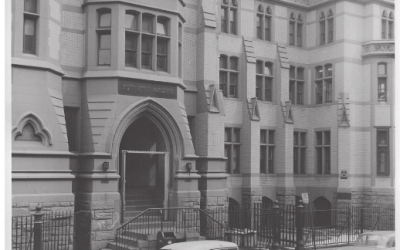
His career illustrates the seriousness of that mission. After arriving in America in 1913, Mendlowitz taught in several Jewish educational settings and eventually moved to Brooklyn. His ambitions were far larger than the institutions available to him. He wanted to build a serious yeshiva in America, but he also understood that American Jewish life required something more than importing European forms. He became the leader and founder of Yeshiva Torah Vodaath which at the time was a tiny Talmud-Torah type school with 22 boys, and beginning in the early 1920s, transformed it into one of the foundational institutions of American Orthodox Judaism approved by the New York State Board of Regents as a recognized high school. Torah Vodaath was not simply a yeshiva. It was an experiment in whether Torah could become an American intellectual and communal force.
What made his approach distinctive was his understanding of the American child. He knew that the Jewish boy growing up in Brooklyn was not a child in Vilna transplanted geographically. He was an American. He would encounter American science, American literature, American economics, American politics, American popular culture, and the American ideal of individual achievement. A Jewish educational system that pretended otherwise would eventually lose the very children it was trying to protect. The answer, therefore, could not be isolation. It had to be education strong enough to withstand engagement. The child needed to know enough Torah to understand that Jewish identity was not an embarrassment, an ethnic curiosity, or an inherited inconvenience. It was an intellectual and spiritual civilization worthy of serious commitment.
This was the revolution that Torah Vodaath represented. It demonstrated that the yeshiva did not have to remain a European institution operating temporarily in America. It could become an American Jewish institution while remaining authentically rooted in Torah. Mendlowitz understood that American Jews could not be educated exclusively through fear. They could not be told that the surrounding society was inherently corrupt and that Jewish survival required permanent withdrawal from American life. Such an approach misunderstood the American Jew. The American Jew wanted to succeed. He wanted education. He wanted economic independence. He wanted his children to enter the professions. He wanted to participate in the extraordinary experiment that was the United States. A Jewish educational system that ignored those aspirations would eventually lose the children it intended to protect.
Mendlowitz therefore pursued a more sophisticated strategy: build Jews who could enter America without being swallowed by America. That required confidence. It required Jewish children to know that Torah was not an obstacle to intellectual achievement, but a source of intellectual discipline. It required parents to understand that Jewish education was not an alternative to preparing children for American life. It was the foundation upon which Jewish children could enter that life with a sense of identity and responsibility.
Yet Mendlowitz understood the limitations of institutional success. One great yeshiva could educate hundreds or even thousands of students. It could not educate an entire Jewish population. The problem of Jewish continuity was therefore much larger than Torah Vodaath. If the American Jewish future depended upon education, then education had to reach beyond the traditional yeshiva population. It had to reach communities that did not yet have strong Torah institutions. It had to reach parents who wanted a Jewish education for their children but did not know how to create one. It had to reach cities where Orthodox Jewish infrastructure barely existed.
The question therefore became national: How do you build Jewish education across an entire country? The answer was Torah Umesorah (https://www.torahumesorah.org/). Mendlowitz was the founder of Torah Umesorah in 1944. The organization was conceived as a national educational infrastructure for Orthodox Hebrew day schools, helping communities create and strengthen institutions of Jewish education. This was a remarkable act of strategic thinking. Mendlowitz was no longer simply building a school. He was building a system capable of producing schools.
That distinction is enormous. A school educates children. An educational movement changes the destiny of a community. Torah Umesorah gave American Orthodoxy a mechanism through which the day-school model could spread from one community to another. The postwar expansion of Orthodox Jewish education would eventually create an extraordinary network of schools across North America. What had once appeared to many American Jews to be an imported European institution became a defining feature of Orthodox American life.
The significance of this achievement cannot be measured merely by enrollment statistics. The day school transformed the social architecture of Jewish life. A school requires teachers. Teachers require training. Families gather around schools. Families create synagogues, youth organizations, charitable institutions, kosher businesses, and neighborhoods. A school can therefore become the nucleus around which an entire Jewish community forms. Mendlowitz understood this before the phenomenon became obvious. He understood that Jewish continuity is not maintained primarily by declarations of Jewish pride. It is maintained by habits acquired during childhood.
A child who learns Torah every morning does not experience Judaism as an extracurricular activity. A child who studies Jewish history does not experience Jewish history as something belonging to grandparents. A child who learns Hebrew encounters Jewish texts in their original language rather than as artifacts translated into someone else’s vocabulary. Education transforms inheritance into experience. That was the revolution.
The Holocaust made the revolution morally urgent. European Jewry had possessed extraordinary schools, yeshivot, scholars, rabbis, and teachers. The Nazis destroyed much of that world with horrifying efficiency. The postwar generation therefore understood that rebuilding Jewish life required rebuilding the educational chain. But Mendlowitz had already been thinking about this problem before the Holocaust reached its final catastrophe. His vision was not reactive. It was preventative. He believed American Jewry needed an educational infrastructure strong enough to survive the temptations of prosperity and assimilation even in the absence of persecution. In this sense, he was preparing for the post-Holocaust world before the Holocaust was over.
There is an extraordinary irony here. The Nazis believed that the destruction of European Jewry would eliminate Jewish civilization. Yet one of the most consequential responses to that destruction occurred in America, where Jewish educators built a new educational infrastructure on the ruins of the old one. The yeshiva crossed the Atlantic. The teacher crossed the Atlantic. The Torah crossed the Atlantic. But something else happened. The educational model itself evolved.
America forced Orthodox Judaism to become organizationally sophisticated. The old European model had depended heavily on established communities and centuries-old networks. America required fundraising campaigns, boards, professional educators, school systems, curricula, transportation, buildings, and national organizations. The American Jew needed Torah, but the American Jewish community also needed institutions capable of delivering Torah on an unprecedented scale. Mendlowitz understood institutions. He understood people. And he understood America. That combination made him the primary architect of modern American Haredi Orthodoxy.
To Be Continued….
*
The best Orthodox Jewish blogs curated and ranked based on multiple factors, including content relevancy, subject expertise, posting frequency, and freshness of content. Blogs with highest credibility within the Orthodox Jewish space are ranked higher. This list is updated regularly to ensure it reflects the most active, influential, and valuable Orthodox Jewish blogs on the internet today. https://bloggers.feedspot.com/orthodox_jewish_blogs/
 |
REPUBLISHED https://blogs.timesofisrael.com/the-post-holocaust-jew-and-the-jewish-recovery-continued/ |
No comments:
Post a Comment