"The question reverberates: What did they know and when did they
know it? Because protecting children is the responsibility of all of us.
That’s why communal institutions need governance, clear guidelines,
follow-through, transparency and process, not just proclamations. Saying “trust us” is no longer enough, if it ever was. But it’s never
too late to do the right thing, starting with acknowledging past
mistakes, apologizing publicly and being responsible, accountable — no
longer complicit. " Gary Rosenblatt
Community Day School Doubles Down, Claiming ‘Not Privy’ To Investigation Of Former Staff Rabbi
Beth Tfiloh board stands by its handling of abuse allegations, though it fires accused rabbi; second teacher let go.
In the wake of a
Jewish Week investigation
that raised questions, in part, about how a Modern Orthodox day school
in Baltimore handled allegations of child sexual abuse against one of
its veteran teachers, the board of the school seemed to double down this
week in asserting that it had acted properly.
The board of trustees of the Beth Tfiloh Dahan Community School
stated
that it had at all times employed “best practices” in dealing with the
teacher, Rabbi Shmuel Krawatsky, and had been unaware of key information
regarding his case.
Though the board said no misconduct on the
part of the rabbi was found related to Beth Tfiloh during his 15 years
at the school, he was nonetheless terminated immediately.

Rabbi Shmuel Krawatsky. Via rabbishmuelkrawatsky.blogspot.com
In a series of statements issued by the
leadership of the school since the article was published last week,
Zipora Schorr, the director of education of the Beth Tfiloh Dahan
Community School,
first appeared to support the rabbi,
a Judaic studies teacher in the middle school. She wrote on Jan. 17
that the case — based on allegations of abuse against three boys at Camp
Shoresh, a Jewish day camp in western Maryland, in the summer of 2015 —
was “resolved” by the authorities in February 2016, after which Rabbi
Krawatsky was reinstated in his Beth Tfiloh post. He had been placed on
leave in the interim. (In an interview with The Jewish Week several
weeks ago, Schorr said she believed in the rabbi’s “complete innocence,”
though she did not explain why.)
Rabbi Krawatsky did not respond to requests
for comment, but his attorney said the rabbi continues to proclaim his
complete innocence and denies that any misconduct took place.
(The Jewish Week article last week noted that
an initial determination by Frederick County Child Protective Services
of a preponderance of evidence of abuse against the rabbi in the case of
two of the boys was, on legal appeal, downgraded to not a preponderance
of evidence of abuse. But the CPS determination remains on record and
was not “resolved.”)
On Jan. 18, Schorr issued another statement
saying that “as a result of the allegations detailed” in The Jewish Week
article, Rabbi Krawatsky has been “terminated” and would “not be on the
premises and will not have any contact with our students.”
On Monday night, the school’s board of
trustees issued a detailed statement affirming that “this matter has
from its inception been handled professionally, sensitively and with the
utmost concern for the safety of our children.”
It asserted that “there is much in the article that is incorrect and subject to question,” though it did not offer details.
The board noted that there have been no
indications of misconduct by Rabbi Krawatsky at Beth Tfiloh in his 15
years teaching at the school, but it was decided that “the explosive
nature of [The Jewish Week’s] allegations and the associated publicity
made it impossible for Rabbi Krawatsky to effectively carry out his
educational duties at Beth Tfiloh.” It authorized his “immediate
termination and prohibition from returning” to the school’s campus,
adding that the decision “should not be viewed as a determination as to
the truth of the media account.”

Beth Tfiloh school where Rabbi Krawatsky used to be employed.
Beth Tfiloh officials assert the school “was
not privy” to a police investigation that took place after the summer of
2015. But the police report of the investigation, a public document,
states that on Sept. 2, 2015, the police investigator and Child
Protection Protective Services (CPS) caseworker made an “unscheduled
visit” to the Beth Tfiloh day school to interview Rabbi Krawatsky. Maj.
Tim Clarke, spokesman for the Frederick County Sheriff’s office,
confirmed to The Jewish Week that the visit took place.
Upon arriving at the school, the report states
the investigators were met by middle school principal Rabbi Yehuda
Oratz and “welcomed and provided a private room where they could meet
with and interview Mr. Krawatsky.”
Further, as reported here last week, though
Schorr initially denied knowledge that Rabbi Krawatsky was twice
“indicated” by CPS for child sexual abuse — the term used for a finding
that there was a preponderance of evidence to suggest sexual abuse —
when confronted with email documentation that the Board of Education
made her aware of the first indication, Schorr subsequently confirmed in
an email: “I was informed of the indication via email on Sept. 25, 2015
from Frederick County Child Protective Services unit.”
Schorr subsequently confirmed in
an email: “I was informed of the indication via email on Sept. 25, 2015
from Frederick County Child Protective Services unit.”
She stated that Rabbi Krawatsky was immediately suspended at that time.
He was reinstated after the “indication” was
downgraded, following a legal appeal, to “unsubstantiated,” a term used
for noting there was not a preponderance of evidence of sexual abuse.
In a Jan. 5, 2016 letter from Chris Rolle, the
defense attorney who represented Rabbi Krawatsky in the appeal, Rolle
called Schorr as a witness for a Jan. 13 appeal hearing. Schorr could
not be reached for comment as to whether or not she was subpoenaed. (The
case was settled prior to adjudication or appellate review.)
The board letter states that, “In the absence
of any credible evidence from an objective source that he engaged in any
inappropriate conduct, Beth Tfiloh had no basis to take any employment
action against Rabbi Krawatsky.”
But the “indications,” at least one of which Schorr acknowledged in her email, are from CPS, a state agency.
[According to the Maryland Department of Human
Resources, an “indicated” finding is accessible to any agency or
institution that wishes to vet employees. A
CPS Background Clearance Request form posted on the department’s website authorizes CPS to release “indications” of child sexual abuse.]
‘In the absence of any credible
evidence from an objective source that he engaged in any inappropriate
conduct, Beth Tfiloh had no basis to take any employment action against
Rabbi Krawatsky.’
-Beth Tfiloh Board
The school’s legal and communications
representative, Amy Rotenberg, told The Jewish Week that neither the
school board nor administration would provide further comment with
regard to these claims. The board continues to affirm its full “support”
of Schorr’s “careful and thoughtful decision-making in the interest of
our school community and the children.”
Further, the board letter states that Beth
Tfiloh is advised by the Baltimore Child Abuse Center regarding
procedures and “best practices” to ensure “the safety of our children.”
The Jewish Week spoke with Drew Fidler, Beth
Tfiloh’s primary contact at the Baltimore Child Abuse Center, in
December 2017. (Schorr provided Fidler’s name when asked for the
school’s correspondent at the Abuse Center.)
Fidler, who confirmed that she began working
with Beth Tfiloh in June 2017, stated to The Jewish Week that an
“unsubstantiated” ruling does not indicate an alleged abuser’s
innocence. She stated she would not recommend a school rehire a person
with a CPS “unsubstantiated” determination on his or her record without
further investigation.
The board acknowledged receiving a March 22,
2016 letter from state authorities stating sexual abuse was
“unsubstantiated” in the case of Rabbi Krawatsky. He was reinstated to
his position teaching children with no further investigation.
(In Maryland, the third potential outcome of a
CPS investigation is “ruled out,” meaning that based on the available
information, child maltreatment did not occur. As previously reported,
this determination was not reached in the cases involving Rabbi
Krawatsky.)
Fidler, who confirmed that she
began working with Beth Tfiloh in June 2017, stated to The Jewish Week
that an “unsubstantiated” ruling does not indicate an alleged abuser’s
innocence.
If a school does choose to rehire a person
with an “unsubstantiated” claim on his or her record, Fidler recommended
that special restrictions and guidelines be enforced to inform and
protect students. She said that “best practices” would also include
publicizing these restrictions and guidelines.
(Fidler’s professional recommendations are corroborated by the several experts consulted for The Jewish Week’s original report.)
The board letter states, and Ms. Schorr
confirmed to The Jewish Week over the phone in December, that Rabbi
Krawatsky was reinstated to his position with no personalized guidelines
or restrictions.
Rotenberg, the Beth Tfiloh representative,
declined to specify any factual inaccuracies in the Jewish Week’s
initial report. She stated only that the online headline of The Jewish
Week’s initial report, “Did Baltimore’s Orthodox Community Turn a Blind
Eye to Child Sexual Abuse?” was “false and defamatory.” She requested
that The Jewish Week retract the headline.
In a separate
statement
from the board on Monday, “in the interest of transparency and full
disclosure,” Beth Tfiloh reported that Dr. Jonathan Lasson, a
psychologist hired as a Judaics and neuroscience teacher in the high
school “in the middle of the 2016-17 school year,” was no longer working
at the school, as of Monday. The board said it was “disappointed to
have learned” from a blog post that Lasson was placed on probation by
the Maryland Board of Examiners and Psychologists. (Lasson did not
respond to request for comment.)
The court order,
a public document, details a complaint from a female patient of
inappropriate behavior on Lasson’s part. It was signed and published on
Oct. 3, 2017.
The school said it had employed a “background check per our usual protocol and screening of new hires and Dr. Lasson was clear.”
The Beth Tfiloh website welcomed Lasson on the staff Oct. 24, 2017.
http://jewishweek.timesofisrael.com/orthodox-day-school-doubles-down-claiming-not-privy-to-investigation-of-former-staff-rabbi/







The Arad suicide makes the front page of all three major dailies Sunday morning, and is accompanied by a goodly amount of commentary over the “hard questions” that followed, in Israel Hayom’s language.
Yedioth Ahronoth leads off with the story, which takes up almost the whole front page and the next three pages of the tabloid. One might think that the prominence the paper gives to what amounts to a very personal and domestic story is indicative of it seeing a larger scandal within, but the paper makes clear it has no truck with sympathy for the devil.
“Crime and punishment,” reads the headline of the paper’s main news story, which is accompanied by self-portraits from Arad of him shooting himself. The story notes that he was the third teacher in the Telma Yellin school in Givatayim to be accused in just two weeks, but mostly focuses on Arad and how the story on him led to his death. (Two complementary stories from the paper delve into the allegations of a wider harassment culture at the art school.)
As for the supposed hard questions, two of the papers’ commentators come to the same conclusion: He’s not a victim and the journalists were doing their job.
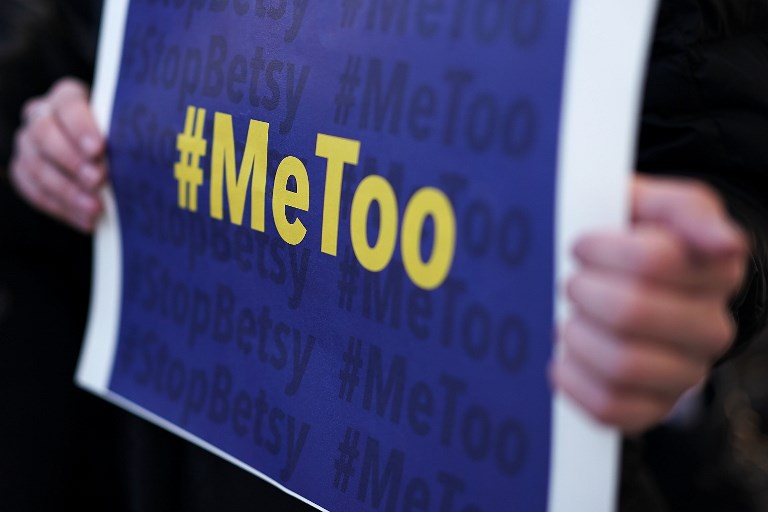
At the same time, the paper’s Hen Arzi-Srour links the death to the #MeToo movement.
“The level of suicide and physical and emotional damage among the victims of violence is unbearable. They, unlike those who hurt them, have no power or standing. They are the ones who are taken advantage of and always brought down. They cry in the dark, alone, out of sight. The victims die in secret. They have no name or face or identity,” she writes. “This isn’t shaming here since the article was well-founded, truthful and to the point: a man who admitted to his deeds. The time has come to say that in the age of #MeToo, the rules have changed. The victim has a voice, and the voice will no longer be quiet.”
Haaretz relegates most of its coverage of the suicide to its arts section, but the same general gist as in Yedioth comes through, including columnist Roni Bar calling the death a tragedy, but one that should not be on the head of Mako, the website that published the allegations.
“Mako journalists did their jobs and gave a voice to victims of sexual misconduct. From reading the investigation and without knowing what went on behind the scenes, it seems they worked carefully, in a well-founded and professional way. Once they became worried over Arad’s mental state they even sent a police car to his house. It’s easy to judge off the cuff, but they could not have known he would actually follow through with his threats,” Bar writes.
But in the same paper, Doron Koren writes that the journalists were out of line and too zealous in trying to join the #MeToo crowd, listing as their sins the fact that the sexual misdeeds were 25 years old and involved a consensual relationship, in his telling.
“The media is still not built to differentiate the severity of different sexual misdeeds,” he writes. “So maybe they will be more careful next time.”
https://www.timesofisrael.com/expose-leads-to-suicide-but-media-wont-play-blame-game/?utm_source=The+Times+of+Israel+Daily+Edition&utm_campaign=049f02dd32-EMAIL_CAMPAIGN_2018_02_04&utm_medium=email&utm_term=0_adb46cec92-049f02dd32-55186525