


The End of Leadership
Or, Why We Don’t Have Leaders Today — We Have Demagogues


Here’s a tiny question.
What happened to this generation of leaders?
Climate
change, financial crisis, inequality, debt, stagnation, robo-dystopia…a
nearly endless, panic-attack inducing list of Really Major Global
Issues Threatening the Ongoing Survival and Prosperity of Humankind…and
they mostly seem to be slumped over snoring at the wheel…when they’re
not busy clapping each other on the back steering us dead-on into the icebergs. (Goldbergs)
In
this little essay, I want to advance a small thesis. Many of today’s
leaders aren’t worthy of the word. Because they are not leaders at all.
So what are they? Let me explain, with a simple example.
There
is no good reason for American leaders, left and right, to have
inflicted decades of austerity on a society in which incomes have been
stagnant and living standards have fallen,inequality has spiralled, and
the average person’s future is ever more uncertain. No good reason at
all. Even the IMF has both renounced austerity and agreed that advanced economies can not just sustain, but probably need, a deficit to operate at optimal levels of productivity.
I
could repeat these stories with reference to politicians around the
globe. In Canada, Australia, Japan, China, Russia, Britain— where a
generation of politicians proclaims they “do not believe in” a European
Union whose living standards are vastly higher than theirs. Here is the
issue: there is simply no support — whether economic, ethical, or moral;
whether scientific, rational, or humanistic — for most of their
policies, stances, perspectives.
So what gives? What happened to this generation of leaders?
There
is something very different about many of today’s so-called leaders. It
is that they are demagogues. Let’s review what “demagogue” actually
means. Here’s a decent definition:
“a
person, especially an orator or political leader, who gains power and
popularity by arousing the emotions, passions, and prejudices of the
people.”
Let
me explain why that’s important, using the example of the 80s. A
generation of conservative politicians then — Thatcher, Reagan, and so
on — and the like — ripped up and rewrote social contracts wholesale.
So
what is the difference between them — and the demagogues of today? A
very great one indeed. There was intellectual and perhaps moral support
for the decisions the leaders of yesterday took.
Here’s a simple example. We may disagree now over trickle-down economics, since prosperity hasn’t trickled down. But at the time there was at least a reasoned position in support of it, built on a consensus amongst thinkers. You may think of the Laffer Curve as a simple illustration: it may have been proven largely wrong now, but at least there was an effort to produce a reason to slash public services then. (The Laffer Curve still proves correct today)
Here’s a simple example. We may disagree now over trickle-down economics, since prosperity hasn’t trickled down. But at the time there was at least a reasoned position in support of it, built on a consensus amongst thinkers. You may think of the Laffer Curve as a simple illustration: it may have been proven largely wrong now, but at least there was an effort to produce a reason to slash public services then. (The Laffer Curve still proves correct today)
The neo-demagogues of meta-modernity are very different. There is no serious intellectual, moral, or ethical support for their decisions at all. Demaogues
are irrational, insensible, not beyond reason — but scurrying in the
abyss deep below it. They are simply, as the definition simply says,
“arousing the passions and prejudices of people”. Let’s take immigration
as a simple example. Decades of logic — not to mention
evidence — confirm that (legal) immigration only benefits advanced economies.
Demagogues
do not act rationally or sensibly, reasonably or sanely — whether in
terms of economics, morality, politics, or anything else that might
justifiably be called a system of thought. Why not? They prey on our
emotions; they exploit our biases and prejudices; like magicians, they
devour our fears and dangle before us our wishes. They are sorcerers of
our animal beings. Pumping the bellows of unreason, they stoke the dark
fires that burn deep in the human soul.
It’s
true: empiricism alone can never guide us in the human world — but
still, we must struggle not merely to be prisoners of our biases and
prejudices. And that is precisely what demagogues reduce us to.
Unthinking servants of our own worst selves. The selves that, instead
of thinking, dreaming, wondering, rebelling, defying, creating,
loving — are filled with spite, greed, jealousy, fear, and, at last,
hate, of the self and the other, of god and man, of life and death
alike.
There
are many ways in which the institutions of modernity are decaying,
sputtering out, breaking down. But one of the most significant,
insidious, and damaging is that they no longer seem to reliably produce
leaders — but demagogues. And, in turn, demagogues are, of course,
historical bellwethers of decline, stagnation, disintegration.
True
leaders lead people to an impossible destination. It does not exist in
the world. It exists in being. They lead us towards to our better
selves. Those seared, impossibly, defiantly, courageously, with
happiness, purpose, meaning. Lives which may swim in the mighty river of
grace, and, because they give thanks for the boundless privilege of
life, bestow the gift of mercy and love upon each and every fellow
traveller they meet. That is the defining characteristic of every leader
that history remembers.
Demagogues
do not lead us to our better selves. They lead us to the very opposite:
our worse selves. They condemn people to become nothing more than
twisted, stunted caricatures of who they were meant to be. And by doing
so, they diminish what is truly most valuable in the world: human
potential.
For
the tragedy of the demagogue is this: the demagogue is an anti-leader.
He is not merely the absence of leadership. But the opposite. He is not
just the drought. He is the locust and the flood. His followers aren’t merely
left no better off — but also no worse off. Life’s most valuable
creation is what is truly wasted by demagogues. The one thing we may
each call our own. Ourselves.
Demagogues
reduce us to being empty, twisted, broken husks of the people we should
have been. People who, in the act of wasting their days on spite,
greed, envy, and anger, fail to develop, grow, become themselves — and
do great and mighty, noble and soaring things. That is why history
condemns not just demagogues. But also the people who eagerly follow
them. For they are prisoners. But they are also jailers. Each of whom
holds the key to the cell next door.
I
don’t think this is the end of leadership — forever. But I do think
that leadership is in deep, serious, and historic trouble today. As both
art and science, practice and pursuit, creation and gift. In all these
ways, I think that leadership demands abiding, radical reinvention — and
further, that reimagining it is going to require coming squarely to
terms with the failures and shortcomings that have produced a hollow
generation of demagogues with scarcely a single true leader amongst
them. And so it is up to each and every one of us who wishes to be a
leader to understand precisely why. For we can no longer conveniently
leave the necessary, worthy, difficult work of leadership at the
doorstep of the boardrooms and backrooms (and Agudah conventions).
Let
us remember where leaders truly lead each and every life that walks
with them. To lives brimming with purpose, riven with grace, seared with
love, overflowing with meaning. That is the truest miracle of all.
That, from mere things scurrying and clawing at one another in the
glittering darkness, we may follow one another to the pure light of our
higher selves.









The Arad suicide makes the front page of all three major dailies Sunday morning, and is accompanied by a goodly amount of commentary over the “hard questions” that followed, in Israel Hayom’s language.
Yedioth Ahronoth leads off with the story, which takes up almost the whole front page and the next three pages of the tabloid. One might think that the prominence the paper gives to what amounts to a very personal and domestic story is indicative of it seeing a larger scandal within, but the paper makes clear it has no truck with sympathy for the devil.
“Crime and punishment,” reads the headline of the paper’s main news story, which is accompanied by self-portraits from Arad of him shooting himself. The story notes that he was the third teacher in the Telma Yellin school in Givatayim to be accused in just two weeks, but mostly focuses on Arad and how the story on him led to his death. (Two complementary stories from the paper delve into the allegations of a wider harassment culture at the art school.)
As for the supposed hard questions, two of the papers’ commentators come to the same conclusion: He’s not a victim and the journalists were doing their job.
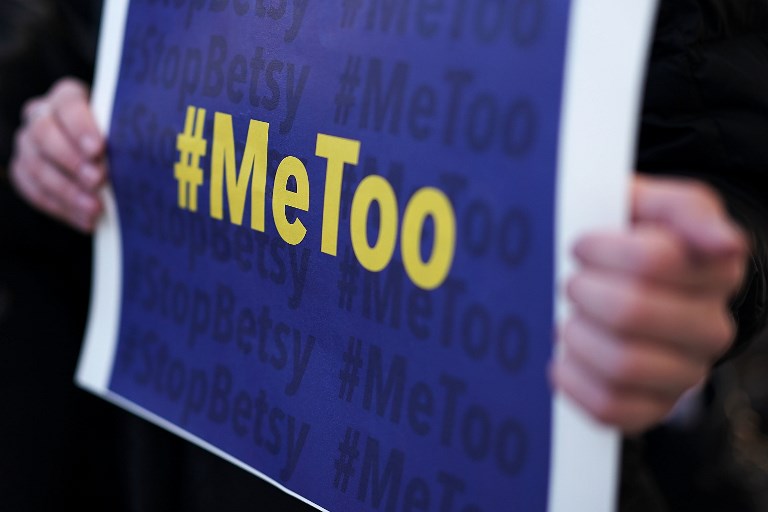
At the same time, the paper’s Hen Arzi-Srour links the death to the #MeToo movement.
“The level of suicide and physical and emotional damage among the victims of violence is unbearable. They, unlike those who hurt them, have no power or standing. They are the ones who are taken advantage of and always brought down. They cry in the dark, alone, out of sight. The victims die in secret. They have no name or face or identity,” she writes. “This isn’t shaming here since the article was well-founded, truthful and to the point: a man who admitted to his deeds. The time has come to say that in the age of #MeToo, the rules have changed. The victim has a voice, and the voice will no longer be quiet.”
Haaretz relegates most of its coverage of the suicide to its arts section, but the same general gist as in Yedioth comes through, including columnist Roni Bar calling the death a tragedy, but one that should not be on the head of Mako, the website that published the allegations.
“Mako journalists did their jobs and gave a voice to victims of sexual misconduct. From reading the investigation and without knowing what went on behind the scenes, it seems they worked carefully, in a well-founded and professional way. Once they became worried over Arad’s mental state they even sent a police car to his house. It’s easy to judge off the cuff, but they could not have known he would actually follow through with his threats,” Bar writes.
But in the same paper, Doron Koren writes that the journalists were out of line and too zealous in trying to join the #MeToo crowd, listing as their sins the fact that the sexual misdeeds were 25 years old and involved a consensual relationship, in his telling.
“The media is still not built to differentiate the severity of different sexual misdeeds,” he writes. “So maybe they will be more careful next time.”
https://www.timesofisrael.com/expose-leads-to-suicide-but-media-wont-play-blame-game/?utm_source=The+Times+of+Israel+Daily+Edition&utm_campaign=049f02dd32-EMAIL_CAMPAIGN_2018_02_04&utm_medium=email&utm_term=0_adb46cec92-049f02dd32-55186525