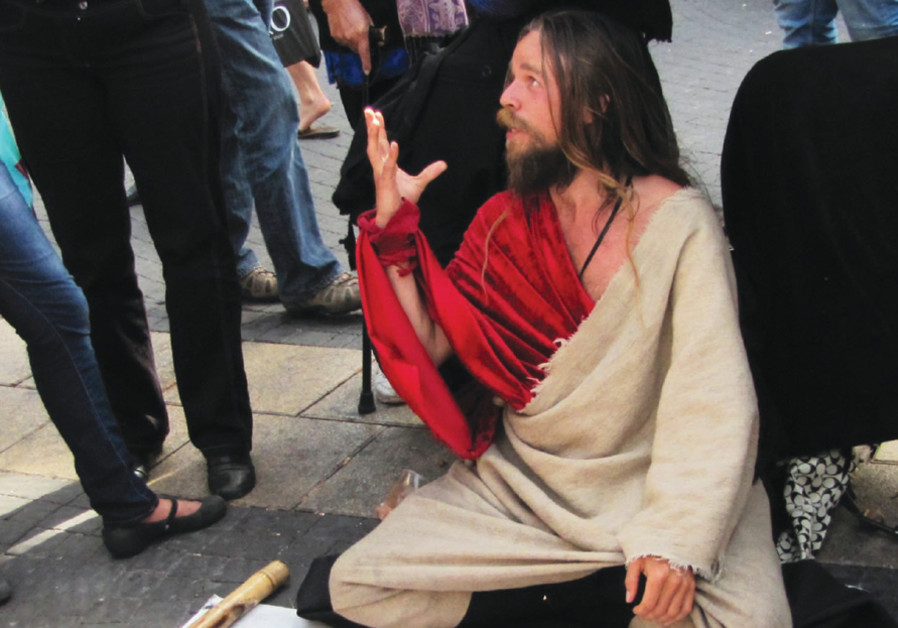
"Jerusalem syndrome” is a diagnosis commonly applied to explain the
behavior of certain unique “characters” who are sometimes seen roaming
the streets of the city.
Donning biblical garb, experiencing
delusions or hallucinations, taking on a different name, and refusing to
leave the city or Israel itself are some of the symptoms that are
considered evidence of this unusual affliction.
Is Jerusalem to blame for these episodes? Is there even such a
thing as Jerusalem syndrome? What is it about this place that has such a
strong and sometimes dangerous effect on some people?
The
phenomenon may have surfaced recently with the disappearance of a
British tourist during a visit to Israel several months ago.
Oliver McAfee, 29, disappeared while cycling the Israel Trail in the Negev at the end of 2017.
In
January, it was reported that McAfee, still not found, might be
suffering from Jerusalem syndrome, as police confirmed that he wrote
passages from the New Testament on several pieces of paper and rocks
that were found in the desert. The police added to the report that it
remained unclear if he had a psychological disorder.
The syndrome
is featured in an episode of The Simpsons, aired in 2010, where the
Springfieldians make a pilgrimage to the Holy Land with their church
group.
While the episode is loaded with fun Israeli-based satire –
Sacha Baron Cohen speaking in Hebrew as an almost too accurate
stereotypical Israeli tour guide – and a Simpsonified Jerusalem, near
the end of the episode Homer has a spat with his devoutly Christian
neighbor Ned Flanders, and the scene cuts to Homer riding a camel in the
desert. Reaching the Dead Sea after a sandstorm, Homer passes out, face
first, in the Dead Sea and awakens to proclaim he is the Messiah, after
having a vision of being visited by talking anthropomorphic vegetables.
Homer
returns to Jerusalem, donning a toga made of a bedsheet, and makes
lofty prophecies. He is diagnosed with Jerusalem syndrome.
Homer
ends up on the Temple Mount, standing before Christians, Muslims and
Jews and calling for a new religion based on their shared love of
chicken, after which all of the assembled stand up and proclaim that
they, too, are the Messiah.
Satire often imitates real life, as
Homer’s portrayal isn’t too far off from the description compiled by
mental health professionals.
JERUSALEM SYNDROME made its first
appearance in the medical books in the 1930s thanks to Heinz Herman, who
was a Jerusalem-based psychiatrist and one of the founders of modern
psychiatric research in Israel.
However, the jury is still out on
whether the syndrome arises independently or whether those who are
afflicted with it had other preexisting conditions.
Psychiatrists
Eliezer Witztum and Moshe Kalian, who for decades have worked
extensively with patients suffering with this affliction, have concluded
that it’s the latter.
Their study, “The ‘Jerusalem Syndrome’ –
Fantasy and Reality: A survey of accounts from the 19th century to the
end of the second millennium,” published in the
Israel Journal of Psychiatry and Related Sciences (1999),
aims to define this phenomenon and looks at nearly two centuries of
patterns of tourists who experience a temporary insanity and often
assume the role of prominent biblical figures.
Jerusalem
syndrome, according to the study, is a behavioral phenomenon observed in
eccentric and psychotic tourists who have been visiting the Holy Land
and has been recorded since the beginning of the 19th century. The
syndrome “should be regarded as an aggravation of a chronic mental
illness, and not as a transient psychotic episode.”
The study
notes the spiritual significance of Jerusalem which has been embedded in
both Jewish and Christian messianic traditions. The syndrome is related
to this notion of Jerusalem being the center of the universe as well as
the location of the “end of days” or redemption, depending on whom you
ask.
Witztum was a full professor in the division of psychiatry
at the Faculty of Health Sciences of Ben-Gurion University of the Negev.
He is the director of the School for Psychotherapy of the Beersheba
Mental Health Center. Speaking with In Jerusalem, he explains that
nearly all of the cases he has dealt with through the years have proven
that a
preexisting mental condition is the common thread of all of these
cases, and that when a tourist visits Jerusalem, this preexisting
condition is triggered in one form or another.
“It’s not a
disease but a cultural phenomenon,” says Witztum. “The Judeo-Christian
faiths have a lot of messianic prophecies that call on the tourists to
have visions, hear voices and go to the Holy Land and do this type of
holy work explained in the Bible; but when they get off the plane, it’s
another story.”
One of the triggers of the syndrome comes from unrealistic expectations before visiting holy sites.
“When
people land here, specifically on religious- based tour groups, they
have very high expectations of spiritual significance that were built up
prior to the trip; and when they get to these places and their
expectations are not met, they become disappointed, and this triggers
the symptoms of what is known as Jerusalem syndrome,” Witztum explains.
“Or
the expectations are built up so much that, upon reaching such places,
especially around the Old City, they become delusional and lose
themselves in the moment, triggering a psychotic or schizophrenic
episode.”
When this occurs, they most likely end up at Kfar Shaul
Mental Health Center, where Witztum has treated dozens of tourists
stricken with the syndrome.
“But when these people get to us,
nearly all of the patients have preexisting mental conditions on record,
and 50% of them are schizophrenic,” he adds.
He related the case
of a German chef who walked into a hotel, asked for access to the
hotel’s kitchen and spoke with the chef and the kitchen staff.
After
a while, he told the staff that he would be taking over the kitchen
because he was sent by God to prepare the “Last Supper,” as the end of
days was coming.
Naturally, the staff refused and a scuffle ensued, before the police were called.
The German chef was brought to Witztum, who treated him.
Although
this phenomenon primarily affects those of the Judeo-Christian faiths
when visiting Jerusalem, Witztum notes that similar patterns can be seen
among Muslims when they visit Mecca.
“So far, there has been one paper
written about this, but I believe this is just a hint of a much larger
phenomenon that can be seen in Mecca and Medina in Saudi Arabia.”
DEBRA
NUSSBAUM STEPEN, a Jerusalem-based licensed tour guide and former
psychotherapist originally from Los Angeles, has seen this phenomenon in
the clinical world and now also in her daily life as a tour guide.
“Walking
around the Old City, I have seen people speaking in tongues and having
ecstatic experiences in and near holy sites,” Stepen tells IJ. “You are
walking in the footsteps of Jesus or King David... and that brings out
the connection with the land and the person’s connection with their
spiritual side.
“I’ve seen the Christian pilgrim groups and they
are experiencing where Jesus walked, and the pastor reads them
Scriptures and it just clicks or something.
“You see the Nahman
guys singing and dancing – that’s not Jerusalem syndrome; that’s them
being them and it’s not crazy. Same thing with newly religious people
who dress in all white and dance fervently with their eyes closed on the
roof of the Aish HaTorah building [which overlooks the Western Wall].”
She
explains that diagnosing Jerusalem syndrome can be a slippery slope:
“It is very important not to misdiagnose something that could either be
considered psychosis or a spiritual experience.”
Stepen says that
people in their late teens and early twenties who are predisposed to
schizophrenia and other mental illnesses tend to experience their first
episode the first time they leave home.
“I have seen the sudden
change and stress of this experience, particularly among gap-year
participants, but this is not Jerusalem syndrome and should not be
labeled as such.”
“What we are dealing with,” says Witztum, “are
mainly the cases that are disturbing the peace: people who sleep on the
street or make a scene; but I believe there are more cases that are
going unreported.”


 Coach Jim Cleamons was selected in the very first round
of the 1971 NBA Draft by the L.A. Lakers. Coach Cleamons has 10 NBA
Championship rings, 1 as a player with the 1972 Los Angeles Lakers and 9
coaching the Chicago Bulls and LA Lakers. Coach Cleamons and his 1972
Laker team still hold the record for most games won in a row, 33! He
played his college ball at Ohio State and was named All NBA Defensive
Team in 1976 with the Cleveland Cavaliers. Coach Clemons was also an NBA
Head Coach with the Dallas Mavericks and New Orleans Hornets. He
coached superstars such as Michael Jordan, Shaquille O’Neal, Kobe
Bryant, Jason Kidd, and many other elite NBA and College players. Coach
Cleamons was selected to be in the Ohio basketball Hall of Fame in 2008.
He continues to energize and teach our youth on a daily basis and
currently consults and assists with the YULA Boys varsity basketball
team in Los Angeles. Coach also runs a one of a kind Community summer
basketball and life camp in South Los Angeles. He conducts numerous
basketball clinics throughout the country and is also working on a new
book detailing his incredibly successful life journey. Coach Cleamons
and his wife, Cheryl, reside in Manhattan Beach, CA and have two
daughters.
Coach Jim Cleamons was selected in the very first round
of the 1971 NBA Draft by the L.A. Lakers. Coach Cleamons has 10 NBA
Championship rings, 1 as a player with the 1972 Los Angeles Lakers and 9
coaching the Chicago Bulls and LA Lakers. Coach Cleamons and his 1972
Laker team still hold the record for most games won in a row, 33! He
played his college ball at Ohio State and was named All NBA Defensive
Team in 1976 with the Cleveland Cavaliers. Coach Clemons was also an NBA
Head Coach with the Dallas Mavericks and New Orleans Hornets. He
coached superstars such as Michael Jordan, Shaquille O’Neal, Kobe
Bryant, Jason Kidd, and many other elite NBA and College players. Coach
Cleamons was selected to be in the Ohio basketball Hall of Fame in 2008.
He continues to energize and teach our youth on a daily basis and
currently consults and assists with the YULA Boys varsity basketball
team in Los Angeles. Coach also runs a one of a kind Community summer
basketball and life camp in South Los Angeles. He conducts numerous
basketball clinics throughout the country and is also working on a new
book detailing his incredibly successful life journey. Coach Cleamons
and his wife, Cheryl, reside in Manhattan Beach, CA and have two
daughters.