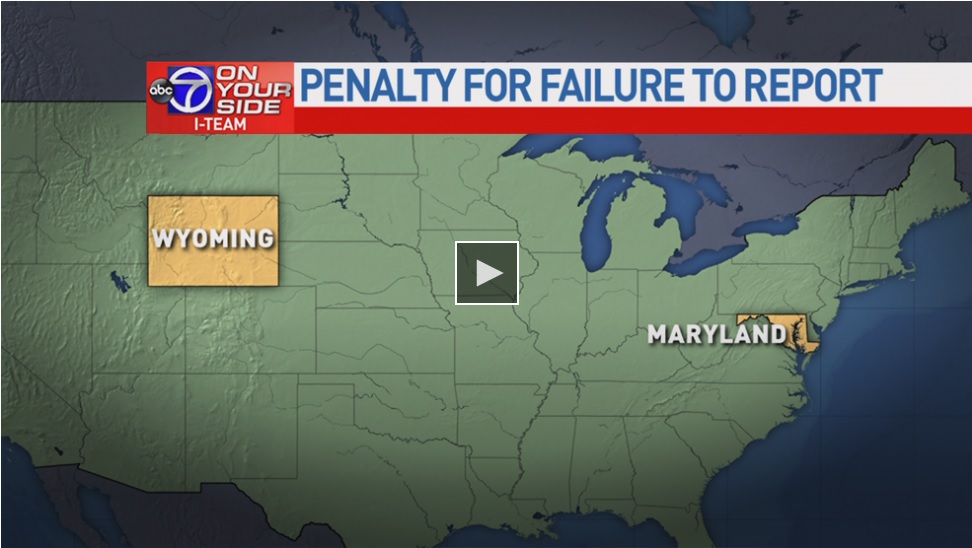
Maryland Finally Enacts Penalties for Failure to Report Child Abuse
On April 18, 2019, Maryland took a big step towards protecting
children when Governor Hogan signed a law creating criminal penalties
for a mandated reporter who fails to report child sexual abuse.
Mandatory reporting laws
date back to the Child Abuse and Treatment Act (CAPTA) of 1974, and
require certain people with knowledge of child abuse to report it to
authorities. Until this 2019 legislation, Maryland was one of only two
US states (the other being
Wyoming)
to have mandated reporting on the books, but have no criminal penalty
failing to report child abuse. Imagine lowering the speed limit to save
lives, but then having no tickets for speeding.
A law with no penalty is no law at all. While past failure to report could result in civil liability for the person not reporting abuse immediately,
Maryland House Bill 787 establishes criminal penalties. Versions of this bill have been proposed in Maryland for
over 15 years, so the passage is a cause for celebration.
After
my family was victimized in the state of Maryland by a member of the
clergy, I learned that Maryland has some of the worst protections for
sexual abuse survivors in the United States. Maryland police regularly
ignore reports of rape, closing them as “unfounded” at nearly twice the rate in other states. When a victim pushes their case, police in Maryland
force victims to sign waivers or recant entirely. And when a victim has the nerve to question the police, Maryland state attorneys are alleged to
get aggressive not with sex abusers, but with abuse victims.
Maryland also lacks strong anti-SLAPP laws to protect those who report abuse from being sued for defamation by their abusers. Even teachers indicated by CPS for abuse (but not prosecuted)
get transferred from school to school, and only in 2018 did Maryland’s largest school system
complete CPS background checks of teachers. If you like the beach, you move to Florida. If you like to ski, you move to Colorado.
Maryland’s legal environment makes it a sandy beach (or a powdery ski slope) for those who like to sexually abuse children.
In fact, Maryland Delegate C.T. Wilson noted that Catholic
priests seeking to escape punishment for abuse in Pennsylvania have been
relocating to Maryland. Wilson plainly stated, “Maryland was a repository for bad actors because we had soft laws.”
The first big recent change to Maryland’s hostile environment to victims came in 2017 when Wilson sponsored a bill to
expand the civil statute of limitations window from 25 to 38, understanding that it can take decades for abuse survivors to come forward. With
a criminal justice system easy on sexual abuse, expanding the civil window is the next best step for victims to obtain justice.
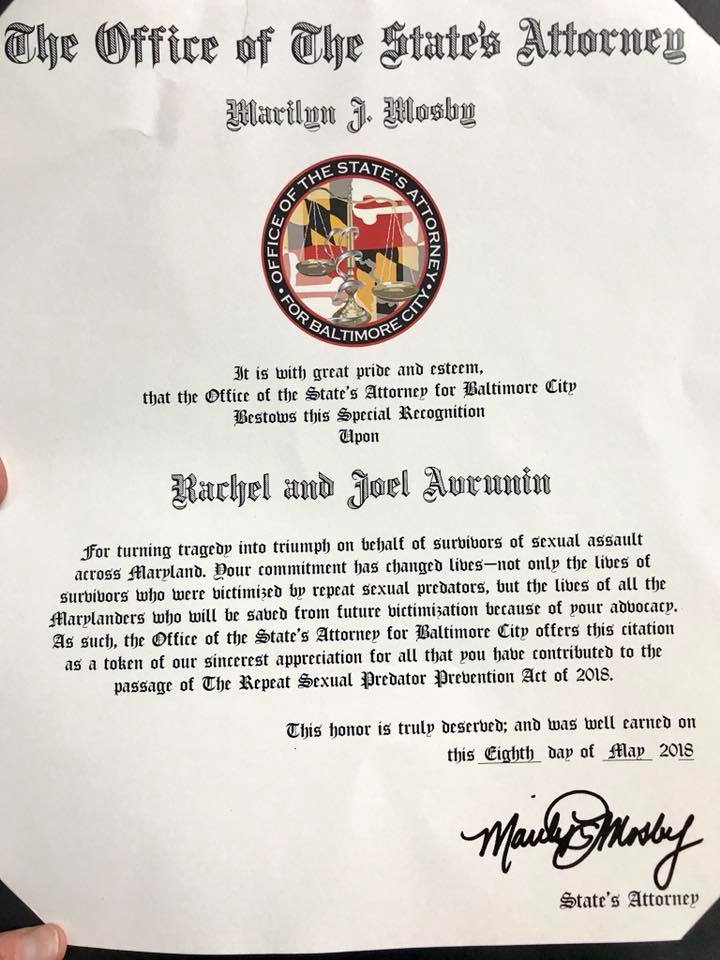
The next big change came in 2018 when I had the honor and privilege to provide testimony to Annapolis in support of the
Repeat Sexual Predator Prevention Act, being championed by
Baltimore City States Attorney Marilyn Mosby.
Prior to this act, in the rare circumstance police investigated sex
crimes, and in the rarer circumstance charges were filed, the
rules of evidence in Maryland
prevented prosecutors
from introducing evidence of other sexual crimes. Maryland’s rules
prevented the introduction of patterns of sexually abusive behavior as
evidence (including multiple victims). The 2018 law had languished in
committee for years, being opposed by Jewish leadership, Catholic
leadership, and criminal defense attorneys. Once it got
out of committee, it passed, and Maryland took another big step towards protecting children and other victims of sexual abuse.
However, the accompanying bill to establish criminal penalties for not reporting child abuse did not make it to a vote in 2018.
In 2019 Maryland took the next big step in victim protection, when
the criminal penalties not only got a vote, but were signed into law. I
cannot find another article celebrating Governor Hogan signing this
bill, and it is quite important in the battle to improve the law and
make sure no other family goes through what my family has endured.
Maryland’s failure to report law previously did not address penalties for violations, only penalties for
interfering in a report. Maryland Family Law § 5-705.2 stated:
An individual may not intentionally
prevent or interfere with the making of a report of suspected abuse or
neglect as required by law. A person who violates this section is guilty
of a misdemeanor and, on conviction, is subject to imprisonment not
exceeding 5 years or a fine not exceeding $10,000 or both.
No penalty was established for those who delayed reporting or failed
to report altogether. Even Maryland legislators had no idea the gaping
hole in their own law. Maryland Senator Joan Carter Conway (D-Baltimore)
said,
I was shocked. I didn’t realize that we were only one of two [states without penalties for failure to report]
The
new law faced opposition
from those who thought the punishment was draconian, and that taking
away professional licensing was punishment enough for failure to report.
In fact, Del Kathleen Dumais (D-Montgomery)
reportedly said
that since the 2015 license revocation law hadn’t been used, they
shouldn’t pass more laws. Arguments like these, combined with opposition
from the Jewish and Catholic lobbies kept this bill languishing in
committee.
The new law modifies Section 5-704 of the Maryland Code of Family law where mandated reporters are defined by
adding the following language:
(B) A PERSON WHO VIOLATES THIS SECTION IS
GUILTY OF A MISDEMEANOR AND ON CONVICTION IS SUBJECT TO A FINE NOT
EXCEEDING $10,000 OR IMPRISONMENT NOT EXCEEDING 3 YEARS OR BOTH.
While this law alone does not solve the sexual assault investigation
and prosecution gap in Maryland, it does provide a tool for more
progressive prosecutors to begin unraveling this crime.
Unfortunately loopholes still exist. Maryland Code of Family Law
Section 5-704 defines mandatory reporters as:
…health practitioner, police officer, educator, or human service worker, acting in a professional capacity
But Maryland Code of Family Law
Section 5-705 provides an exemption from these laws from clergy if they are:
bound to maintain the confidentiality of that communication under canon law, church doctrine, or practice
 |
| Rabbi Shmuel Kamenetsky |
Unfortunately, the clergy exemption
is still too prevalent in many states. Maryland law does not clearly
differentiate between a Rabbi operating within confidential canon
law/rabbinic doctrine, and a Rabbi who is working as a teacher, a school
principal, a camp director, or a medical doctor. The largest Jewish
community in Maryland mostly follows the rulings of the Agudath Israel
of America, who requires rabbinic approval
prior to reporting abuse. One of the largest religious schools
specifically brings questions to Rabbi Shmuel Kamenetsky who also requires Rabbinic screening of child abuse
prior to reporting. Rabbis in Maryland trained at the local Ner Israel
rabbinic college advise that when there is an indication of abuse, people should
Call CHANA [our religiously directed private community
organization], and together with their guidance and support, they will
help you navigate if and when to involve the police, CPS, or whatever
may be most appropriate.
Should
a school principal, teacher, or healthcare worker be charged under the
new mandatory reporting law, the vague wording will put prosecutors and
judges in the uncomfortable situation of litigating the intricacies of Jewish law (halacha). Will the rabbis who delay reporting abuse
while they run internal investigations be able to claim their behavior
is in keeping with canon Orthodox Jewish law? What makes a person a
Rabbi? In the ultra-Orthodox world, often a formal ordination (smicha) process is not required, merely a letter from a school principal (Rosh Yeshiva) calling a student a Rabbi. Could a school teacher charged under the new law get a last minute smicha exempting him from the law?
Catholic opposition to clergy reporting is actually
starting to abate, led by new initiatives. It certainly helps that prosecutors in Maryland have
started to look through files of the archdiocese of Baltimore.
As of today, the most vocal opponents of mandatory clergy reporting are not Catholic but Jewish. In response to mandatory clergy reporting laws being debated in neighboring Washington DC and
Virginia, Rabbi Shmuel Herzfeld provided what I would term a strawman argument as he
commented:
Turning clergy into policemen is very dangerous…….If we try to hurt how religious societies function, it will hurt children
Ron Halber of the Jewish Community Relations Council of Greater Washington offered tepid support to clergy reporting, but then
walked it back with the caveat:
In some traditions there are privileged communications
that take place between religious authorities and parishioners. We want
to make sure there’s nothing blocking free exercise
It is ironic that prosecutors in Maryland are investigating
the Catholic Archdiocese of Baltimore, but have made no public inquiries
into the Jewish Archdiocese (known as the Vaad of Baltimore and Vaad of
Greater Washington). A push for mandatory clergy reporting in Maryland as is currently under debate in DC and
Virginia would be a great first step.
The problem is that Maryland Code Sections 5-704 and Sections 5-705
are in conflict due to the vague language. The legislature could fix
this in at least two ways. First,
narrow the legal definition of clergy-communicant privilege
by defining who can claim the religious exemption and when. A Priest
must have a church, and a Rabbi must have a synagogue. The disclosure
must be in a
recognized protected conversation. Right now the law fails to
clearly differentiate abuse
learned through spiritual privilege, and abuse heard through other
means, such as while playing a game of basketball. The aforementioned
Jewish community group that reportedly chooses which cases to report to
police will sometimes refer abuse victims to a Rabbi for therapy.
Is that Rabbi required to report child abuse he learns about because he
is a therapist, or is he exempt from reporting because he is a Rabbi? The law does not make it clear.
Even better, the second way would be to just do away with this
exemption and solve the problem as dozens of other states have already
done (and has been largely upheld by the courts such as in California).
There are limits to what you can do under the guise of religion. Freedom
of religion doesn’t permit human sacrifice. Most states rule that
freedom of religion does not permit child brides and polygamy. Even the
religious exemption for
vaccination is
being reconsidered.
Likewise, we should not allow child abuse or child abuse disclosure to be protected as a religious act.
Ultimately,
the vague clergy exemption will need to be litigated by the first
prosecutor who is courageous enough to challenge the Jewish and Catholic
lobby in the state of Maryland. It is important that elected officials
begin to ask difficult questions of those in law enforcement who seem
more angered by vocal victims than by abusers.
Abusive prosecutors and
abusive sheriffs
are nothing new, and despite operating under broad immunity, federal
investigations and groups like the ACLU have worked to reform these
practices. Ultimately, the citizenry has to demand accountability from
those in charge.
Prosecutorial tolerance
for Orthodox Jewish abusers and those who fail to report abuse such as
has been documented in Baltimore, Lakewood, and Brooklyn must end.
Publicize this new law. Call the editors at the
Baltimore Sun, the Frederick News Post, and the Washington Post and ask
them why they haven’t covered this legislation. It will soon be a
criminal offense to fail to report child sexual abuse for mandatory
reporters. It is time citizens of Maryland ask prosecutors running for
States Attorney what they have done to enforce this new law and to ask
legislators to stop allowing religious exemptions for mandatory
reporting of child abuse.
It is also time to build on the
success of 2018 and 2019 by rallying for mandatory clergy reporting,
police investigatory reform, removing the civil statute of limitations (which sadly failed in 2019), and anti-SLAPP free speech legislation for survivors of sexual assault.
—
Note: I am not a lawyer and this
column is not meant as legal advice but merely opinion on public
legislation. If you have questions on your own legal situation, consult a
competent attorney. Always report child abuse to the proper authorities
in your state.
https://blogs.timesofisrael.com/maryland-finally-enacts-penalties-for-failure-to-report-child-abuse/?fbclid=IwAR055e95Ti4BcwCvDTSng4B5pHZUr1k6EnpX35DgCdOyFM8LvFauhudvr40