The war as an intelligence lab, understanding the failure leading to Hamas massacre
Analysis: The
roots of the present catastrophe are not limited to the events of the
night between October 6 and 7 but reflect an extreme and long-lasting
lack of understanding of the enemy
An IDF tank overtaken by Gaza residents during the Hamas massacre on Oct. 7
The current discourse is nothing more than a fervent search for keys under the streetlight. The point of departure is that intelligence experts have sharp minds, and therefore, the search for flaws and suggested solutions should focus primarily on this aspect.
Thus, ideas are raised for improving thinking and assessment formulation designs and processes (particularly the groupthink challenge), as well as for developing new methodologies, enhancing control systems, revisiting technology’s dominance in intelligence work, or optimizing the relations between various intelligence organizations.
The analysis of the defects does not include two other aspects that are viewed as secondary. The first – the behavioral/personality dimension that plays a key role in all modern-day intelligence failures, including October 7.
Intelligence work is spearheaded by people with extraordinary qualities, but they are not immune to the fundamentals that are often found to underlie any disaster: self-assuredness; arrogance; dogmatism; difficulty in doubting and encouraging pluralism; as well as profound knowledge gaps with regard to the nature and logic of their objects of study.
Senior
intelligence officers spoke of the lessons learned from the past,
primarily the need for humility and caution, while being blind to the
fact that they themselves were symptomatic of the same disease
This point is further accentuated in view of the October 7 fiasco occurring precisely half a century after that of the Yom Kippur War. In the weeks that led up to October 7, events were held to mark 50 years to the 1973 War, during which senior intelligence officers spoke of the lessons learned from the past, primarily the need for humility and caution while being blind to the fact that they themselves were symptomatic of the same disease that soon swept them up in a whirlwind no less shocking than the Yom Kippur War. One possible solution is commanders and consultants who alert to personal behavioral patterns that impact professional work.
The second aspect that has been overlooked is far more grievous, and pertains to the portrait of intelligence officers, as well as to the world of knowledge with which they are charged. Limited familiarity with the basic characteristics of their objects of study, who operate in a culture very different from our own, is an issue that has already been raised in the inquiry into the 1973 debacle. But although understood, it was not addressed, and so – as overlooked malfunctions tend to do – was preserved, enhanced, and ultimately erupted with great force. In recent decades, fewer Israelis are fluent in Arabic and proficient in the region’s culture and history, but, while true for Israeli society as a whole, this issue is of particular significance among intelligence officers tasked with cracking the logic that drives “the other side.”
This state of affairs reflects a severe crisis few are aware of or discuss with which the intelligence profession has been contending in recent decades in Israel and worldwide. Over the years, intelligence has transformed from a vivacious experience that centers primarily on people, and should therefore rely on the tools essential to analyzing their psyche, to a form of science reliant upon complex methodologies and philosophical conundrum-cracking, which gradually steered clear of focusing on individuals, especially those affiliated with other cultures.
It is against this backdrop that the portrait of intelligence officers has been shaped, including the skills they are required to possess, the assignments they are required to complete, and how they are to be trained. Their minds are sharp and they are far more knowledgeable now due to information explosion, but their understanding of the reality that they are researching has diminished.
When
the roots of a failure remain untouched, it is no surprise that past
flaws resurface, headed by the tendency to impose our own logic on our
object of study
The roots of the present catastrophe are not limited to the events of the night between October 6 and 7. This failure reflects an extreme and long-lasting lack of understanding of the enemy. The intelligence inquiry cannot end with a description of the roots of the misconception, but must proceed to analyze how it was formed, why it had endured for as long as it did, and why it was so widely held as a “solid truth.” The lessons raised thus far with regard to the roots of the intelligence fiasco can be likened to the advice of a plastic surgeon pursuing aesthetics when the touch of a geneticist is needed to break down the intelligence officers’ DNA and critically examine its effectiveness in view of the assignments they are required to complete.
When the roots of a failure remain untouched, it is no surprise that past flaws resurface, headed by the tendency to impose our own logic on our object of study, as reflected in the economic arrangement conception vis-à-vis Gaza, as well as the notion that Hamas is undergoing an “evolution” that is lessening its adherence to its extreme ideological vision. This problem is reflected in a document recently drafted by Israeli military intelligence on the roots of the misconception, arguing that the intelligence misunderstood that the enemy was not driven by “rational logic” but by “jihadi instinct.” The same was said of Yahya Sinwar in the years that led to October 7, exempting the intelligence agencies from the need to deeply analyze the enemy’s logic by claiming it is irrational.
The ongoing war serves as an intelligence lab for identifying gaps and validating competence: October 7 revealed a flaw in the ability to alert to war founded on the difficulty of understanding the enemy; the Israeli surprise in view of the Iranian attack in April 2024 – following the strike against the consulate in Damascus – also reflected a gap in assessing the enemy’s logic; and the surprising collapse of Assad’s regime revealed a lack of understanding of in-depth processes and formation dynamics.
A poignant analysis of the roots of October 7 must cause unease among intelligence officers, not only because they had failed to alert to the enemy’s intentions and had misread the latter, but because many of them are not well-versed in the enemy’s language and cultural codes – essential components in the toolbox of those who engage in cultures that are not their own, such as historians, journalists, and, of course, intelligence officers. The latter must recognize that technology and methodology cannot make up for profound understandings.
Did It Exist or Not? The Missing Order of the Jerusalem Talmud
Discoveries and disappointments, rumors and accusations,
fraudsters and conspiracies—along with an adventurous journey across the
dusty roads of Turkey. This is the story of a controversy that shook
the world of Torah study and academic research 120 years ago.
As if the early decades of the 20th century weren’t turbulent
enough—especially in the Jewish world—a storm that erupted in 1905 sent
shockwaves through the community of Torah scholars for years. It was a
global controversy, brimming with drama, and if you aren’t already
familiar with this story, it’s about time you heard it!
Before diving into the details, let’s set the stage. The Mishnah,
compiled by Rabbi Judah the Prince around 200 CE, is divided into six
orders (shas): Zera’im (Seeds), Mo’ed (Festivals), Nashim
(Women), Nezikin (Damages), Kodashim (Holy Things), and Taharot
(Purities). Each order is further divided into tractates.
About 150 years later, in the Land of Israel, the Jerusalem Talmud
was compiled. Later, in Babylonia, the Babylonian Talmud was written.
Both Talmuds expand upon and explain the Mishnah, documenting legal
discussions and the evolution of Jewish law as debated by the sages of
their time. However, not every tractate of the Mishnah is included in
the Talmud (Gemara), and some tractates appear in only one of the two
Talmuds. For instance, the Babylonian Talmud contains tractates from
parts of Kodashim, but the Jerusalem Talmud lacks the order of Kodashim
altogether.
Or at least, that’s what was believed—until 120 years ago. And thus, the controversy was born.
A Lost Manuscript or a Fabrication?
For centuries, scholars debated whether the Jerusalem Talmud once
included the order of Kodashim and was lost over time, or if it was
never compiled in the first place. According to Maimonides and several
other authorities, a Jerusalem Talmud for Kodashim did exist nearly
1,700 years ago. Others argue that it never did.
In 1868, Rabbi Benjamin Hirsch Auerbach claimed he had heard that a
manuscript of the Jerusalem Talmud on Kodashim was hidden in the Vatican
Library in Rome. This rumor attracted fraudsters, who, in 1873,
attempted to collect money from unsuspecting Jews to fund a trip to
Rome, where they would supposedly retrieve and publish the lost text.
However, they were exposed before any damage was done, and Vatican
experts confirmed that no such manuscript existed in their collection.
Fifty years later, in the 1920s, Rabbi Mordechai Farhand, a dayan
(rabbinical judge) from the Nitra community, traveled to the Vatican to
search for the manuscript. He found nothing.
The Vatican Library, image from the Vatican Library website
But in fact, the Vatican episode was one of the milder chapters in the saga of the missing tractate.
A Dramatic Announcement
In 1905–1906, an electrifying proclamation spread across the Jewish
communities of Europe. According to the announcement, Rabbi Shlomo
Yehuda Elgazi S”T (Sephardi Tahor, or “pure Sephardi”), also known by
the Ashkenazi surname Friedländer, from the city of Satmar, had
discovered the lost Jerusalem Talmud order of Kodashim. He intended to
publish it, complete with his own original commentary, as a continuation
of his earlier work Cheshek Shlomo, which covered other orders of the Jerusalem Talmud.
Excitement swept through the world of Torah study. Leading rabbis
endorsed the printing of the long-lost text. A year later, the first
volume, containing the tractates Chullin and Bekhorot, was offered for
sale.
Seemingly overnight, contradictions that had puzzled scholars for
centuries—regarding laws of ritual slaughter, Temple service, and
sacrificial offerings—were resolved. Difficult halakhic questions found
clear answers, all thanks to Friedländer’s newly printed Talmud.
A
letter written by Friedländer to the scholar Shlomo Buber regarding the
Jerusalem Talmud. From the Shwadron Collection, the National Library of
Israel.
A Treasure Hunt Across Turkey
Where had Friedländer found the lost order of Kodashim?
In his introduction to Tractate Chullin, he described the discovery
in vivid detail. According to his account, his brother, Eliyahu Elgazi,
traveled to Izmir on business and purchased books from the estate of
Rabbi Yehoshua Benveniste, who had died in Turkey 250 years earlier.
Among the volumes were first-edition printings of the Jerusalem Talmud,
annotated by Benveniste himself. Eliyahu, knowing his brother was
writing a commentary on the Jerusalem Talmud, sent the books to him.
In one of the volumes, Friedländer allegedly found two old letters that deepened the mystery.
One letter, signed by the Chief Rabbi of Constantinople, expressed
support for publishing Rabbi Benveniste’s annotations on the Jerusalem
Talmud for Kodashim. This suggested that such a manuscript did indeed
exist. The letter detailed how a converso named Don Abraham HaLevi, who
lived in Lisbon, had befriended a priest from Barcelona who was also a
former converso. The priest entrusted Don Abraham with a bundle of
manuscripts, which he then carried with him to Turkey. There, he gifted
them to Rabbi Benveniste, who had helped him return to Judaism. Among
the documents, Rabbi Benveniste was astonished to find the long-lost
Jerusalem Talmud on Kodashim.
But the second letter painted a different picture. According to this letter, Rabbi Benveniste ultimately decided not
to publish the manuscript, fearing that it would be seen as heretical.
At the time, the Jewish world—especially in Turkey—was still reeling
from the false messianism of Shabbetai Tzvi, whose radical teachings had
led to the abolition of many religious commandments. The discovery of a
“new” Jewish text, especially one as significant as a missing section
of the Talmud, might have raised suspicions and been used as
justification for further religious upheaval.
Friedländer was captivated by these letters. He had to find the manuscript.
His brother Eliyahu and their friend, Rabbi Yaakov Kobi, embarked on
an adventure across Turkey, searching for descendants of Rabbi
Benveniste in the hopes that one of them still possessed the treasure.
Eventually, they tracked down a villager named Suleiman Benveniste, who
showed them an amulet wrapped in silk, claiming it was the missing
Talmud. To their disappointment, the manuscript was in terrible
condition, with large sections missing.
Eliyahu and Yaakov convinced Suleiman to send the manuscript to
Friedländer in Hungary, promising him a share of the profits from its
publication. According to Friedländer, a colophon at the end of the text
revealed that the scribe, Yitzhak Bar Yosef Albergloni, had copied the
Talmud in the year 1212 from a carefully edited manuscript once owned by
Hai Gaon, the leader of Babylonian Jewry at the time.
If true, this was a stunning discovery. The lost Jerusalem Talmud had finally been revealed.
The War for the Truth
But the euphoria was short-lived. The first to dampen the excitement
of Torah scholars and talmudic researchers was Rabbi Dov Aryeh Ritter of
Rotterdam, who, in an article, described his initial joy at hearing
about the discovery—only to later express disappointment upon realizing
it was a forgery. Soon, other rabbis across Europe began questioning the
authenticity of the book. Rabbi Dov Baer Ratner of Vilna published a series of articles exposing Friedländer’s fraud.
Rabbi Ritter’s article (Der Israelit, June 1907).
Friedländer, however, did not sit idly by. He fiercely responded to
anyone who suggested that the text was a forgery. One of his students,
Avraham Rosenberg, wrote a scathing rebuttal in his book Aneh Kesil (Answer a Fool), directly attacking Rabbi Ratner.
Aneh Kesil (Answer a Fool), Avraham Rosenberg, 1908.
Another prominent critic of Friedländer was Rabbi Meir Dan Plotzky, who, in his book She’alu Shalom Yerushalayim,
systematically analyzed the text and demonstrated that it was
fraudulent. Another of Friedländer’s students, Yosef Ben Mahar”i, came
to his teacher’s defense in his book Herev Nokemet (Avenging Sword), launching personal attacks on Rabbi Plotzky but failing to address the substantive evidence of forgery.
She’alu Shalom Yerushalayim and Herev Nokemet
Despite mounting skepticism, Friedländer published another volume of
the so-called Jerusalem Talmud—this time on the tractates Zevachim and
Arakhin.
Jerusalem Talmud, Tractate Zevachim
Meanwhile, the Rebbe of Gur and many others demanded to see the
original manuscript, which Friedländer claimed was kept by Suleiman
Benveniste. But Friedländer repeatedly evaded such requests. No one ever
saw the manuscript or the letters he claimed to have discovered in
Turkey.
The Mask Falls
Jewish Europe was in turmoil. Some were thrilled by the discovery,
while others decried it as an elaborate fraud. At the height of the
controversy, Rabbi Zvi Hirsch Halevi Horowitz of Hermannstadt published
damning information on another deception by Friedländer: He had claimed
to have received an amulet from a Zurich museum, allegedly written by
Rabbi Jonathan Eybeschutz, from which he supposedly deduced that
Eybeschutz was a Sabbatean. Rabbi Horowitz’s investigation, however,
revealed that no such amulet existed—Friedländer had fabricated the
entire story to bolster his supposed expertise in deciphering
manuscripts. With this revelation, many concluded that his “students”
Avraham Rosenberg and Yosef were fictitious as well, and that
Friedländer himself had authored the books defending his fraudulent
claims.
The final blow to Friedländer’s reputation came from the rabbis of
Dvinsk—Rabbi Yosef Rosen, known as the Rogatchover Gaon, and Rabbi Meir
Simcha of Dvinsk—who officially declared the Jerusalem Talmud on
Kodashim a forgery. It remained unclear, however, whether Friedländer
had personally forged it or had acquired the forgery from another
source.
Over time, pieces of real information about Friedländer surfaced. He
had claimed to have studied at the famed Volozhin Yeshiva and to have
served as deputy rabbi of Frankfurt, head of a rabbinical court in
western Germany, assistant rabbi of Satmar, and head of a yeshiva. None
of this was true.
So, who was he, really?
He was born in Belarus under the name Zusia. A gifted and intelligent
young man, but certainly not a Sephardi named Elgazi. He married a
woman, abandoned her during his wanderings, and later married another
without ever divorcing the first. He was a talented scholar, impressing
rabbis with his knowledge and articles published in Torah journals.
“The Truth Is That I Forged It”
There is no doubt that Friedländer had a unique talent. He crafted a
complex and intricate story about discovering the manuscript, and if he
indeed wrote it himself, he must have possessed deep knowledge of
rabbinic literature and persuasive writing skills. According to Rabbi
Yaakov Tzvi Yanovsky in his 1913 pamphlet Tzaid Ramaiah (Hunting for Fraud), Friedländer relied heavily on the book Yafeh Einayim
by Rabbi Aryeh Leib Yellin. This book compiled Talmudic discussions
from across rabbinic literature, making it an excellent resource for
inserting relevant citations—or even fabricating new ones.
Friedländer also exploited legal rulings by Maimonides and his
contemporaries that lacked explicit sources. Conveniently, he “found”
those missing sources in his own forged Jerusalem Talmud. In response to
Rabbi Yanovsky’s accusations, Friedländer published a rebuttal pamphlet
titled Letz Hayayin (The Wine Jester), predictably attacking his critic rather than addressing the evidence.
Tzaid Ramaiah (Hunting for Fraud), by Rabbi Yaakov Tzvi Yanovsky, 1913
Years after Friedländer’s death, the truth came to light. In a 1951 article published in HaPardes,
Rabbi Yekuthiel Yehuda Greenwald described his encounters with
Friedländer in Khust and later in Satmar. As a young man, Greenwald had
been impressed by Friedländer’s charismatic and mysterious persona,
supporting him during the Jerusalem Talmud controversy. But in the
article, written nearly 40 years after the scandal, Greenwald revealed
what Friedländer had once admitted to him: “The truth is that I forged
it. I did not find a manuscript, but everything I wrote was composed
from the words of the sages that I gathered from various sources.”
Many books and articles have been written about this strange affair.
Today, it is widely known that the Jerusalem Talmud order of Kodashim is
a forgery, and yet it was reprinted in facsimile edition in Israel in
1996 and in the United States in 2003. But does anyone actually want to
study it?
More recent printings of the forged Jerusalem Talmud order of Kadoshim
If you still have your doubts, come visit the National Library, order
a copy from our rare books collection, and see for yourself!
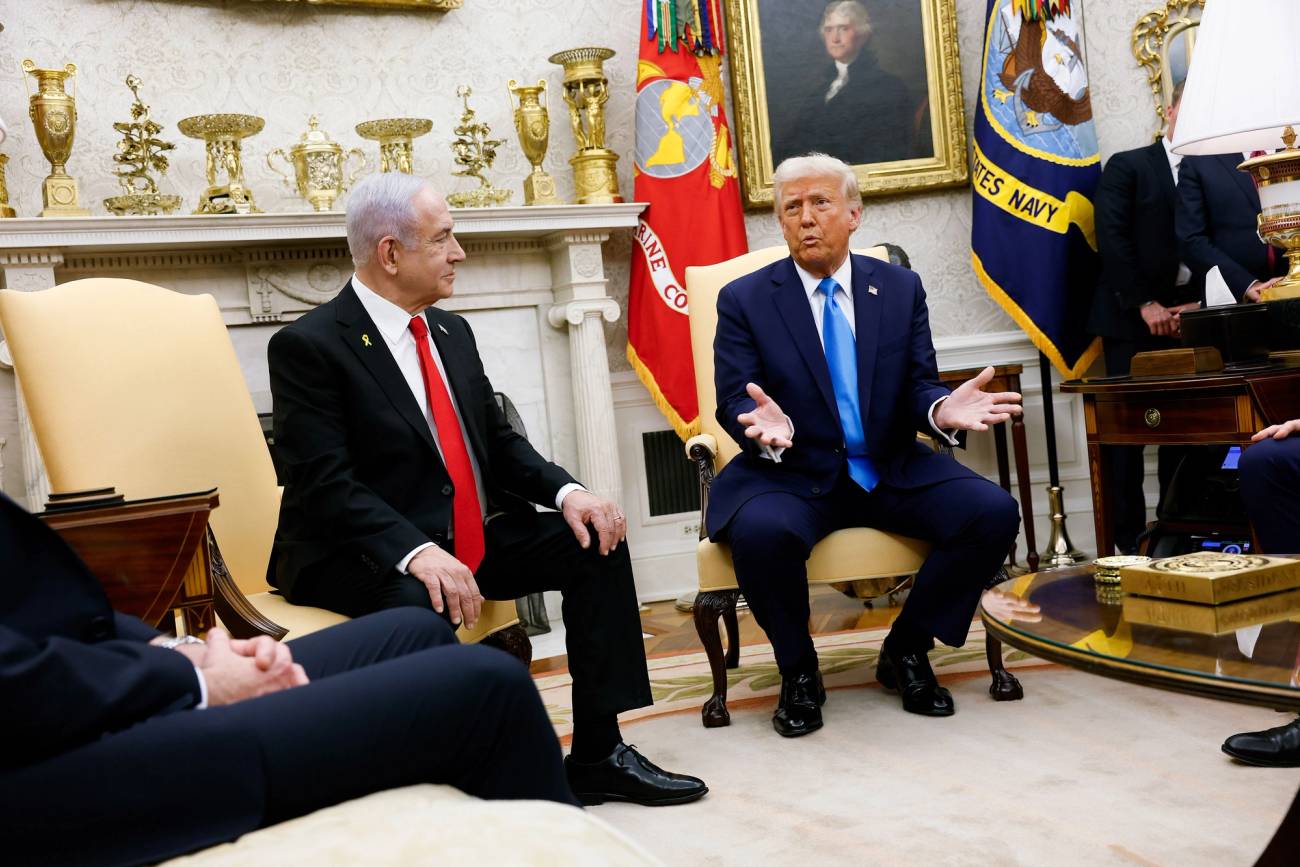
Donald Trump and Benjamin Netanyahu speak during a meeting in the Oval Office on Feb. 4, 2025
Yesterday,
President Donald Trump single-handedly collapsed the most destructive
idea of the last hundred years—Palestine. During meetings with Israeli
Prime Minister Benjamin Netanyahu and other Israeli officials, Trump
said he was going to move 1.7 million Palestinians out of Gaza. And just
like that, he broke the long spell that had captured generations of
world leaders, peace activists, and Middle East terror masters alike,
who had paradoxically come to regard the repeated failure and haunting
secondary consequences of the idea of joint Arab Muslim and Jewish
statehood in the same small piece of land as proof of its necessity.
Palestine
was a misshapen idea from the beginning, engendered by an act of pure
negation. The Arabs could have gone along with the U.N.’s partition plan
like the Jews did, and chosen to build whatever version of Switzerland
or Belgium on the eastern Med in 1948. Instead, they resoundingly chose
war. That’s the storied “Nakba” at the core of the Palestinian
legend—the catastrophe that drove the Arabs from their land and
hung a key around the neck of a nation waiting to go home. The Arabs
chose the catastrophe; they chose war, based on the premise that they
would inevitably win and exterminate the Jews.
Yet
despite repeated military failures, and the increasing distance between
the first-world powerhouse that the Israelis built and their
increasingly war-torn, third-world neighborhood, the global conscience
was always predisposed to rebuilding what the Palestinians destroyed.
Accordingly, the Palestinian Arabs became a tribe of feral children
whose identity was carved out of the relentless vow to eliminate Israel
and slaughter the Jews en masse—despite repeated failures, each one more
crushing than the last.
Trump
said, enough, we’re not rebuilding Gaza. Time for a new idea—the Gazans
have to to go, they can try to start again somewhere else, in a land
where every building still standing isn’t already wired to explode.
Gazans
waged an exterminationist campaign against Israel, and they lost. At
any other time in history, save the last 75 years, they would be lucky
to lose only territory and not have their legend and language
permanently deleted from the book of the living.
What
if they won’t go, or if the Egyptians and Jordanians won’t take them?
They’ll take them, said Trump. Ah, he’s talking big, but it’s not real,
say the experts—after all, he’s a real estate guy, and he’s pretending
it’s just another property deal to pressure Hamas—Mar-a-Gaza. You can’t
move a million people just like that, says an American electorate that
elected Trump because he promised to deport tens of millions of illegal
aliens who crossed the U.S. border in the last four years. He’s nuts
says the D.C. foreign policy crowd: He’ll destabilize Egypt and Jordan,
and undermine America’s best Arab friends and allies in the region.
Yet
Trump is right to see both Egypt and Jordan as paltry constructions
with little-to-no ability to project force on America’s behalf, and
whose survival depends month to month on American aid. Cairo is useful
to the United States only insofar as it, one, makes sure the Suez Canal
is open and, two, observes the peace treaty with Israel—i.e., continues
its campaign of repression against a populace of 112 million people who
can barely afford to buy bread, and many of whose dreams are filled with
the same insanity that drives Hamas. The only antidote to this misery
that Egypt’s rulers have found is blaming the Zionists next door for the
ills of their own society, while torturing religious extremists in
their prisons. Maybe when Elon Musk is finished fixing Washington he can
conduct an audit of where American money goes in Egypt. Somehow, I
doubt he’d get in the door.
Egyptian
President Abdel Fattah al-Sisi’s problem is that he allowed Hamas to
smuggle arms through the Philadelphi crossing into Gaza, thereby
violating Egypt’s peace treaty with Israel—which is what we nominally
pay him for. From the perspective of Trump, an American president keen
to enforce treaty obligations, Sisi has a new chance to prove himself as
a friend of America and not a grafting liar by adding a million
Gazans—who in the past have been ruled by Egypt and have family names
like al-Masri (“the Egyptian”)—to Egypt’s existing population of 112
million, amounting percentagewise to roughly the same number of legal
immigrants that the United States accepts per year. Sisi can deal with
the Hamas members among the Gazan immigrants the same way he deals with
Muslim Brotherhood militants in his own society—or he can give them all
medals for their service. It’s up to him.
And
if not? Well, he might remember that Hosni Mubarak’s regime collapsed
not because of Muslim Brotherhood-led street protests during the 2011
Arab Spring but because Barack Obama withdrew his support from the
longtime U.S. ally.
With
money from the Gulf states, or even Israel, Sisi can afford to absorb
Palestinians and might even volunteer to take all of Gaza—the average
salary in Egypt at present being the equivalent of $5,000 per year. He
can then leave Jordan’s King Abdullah responsible for the rest of the
Palestinians in the likely event that Trump, as he did in his first
term, encourages Netanyahu to annex the Jordan Valley, or goes a step
further and acknowledges Israeli sovereignty over Judea and Samaria.
Since the CIA has long treated the Hashemite Kingdom as a key asset, we can expect within the next week The Washington Post’s
David Ignatius to publish an article based on intelligence
sources—i.e., U.S. and Jordanian spies—concocting a story about Trump’s
rationale for “destabilizing Jordan.” The reality is that the
Jordanians, with U.S. help, put down a Palestinian rebellion in 1970.
The country of a little more than 11 million is already estimated to be
two-thirds Palestinian, the rest Jordanian tribesmen, and it’s hard to
see how adding another 500,000 Palestinians will make it harder for
Jordan’s notoriously effective security services to contain their
neighbors, especially if the offer includes a few dozen more Black Hawk
helicopters. After all, no one will expect the Jordanians to allow Hamas
to build a giant tunnel-city stuffed with rocket factories beneath
their encampments while giving them billions in foreign aid to pay for
it all.
Again,
the key players here aren’t Jordan and Egypt but the oil rich Gulf
Cooperation Council states, especially Saudi Arabia, the United Arab
Emirates, and of course Qatar. Trump might make Saudi largesse in
resettling the Gazans a precondition for the much-hyped prospect of
normalizing relations between Riyadh and Jerusalem. Given the fact that
Israel regularly attracts nine- and 10-figure investments from Silicon
Valley’s biggest funds, the reality is that the Saudis have little to
offer Israel except for money applied to exactly this type of local
purpose. Moving millions of Gazans who have repeatedly attacked their
Israeli neighbors out of what is now a shattered war zone is a sensible
investment in the kind of stability that helps rich people get richer.
The
Arabs and Democrats are only the most vocal of the many opposed to
Trump’s initiative. Left-wing governments from Europe to Australia are
lining up to pledge their allegiance to the fantasy of a Palestinian
state, in the hopes of propitiating Muslim and Arab constituencies at
home—whose understanding of “peace” means eliminating Israel. But even
leaving the patent bad faith of those professing “peace” aside, moving
Gazans out of Gaza is the only sane option 14 months after they
initiated a campaign of rape, murder, and hostage-taking that brought
their own house down on their heads.
After
all, what’s more fanciful, moving 1.7 million people out of Gaza, a
large portion of whom would simply be required to board air-conditioned
buses or walk across the nearby Egypt border, or compelling them to live
in a giant rubble field booby-trapped by an Iran-backed terrorist
group? Estimates vary as to how long it would take to clear Gaza of
explosives—half a decade or more? Fifteen years? Twenty? Are the Gazans
supposed to live quietly in tents for the next decade or two while their
homes are rebuilt next door? Where? In “temporary cities” made of Dwell Magazine-like rehabbed shipping containers built by graduates of Birmingham University? In Hamas’ tunnels?
Regardless,
should the Palestinians remain in Gaza, they would invariably return to
war no matter how much munificence the Gulf Arab states, the European
Union, and perhaps even the U.S. might shower on the toxic sand castle
built over the past two decades with billions of Western aid money.
Proof the Palestinians can’t and won’t keep the peace is that even after
they won a reprieve when Trump’s Middle East envoy Steve Witkoff forced
the Biden administration’s cease-fire on Jerusalem, Hamas and its
NGO-supported human shields celebrated in the streets as if the Hamas
space program had successfully landed Palestinians on Mars. Even as
Israel released jailed murderers, the Gazans paraded Israeli hostages
through the ruins of Gaza like trophies of war.
The
Saudis, Qataris, Emiratis and others who now rend their clothes while
lamenting the likely fate of their ant-farm death cult might well have
counseled: Quiet brothers, you have been spared. Don’t bring
attention to yourselves. For the winds of Gaza shift on a whim and who
knows if you are not next to be swept away by fate—or the American
president.
Here is the stark reality: Gazans, not just
the enlisted members of the Hamas brigades, waged an exterminationist
campaign against Israel, and they lost. At virtually any other time in
history, save the last 75 years, they would be lucky to lose only
territory and not have their legend and language permanently deleted
from the book of the living.
Trump’s
generous offer to the Gazans therefore signals a return to history, but
with a twist. Trump has not only spared them, but vowed to provide them
with new lives, better lives, work, new homes, a chance to raise their
families in peace, an existence not premised on total and permanent war
with a more powerful adversary destined to rout them entirely, and would
have already done so if not for the objections of other powerful global
players.
Trump,
in his innovative mercy, has offered to save the Palestinian people
from their own history, and give them a new idea to live by. They should
thank their maker for the chance to start anew—and give thanks as well
to the American president, who realistically promises them a better
future, backed by U.S. global power. Given the repeated failure of the
multi-decade-long dream of eliminating and replacing the Jews of Israel,
it seems unlikely that the Palestinians will receive a better offer.
A globally recognized A+ commentator and analyst on the
Israel-Hamas conflict and more—Lt. Col. Jonathan Conricus (Res.). He
spoke on Saturday evening—after a very busy day doing media in
Israel and abroad. The hostage release has been a spectacle unlike any
other—when an Islamist terror group commands center stage on media
worldwide—showcasing their grotesque propaganda machine and what appears
to be surprising military prowess after 16 months of war. Hamas, which
produced and choreographed three of the four release “ceremonies” to
date, has shown the world that it remains a strong fighting force with
discipline, might, and well-fed and outfitted terrorists—sartorially and
in terms of weapons. Its smaller ally—Palestinian Islamic
Jihad—demonstrated that they are far less “together.” During the release
they organized last Thursday, two Israeli hostages, who had been held
in isolation throughout their captivity, were nearly lynched by a
braying mob that surged towards them. Conricus and I get into it all:
who won, who lost, and what this all might mean for the rest of the
hostages and the horrible war that never seems to end. And we also
discuss the unfortunate reality that for months the Government of Israel
rebuked its citizens for gathering at weekly rallies in support of the
hostages and their families. It showed weakness, we were told, and the
rallies played into the hands of Hamas. I never understood that
analysis, but here’s what we know today: that those rallies were covered
on Arabic radio and TV—and many hostages knew about them. And that
advocacy was an invaluable morale booster for those in Hamas dungeons.
It’s always fascinating speaking with Mr. Conricus. I expect you will
find it so as well.
Below is a link to our YouTube version of the podcast;
you can watch it there if you prefer the audio-visual thing. The
introductions to the podcast and YouTube versions are different but
otherwise the same content. We aim to please. If you appreciate our
work, please take a moment to like us on your podcast platform, YouTube,
or wherever. And if you would subscribe to YouTube, that would be very helpful. Numbers and algorithms—that’s what they tell me. Thanks for being here.
How many Palestinian terrorists will promptly return to terrorism?
The ceasefire that is now in force between Israel and Hamas has left
many supporters of Israel aghast.
For It was the IDF that had battered
Hamas, not the other way round, yet Israel found itself having to sue
for peace, granting Hamas concession after concession and leaving the
terror group able to claim that it is still standing. Israel has agreed
in this first phase to pull the IDF forces from Gaza’s main cities,
including Rafah, Khan Younis, and Gaza City, thus allowing Hamas
operatives inside those cities to reappear from their hideouts, both
above and below ground, to regroup, rearm, and also to recruit new
members. Israel has agreed to give up the east-west Netzarim Corridor,
which allowed the IDF to prevent Hamas operatives moving from south to
the north, or north to south of the Strip, in attempts to evade IDF
attacks that focus now on one, and now on another part of Gaza. Israel
will also withdraw its forces from the Philadelphi Corridor, along the
Egypt-Gaza border, which has allowed the IDF to prevent weapons from
being smuggled from the Sinai into Gaza.
Veteran Israeli journalist Nadav Shragai discusses the lopsided — in
both quantity and quality — hostage-for-criminal exchange that Israel
has agreed to here: “Why the Hamas Deal Could Lead to More Hostage
Taking — And Why No One Is Talking About It,”JNS.org, Jan. 19, 2025:
…Those who insist may naively believe that after the
deal, we can resume the war against Hamas at our discretion. However, we
must simultaneously recognize the deal’s devastating repercussions and
damage.
It is imperative to cling to the truth, no matter how painful, and to
pose relevant questions—questions we have long avoided. We must
confront the harsh realities we have whitewashed and repressed. This
reckoning must occur now, mere moments before the first phase of the
deal, and only then can we make an informed decision.
We must question aloud why the discourse
surrounding the deal’s cost has focused for months solely on Gaza’s
Philadelphi Corridor (on the southern border with Egypt), the Netzarim
axis (in the middle of the Strip), the return of Gazans to the northern
Strip, and the war’s conclusion.
Meanwhile, the release of hundreds of
terrorists—hundreds of potential “Sinwars”—remains absent from the
conversation, accepted as a fait accompli and an inescapable fate we
must simply “deal with” and contain.
We should challenge the assessments of the
Israel Security Agency (Shin Bet) and the Israel Defense Forces that
they can “manage” the released terrorists. On the eve of the Shalit
deal, they made similar assurances and misjudged the reality.
We must ask them directly: Could you be
mistaken again? Might Shin Bet chief Ronen Bar be wrong in 2025, just as
Yoram Cohen was in 2011?
It is crucial to remember that since 1985,
Israel has released thousands of terrorists through various deals,
gestures and diplomatic frameworks. About half of them returned to
terrorism and murdered Jews. Hundreds were killed or wounded by these
released terrorists long before the Simchat Torah massacre on Oct. 7,
2023….
How many hundreds of Palestinian terrorists that Hamas demands be let
loose in this latest, most regrettable exchange, will promptly return
to terrorism, and how many Israelis will die as a result? And why did
the Israeli leaders not show that they had learned the lesson of the
Shalt debacle, and insist that no terrorist murderers should be included
in the exchange?
They could have listed a number of the most vicious of
the killers that Hamas has demanded be freed, such as those responsible
for the attack on the Passover service at the Park Hotel in 2001,
including Abdullah Barghouti, a bomb expert who was sentenced to 67 life
terms; Abbas Sayed, the planner of the Passover Seder, when 30 elderly
Israelis were killed and 130 wounded, Ibrahim Hamed, commander of the
Izz ad-Din al-Qassam Brigades in Judea and Samaria during the Second
Intifada, the man responsible for attacks including the double suicide
bombing on Ben-Yehuda Street and at Cafe Moment in Jerusalem, and Ahmed
Mughrabi, the Fatah-Tanzim commander in Bethlehem.
Imagine the effect of
listing these men, and their intolerable crimes, whom Israel is
supposed to free but could still appeal to the world’s conscience: “are
these people who, if they had been murdering your people in similar
ways, you would have agreed to free?”
What Matters Now to Haviv Rettig Gur: Death penalty for terrorists?
In the context of the release of convicted
Palestinian mass murderers, ToI’s senior analyst delves into the charged
issue of capital punishment and how it may shift the conflict
Welcome to a bonus episode of What Matters Now, a weekly podcast
exploring key issues currently shaping Israel and the Jewish World, with
host deputy editor Amanda Borschel-Dan speaking with senior analyst
Haviv Rettig Gur.
This week, we answer a slew of listeners’ responses to our conversation last week, “Excruciating dilemmas as murderers set to be released,” about the painful issue of the release of Palestinian security prisoners as part of the hostage release-ceasefire deal.
We received dozens of emails from listeners who asked how an Israeli implementation of the death penalty
for mass murderers may shift future terrible negotiations as the nation
currently reels from the reality that terrorists with blood on their
hands are being freed.
The IDF observers from Nahal Oz made a conscious effort to observe Jewish traditions even while being held by Hamas in Gaza.
Agam Berger reunited with her family(photo credit: IDF)
After 482 days in Hamas captivity, Israeli hostages
Arbel Yehud, Gadi Moses, and Agam Berger returned home on Thursday,
revealing harrowing details of their ordeal—including how they clung to
their faith, refusing to eat leavened bread on Passover and attempting
to fast on Yom Kippur, despite their captors’ cruelty.
The IDF observers from Nahal Oz, including Agam Berger,
made a conscious effort to observe Jewish traditions even while being
held underground and in Hamas-controlled apartments in Gaza, Ynet
reported.
Despite
the dire conditions, they refused to eat chametz (leavened bread) on
Passover and attempted to fast on Yom Kippur, a difficult task given the
severe malnutrition they suffered.
Berger,
the last IDF observer to be released, said that holding onto faith gave
her strength. She had remained in captivity alone for a full week after
her comrades Liri, Daniella, Naama, and Karina
were freed. She reportedly took comfort in knowing they had been
released and held onto hope that she would be next, according to Kan
News.
Families of four released hostages reunite with the returned hostages, January 25, 2025.
482 days of isolation
For
nearly 16 months, Arbel Yehud was held in complete isolation,
underground for extended periods. She suffered from severe malnutrition,
had minimal food, and endured cruel treatment from her captors.
According
to Kan News, Yehud was informed during her captivity that her brother,
Dolev Yehud, had been murdered in the October 7 attack on Nir Oz. Still,
she remained unaware of the full scale of the massacre. "I was mostly
alone," she reportedly said after her release.
"What
you saw today—the armed men escorting me—that is just a fraction of the
horror,” she said of the thousands of terrorists whom surrounded her in
Khan Yunis, while being transferred to the Red Cross on her way back to
Israel.
Gadi Moses: ‘I never broke, I never cried’
80-year-old
Gadi Moses spent his captivity focusing on the day he would return home
to rebuild his community. "I never broke, I never cried—I just waited
for the moment I would be free," he told his family, as reported by Kan
News.
Moses
saw his relatives on TV, including footage on Al Jazeera, but had no
contact with them. Like Yehud, he was mentally and physically tested
throughout his captivity but refused to give up hope.
A
Red Cross convoy arrives to collect Israeli hostages who were released
after a ceasefire agreement between Israel and Hamas took effect, in
Gaza City, on Sunday
The
release of three Israeli captives marks an important milestone in the
implementation of the agreement for the return of hostages to their
loved ones.
Hostages Romi, Doron and Emily were taunted and tormented by howling mobs
— broadcast live on Qatari state media Al Jazeera — as they were
transferred by Hamas to the custody of the Red Cross, the first time the
international aid organization had seen them in their 470 days of captivity.
It is the first stage of a three-stage process towards the release of 94 more hostages in exchange for the continued release of nearly 2000 security detainees and terrorists, many with blood on their hands.
The asymmetry of paradigms — rescue and recovery of hostages, versus
clemency for convicted mass murderers — rewards terrorist criminality
and extortion while incentivizing further acts of terror.
In announcing the agreement, Hamas leaders reiterated, yet again, their intention to commit the heinous crimes of October 7 all over again.
The mass murderers being released by Israel to secure the return of
innocent civilians taken hostage could therefore be the architects and
perpetrators of another atrocity.
In pursuing
a ceasefire and hostage release, the convicted killers emerging from
Israeli jails might well breach the ceasefire, take more hostages, and
start another war. Indeed, the previous release
of over 1,000 terrorists in the Gilad Shalit exchange included Yahya
Sinwar and other Hamas leaders who went on to perpetrate the crimes of
October 7.
No
country should be put in such a painful and impossible position, and
every country should have condemned this dangerous paradigm imposed by
terrorists, while simultaneously supporting the agreement.
Every
life is a universe, and saving a single life is like saving an entire
universe. For each hostage ripped from their home who is now returning
to their loved ones alive, it is a whole world that has been rescued.
For all the lives that would otherwise be lost to the war, the ceasefire
offers life-saving protective cover. And for the cause of peace and
security that Hamas and their state backers sought to so desperately
disrupt with their October 7 assault, the agreement will allow for the
continued expansion of the Abraham Accords and regional peace
agreements, changing the world as a whole for the better.
Despite the very real risks and painful sacrifices presented by the agreement, it deserves global support.
But there are important lessons to be learnt.
A
hostage recovery and ceasefire agreement could have likely been
achieved earlier — and many lives saved — and at lower cost with less
risks, had the world held Hamas accountable and more clearly and
unequivocally called for the release of the hostages as a standalone
humanitarian principle and international legal obligation.
Advertisement 4
Story continues below
Indeed, the current agreement reflects the framework
for a hostage release and humanitarian ceasefire that was first
proposed in December 2023, and an exact replica of what was proposed in
May by the U.S. and supported by Israel, but rejected by Hamas. Its
August reformulation was similarly rejected by Hamas.
The
singling out of Israel for selective opprobrium and indictment, coupled
with indulgence of Hamas demands, only prolonged the painful process,
and the pernicious paradigm that underpinned it.In not condemning
Hamas’ outrageous demands, the international community delayed a
ceasefire and thereby contributed to the suffering of Palestinians and
Israelis alike.
The Canadian government was missing in
action, thereby prejudicing this process and the cause of the hostages.
As a major G7 country and founding nation of the rules-based
international order and its multilateral institutions like the UN,
Canada’s foreign policy positions matter in influencing other countries
and shaping the global narrative.
The
government could have more clearly called for “the immediate and
unconditional release of all the hostages,” without referencing any
other considerations in the same statement.
While negotiations are the means through which this would be achieved,
the rhetoric surrounding it matters, and “unconditional and immediate”
underscores the illegality of hostage-taking and reinforces
international norms against it, while increasing pressure on Hamas. Many
others, such as the U.K. government, have effectively done so.
Advertisement 5
Story continues below
Far
too often, the Canadian government linked the recovery of hostages to
other considerations or conditions including a ceasefire, two-state
solution (which we otherwise support), and the broader situation in the
Middle East, thereby encouraging other countries to do the same and
emboldening Hamas intransigence.
In echoing false accusations against Israel
like the Al-Shifa hospital bombing — where the evidence revealed that
the bombing was by Palestinian Islamic Jihad — and becoming the first G7
country to ban sales of defence materials
to Israel, Canada further marginalized Israel amidst hostage
negotiations, strengthened Hamas, and was marginal amongst major allies.
Even Hamas issued a statement thanking the Canadian government for its positions.
As
counsel to families of hostages and victims of October 7, we have been
supporting the ongoing investigations by U.S. law enforcement, which led
to the issuance of indictments against Hamas perpetrators. While Canada
had initiated criminal investigations for Russian crimes against
Ukrainians, ISIS crimes against Yazidis and others, and Canadian victims
of terrorism and kidnapping abroad, the government has opted not to
pursue justice and accountability for the Jewish Canadian victims of
Hamas.
Advertisement 6
Story continues below
This
did not only hurt Israelis and Palestinians, but also Canadians, who
are at increasing risk of being abducted abroad. As hostage-takings rise
around the world, Canada’s words and deeds inadvertently normalized the
largest international hostage-taking in history, thereby undermining
the international norms against it and putting all Canadians abroad at
risk.
As the hostage recovery and ceasefire
agreement is implemented, all Canadian public officials and
parliamentarians can support its success by continuing to emphasize the
standalone nature of the hostage crisis, and the need for the return of
all the hostages, including human remains being illegally held captive.
Particular reference should continue to be made to Toronto-native Judi Weinstein,
who deserves a dignified burial and her Canadian family the closure of a
funeral and gravesite. As well, specific support should be extended to
hostages with close Canadian connections, such as Omer Neutra,Agam Berger, and Hadar Goldin.
The
current hostage crisis and concomitant rise of other global
hostage-takings — and Canada’s insufficient leadership therein —
demonstrates the need for a new approach.
Advertisement 7
Story continues below
When Parliament resumes in March, it should adopt Bill C-353, the Foreign Hostage Takers Accountability Act, which makes important improvements to the legislative framework to combat hostage-taking.
Canada
should also establish a standalone office for freeing hostages with a
dedicated staff and an integrated whole-of-government approach, headed
by a Special Envoy or Ambassador. This would be in line with our major
allies, where the U.S. already has a Special Envoy — the cornerstone of a bipartisan foreign policy priority — and the U.K. is in the process of establishing one, after having already appointed an ambassador and team specifically for the October 7 hostages.
Grounded in the Canada-led Declaration on Arbitrary Detention in State to State Relations
endorsed by 79 states — and wherein hostage-taking by terrorist state
proxy would logically be within its mandate — Canada should convene a
global task force of states against hostage-taking with concrete
collective actions against hostage-takers and their state backers.
The
return of hostages must continue to be urgently pursued as a
humanitarian imperative until all are free. It is a legal obligation of
the first order, as every day hostages remain in captivity is an ongoing
Crime Against Humanity.
Canada can now help free the captives in Gaza while combating the
global scourge of hostage-taking by exercising global leadership.
Irwin
Cotler is a former Minister of Justice and Attorney General of Canada
and longtime parliamentarian. Brandon Silver is an international human
rights lawyer and Director of Policy and Projects at the Raoul
Wallenberg Centre for Human Rights. They serve as counsel to families of
Hamas hostages and Canadian victims of October 7.