The streets of Williamsburg, Brooklyn, one of the Orthodox neighborhoods in New York City where COVID cases have increased recently. Few people are wearing masks.

The recent data revealing that 40 percent of all confirmed cases of COVID-19 are members of the ultra-Orthodox sector impels all of us, and not just the ultra-Orthodox, to engage in serious self-scrutiny and soul-searching.
On the one hand, a fundamental principle of a pluralistic society respectful of human rights is honoring a minority’s right to its religion, its culture, and its language. Its members have a right to live according to their own values and culture, to conduct public prayers, and to educate their children as they see fit.
On the other hand, these rights, like all others, are not absolute. There are times when the minority’s autonomy must take a back seat in order to protect the citizenry as a whole.
Israel, like every other country, is battling the coronavirus pandemic. Extremely harsh restrictions on freedom of movement, on conducting business, and on the right to enjoy cultural events have been imposed on the public in recent weeks, in an attempt to curtail the spread of contagion and to ensure that it will be possible to provide proper treatment for those who contract the virus. From the start, the authorities defined certain exceptions to these restrictions in order to permit public prayer and Torah study in ultra-Orthodox yeshivot. In the last few days, we have seen that even the lenient rules set for services on Yom Kippur were brazenly flouted by many groups in the community, though not by all of the ultra-Orthodox.
We are not referring here to the behavior of individuals who decided to do whatever they please. And we must note that there are lawbreakers in every sector of the public. However, as the photos of the buses transporting yeshiva students home at the height of the strict lockdown reveal, in this case, we are dealing with organized activity. According to Major Gen. (res.) Roni Numa, in charge of overseeing the battle against the pandemic in the ultra-Orthodox sector, about 10,000 yeshiva students, out of the total of 40,000, did not adhere even to the rules adapted specifically to address their needs, and did not have themselves tested for the virus before they went home on vacation. In light of the high incidence of COVID-19 in the sector, there is a serious fear that the disease will spread to their families and to the public at large.
This isn’t a case of a handful of people who thumbed their noses at the restrictions, but rather a conscious decision by some of the ultra-Orthodox rabbis. The problem is that the risks involved do not threaten only the followers of that rabbi. They affect the public as a whole, the same public that will have to make use of the same limited resources available in the hospitals, if there is a sharp upswing in contagion. At this point, the self-segregation of ultra-Orthodox communities comes to a halt; most of their members will not hesitate to be admitted to public hospitals for treatment, if needed.
We must acknowledge that the handwriting was on the wall. Since the founding of the state, the “professional scholars” (“toratto omannutto”) deal, in its various forms, has made rabbis and yeshiva deans into middlemen between the state and the IDF on one side, and their students of draft age, on the other. A state’s sovereignty is expressed in the fact that all its laws apply to all living within its territory. However, in many matters related to the ultra-Orthodox, the state seems to have pulled back from imposing its sovereignty, and accepted the convenience of “dialogue” and “consensus” with ultra-Orthodox leadership.
In the present crisis as well, the same approach seems to have been adopted — one law for citizens in general, and another — for the ultra-Orthodox, providing their rabbis agree. As we see, this approach has failed miserably.
Over the years, some have asserted that, in the name of tolerance towards the minority or in light of practical considerations, we must come to terms with the fact that young ultra-Orthodox men do not serve in the IDF and are exempted from having to do their part in rowing the national boat. But now we see that while most of us are frantically bailing the water out of the boat, many of the ultra-Orthodox are drilling holes in the hull, that may drown us all.
This situation requires a fundamental change of course — a U-turn — in the relationship between the state and the ultra-Orthodox. Developing a healthier relationship requires caution and consideration. Respect for the ultra-Orthodox lifestyle? Yes. Dialogue? That too is appropriate. The state renouncing its sovereignty and allowing rabbis to exercise unlimited power as the brokers between their flocks and the state? Absolutely not! We must put an end to this situation if we have the will to live.
Ultra-Orthodox Jews, some wearing face masks, pray during the Sukkot holiday at the Western Wall in the old city of Jerusalem, on Oct. 7 amid Israel's second coronavirus lockdown.
By every measure, Israel’s war against the coronavirus pandemic has been a miserable failure; it’s a stark turn after what appeared to be an initial success during a strict lockdown earlier this year. Last month, it was the first country in the world to go into a second general lockdown, just four months after the first one ended. In recent weeks, it has had one of the highest rates of COVID-19 deaths per capita in the world. Crisis management has been beset by confusion and petty politics, for which Prime Minister Benjamin Netanyahu deserves most of the blame.
But there’s another factor behind Israel’s stunning failure: While Israelis have generally abided by the lockdown rules, the ultra-Orthodox Jews known as Haredim who make up about 10-12 percent of the population have generally not, due their unique and jealously guarded lifestyle. The result is that they have accounted for as much as 40 percent of new daily confirmed cases.
The phenomenon is not unique to Israel: In the New York City metropolitan area, another region with a large population of ultra-Orthodox Jews, communities have also been hit hard by the coronavirus. In one, Kiryas Joel, about an hour north of the city, the average rate of positive test results recently was 28 percent, compared with 1 percent statewide.
In both Israel and New York, the question of how to address the problem has gotten enmeshed in politics. Never well-liked by Israel’s secular majority because of their refusal to serve in the army and their control over personal issues, such as marriage, Haredim have become a whipping boy in the mainstream media
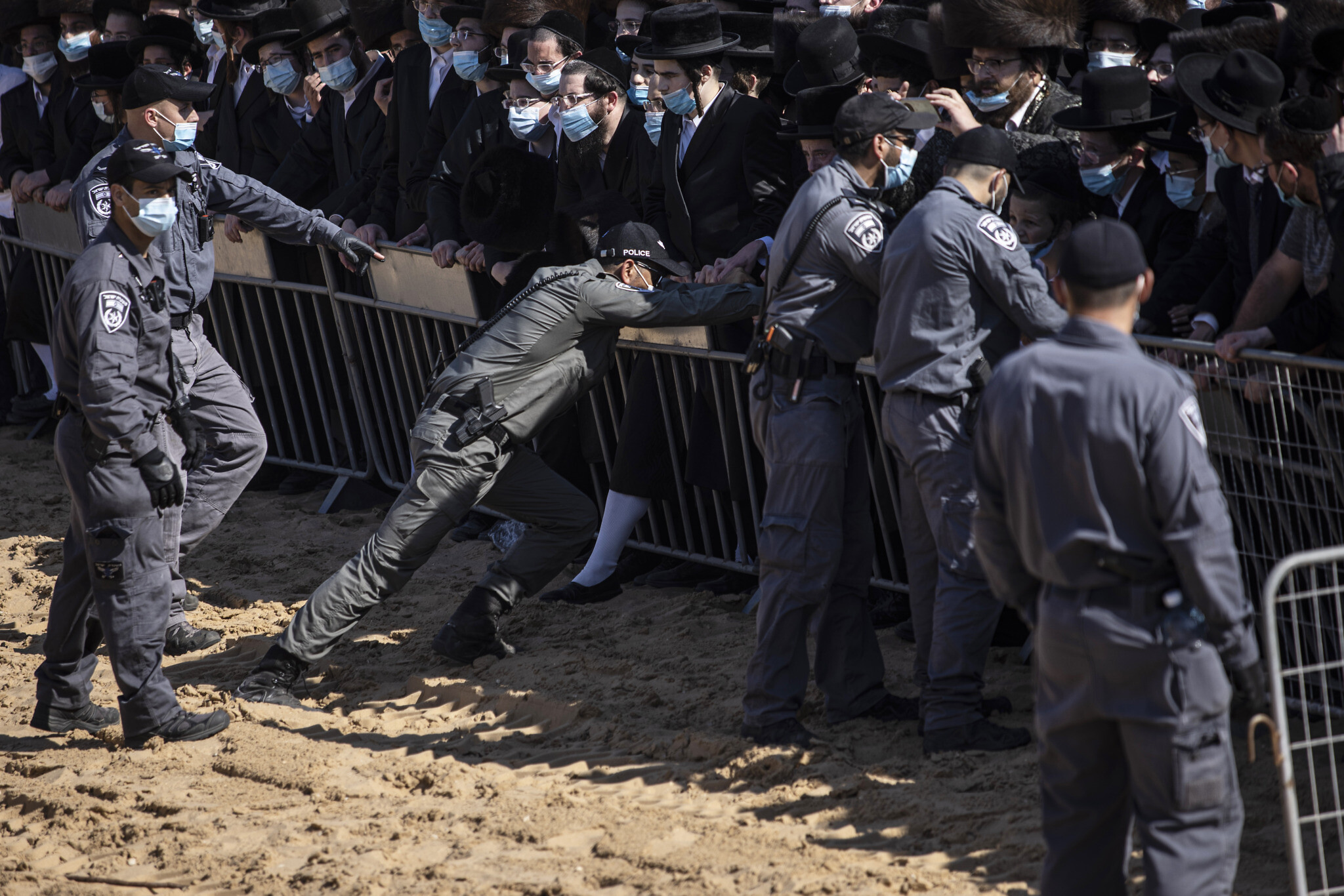
Never well-liked by Israel’s secular majority because of their refusal to serve in the army and their control over personal issues, such as marriage, Haredim have become a whipping boy in the mainstream media, which regales viewers with videos of mass gatherings in defiance of the rules and confrontations with the police.
In turn, Haredi leaders and apologists say they are being unfairly singled out. In New York, many claim they are being targeted due to anti-Semitism. More reasonably, they say that keeping the coronavirus under control is more difficult for them than for other populations.
To a degree, they have a point. Haredi Jews in Israel and to a lesser degree in the United States live in crowded conditions and have less access to information, not to mention fewer intellectual tools for fully understanding the pandemic by virtue of an education devoted almost exclusively to the study of religious texts. However, unlike any other impoverished, undereducated minority, the Haredim have consciously chosen this way of life by adhering to an ideology that looks upon the modern world as a threat. It undercuts the argument that they are blameless victims of a virus.
The crowding is one manifestation of a much bigger problem. In Israel—and increasingly in the United States—the ultra-Orthodox community is impoverished and uneducated in the skills that prepare them for life in the modern world. Over the last decades, the Haredi ideal has been to be a “society of learners,” where men pursue a life of religious study to the exclusion of everything else well into adulthood. In their role as sole family breadwinner, women get somewhat better schooling. But with a limited education and an average fertility rate of seven children per woman in Israel, their ability to sustain their families is severely limited.
However, their vulnerability has another, more troubling dimension that would be in their control if they chose. Much of ultra-Orthodox life revolves around being in public—long hours spent in schools and study halls, regular daily prayers in synagogues, and mass events like weddings and funerals
Much of ultra-Orthodox life revolves around being in public—long hours spent in schools and study halls, regular daily prayers in synagogues, and mass events like weddings and funeralsfor rabbinic leaders that can draw thousands or even hundreds of thousands.
The Haredi world has been loath to give any of this up even though these activities act as virus hothouses. Even as the intensity of their religious observance makes them especially vulnerable to COVID-19, the ultra-Orthodox share the same attitude of distrust and resistance to the dictates of nonbelieving world as fundamentalist Christians.
The threat of death and disease should be a powerful countervailing force, but Haredi leaders live in perpetual fear of their followers’ religious observance slacking off and even of them leaving the community. If the momentum of prayer, study, and mass gatherings is halted for even a few weeks, no one can predict what the consequences would be. One study estimates that 15 percent of young Israeli Haredim leave the community.
Some Haredi leaders have urged the followers to be more cautious, but many more see these activities not only as critical to their way of life but also as an act of defiance against the outside world.
Some Haredi leaders have urged the followers to be more cautious, but many more see these activities not only as critical to their way of life but also as an act of defiance against the outside world.Outsiders, be they the secular Israeli establishment or the New York City Department of Health, which has clashed with the ultra-Orthodox over circumcision and measles, are viewed as hellbent on disrupting the age-old patterns of Jewish life.
Given the insularity of the community, it’s not hard for Haredim to frame the pandemic as a political or religious dispute of us versus them, rather than as a public health challenge of everyone versus the virus. Strangely, this attitude has morphed into sentiment in favor of U.S. President Donald Trump in the ultra-Orthodox world that has grown even stronger as they see him opposing COVID-19 restrictions.
The coronavirus will eventually dissipate, but the conditions that made ultra-Orthodox communities so vulnerable to it will remain.
The American ultra-Orthodox world has increasingly mimicked the Israeli society of learners. In Israel, a life of learning is enabled by a government that subsidizes them. It doesn’t subsidize them enough to lift them out of poverty, but it does keep the community afloat.
In the United States, it’s more difficult because separation of church and state is strictly observed and access to government aid is severely constrained. Even so, poverty among the Hasidic stream of the ultra-Orthodoxy in the greater New York area was estimated a decade ago at more than 40 percent (the cutoff being annual household income of under $50,000). Today, it is almost certainly higher.
Like their Israeli counterparts, American ultra-Orthodox schools are depriving the young of the basic skills needed for the job market, an issue that came to the fore two years ago when New York state tried to enforce core curriculum standards on their schools. One study estimated that the youngest Haredi boys get about six hours a week of instruction of basic English and math, and even that paltry education comes to an end after they reach age 13.
https://foreignpolicy.com/2020/10/12/the-government-cant-save-ultra-orthodox-jews-from-covid-19-religious-leaders-can/In their lawsuit, rabbis, leaders of synagogues and the national Orthodox Jewish group Agudath Israel had argued that Governor Andrew Cuomo was singling out Jews during the weeklong Sukkot holiday and this weekend’s Simchat Torah holiday, which marks the annual cycle of reading the Torah.
“That targeting of a religious minority on the eve of its holidays is reason enough to reject all of defendant’s arguments and allow plaintiffs to celebrate their holidays this weekend as they have for over 2,000 years,” the groups argued in a Friday court filing.
*A federal judge refused on Friday to block New York’s plan to temporarily limit the size of religious gatherings in COVID-19 hot spots.
US District Judge Kiyo Matsumoto issued the ruling after an emergency hearing in a lawsuit brought by rabbis and synagogues, arguing the restrictions were unconstitutional. They had sought to have enforcement delayed until at least after the Jewish holidays this weekend.
The rules limit indoor prayer services to 10 people in areas where the virus is spreading fastest. In other areas within hot spots, indoor religious services are capped at 25 people.
*
Ruling from the bench, the judge said the state had an interest in protecting public safety.
“And a mass gathering is not less dangerous simply because it is religious in nature,” reads Cuomo’s filing. “Moreover, the right to practice religion freely does not include liberty to expose the community… to communicable disease.”
Today, 4:23 PM
To: Paul Mendlowitz

(JTA) – Protests by Orthodox Jews against New York’s crackdown on gatherings in their neighborhoods turned tense and at times violent Tuesday night as throngs of young men demonstrated in the streets of Borough Park.
The late-night protest in a heavily Orthodox area of Brooklyn took aim at new restrictions that would close schools, limit attendance at synagogues services and close nonessential businesses in areas with upticks in COVID-19.
The protestors set fire to a pile of masks, at one point surrounded a city bus that was moving through the area and at another ran a reporter out of the area.
In a particularly violent episode, one man — the brother of Mordy Getz, a well-known Orthodox businessman who was outspoken about the need for masks and social distancing earlier in the pandemic — was beaten so severely by protesters after he took a video of the scene that he was taken to the hospital. Onlookers could be heard calling him a “moser,” one who informs on fellow Jews to the authorities and who some Jewish legal authorities say can be killed as a result, an insult applied to his brother back in April, as he was placed on a stretcher to be taken to the hospital.
The protests laid bare the frustration felt by local Orthodox Jews who are now at the center of the first widespread resurgence of COVID in New York since the spring. Many in the community believe that city and state officials are unfairly targeting Orthodox Jews, who are already vulnerable to anti-Semitism, in their pandemic response. Local elected officials and community leaders on Tuesday vowed to resist the latest rules, through litigation and civil disobedience.
“We will not close,” radio host and local celebrity Heshy Tischler proclaimed to cheers from the assembled crowds. Later, he told protestors, “You are my soldiers. We are at war.”
Dov Hikind, the former state Assemblyman who is a leader in the community, said the form the protests took were regrettable.
“I’m ashamed of what happened,” Hikind said. “To raise your hand and touch another person, Jew or non-Jew, to injure someone and have them end up in the hospital, what a tragedy.”
He added, “If there would have been a protest last night organized by community leaders and elected officials where everyone was wearing a mask, then of course there’s no problem. … There’s nothing wrong with expressing yourself.”
The protests came in response to New York Gov. Andrew Cuomo’s announcement Tuesday afternoon of new restrictions on a large swath of Brooklyn that is experiencing an uptick in COVID cases. His announcement followed a similar one by New York City Mayor Bill de Blasio, who on Sunday, during the Jewish holiday of Sukkot when Orthodox Jews do not use cell phones or computers, said he would move to close schools on Wednesday, pending the governor’s approval. The governor then announced Monday that he would close the schools Tuesday. (Most Orthodox schools are in fact closed this week for Sukkot.)
In a statement Tuesday evening, local Orthodox lawmakers accused New York Gov. Andrew Cuomo of “a duplicitous bait-and-switch.”
“The governor informed Jewish community leaders in a conference call that synagogues in ‘red zones’ would be permitted to operate at 50%, and he requested community cooperation (which he was assured would happen,” they wrote, referencing a call Cuomo held with Orthodox leaders Tuesday before he announced the new restrictions.
“Outrageously, just hours later, Governor Cuomo announced a draconian return to restrictions that would shutter thousands of New York businesses and limit houses of worship to a maximum capacity of 10 (no matter the maximum capacity of the building).”
A statement from Agudath Israel, an organization representing haredi Orthodox communities, also expressed frustration with the lack of notice given about the restrictions in a call earlier in the day and suggested the new rules might be unconstitutional.
“Governor Cuomo’s surprise mass closure announcement today, and limit of 10 individuals per house of worship in ‘red zones,’ is appalling to all people of religion and good faith,” they said.
They seemed to be considering the possibility of challenging the governor’s new restrictions in court. “Agudath Israel intends to explore all appropriate measures to undo this deeply offensive action,” they said. A federal judge issued an injunction blocking New York State from imposing stricter standards on indoor gatherings at religious services than those imposed on other gathering places, citing religious liberty concerns. Agudath Israel filed an amicus brief in that case.
The protesters in Borough Park were joined Tuesday night by Tischler and their City Council representative, Kalman Yeger, who encouraged the crowd to stand up for religious freedom.
“We are not going to be deprived of the right that we have in America, like everybody else in America, the right to observe our religion,” he said in a video posted to Twitter by local news outlet BoroPark24. “I don’t care who in government thinks that they can stop us, they’re wrong. Let them try.”
Tischler also appeared later Tuesday night in Crown Heights, another heavily Orthodox Brooklyn neighborhood where there are no new restrictions but where de Blasio has identified a slight uptick in COVID test positivity rates. Tischler appeared at a Simchat Beit Hashoevah, a gathering on the holiday of Sukkot that is marked by singing and dancing, and addressed the crowd.
“We have a court order, we won, our schools and shuls are open, we will not close,” he said, seemingly referring to a court injunction over the summer issued by a federal judge that blocked New York State from imposing stricter rules on religious gatherings than in other indoor venues.
“And here’s the deal, I’m filing a new court order, I’m holding Cuomo and the idiot de Blasio in contempt,” he said. “We will civil disobedience…our amendments, our first amendments, our rights, we will not close our shuls Simchas Torah!”
Other videos circulated of protesters chanting, “Jewish lives matter.”
At one point, protesters set fire to a pile of masks in the middle of a street.
https://www.jta.org/2020/10/07/health/orthodox-jews-in-brooklyn-burn-masks-during-massive-protest-against-new-yorks-new-covid-restrictions?utm_source=JTA_Maropost&utm_campaign=JTA_DB&utm_medium=email&mpweb=1161-23464-462090
Guest post by Professor Shaul Magid
On COVID and haredim:This has become a national
issue but is one that has persisted from the beginning of the crisis. Of
late there has been much written by Modern Orthodox and non-Orthodox
Jews about the haredim, how they are behaving and why they are behaving
that way. While well-placed, I found a lot did not have a real
foundational and experiential understanding of the haredi world. I lived
in Boro for almost three years in the late 1970s. It was a long time
ago but I think I came to understand and absorb that world and something
of that remains.
This is NOT an apologia for the haredim; what is happening is horrible
and will damage that community for years. They erred seriously and now
are paying the price, as well as bearing responsibility for others. What
I am trying to do, however, is understand what evoked this response in
this way.
Yssocher Katz posted what I found to be the most thoughtful post on the
haredim I have seen. Without apologies he tried to situated a value
system in the orbit of behavior and suggest that while this is a
mistake, it comes from a place that is not unreasonable. He dealt mostly
with religious practice and in a religious register.
I will offer a more societal, maybe sociological rendering that squares with to Yssocher's remarks.
The haredi community is a much more social community than most of us
live in. By social I mean that the collective life is driven by social
events, from as small as daily minyan, night seder, to as big as a
hasidishe wedding or the rebbe’s table on Sukkos. These events don’t
have the same values in our world as in theirs. For them, this is the
crux of their “leisure” time, it is largely where people meet outside
business or study. I recall being surprised when I entered the haredi
world that children were always a part of that social world. The notion
of children not being invited to weddings is unheard of. One often finds
a family with small children in Boro Park walking home from some simcha
at midnight. I recall being back in America and invited to a secular
wedding where we were told we could not bring children. It was
arresting.
As a result, having all that taken away is different for them than for
us. It is wrong not to have done it, but viewing it from our frame of
reference misses something crucial: you are taking away their whole
social world. Now of course they use Whattapp etc. but more
fundamentally, it demanded more of them then us. We were more equipped
in part because we are less social.
One can also include that living in close quarters with many children
(other high risk communities also share this problem), makes social
distancing very challenging. Many of us have spacious and/or comfortable
places to live, Netflix, plugged into all manner of technology to keep
us connected to the world and our kids out of our hair. Generally, the
haredi world doesn’t have that kind of man-made internal entertainment.
Many have computers and are increasingly connected to the outside world
but the community has an ethos to minimize that as much as possible,
especially among the young. Television or Fortnight is not their
babysitter.
Of course, one can see, for boys, that yeshiva education is a highly
social thing. One doesn’t study regularly alone, or if he does, he does
so in a room with 100 other young men. That creates an expectation of
sociality that is almost unconscious. Girls, of course, are deprived of
that educational experience but their lives are founded on social
circles in very close ways.
In any event, even as many leading rabbis came out strongly for masks
etc (they did so late, but that is another story) it never was able to
filter down to the people perhaps in part because the sacrifices were
quite difficult and they did not have the will to recognize they were
going to have radically revise their social structure. That may be true
for us as well, but not in the same way. Haredim have zoom but many of
them never used it before COVID and it is a steep learning curve. This
is just to say that the social structure of haredim, at least in
American centers, presents certain challenges to them that it doesn’t
quite present to us.
They failed. But one can also ask why. Science? Maybe a bit but not
really. Most of us don’t know much science either. Its really about
authority not science. We trust that authority. For them there are
competing authorities that also play a role. They are paying a high
price.
There is also remnants of mistrust of the “state” (even though the state
protects their right to exist), and the way the community for
complicated and fascinating reasons for another time, have become big
fans of the state of Israel and in most cases, lean pretty right because
their religious beliefs serve as the foundation of their views on the
Jewish state. A hasid who will vote for Trump because he is good for
Israel could be the grandson and a hasid in Poland who was vehemently
anti-Zionist. The grandson could live the same lifestyle, in the same
Hasidic court. The one big difference is that the grandson will be
pro-Israel (albeit not a Zionist).
In this way they fell for Trump, saw in him someone they could lean on,
they are people who can be taken by a certain kind of strength. Hasidism
often liked strong leaders. Hillel Zeitlin writes about the admiration
of Czar Nicholas and Rasputin. In any case, they were convinced that
liberal was bad for them. This has its own history in Europe when it was
communism.
The haredim will have to comes to terms with this. And they will do it.
And yes, tragically more people will likely die first. That community
has been devastated from this disease much more than upper-class Jews in
the suburbs or “uptown.” Theirs more resembles poorer neighbors with
diverse populations. So they don’t need to hear from us how many people
died. They know. I think we can help, perhaps, by understanding their
challenges in context; a world that seems very much like ours, and in
some ways is, but is also very different is ways that have made this
moment history difficult, and tragic.
Hag sukkos samaech
Shaul Magid is the Distinguished Fellow in Jewish Studies at
Dartmouth College. From 2004-2018 he was a professor of religious
studies and the Jay and Jeannie Schottenstein Chair of Jewish Studies in
Modern Judaism at Indiana University

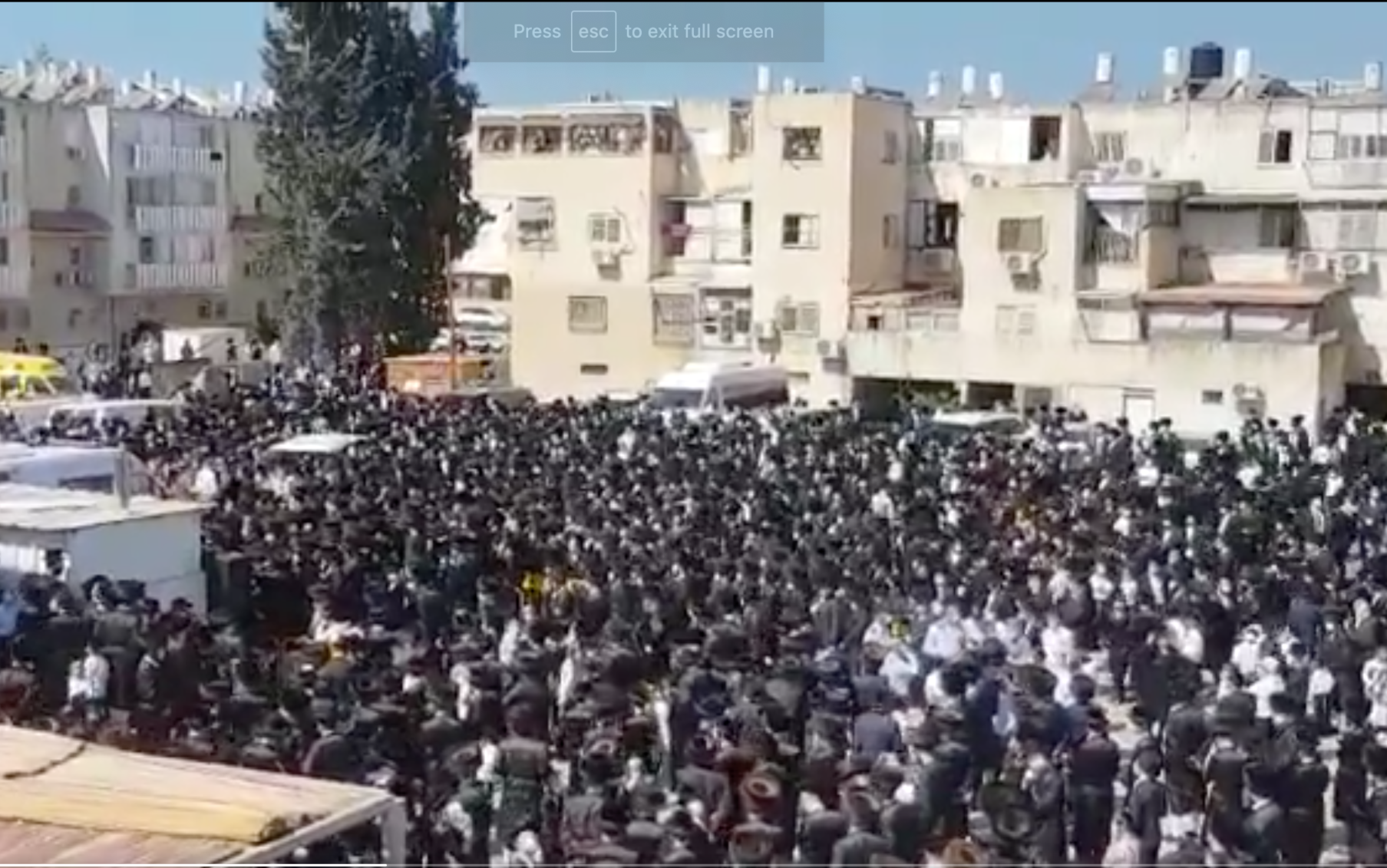
Thousands of people gathered Monday at a funeral in Ashdod for a Hasidic rabbi who died overnight after contracting COVID-19, despite a national lockdown aimed at curbing infections that forbids such gatherings.
The ceremony ended with clashes between mourners and police seeking to disperse the crowds.
Video from the funeral showed that although most participants were wearing face masks, they were not keeping to required social distancing.
The Pittsburgh Rebbe, Rabbi Mordechai Leifer, 64, died overnight after a two-month battle with the virus. His title stems from the Hasidic dynasty founded in the US steel town some 100 years ago, and which today is centered in Ashdod.
He was buried in Ashdod, areas of which have been declared virus hotspots due to high infection rates.
Police said in a statement that the funeral procession had been approved in smaller numbers, and that attendees were expected to keep distance between each other and wear masks.
Police had permitted around 300-400 to take part in the event but estimates put the number of people who actually turned up at around 5,000, Channel 12 reported. According to the network, angry confrontations developed between police and participants.
Channel 12 said the overcrowding led eulogies for Leifer to be cut short.
Kan news published a video showing policemen in the midst of the massive crowd, making efforts to tell people to keep their distance from each other.
Opposition lawmaker Avigdor Liberman, who leads Yisrael Beytenu party, blamed Prime Minister Benjamin Netanyahu’s policies for the scenes, writing on Facebook that “the images we are seeing are a spit in the face of the entire country.”
“The ultra-Orthodox sector is trying to reach herd immunity because of surrender by Bibi and [Gantz] to the Orthodox parties,” he wrote, using a nickname for Netanyahu. “No leadership, no budget, no decisions, no policy, no enforcement.”
Criticism of the ultra-Orthodox community has been growing in recent days, with reports showing that a significant number have been disregarding lockdown restrictions during the Sukkot holiday, including by continuing to host mass gatherings.
As police have stepped up enforcement, there has also been increasing anger within the ultra-Orthodox community and accusations of disproportionate force, including against children.
Sunday saw violent clashes between police and ultra-Orthodox in Jerusalem and in Bnei Brak, where 13 people were arrested as officers broke up mass gatherings for the holiday. Besides violating the restrictions on gatherings in enclosed spaces, police said most worshipers were not wearing masks or adhering to social distancing rules. After cops started handing out fines, the worshipers “began resisting and disturbing public order,” according to police.
The ultra-Orthodox community has seen high coronavirus infection rates, with an assessment last week finding that the rate of infection in the community is 2.5 times that of the national average. The country’s coronavirus czar Ronni Gamzu said last week that 40 percent of recent virus cases were in the ultra-Orthodox community, which constitutes some 12% of the population.
Last week, on the eve of Yom Kippur, I blogged about New York City's plans to impose heightened restrictions on Jewish neighborhoods in New York.
Yesterday, New York Governor Andrew Cuomo, flagged the "20 hotspot Zip Codes" with positive cases (Kings County is Brooklyn).
Yesterday, the New York City Commission of Health and Mental Hygiene imposed a series of new restrictions on eight of these zip codes in Brooklyn and Queens. I will list the positivity rate in each zip code, as well as the number of positive tests.
All of these zip codes are in predominantly Jewish neighborhoods in Brooklyn and Queens.
The Commissioner did not impose restrictions on six neighborhoods in New York that had comparable positivity rates and positive tests:
These neighborhoods are not predominantly Jewish.
The restrictions on private schools in this area are very onerous.
All non-public schools in the affected zip codes must comply with the following additional requirements:
- All individuals on the school premises must remain at least 6 feet apart at all times, except: in emergencies or when doing so would create a safety hazard; or when physical barriers are put in place between individuals in accordance with New York State guidance for in-person instruction at pre-k to Grade 12 schools during the COVID-19 public health emergency; and
- Face coverings are required in school buildings at al times, except for individuals who cannot wear a face covering because of developmental, medical or age reasons;
- Coordinating with the Department and the Test + Trace Corps to identify, isolate and prevent the spread of COVID-19; and
- Following the protocols established by the Department for opening and closing classrooms and schools if a student or staff is confirmed with COVID-19, and excluding students and staff who have symptoms or are confirmed with COVID-19 or have been identified as a close contact to someone with COVID-19.
Students, teachers and staff having close contact with confirmed cases of COVID-19 must quarantine for 14 days from such contact, in accordance with the New York State Department of Health's guidelines for precautionary quarantine.
This order shall be effective immediately and remain in effect through the end of the 2020-2021 school year, including any summer school sessions during 2021, or such earlier time as I may indicate….
An attorney in New York told me that if read literally, it is impossible to comply with these rules.
Get the TROs ready.
New Jersey’s fastest-growing town hit 27% positivity among those tested for the novel coronavirus while the state’s overall rate reached its highest since July.
The statewide figure of 3% is highest since July 17, state officials said at a Trenton news conference. Ocean County’s 5.4% positivity rate leads among the Garden State’s 21 counties, and Lakewood is the biggest worry among its towns. A majority of Lakewood’s population of about 100,000 residents is Orthodox Jewish, like New York City communities where cases also are booming. Many of the faith follow a tradition of big families, and state officials are concerned that close contact during Yom Kippur and other holidays may have worsened the spread of the virus. Ocean County has led New Jersey’s new-case count for two weeks. Outdoor bars have been cited for not enforcing distancing orders and law enforcement on Sept. 14 broke up hundreds of people partying outside MTV’s “Jersey Shore” house in Seaside Heights.
Most positives are in Lakewood, which Governor Phil Murphy called the state’s fastest-growing town. In recent days, the township has doubled daily testing to 1,000. “We need to step that up,” said Judith Persichilli, the state health commissioner. In New York City as of Tuesday, nine zip codes, all with prominent Orthodox Jewish populations, accounted for 25% of cases over two weeks, according to Mayor Bill de Blasio. In New Jersey, Murphy said he would talk about other virus-fighting strategies for Lakewood later this week. So far, his administration is assigning more contact tracers to warn of potential exposure and working with community and religious leaders to request strict compliance with distancing and masking orders.
Meanwhile, the state reported 43 coronavirus cases linked to 11 schools. The schools outbreaks, defined as two or more cases, have occurred among students and staff. New Jersey is about a month into its school year, but some cases were traced to August, when school employees started to come together for lesson plans and other tasks. New Jersey has so far reported 16,122 deaths with a lab-confirmed or probable coronavirus link.
Bloomberg/UOJ News
Governor Andrew Cuomo announced on Tuesday that he plans to meet with Orthodox Jewish leaders to address the clusters of COVID-19 in their communities “downstate.”
“I’m going to be meeting with religious leaders of the Orthodox community and local officials,” Cuomo told reporters. “If you look at those clusters and you look at those zip codes, you will see there’s an overlap with large Orthodox Jewish communities. That is a fact. I will be meeting with them to talk about it.”
“This is a public health concern for their community,” the governor stressed, adding, “It’s also a public health concern for surrounding communities. I’ve said from day one, these public health rules apply to every religion, atheists – it just applies to every citizen of the State of New York, period.”
According to Governor Cuomo, “We have seen hotspots before, but this is probably the largest cluster that we have addressed before, and the clusters are Brooklyn, Orange, Rockland. The activity in the cluster is very different than what’s going on in the rest of the state. That’s actually good news in some ways because you have effectively identified the genesis of the potential growth of the virus. Once you have the information, you aggressively target these clusters. These are embers that are starting to catch fire in dry grass. Send all the firefighting equipment and personnel to those embers and stamp out the embers right away. That’s what this data does. Local governments are the first line of defense and they must respond. Competent government must do compliance and enforcement. A cluster today can be community spread tomorrow.”
According to the NY Daily News, NY State’s worst “cluster” is in the mostly-Satmar town of Kiryas Joel in Orange County, where 19% of the tests Monday came back positive. Two other areas, in Rockland County, had 10% and 9% rates. In some Brooklyn and Queens neighborhoods, the rates are around 5%.
NYC Mayor de Blasio on Tuesday cited the clusters of coronavirus in Brooklyn and Queens and vowed that the city will enforce the strict wearing of masks and other steps in those hot spots, which include Gravesend/Homecrest, Midwood, Kew Gardens, Edgemere/Far Rockaway, Borough Park, Bensonhurst/Mapleton, Gerritsen Beach/Homecrest/Sheepshead Bay, and Flatlands/Midwood.
According to the Daily News, the outbreaks in Orthodox Jewish neighborhoods, as well as other parts of Brooklyn and Queens, have by now pushed NY City’s infection rate to 3.25%, after months of successfully keeping the rate at around 1%.
“This is an inflection point,” Mayor de Blasio said. “We have to take more action at this point and more serious action and we will be escalating with each day depending on what we see happening on the ground.”
The Governor noted that 20 hotspot ZIP codes on Monday reported a 5% positive rate. Areas that have high positive rates will be subject to focused testing efforts including access to rapid testing machines. These ZIP codes include:
|
REGION |
COUNTY |
ZIP |
% POSITIVE |
TESTS |
POSITIVES |
|
Mid-Hudson |
Orange |
10950 |
18% |
211 |
39 |
|
Mid-Hudson |
Rockland |
10952 |
10% |
154 |
15 |
|
Mid-Hudson |
Rockland |
10977 |
8% |
330 |
27 |
|
NYC |
Kings |
11223 |
7% |
347 |
24 |
|
NYC |
Queens |
11374 |
5% |
151 |
8 |
|
NYC |
Queens |
11691 |
4% |
608 |
27 |
|
Southern Tier |
Broome |
13760 |
4% |
163 |
7 |
|
NYC |
Kings |
11229 |
4% |
299 |
12 |
|
NYC |
Kings |
11235 |
4% |
366 |
14 |
|
NYC |
Kings |
11219 |
4% |
455 |
17 |
|
NYC |
Kings |
11211 |
4% |
329 |
12 |
|
NYC |
Kings |
11230 |
4% |
482 |
17 |
|
NYC |
Kings |
11204 |
3% |
272 |
9 |
|
NYC |
Kings |
11218 |
3% |
417 |
13 |
|
Mid-Hudson |
Westchester |
10801 |
3% |
137 |
4 |
|
NYC |
Richmond |
10301 |
3% |
208 |
6 |
|
NYC |
Kings |
11210 |
3% |
248 |
7 |
|
NYC |
Richmond |
10306 |
3% |
359 |
10 |
|
NYC |
Queens |
11432 |
3% |
223 |
6 |
|
NYC |
Queens |
11370 |
3% |
115 |
3 |
| Jews
across the world observed Yom Kippur. It was a day filled with prayer,
introspection and commitment to improve. On more than a half-dozen
occasions, we asked God to suppress plague and disease. These entreaties took on an added resonance this year, with the plague of COVID-19 having already taken the lives of more than 200,000 Americans. The fervor of our prayers was deepened by our ability to picture relatives, friends, neighbors and colleagues who have been felled by this dreaded virus. Anyone who ministers to a congregation knows that too often there is a disconnect between what we pray for and our behavior. We sincerely seek the end of the virus, but we are not yet doing all that we can to make that happen. The past week’s uptick in infections, including in neighborhoods with Haredi and Hasidic populations in New York City and its suburbs, brought attention to the Orthodox community’s response to COVID-19. This recent increase needs to be taken seriously. Our communal behavior has to match our communal prayer. Dr. Anthony Fauci and other public health experts have pointed to wearing a mask as the single most important step one can take to prevent the spread of the virus. There is no reason that mask compliance in the Orthodox community shouldn’t mirror that seen elsewhere across New York. As with many other matters contemplated on Yom Kippur, we must acknowledge that we need to do better and that we need to do more. We must commit to doing better and doing more. For our own health, and for the continued good health of all those we come into contact with, including our rabbis, teachers, parents and grandparents. New York’s public health officials also need to reflect on their approach. Shaming is not a legitimate or effective tool. No other community is singled out and stereotyped as the Orthodox are. That too needs to change. Understanding the roots of the complacency that has crept into the community is not the same as justifying it. It is a necessary step toward remedying it. This summer saw day camps and daycare centers running without incident. When overnight camps were banned in New York State, many safely moved their operations to neighboring states. Synagogues resumed services. All this may have led to a false sense of security about a potential second wave. But instead of communication, the city’s Department of Health countered with criticism. Fauci also offers a model of how public health officials should act during a pandemic. Engagement and building trust is what is necessary and what works. There is also lingering distrust because of the different way the city treated the several hundred Hasidic mourners at an outdoor funeral at the very end of April and the far larger crowds righteously protesting the horrific murder of George Floyd a month later. The Hasidim were singled out for harsh criticism by Mayor de Blasio, who called their attendance “absolutely unacceptable.” Those protesting racial injustice were accommodated and encouraged. The point is not to compare the two issues but to highlight why the Hasidic community remains skeptical about whether the city takes their devotion to religious worship, education and ritual as seriously as it takes the priorities of other communities. It also rankles that while the funeral attended by several hundred Hasidim received national attention, little or nothing was written about the funeral of a far better known rabbi, Yaakov Perlow, who died exactly three weeks earlier. He was the head of the Agudath Israel movement, and the school and synagogue he led had thousands of current and former students and worshippers. His funeral was conducted entirely online, and his burial was attended by only a handful of masked and socially distanced immediate family members. Ignoring this funeral while highlighting another creates a distorted view of our community’s conduct and leadership. Here’s one suggestion for a path forward: The city should work with Orthodox leaders to develop and implement a public safety plan. Its mission will not be public relations but public health. Policies can be crafted and the concerns of the community can be addressed before problems arise and ultimatums are issued. To take but one example, if the city and state regularly track the percentage of positive cases, shouldn’t private schools be assessed relative to their size? Isn’t a school with 2,000 students different than a school with 200? Let’s all undertake to set aside the frustrations of the past week and commit to working cooperatively. Together we can demonstrate that we can protect both our spiritual and our physical health. Schick is a former deputy attorney general in New York and the president of the Rabbi Jacob Joseph School. Zwiebel is the executive vice president of Agudath Israel of America
https://www.nydailynews.com/opinion/ny-oped-how-orthodox-jews-can-attack-covid-20200929-dvjiqgvrkbdhhix5kib5gzfzdi-story.html |
On March 12, 2020, I came out of my self-imposed blog retirement (I'm at my office every work day, except when I'm not), for one reason only! To bring attention to the onslaught of the upcoming pandemic that I believed at the time will bring an untold amount of death to the global population.
http://theunorthodoxjew.blogspot.com/2020/03/this-suggests-that-anyone-in-position.html
I e-mailed my children in January, that the pandemic that started in Wuhan, China was spreading rapidly and would arrive in the USA shortly. I told them to stock up on non-perishable food and water. I begged them not to attend shul on Purim or attend any Purim festivities.
So this is not hindsight; read my blog posts from March 12 forward.
I'm a student of history, and I researched the Pandemic of 1918, and realized how pandemics start and spread.
I basically pleaded with the Jewish community and anyone else that reads my blog to take this seriously, nah, what did I know?
It was the rabbis that knew EVERYTHING about EVERYTHING - they said go to shul on Purim, stay in yeshivas, and even now, pack the shuls on the yomim tovim as Israel goes into full lockdown. The vast majority of Orthodox rabbis are either ignorant of science or anti-science, until they need a doctor!
It is hard to feel pity for idiots, maybe that is a fault of mine, nevertheless, I don't! I do not wish anyone harm, but you choose your own destiny based on your free will!
So, whether I (or you) like it or not, I'm back for the time-being, and I will continue to call matters of life and death to your attention (spiritually or physically), and anything else that I believe is necessary. If I insulted anyone over the past year, -------- you probably deserved it :-)
Wishing almost all a G'mar Chasima Tova.
PM
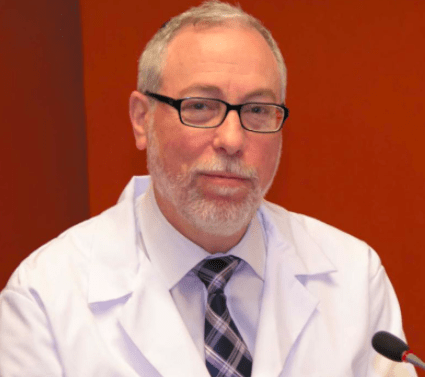
by Rabbi Aaron E. Glatt, MD
We are again at a crossroads. Both in the Jewish calendar, entering into Yom Kippur, where life and death decisions will be made, and in the world of COVID-19, with a disconcerting continuing rise in cases in our area, where life and death decisions will be made.
“Mi Bamageifa” (and who will die by plague…):
In just the past 24 hours, I have been inundated with numerous pressing shailos from communities all over regarding COVID-19 exposures. Here are but a few of the quarantine questions that Rabbonim and shul presidents have asked me.
“Our Rosh Hashana chazzan said wearing a mask was too difficult. He davened for the amud without one. He developed symptoms and tested positive the following day…”
“Our Rav gave a drasha on Rosh Hashana without a mask. He turned positive the next day…”
“A Rebbi (who was also a chazzan in a shul) did not wear a mask in his school or shul. He turned positive after Rosh Hashana…”
All wanted to know – does everyone in shul / school class need to quarantine?
Speciously, many people remain unconcerned about their spreading COVID-19 and ruining Yom Kippur and Succos for everyone they come into contact with, as evidenced by the laxity in some communities and some individuals regarding masking and distancing compliance. Based on what?
To remove any doubts about the scientific truths to date, these are the undisputed COVID-19 facts.
Worldwide to date: Cases: 31,672,300; Deaths: 972,081
United States to date: Cases: 6,897,661; Deaths: 200,818
The U.S. this week has an average of 41,490 new COVID-19 cases daily, up 13% from the average seen two weeks ago. That comes to 13 new cases / 100,000 population. At least 27 states are now reporting increased cases compared to just 9 states on September 14. On average, the U.S. is seeing ~ 770 daily deaths, and a model from the University of Washington predicts the U.S. death toll will double to 400,000 before the end of the year. The U.S. accounts for 4% of the world’s population, but has ~ 20% of the world’s deaths from COVID-19. Dr. Michael T. Osterholm, an excellent reputable senior epidemiologist at the University of Minnesota, stated: “I think we’re just in the beginning of what’s going to be a marked increase in cases in the fall. And it won’t be just a testing artifact, either. This is real.”
Israel: Sadly, acheinu beis Yisroel has been averaging well over 4,000 new cases daily, a rate of 47 new cases / 100,000, a rate 3.5x the U.S. incidence, a rate higher than any other country in the world at this time. Today there were 6,782 cases. Hospitals in Israel are nearing overload, surpassing the safe number of patients that they are able to care for. Hashem yeracheim.
5 Towns: Each one of the 5 Towns falls in the highest new case incidence numbers for Nassau County. Lawrence holds the number one spot in the County for the last 8 weeks, with Cedarhurst 3rd, followed by Great Neck 4th, Woodmere 5th and Hewlett 6th. Inwood is 8th.
Far Rockaway: FR has the distinction, along with 5 other neighborhoods (Midwood, Borough Park, Williamsburg, Kew Gardens and Bensonhurst) of accounting for 20% of all new NYC cases.
How do you think these / our neighborhoods are described in the lay press and by the Department of Health? What type of comments do you think are being made on polite social media, never mind on the dark web and nefarious sites that always besmirch us.
Why is this happening now?
This all “re-started” with the flagrant disregard for scientifically vetted guidelines around weddings and kiddushim, large public gatherings, with many people eating unmasked and in close proximity.
What proof exists, you may ask, that such events indeed cause suffering? Maine public health officials just published a shocking report of an August 7th wedding in Millinocket, Maine. At the wedding, guests ignored social distancing guidelines and mask recommendations. The results: 135 guests got COVID-19, with 7 guests DYING from this wedded bliss exposure. Do you think that young couple will ever be able to look back happily at what should have been one of the most joyous events in their life, knowing that their “simcha” was the cause of so much misery? This wedding is just one in a list of several studied “superspreader” events in the country over the summer. How many more are still to occur?
Do we all have such a short collective memory of what happened Purim and Pesach? Have we forgotten the numerous funerals and shivah calls that we zoomed? Aren’t we “gomlei chassadim”?
How can any person insist on their ‘right’ to not wear a mask when it will potentially cause a fellow person to die? When it might perpetuate a vile chilul Hashem that our community does not follow public health guidelines? How many yeshivas and shuls have to be publicly quarantined before we realize the bittul Torah and bittul tefillah betzibbur that we have caused?
All of this can still be avoided by following the simple – and not so difficult – halachic obligation to mask and social distance. This statement is based on my conversations with numerous poskim from all aspects of the frum community.
Rabbi Axelrod, shlita, will be giving his inaugural Shabbos Shuva drasha this motzei Shabbos, September 26th, at 9:00 PM. He asked me to please still give my COVID-19 update Zoom talk before his shiur, which I will do from 8:15 – 8:45 PM this motzei Shabbos. You can join both sessions via:
Zoom at Meeting ID 980 3243 6809; Password: SUMMER2020;
or by phone: 929 205 6099;
or via YouTube link obtainable from yiwoodmerecovidupdate@gmail.com.