EVERY SIGNATURE MATTERS - THIS BILL MUST PASS!

EVERY SIGNATURE MATTERS - THIS BILL MUST PASS!
CLICK - GOAL - 100,000 NEW SIGNATURES! 75,000 SIGNATURES HAVE ALREADY BEEN SUBMITTED TO GOVERNOR CUOMO!

EFF Urges Court to Block Dragnet Subpoenas Targeting Online Commenters

EFF Urges Court to Block Dragnet Subpoenas Targeting Online Commenters
CLICK! For the full motion to quash: http://www.eff.org/files/filenode/hersh_v_cohen/UOJ-motiontoquashmemo.pdf

Thursday, June 08, 2017

I’m rarely a fan of vigilante justice, but in this case, the courts ended up being okay with it.

Child Molester Walks By Father of Victim, Gets Exactly What He Deserves


An old case of dad justice from decades ago is going viral on YouTube.

I’m rarely a fan of vigilante justice, but in this case, the courts ended up being okay with it.

Leon Gary Plauche, a Louisiana native, gained fame back in the 1980s after taking televised justice on Jeff Doucet, a well-known karate instructor who had abducted and molested his child.

Plauche was initially charged with second-degree murder, but ended up getting only five months probation.

Watch below (warning: some may find content disturbing):


Read more: http://www.headlinepolitics.com/child-molester-father-victim-deserves/#ixzz4jEl3V3Vi

Wednesday, June 07, 2017

Sherman is the oldest Rhesus monkey ever recorded, nearly 20 years older than the average lifespan for his species in captivity. As younger monkeys were developing diseases and dying, he seemed to be immune to ageing. Even into his 30s he would have been considered an old monkey, but he didn’t look or act like one....


The secret to a long and healthy life? Eat less


Permanently cutting the daily calories you consume may turn out to have a profound effect on your future life, according to some tantalising scientific studies.

In a restaurant setting sometime in the not-too distant future, a man and a woman are on their first date. After the initial nerves subside, all is going well.

The man is 33, he says, has been single for most of those years, and, although he doesn’t mention it, knows he is looking to settle down and have a family. The woman replies that she is 52, has been married, divorced, and has children in their early 20s. He had no idea – she looked his age, or younger.

This is a dream of Julie Mattison from the National Institute on Ageing (NIA) in the United States. She envisions a time when chronological age ticks by with every year, but biological age can be set to a different timer, where elderly doesn’t mean what it does now.

It sounds far-fetched, but our society has already made great strides towards that goal, thanks to advances in medicine and improvements in healthy living. In 2014, for instance, the United States Health Interview Survey reported that 16% of people aged between 50 and 64 were impaired every day with chronic illness. Three decades earlier that number was 23%. In other words, as well as benefiting from longer lifespans, we are also experiencing longer “healthspans” – and the latter is proving to be even more malleable. To paraphrase and update a speech from John F Kennedy given at the first White House Conference on Ageing in 1961, life can indeed be added to years, rather than just years added to life.
Healthspan is proving to be even more malleable than lifespan  
So, what do we need to do to enhance the length and quality of our lives even more? Researchers worldwide are pursuing various ideas, but for Mattison and colleagues, the answer is a simple change in diet. They believe that the key to a better old age may be to reduce the amount of food on our plates, via an approach called “calorie restriction”. This diet goes further than cutting back on fatty foods from time-to-time; it’s about making gradual and careful reductions in portion size permanently. Since the early 1930s, a 30% reduction in the amount of food consumed per day has been linked to longer, more active lives in worms, flies, rats, mice, and monkeys. Across the animal kingdom, in other words, calorie restriction has proven the best remedy for the ravages of life. And it’s possible that humans have just as much to gain.

High calorie foods can be hard to avoid today (Credit: Getty Images)

The idea that what a person eats influences their health no doubt predates any historical accounts that remain today. But, as is often the case for any scientific discipline, the first detailed accounts come from Ancient Greece. Hippocrates, one of the first physicians to claim diseases were natural and not supernatural, observed that many ailments were associated with gluttony; obese Greeks tended to die younger than slim Greeks, that was clear and written down on papyrus.

Spreading from this epicentre of science, these ideas were adopted and adapted over the centuries. And at the end of the 15th Century, Alvise Cornaro, an infirm aristocrat from a small village near Venice in Italy, turned the prevailing wisdom on its head, and on himself.

If indulgence was harmful, would dietary asceticism be helpful? To find out, Cornaro, aged 40, ate only 350g (12oz) of food per day, roughly 1000 calories according to recent estimates. He ate bread, panatela or broth, and eggs. For meat he chose veal, goat, beef, partridge, thrush, and any poultry that was available. He bought fish caught from the local rivers.

Restricted in amount but not variety, Cornaro claimed to have achieved “perfect health” up until his death more than 40 years later. Although he changed his birthdate as he aged, claiming that he had reached his 98th year, it is thought that he was around 84 when he died – still an impressive feat in the 16th Century, a time when 50 or 60 years old was considered elderly. In 1591, his grandson published his posthumous three-volume tome entitled “Discourses on the Sober Life,” pushing dietary restriction into the mainstream, and redefining ageing itself.

With an additional boost of health into the evening of life, the elderly, in full possession of their mental capacities, would be able to put decades of amassed knowledge to good use, Carnaro claimed. With his diet, beauty became the aged, not the youthful.


Longevity trials


Cornaro was an interesting man but his findings are not to be taken as fact by any branch of science. Even if he was true to his word and did not suffer ill health for nearly half a century, which seems unlikely, he was a case study of one – not representative of humans as a whole.

But since a foundational study in 1935 in white rats, a dietary restriction of between 30-50% has been shown to extend lifespan, delaying death from age-related disorders and disease. Of course, what works for a rat or any other laboratory organism might not work for a human.


(Credit: Getty Images)
It may sound obvious, but what you choose to put in your trolley can have a profound effect on the length and quality of your life (Credit: Getty Images)

Long-term trials, following humans from early adulthood to death, are a rarity. “I don’t see a human study of longevity as something that would be a fundable research programme,” says Mattison.

“Even if you start humans at 40 or 50 years old, you’re still looking at potentially 40 or 50 more years [of study].” Plus, she adds, ensuring that extraneous factors – exercise, smoking, medical treatments, mental wellbeing – don’t influence the trial’s end results is near impossible for our socially and culturally complex species.

That’s why, in the late 1980s, two independent long-term trials – one at NIA and the other at the University of Wisconsin – were set up to study calorie restriction and ageing in Rhesus monkeys. Not only do we share 93% of our DNA with these primates, we age in the same way too.

Slowly, after middle age (around 15 years in Rhesus monkeys) the back starts to hunch, the skin and muscles start to sag, and, where it still grows, hair goes from gingery brown to grey. The similarities go deeper. In these primates, the occurrence of cancer, diabetes, and heart disease increases in frequency and severity with age. “They’re an excellent model to study ageing,” says Rozalyn Anderson, a gerontologist from the University of Wisconsin.
Sherman is the oldest Rhesus monkey ever recorded, nearly 20 years older than the average lifespan for his species in captivity  
And they’re easy to control. Fed with specially made biscuits, the diets of the 76 monkeys at the University of Wisconsin and the 121 at NIA are tailored to their age, weight, and natural appetite. All monkeys receive the full complement of nutrients and minerals that their bodies crave. It’s just that half of the monkeys, the calorie restricted (or CR) group, eat 30% less.

They are far from malnourished or starving. Take Sherman, a 43-year-old monkey from NIA. Mattison says that since being placed on the CR diet in 1987, aged 16, Sherman hasn’t shown any overt signs of hunger that are well characterised in his species.


Rhesus monkeys given a stricter, low calorie diet lived longer (Credit: Getty Images)

Sherman is the oldest Rhesus monkey ever recorded, nearly 20 years older than the average lifespan for his species in captivity. As younger monkeys were developing diseases and dying, he seemed to be immune to ageing. Even into his 30s he would have been considered an old monkey, but he didn’t look or act like one. 

The same is true, to varying extents, for the rest of his experimental troop at NIA. “We have a lower incidence of diabetes, and lower incidence of cancer in the CR groups,” says Mattison. In 2009, the University of Wisconsin trial published similarly spectacular results.

Not only did their CR monkeys look remarkably younger – with more hair, less sag, and brown instead of grey – than monkeys that were fed a standard diet, they were healthier on the inside too, free from pathology. Cancers, such as the common intestinal adenocarcinoma, were reduced by over 50%. The risk of heart disease was similarly halved. And while 11 of the ad libitum (“at one’s pleasure,” in Latin) monkeys developed diabetes and five exhibited signs that they were pre-diabetic, the blood glucose regulation seemed healthy in all CR monkeys. For them, diabetes wasn’t a thing.  

Overall, only 13% of the monkeys in the CR group had died of age-related causes in 20 years. In the ad libitum group, 37% had died, nearly three times as many. In an update study from the University of Wisconsin in 2014, this percentage remained stable.
The results show that ageing itself is a reasonable target for clinical intervention and medical treatment – Rozalyn Anderson  
“We have demonstrated that ageing can be manipulated in primates,” says Anderson. “It kind of gets glossed over because it’s obvious, but conceptually that’s hugely important; it means that ageing itself is a reasonable target for clinical intervention and medical treatment.”

If ageing can be delayed, in other words, all of the diseases associated with it will follow suit. “Going after each disease one at a time isn’t going to significantly extend lifespan for people because they’ll die of something else,” says Anderson. “If you cured all cancers, you wouldn’t offset death due to cardiovascular disease, or dementia, or diabetes-associated disorders. Whereas if you go after ageing you can offset the lot in one go.”


Calorie restriction involves a permanent reduction in a diet (Credit: Getty Images)

Eating less certainly seemed to help the monkeys, but calorie restriction is much tougher for people out in the real world. For one, our access to regular, high-calorie meals is now easier than ever; with companies like Deliveroo and UberEats, there is no longer a need to walk to the restaurant anymore. And two, gaining weight simply comes more naturally to some people.

“There’s a huge genetic component to all of this and its much harder work for some people than it is for others to stay trim,” says Anderson. “We all know someone who can eat an entire cake and nothing happens, they look the exact same. And then someone else walks past a table with a cake on it and they have to go up a pant size.”

Ideally, the amount and types of food we eat should be tailored to who we are – our genetic predisposition to gaining weight, how we metabolise sugars, how we store fat, and other physiological fluxes that are beyond the scope of scientific instruction at the moment, and perhaps forever.

But a predisposition to obesity can be used as a guide to life choices rather than an inevitability. “I personally have a genetic history of obesity running through my family, and I practice a flexible form of caloric restriction,” says Susan Roberts a dietary scientist at Tufts University in Boston. “I keep my BMI at 22, and [have calculated] that that requires eating 80% of what I would eat if my BMI was at 30 like every other member of my family.” Roberts stresses that it isn’t hard – she follows her own weight management programme using a tool called iDiet to help her eat less but avoid feeling hungry or deprived of enjoyment. If this wasn’t possible, she adds, she wouldn’t practise calorie restriction.
Not only has Roberts seen the problems of obesity first-hand in her family, she knows the benefits of CR better than most. For over 10 years she has been a leading scientist in the Comprehensive Assessment of Long-Term Effects of Reducing Intake of Energy trial, also known as Calerie. Over two years, 218 healthy men and women aged between 21 and 50 years were split into two groups.  In one, people were allowed to eat as they normally would (ad libitum), while the other ate 25% less (CR). Both had health checks every six months.

Unlike in the Rhesus monkey trials, tests over two years can’t determine whether CR reduces or delays age-related diseases. There simply isn’t enough time for their development. But the Calerie trials tested for the next best thing: the early biological signs of heart disease, cancer, and diabetes.

Published in 2015, the results after two years were very positive. In the blood of calorie-restricted people, the ratio of “good” cholesterol to “bad” cholesterol had increased, molecules associated with tumour formation – called tumour necrosis factors (TNFs) – were reduced by around 25%, and levels of insulin resistance, a sure sign of diabetes, fell by nearly 40% compared to people who ate their normal diets. Overall, the blood’s pressure was lower.
Significant health benefits may be garnered in an already healthy body, but further trials are needed  
Admittedly, some benefits may come from weight-loss. Earlier trials from Calerie had included people that were obese as well as those with a healthy body mass index (BMI) of 25 or below, and slimming down would have certainly improved the welfare of the heavier participants. “One thing that’s been very clear for a long time is that being overweight or obese is bad for you,” says Roberts. Diseases and disorders previously thought to be age-associated diseases are now popping up in the obese population, she adds.

But the latest results suggested that significant health benefits can be garnered in an already healthy body – a person who isn’t underweight or obese. That is, someone whose BMI lies between 18.5 and 25.

Despite these results, evidence from further trials will be needed before someone with an already healthy BMI should be advised to reduce their calorie intake. (And anyone wanting to change their diet would be advised to consult a medical professional beforehand.)

Elderly life need not be one of disease and illness (Credit: Getty Images)

In the meantime, the scientists will be hoping that their rhesus macaques may help us to understand exactly why calories restriction may have these effects. With nearly 30 years of data on lives and deaths, and blood and tissue samples, from nearly 200 monkeys, the work at NIA and the University of Wisconsin aim to shine a light into the black box of calorie restriction, illuminating just how it delays ageing.

With less food, is the metabolism forced to be more efficient with what it has? Is there a common molecular switch regulating ageing that is turned on (or off) with fewer calories? Or is there an as of yet unknown mechanism underpinning our lives and deaths? The importance of monkeys like Sherman far outspans their lives.
Calorie restriction may be one of the most promising avenues for improving health and how long it lasts in our lives
Answers to such questions might be long in coming. “If I cloned 10 of myself and we all worked furiously, I don’t think we’d have it solved,” says Anderson. “The biology is inordinately complicated.” It’s a worthwhile undertaking – understand how CR works and other treatments could then be used to target that specific part of our biology. Ageing could be treated directly, that is, without the need of calorie restriction. “And I think that’s really the golden ticket,” says Anderson.

Although lacking a neat explanation, calorie restriction is one of the most promising avenues for improving health and how long it lasts in our lives. “There was nothing in what we saw that made us think caloric restriction doesn’t work in people,” says Roberts, from the Calerie trial. And, unlike drug-based treatments, it doesn’t come with a long list of possible side effects. “Our people were not hungrier, their mood was fine, their sexual function was fine. We looked pretty hard for bad things and didn’t find them,” says Roberts.

One expected issue was a slight decrease in bone density that is often tied to gradual weight loss, says Roberts. But as a precaution, volunteers were provided with small calcium supplements throughout the trial.

Even with such promising findings, “this [the Calerie trial] is the first study of its kind, and I don’t think that any of us would feel confident in saying, ‘okay, we’re going to recommend this to everyone in the world,’” says Roberts. “But it’s a really exciting prospect. I think that delaying the progression of chronic diseases is something that everyone can get behind and get excited about, because nobody wants to live life with one of those.”


http://www.bbc.com/future/story/20170601-the-secret-to-a-long-and-healthy-life-eat-less?utm_source=pocket&utm_medium=email&utm_campaign=pockethits

Tuesday, June 06, 2017

There is a sophistication to Shenker’s compositions that is a substantive cut above the popular run-of-the-mill neo-Chassidic music of today....


Image result

Ben Zion Shenker: The Unsung Composer of the Songs We All Sing

Ben Zion Shenker, z”l, 1925-2016

By David Olivestone

This past November, on the Friday evening of the week in which Ben Zion Shenker, z”l, passed away, my wife and I were guests in the home of a Sephardi family. Expecting a different type of Shabbat experience, I was taken by surprise when the host led us in singing Eshet Chayil to the melody with which we are all so familiar. He dedicated it to two kallot (new brides) who were present. I made another suggestion: “Let’s also dedicate it to the memory of Ben Zion Shenker, who composed that melody and who died this week.” But it turned out that neither our host nor anyone else around the table had ever heard of Ben Zion Shenker. “I assumed that niggun was a hundred years old or more,” said our host. And, of course, when I told him that Shenker was also the composer of the most familiar tunes we sing for Mizmor leDavid and Yassis Alayich, besides more than five hundred other niggunim, he was amazed.

I only met Ben Zion Shenker once, at a presentation he gave about his work, but you could not but be struck by his modesty, even though he was revered in Jewish musical circles as the leading contemporary exponent of Chassidic music. Having been an avid Shenker fan for many years, I asked him for an autograph, and he was clearly taken aback. Given this humility, perhaps his anonymity among the larger Jewish community is unsurprising.

Unlike most other singers, chazzanim, and even many composers, Shenker could not be classified as a “performer,” apart from on his recordings. His appearances on the concert stage were extremely rare, though he was unstinting in giving of himself to lead hours of singing at Chassidic events. And when you listen to any of the many albums he recorded, or watch him in action on YouTube videos, it is evident that he was never simply trying to show off his warm and vibrant voice (what the New York Times, in its obituary, described as a “reedy tenor”). His concern was with how the melody could convey the message contained in the words, how one’s deveikut (attachment to God) could be intensified through the song. Famed Chassidic entertainer Avraham Fried says there was “a soulful transcendental feeling of prayer” in Shenker’s singing.

Even in a professional environment, he never stepped out of character. Veteran Jewish music publisher and historian Velvel Pasternak, who produced many of the early Chassidic albums, once told me about the difference between Shenker and other Chassidic singers. “When the others walk into the studio,” Pasternak related, “they bring throat sprays and inhalers, and all sorts of props. First they do their vocal exercises and warm-ups, and only then are they ready. Ben Zion comes in with a siddur, and simply starts to sing.”

Shenker was born in Brooklyn in 1925. Music was his passion since childhood. In a 2011 interview, he told Charlie Bernhaut, longtime host of a weekly online program of chazzanut and other Jewish music, that his mother never had to give him toys to play with. “She would put me down next to the phonograph with a pile of Yossele Rosenblatt records,” he recalled, “and I would sit there entranced for hours on end.”

He joined the choir of Cantor Joshua Weisser at twelve years old, and soon began studying with the well-known Jewish music teacher and conductor Seymour Silbermintz. When he was about fifteen, his father took him along to a tisch of the second Modzitzer rebbe, Reb Shaul, himself a prolific composer, who had just arrived in America. Picking up a book of music notes of niggunim that happened to be there, Shenker began humming the songs. The rebbe was amazed that the young boy could read music and thus began a lifelong relationship, with Shenker acting as musical secretary to the rebbe. To make a living, even though he had semichah, Shenker was involved in his family’s sweater business, and later in a diamond company, but music was his real occupation.


Shenker’s creativity and influence spanned many decades. He composed the tunes for Mizmor leDavid and Eshet Chayil in 1946 and 1953 respectively, sang in the first-ever album of Chassidic niggunim in 1956, and was still composing, and even recording his latest compositions, together with klezmer musician Andy Statman, in his nineties. He inspired several generations of Jewish singers and musicians, including Shlomo Carlebach, who became a close friend.

There is a sophistication to Shenker’s compositions that is a substantive cut above the popular run-of-the-mill neo-Chassidic music of today. Often relatively simple, at other times complex in the Modzitz tradition, his compositions touch every emotion, with joy being by far the most common. He loved to sing marches, his right fist banging unceasingly on the table to the tempo. Prayerful pesukim from Tehillim or the Prophets inspired him to compose tender, poignant melodies that touch the recesses of the heart. Not infrequently, he would transform into a traditional chazzan, mining the depths of his soul for plaintive musical phrases that would uplift and inspire.

According to Yossi Green, also a leading contemporary composer of niggunim, “Ben Zion Shenker was the trailblazer of a new genre of Jewish music—the American niggun, with a modern syncopated rhythm, a low first part, and a high, exciting second part.” Pasternak points to one quality of Shenker’s compositions that characterizes them all. “He had a great ability to write a melody that people can sing.”

That is so true. Is there any shul anywhere at which his Mizmor leDavid is not sung during seudah shlishit? But besides his own compositions, he popularized dozens of Modzitz niggunim, such as Lo Tevoshi that enlivens our Kabbalat Shabbat, Ein Kitzva that energizes our Rosh Hashanah and Yom Kippur Mussaf, and Shoshanat Ya’akov that entertains us on Purim. Melodies like these have become so much a part of our lives that it is hard to imagine a Shabbat or yom tov davening, or a wedding, without them. Shimon Cramer, popular singer and chazzan of the Riverdale Jewish Center in New York, grew up on Shenker’s music in London. “Everyone was using his melodies for parts of the davening,” Cramer recalls. “I’m sure that still today there are some tunes that I sing that I don’t even realize are his.”

Pasternak has taken on the huge task of notating, and ultimately publishing, all of Ben Zion Shenker’s songs, so that his genius will live on and can reach ever wider circles. Yet how will their composer be remembered? Like Carlebach and some others, perhaps his reputation will become that much greater after his passing. But surely he himself would want his legacy to be measured only by how much his music continues to inspire us in our prayers and to uplift us in our celebrations of life.


David Olivestone, formerly senior communications officer of the Orthodox Union, lives in Jerusalem and is a member of the Jewish Action Editorial Committee. His most recent contribution to the magazine was a tribute to Cantor Sherwood Goffin.


Listen to Ben Zion Shenker’s niggunim at: http://www.benzionshenker.com/index.html; https://www.youtube.com/watch?v=zi9yX87ReoM&t=5s; and https://www.youtube.com/watch?v=3B-kAFls9MU.

Monday, June 05, 2017

The inability of linguists to reach a consensus have led some to decry that the mystery of where Yiddish came from will never be solved. But now for the first time a pioneering tool that converts genome data into ancestral coordinates, is helping to pinpoint the DNA of Yiddish speakers...


Uncovering ancient Ashkenaz – the birthplace of Yiddish speakers

Did Ashkenazi Jews descend from ancient Turkey?


At 1,000 years, the search for the location of Ashkenaz – thought to be the birthplace of Ashkanazic Jews and the Yiddish language – is one of the longest quests in human history. It is perhaps second only in length to the search for Noah’s Ark which began in the 3rd century AD.

The place name Ashkenaz occurs three times in the Bible, but by the Middle Ages the exact origin of Ashkenaz was forgotten. Because of the migration of the Ashkenazic Jews it later became associated with Germany. This led to all German Jews being considered “Ashkenazic”, a term which was then applied to central and eastern European Jews who follow Ashkenazic religious customs and who speak Yiddish.

The Yiddish language – which consists of Hebrew, German, Slavic elements and is written in Aramaic – has been spoken at least since the 9th century AD, but its origins have been debated by linguists for several centuries. While some have suggested a German origin, others believe a more complex beginning for the language, starting in Slavic lands in Khazaria – the Middle Age Khazar Empire that covered present-day southern Russia, Kazakhstan, Ukraine, and parts of the Caucasus – and followed by Ukraine, and finally Germany. Although the language adopted a German vocabulary it retained its Slavic grammar – which is why Yiddish is often referred to as “bad German”.

The inability of linguists to reach a consensus have led some to decry that the mystery of where Yiddish came from will never be solved. But now for the first time a pioneering tool that converts genome data into ancestral coordinates, is helping to pinpoint the DNA of Yiddish speakers.

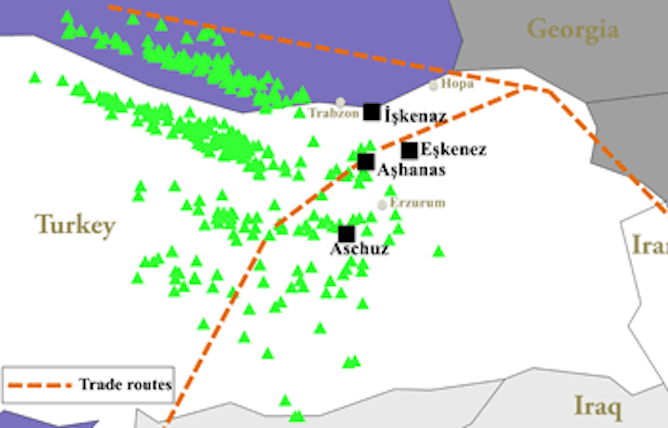
In the largest genomic study of Ashkenazic Jews, and the first one to study Yiddish speakers, we applied our Geographic Population Structure (GPS) tool – which operates in a similar way to the sat nav in your car – to the genomes of more than 360 Yiddish and non-Yiddish speaking Ashkenazic Jews.

DNA of Yiddish speakers could have originated from four ancient villages in north-west Turkey.
Surprisingly, our GPS honed in on north-east Turkey, where we found four primeval villages, one of which was abandoned in the mid-7th century AD.

These ancient villages identified by the GPS tool are clustered close to the Silk Road – the ancient network of trade routes – and are named Iskenaz, Eskenaz, Ashanaz, and Ashkuz. And it is likely that these are the villages that mark the location of the lost lands of Ashkenaz.

The history of a people

Located on the cross roads of ancient trade routes, this region suggests that the Yiddish language was developed by Iranian and Ashkenazic Jews as they traded on the Silk Road from the first centuries AD to around the 9th century when they arrived in Slavic lands.

Putting together evidence from linguistic, history, and genetics, we concluded that the ancient Ashkenazic Jews were merchants who developed Yiddish as a secret language – with 251 words for “buy” and “sell” – to maintain their monopoly. They were known to trade in everything from fur to slaves.

By the 8th century the words “Jew” and “merchant” were practically synonymous, and it was around this time that Ashkenazic Jews began relocating from ancient Ashkenaz to the Khazar Empire to expand their mercantile operations.

Two Jewish merchants in medieval dress
This Jewish migration led to some of the Turkic Khazar rulers and numerous eastern Slavs living within the Khazar Empire to convert to Judaism so they didn’t miss out on the lucrative Silk Road trade between Germany and China.

But the demise of Khazaria due to continued invasions and finally the Black Death devastated this last Jewish Empire of Khazaria. This led to the Ashkenazic Jews splitting into two groups – some remaining in the Caucasus and others migrating into eastern Europe and Germany.
The two groups still called themselves Ashkenazic Jews, however the name Ashkenaz became more strongly associated with Germany and the the European group – for whom Yiddish became their primary language.

A secret language

Since north-east Turkey is the only place in the world where the place names of Iskenaz, Eskenaz, Ashanaz, and Ashkuz exist this strongly implies that Yiddish was established around the first millennium at a time when Jewish traders moved goods from Asia to Europe. This was done by developing the language of Yiddish, which very few can speak or understand other than Jews.
Further evidence to the origin of Ashkenazic Jews can be found in many customs – such as the breaking of a glass at a wedding ceremony and placing stones over tombstones, which were probably introduced by Slavic converts to Judaism.

By studying the origin of Yiddish using our GPS technology, combined with a citizen science approach, we were able to shed light on one of the most forgotten chapters of history and demonstrate the use of bio-geographical genetic tools to study the origin of languages. For Ashkanazic Jews these are the ties that bind their history, culture, behaviour, and identity.

University of Sheffield provides funding as a founding partner of The Conversation UK.
View all partners

Republish this article Republish our articles for free, online or in print, under Creative Commons license.

Sunday, June 04, 2017

Is London "Occupied" Arab Land? For Peace, Give Them Buckingham Palace!

Jihadi terrorists shouting 'this is for Allah' kill seven in knife frenzy at 'FIVE' locations in the capital: Hunt for men with 12in blades who began the rampage by mowing down revellers on London Bridge

  • The men, described as being 'of Mediterranean origin', reportedly drove the van at 50mph across the bridge 
  • One horrified woman said she saw three people with what appeared to be their throats cut at London Bridge  
  • The gang had metal canisters strapped to their chests and two were reportedly shot dead by armed police  
  • They also tried to storm into pub in nearby Borough Market, where a man was reportedly stabbed five times 
  • Also unconfirmed reports of gunfire on Southwark Street amid the 'utter chaos' of attack on Saturday night 
  • A bomb squad has attended and boats are searching the Thames amid reports people were pushed in water

Friday, May 26, 2017

The Fallout Of A Fraudulent Conversion....And This Is Just The Beginning....


Jared & Ivanka:  An Embarrassment to "Judaism" - (And The Corrupt Rabbis That Conducted This Hoax ...) 


THE MAN RESPONSIBLE FOR THIS FRAUDULENT CONVERSION


Last weekend in Riyadh, Saudi Arabia Jared Kushner and Ivanka Trump demonstrated for all of us the real meaning of chillul haShem, desecrating God’s name.

The first instance was the trumped up story that some rabbi gave them permission to travel with President Trump on his flight from Washington which left there on Friday and arrived in Riyadh on Shabbat.  The phantom rabbi has not been identified but, presumably, it was the same person who gave them permission to ride around Washington on January 20th to attend the inauguration balls that evening. 

The second instance was in Riyadh itself on Shabbat, where video records of the President’s meetings there showed Jared and Ivanka getting in and out of vehicles to attend those very same meetings.
Now one might ask what the big deal is. They are not the first Jews in politics who were or are seen not observing the Sabbath.  That, of course, is true and while it may bother us from time to time, we know that not every Jew observes all of the strictures of Jewish law.

But in their case they trumpet their orthodoxy to the world and wear it as a badge of honor.  When politicians choose to do that they perforce take on themselves an obligation not to break the Sabbath and do whatever they can to ensure that they are shomre Shabbat, that is Sabbath observers as Jewish law dictates.  Everyone knows that there is no orthodox Rabbi who would give permission to ride on the Sabbath except in circumstances of pikuach nefesh, such as the need to save a life or some similar emergency such as defending oneself from imminent attack.

One could argue, for example, that given the fact that the inauguration parade in January ran into the Sabbath, it would not have been safe for them to have walked home and, as such, it was permissible to ride.  But to go to the inauguration balls that followed on Friday night?  To ride around Riyadh on the Sabbath to attend meetings with the Saudi king?  Do they not realize the shame they brought on the Jewish people for not being observant of their own faith?  Does anyone think for a moment that the Saudis would have scheduled such meetings on Friday?  Or that this message of chillul haShem was lost on the Saudis?

Yet, even more critical is the message that this sends to the luckless Jew working in a business in Little Rock, Arkansas, for example, who tells his boss that in the winter he needs to leave work early to be home for Shabbat.  And his boss’ answer?  “I really don’t understand, the president’s daughter and son in law are observant and they get permission to work on the Sabbath, why can’t you?”

When I was going through officer training in the US Army so many years ago, Jewish officers had to attend a special session with the Jewish chaplain.  One of the lessons he taught (at that time they were all “he’s”) was that whether or not we were personally observant we needed to be careful what we did and did not do on Shabbat because our conduct could negatively influence how a religious enlisted person would be treated by his superior when a request came up not to work on Shabbat.  

Regardless of our individual observance levels once we thought about it we knew that the advice was spot on.

Jared and Ivanka can choose to be non-observant and do whatever they want to do vis-à-vis Jewish practices and, while I wish it would be otherwise, I can live with that.  Or, as they claim to do, they can choose to be compliant with Jewish law as the Orthodox interpret it, but then they have to stick by it.  No phantom dispensations, no mockery of the faith and no shortcuts.  It is their choice but, once they make it and brag about it, their choices are limited to what is generally accepted as permitted.

Roy Disney once said “When your values are clear to you, making decisions becomes easier.”  It is an axiom that the Kushners would do well to learn so that they don’t continue to be an embarrassment to those who try to live their Jewish values truthfully every day.

http://blogs.timesofisrael.com/jared-ivanka-an-embarrassment-to-judaism/

Rabbi Moshe Feinstein states the very marriage of a gentile woman to a non observant Jew, is equivalent to an open declaration that she will not observe the precepts. This is so, because it is highly unlikely that the gentile member of such a union, will be more committed to Judaism than her remiss Jewish husband...


 READ:

http://theunorthodoxjew.blogspot.com/2017/05/rabbi-moshe-feinstein-states-very.html

Rabbi David Bleich on the Conversion Crisis - Considered by Most Jewish Scholars as a Posek of the Greatest Stature

The questions posed with regard to problematic contemporary conversions are threefold in nature:

When Rabbis Become Prostitutes - The Redefining of an Orthodox Jew - "Jared every year sends a $500 check before Passover to one of his former day school teachers “as a gesture of appreciation... "

 READ:

Jared Kushner & Ivanka Trump In Church on Friday and Shabbos! Trump's Conversion Farce Must Be Repudiated, Rebuked & Delegitimized by Every Orthodox Rabbi! Kabbalat Shabbos With Jared & Ivanka! Israel & The Jewish People Have Every Reason To Be Concerned About Kushner's Total Rejection of Core Jewish Values (מומר להכעיס) , and In Essence, Contemptuous Conduct.

READ:

Thursday, May 25, 2017

Trump's "Piece" Process Begins.... Jewish Land For Worthless Pieces Of Paper and Promises.....

US said pushing Israel to transfer parts of West Bank to PA administrative rule

Economic incentives insufficient; Americans reportedly want Netanyahu to do more to revive peace talks; PMO denies TV report


A red sign on the side of a road warns Israeli citizens from entering the West Bank city of Nablus on July 29, 2015. (Garrett Mills/Flash90)
A red sign on the side of a road warns Israeli citizens from entering the West Bank city of Nablus on July 29, 2015. 
 
The administration of US President Donald Trump is said to be pressing Israel to transfer parts of the West Bank to Palestinian administrative control as a goodwill gesture to help revive peace talks between the two sides.

Despite a series of economic incentives approved on Sunday by the Israeli cabinet, the US wants to see greater concessions to the Palestinian Authority and views the recent measures as insufficient, Channel 10 reported Wednesday. 

Specifically they have asked for areas in the northern West Bank to be transferred from Area C to Area B, according to the report.

Under the Oslo Accords, Area C of the West Bank (60%, where most of the settlements are located, and some 150,000 Palestinians live) is under full Israeli administrative and military control, while in Area B (22%), administrative control is the responsibility of the PA while the IDF is in charge of security. Area A (18%, encompassing the major Palestinian cities) is under the full administrative and military control of the Palestinian Authority.

The Prime Minister’s Office later denied the Channel 10 report.

President Donald Trump and Prime Minister Benjamin Netanyahu speak at the Israel Museum in Jerusalem on May 23, 2017 (Courtesy)
President Donald Trump and Prime Minister Benjamin Netanyahu 


It was not immediately clear when the US supposedly made these demands, but US Secretary of State Rex Tillerson told reporters on Wednesday aboard Air Force One that Trump “pressured” both Netanyahu and PA President Mahmoud Abbas during his meeting with the two leaders this week to return to the negotiating table.

It was also not known what concessions the US sought from the Palestinians during Trump’s trip to help restart the peace process.

During his visit to Israel and the West Bank on Monday-Tuesday, Trump repeatedly emphasized his desire to help broker a peace agreement between Israelis and Palestinians, but offered little in how he would encourage the two sides to revive peace talks.

Trump has repeatedly said he was looking to broker the “ultimate deal” with Israelis and Palestinians and is convinced he could do so. Trump has tasked his son-in-law Jared Kushner, and former real estate lawyer Jason Greenblatt with charting a course forward. Still, White House officials had downplayed the prospects for a breakthrough on this trip, saying it was important to manage their ambitions as they wade into terrain that has tripped up more experienced diplomats.

US President Donald Trump delivers a speech at the Israel Museum in Jerusalem on May 23, 2017. (AFP Photo/Menahem Kahana)

In a speech Tuesday at the Israel Museum, the president heaped praise on Israel, while calling on both sides to make compromises toward peace. He urged them to put aside the “pain and disagreements of the past” and declared that both sides were ready to move forward.

The president notably avoided all of the thorny issues that have stymied peace efforts for decades. He did not mention Israeli settlements, the status of Jerusalem or even whether the US would continue to insist on a two-state solution giving the Palestinians sovereign territory.

In a meeting with opposition leader Isaac Herzog on Tuesday, Kushner said Washington intended to move fast to advance a renewal of peace talks between Israel and the Palestinians, a spokesman for Herzog said, with Trump’s envoy Jason Greenblatt reportedly set to return next week so as not to leave a “diplomatic vacuum.”

In a separate report Wednesday, Channel 10 said that Israel’s National Security Council is currently considering a plan to transfer control of two East Jerusalem neighborhoods from the Jerusalem Municipality to a yet-to-be established local council.

Wednesday, May 24, 2017

Does Trump have new ideas? If he does, we were still waiting to hear what they are as he departed for Europe.


President Donald Trump touches the Western Wall on May 22.

Hopeful rhetoric, vague vision for peace after Trump’s Middle East visit


President Donald Trump has come and gone from his trip to the Middle East, his first foreign excursion since taking office earlier this year. He arrived — first in Riyadh, Saudi Arabia, then Jerusalem and Bethlehem in Israel — with strong words about Iran as the neighborhood bully and, like so many American presidents before him, buoyant words for the Israeli and Palestinian people.

Optimistic words. Hopeful words. They all conveyed a vision and new possibility for peace in the region, a prospect “I’ve heard,” he said, that is “one of the toughest deals of all. But I have a feeling we will get there eventually, I hope.”

Good for Trump. A new American president. A new chance for a solution. A new team to get it done. 

But where were the new ideas Israeli leaders are so certain he has? What is the new approach? How does he propose to untangle the thorny issues on the ground — boundaries, settlers, Jerusalem, etc. — that have left so many presidents before him bloody with failure?

Peace between Israelis and Palestinians was a topic of much discussion when Trump visited Jerusalem and Bethlehem. It was front and center, but not necessarily the first item on the agenda. In his speech to the Arab world in Riyadh days before, in his unscripted photo-op with Prime Minister Benjamin Netanyahu, in his later remarks in the prime minister’s house, Trump was more focused on Iran as the source of menace in the region. He and Netanyahu suggested that there are new opportunities in the region. Countries must unite against a common threat — Iran. That’s an opening that can be explored.

Michael Oren, historian, former Israeli ambassador to the United States and currently Israel’s deputy minister for diplomacy, said he believes that this new reality is a conduit of a “tremendous” shift. If once it was assumed that a peace with the Palestinians could lead to reconciliation of Israel with the rest of the Arab world — the situations is now reversed: A peace with the Arab world could lead to a deal with the Palestinians. If the Saudis come on board, if other Gulf states come on board, if the Arab world realizes that fighting against Israel makes no sense in this era of radicalism, the Palestinians might realize that the train of peace is leaving the station and that they’d better hurry so they don’t miss it.

Maybe this is what Israeli leaders mean when they constantly talk about “new ideas.” Trump is a devotee of “new” ideas, “bold” ideas, “different” ideas. For Israel, to resist his push for a deal would be a mistake. But it might be able to convince him that his predecessors failed because of their conventional thinking — and that he, a man bold enough, ought to reformulate the meaning of the ultimate deal. The “two-state solution” is old, tired — and it is so Clinton and Obama. Trump could make his mark by thinking outside of the box, that is, by dropping old ideas and replacing them with new ideas. 

Israeli President Reuven Rivlin sang the praises of new ideas after his meeting with Trump: “Our destiny — Palestinians and Jews — is to live together in this land,” he said. “In order to achieve this, we need new ideas, new energy that will help us move forward, together.” 

But move where? Rivlin has his new ideas; he supports one state, or a confederation of Israelis and Palestinians. Naftali Bennett, the head of the Jewish Home Party and the leader most forthright in attempting to directly tell Trump what needs to be done (“We expect you to be the first president to recognize a united Jerusalem,” he said, to which Trump responded, “That’s an idea!”), has different new ideas. He supports an autonomy for Palestinians and annexation of the rest. Other leaders also have new ideas, including the oldest “new” idea of sticking to an improved status quo. 

Does Trump have new ideas? If he does, we were still waiting to hear what they are as he departed for Europe. It was worth noting that Trump refrained from using the term “two-state solution” during his visit. It is possible that he is more open than his predecessors to considering alternative ideas, assuming he has them. In Saudi Arabia, in Jerusalem and in Bethlehem, he kept hinting that his deal is partially built on the goodwill of the conservative Arab regimes of Jordan, Egypt and Saudi Arabia. Former President Bill Clinton failed to get them on board at Camp David. He was disappointed by their refusal to help him push the late Yasser Arafat, chairman of the Palestine Liberation Organization, toward accepting the deal that was offered to him. Trump and some of his top advisers believe circumstances have changed in a way that could make such a push more realistic today.
His brief trip was barely a beginning of a long process of exploration of these assumptions and ideas. Although it sent a symbolic message of involvement and new energy, it did little to advance a detailed vision of a peace process. And of course, involvement is crucial, as both Arab and Israeli leaders made clear in their remarks, taking a swipe at the Barack Obama administration.

“We are happy to see that America is back,” said Rivlin, usually not the type to bash the former president. Netanyahu, not surprisingly, was more direct: “I want to tell you also how much we appreciate the reassertion of American leadership in the Middle East.”

The new American president ought to know that there is no correlation between the number of visits to the Middle East and the level of success in handling Middle East affairs. Yes, Trump made “history” — a word used much too often to describe routine events — in going to Israel and Saudi Arabia earlier in his term than any other president. He made “history” again by being the first sitting American president to visit the Western Wall. So what? Nixon made history by being the first president to travel to Israel. Shortly afterward, he was forced out of office. Clinton made history by coming to Israel more than all other presidents, four times. It did not guarantee his success. 

The only presidential visit that really made a change was Jimmy Carter’s in 1979. That was a dramatic visit, with ups, downs and crises. It was a make-or-break visit: Carter traveled to Egypt, then to Israel, and forced the hand of the late Israeli Prime Minister Menachem Begin to accept the peace deal that was proposed to him. A few years ago, Israel’s state archives released documents from that visit, including a cable that was sent from Zvi Rafiah, Israel’s then-liaison to the U.S. Congress. Carter briefed congressional leaders when he was back in Washington, D.C., and Rafiah reported to his superiors in Jerusalem that during this meeting, Carter described his meeting with the Israeli cabinet as “terrible.”

“Terrible” and “horrible” are two of Trump’s favorite words. So maybe he will also describe parts of his visit as terrible. Maybe he did not appreciate the food, or the heat, or the forced selfie with Knesset Member Oren Hazan. But as far as we know, by the end of his visit on May 23, nothing truly “terrible” happened. Everybody was nice to him. Everybody agreed with him. Everybody encouraged him to keep doing what he is doing, whatever that is.

A time for confrontation might still come, when a more detailed plan emerges, and a real price is demanded of the parties. Already, Israel and the Palestinians got a taste of the future. Israel watched reluctantly, yet silently, as the Saudis bought weapons in quantities that might put Israel’s military edge at risk. The Palestinians witnessed an American president visiting the Kotel. They heard an American president, not for the first time, raise the issue of terrorism as an obstacle they need to overcome to achieve their objectives. They heard him say “peace” but not “a Palestinian state.”
And so. There was a visit and it went smoothly. For Trump, that is certainly an achievement. Everybody was trying to convince everybody that the visit was successful and that Trump is exactly what they expected him to be. 

But there was reason for caution. On the evening of May 22, about an hour before Trump and Netanyahu made their joint statement in Jerusalem, I was sitting in a radio studio in the city of Modi’in. The interviewee on the line was Member of Knesset Ahmad Tibi, an Arab legislator, an articulate critic of Israel’s policies, and a frequent visitor at the offices of Mahmoud Abbas, the Palestinian president. 

He was cautious. Very cautious. Wisely cautious. Tibi has hopes, but he isn’t letting them get too high. He knows Trump changes his mind, he said. He knows it is not yet clear what Trump wants, beyond the generalities of having a “deal” and brokering “peace.” He knows Trump won’t always have the patience necessary to see a bumpy peace process through. And so Tibi’s message was simple: I’ll believe him about his Israeli-Palestinian peace effort when I see it.

When I asked Tzachi Hanegbi, Israel’s communications minister, about Trump reportedly walking back on his campaign promise to move the American embassy to Jerusalem, Hanegbi didn’t even blink before explaining that a visit to the Western Wall is much more important than moving the embassy. And when Tibi was asked if he was annoyed by Trump’s visit to the Kotel, Tibi didn’t even blink before explaining that it was an insignificant event that reinforced the fact that the U.S. does not recognize the site as Israeli.

Despite what did and didn’t happen, give Trump credit for this: He was polite, almost gaffe free and vague enough to keep the valuable posture of a Rorschach test: for now, all interpretation of his actions and intentions are still in the eye of the beholder. 


HEY GOD - WHERE'S YOUR NOTE TO ME?


Tuesday, May 23, 2017

History Repeating Itself - Arming The Terrorists!


"....What was missing was any hint of a rebuke to the Saudi theocracy for its toxic behavior. By every measure, Saudi Arabia is among the most despotic countries on earth. Freedom House, the venerable human-rights watchdog, has for years given Saudi Arabia its worst possible rating. The government “restricts almost all political rights and civil liberties through a combination of oppressive laws and the use of force,” Freedom House notes in its 2017 report.
 

Political parties are forbidden, and organized political opposition exists only outside the country. Political dissent is criminalized. Activists who challenge the kingdom’s record on political inclusion or call for constitutional changes are treated harshly. . .

Islam is the official religion, and all Saudis are required by law to be Muslims. A 2014 royal decree punishes atheism with up to 20 years in prison. The government prohibits the public practice of any religion other than Islam. . . .

Women are not treated as equal members of society, and many laws discriminate against them. They are not permitted to drive cars . . . and must obtain permission from a male guardian in order to travel within or outside of the country. . . .

The religious police enforce a strict policy of gender segregation and often harass women, using physical punishment to ensure compliance with conservative standards of dress in public.

But there was no suggestion in Trump’s address that Saudi Arabia’s brutal repression is of particular concern to the United States. Nor was there any mention of the fact that Saudi money is deployed worldwide to promote Wahhabism, the fundamentalist strain of Islam that fuels extremist intolerance. (It wasn't so long ago that Trump himself called Saudi Arabia "the world's biggest funder of terrorism.)

Rather than allude to any of that, the president flattered his hosts. He praised their “encouraging statement of tolerance, respect, empowering women, and economic development.” He assured them that he had not come “to lecture [or] to tell other people how to live.” The words “freedom,” “liberty,” and “democracy” didn’t cross his lips. He said nothing of the kingdom’s prisoners of conscience, scores of whom are publicly whipped or beheaded each year.

Trump might have put his bully pulpit to better use. He could have urged clemency for Raif Badawi, the pro-democracy blogger who was sentenced to 1,000 lashes and 10 years in prison for the crime of defending free speech and pluralism on his website, the Saudi Free Liberals Forum. Badawi’s cause has been championed by 18 Nobel laureates, by Amnesty International, by a bipartisan group of U.S. senators. But not by President Trump.

At most, Trump’s remarks in Riyadh — carefully read off a Teleprompter, with few ad libs — were a wash. He was clear on the menace of radical Islam, which was to the good. But he was equally clear about his unwillingness to deploy American power, even the power of American ideals, to crush that menace....."


 Via Jeff Jacoby ---The Boston Globe


US–Saudi Arabia AWACS Sale

From Wikipedia, the free encyclopedia
The sale of AWACS (Airborne Warning and Control System) surveillance planes to Saudi Arabia by the United States administration of President Ronald Reagan was a controversial part of what was then the largest foreign arms sale in US history. The sale saw objections from a majority of Americans, prominent US Senators, the State of Israel and the Israel lobby.[1]

The sale included the five E-3 Sentry AWACS aircraft and eight KE-3 refueling aircraft, with spare parts and support, delivered between June 1986 and September 1987.[2]

Contents

AWACS


USAF E-3 Sentry in flight

The United States Air Force began using the E-3 Airborne Warning and Control System aircraft in 1977 following ten years of prototype design, development, and testing.[3] The U.S. currently has a fleet of 32 E-3s, the largest in the world. NATO possesses 17, the United Kingdom has seven, Saudi Arabia has five, and France has four.[4]

The E-3 is a modified Boeing 707 commercial jetliner characterized by the strikingly large thirty-foot rotating antenna mounted on its roof. This antenna can detect and track other aircraft within an area of 175,000 square miles (450,000 km2), flying at any altitude or over any terrain, allowing the AWACS to detect aircraft that remain hidden from ground radar.[5] The planes' mobility is a crucial feature, providing for the use of this sophisticated detection equipment whenever and wherever needed; AWACS can be deployed quickly into military conflict "regardless of intensity" according to Boeing, who claims AWACS are the "world’s standard for airborne early warning systems."[6]

The Saudi AWACS bear Arabic writing on their exterior with a translation below, "Royal Saudi Air Force". The roof-mounted antenna is an AWACS plane’s dominant feature; it is a smooth black disk with a white stripe down the center, and it rotates constantly. The antenna is about a fifth of the length of the plane and it sits higher above the roof than the plane’s roof sits above the ground. Another noticeable difference from a commercial 707 is the lack of passenger windows. Colonel Walt Kowalik said about the lack of windows, "We don't want 'em ... we don't want our people looking out of windows. We want them concentrating on what's in front of them."[5] An Associated Press writer described blue carpet and "subdued" lighting, "as in a movie theatre."[5]
 

Reaction in the United States

Only months old, the Reagan Administration announced its plans to sell five of the U.S.-made AWACS to Saudi Arabia. The proposal, part of the largest foreign arms sale ever[7] was not received warmly on Capitol Hill where Congressional consent was required. The AWACS proposal was also harshly rejected by Israel and disapproved of by a majority of Americans. Upon formal introduction of the AWACS proposal to Congress in the fall of 1981, many Senators reacted coldly. "This is one of the worst and most dangerous arms sales ever," proclaimed Massachusetts Senator Edward Kennedy. Senator Donald Riegle said, "We are being asked to submit to a kind of blackmail; the price gouging of oil."[8] These Senators feared that the AWACS sale was not designed to promote stability, as would be claimed by the Administration, but to secure U.S. oil resources. Such a deal would mean technology for oil access, and as Kennedy said, a potentially dangerous deal at that. Senator Bob Packwood, who as a Republican was a member of Reagan’s party, was also a leader of opposition to the AWACS deal in the Senate. Packwood spelled out the danger he saw in arming Saudi Arabia:

"They have displayed a hostility that must be interpreted as their deliberate intentions to promote continued instability in the Middle East." Packwood questioned the choice of Saudi Arabia as an arbiter of peace saying, "Let’s think about which nations have been seriously committed to negotiating peace in the Middle East and which have not shared that commitment."[9] With the recently ended American hostage crisis in Iran fresh in mind, Americans were reluctant to sell military equipment to anyone. In fact, a May 1981 poll showed that 52% of those surveyed opposed arms sales to any country, and only 19% wanted the U.S. to sell AWACS to Saudi Arabia.[10]

Considering Israel

Israel, feeling its security directly threatened, was the most strongly opposed to the AWACS deal of anyone involved. Israeli Prime Minister Menachem Begin expressed "profound regret and unreserved opposition" to the Saudi AWACS proposal.[11] Experts on Israeli defense said that AWACS could track every move of the Israel’s air force, denying it the chance to launch a "surprise first strike, the basis of Israeli defense doctrine."[11] While Israel's "unreserved opposition" was based on the real security threat it faced, its "profound regret" could have been rooted in perceived betrayal by the United States. A protector of Israel since the Six-Day War, the U.S. was planning to sell military surveillance planes to Saudi Arabia, a country hostile towards Israel. A Boston Globe editorial from May 4, 1981 recognized this contradiction as well as other threats posed by the AWACS sale, noting, "the intention to sell AWACS planes to Saudi Arabia constitutes not only a manifest contradiction of Reagan's campaign promise to enhance Israel's security, but also serves to further destabilize the Mideast, a region whose stability was supposed to be a strategic priority of the Reagan foreign policy." The sensitivity of Congress to the threats against peace and stability, was matched by its sensitivity to Israel's concerns.

The Reagan Administration actively sought to diminish Israel's voice and influence over the deal. In public speeches, Administration officials admonished Israel for getting involved in a U.S. foreign policy matter. Secretary of State Alexander Haig said the President must be "free of the restraints of overriding external vetoes," and went on to say that were the AWACS deal blocked by Israeli influence, there would be "serious implications on all American policies in the Middle East. ... I'll just leave it there."[8] Reagan himself declared, "It is not the business of other nations to make American foreign policy."[12]

Winning support

In order to gain support for the AWACS deal in Congress and in the country, the Administration lobbied strongly on behalf of it. Though it continually stated the AWACS deal would benefit US "interests" in the Middle East, the Administration also gave promises of the AWACS planes' importance in securing peace. In a speech to Congress, Alexander Haig said that if the AWACS sale was blocked, "our security, the security of Israel and peace itself (might) be endangered,"[13] Reagan himself promoted the AWACS sale saying, "By contributing to the stability of the area, it improves Israeli security."[12] The Administration even commissioned former government officials to speak about AWACS as part of the peace cause. Richard Nixon's Secretary of State Henry Kissinger said "it is essential for the peace process in the Middle East."[14] Congress approved the AWACS sale, and as part of the then-largest arms export ever, the planes were a symbolic commitment to the US/Saudi relationship.

US arms sale to Saudi Arabia, 2010


On October 20, 2010, the US State Department notified Congress of its intention to make the biggest arms sale in American history—an estimated $60.5 billion purchase by Saudi Arabia, trumping the former US-Saudi AWACS sale. The package represents a considerable improvement in the offensive capability of the Saudi armed forces. Israel did not raise objections to the sale, except to say that it was "not thrilled about it." At the time, a senior administration official stressed: "This is a big development, because it's part of a larger regional strategy and the maintenance of a strong US presence in the region. We're paying attention to the needs of our allies and what everyone in the region believes is a flexing of muscles by a more aggressive Iran. One way to deal with that is to make our allies and friends strong."[15]

https://en.wikipedia.org/wiki/US%E2%80%93Saudi_Arabia_AWACS_Sale